
Fri Fun Facts: Academic Privilege and Making a Difference

Today’s Friday Fun Facts continues my discussion about the Occupy conversations. I’m thinking about academic privilege and my own responsibilities. I’ll end with some points about how I’m reminded how faculty make a difference.

There are different units and levels of privilege on campus. Even though I am pre-tenure, I know how lucky I am to have my teaching-focused regular faculty position. Regardless, in some respects on campus, I am the 1%. Off campus, I am also part of the 1% by virtue of my college education. I might not fit per the income guidelines as a Senior Instructor at UVIC does not get paid $170, 000 or at least this one does not! I’ve been grappling with my political commitments. I marched to the legislature and then back to Centennial Square. But, I only officially visited the encampment twice during the month long “occupation.”

I did speak to this movement in other venues and feel that my work in the classroom and office hours mentoring students is important. Is it enough, though? I know that some days when office hours and teaching have drained me, I have felt that it is more than enough. Yet, on other days I wonder if I am doing enough to make a difference in my students’ academic lives and experience on campus and in the larger community.

Just as I wonder this, as I wander from one meeting to the next, I check my email and see emails from two former students thanking me for making a difference in their lives. The timing was perfect. Students telling me that the readings and lectures are influencing decisions or used in their daily lives reminds me that teaching and mentoring is important.

1. Office hours. It’s in office hours where I hear about successful classes. I hear so many positive statements about colleagues in Political Science or other departments. I wish I could bottle up these statements and send them to colleagues on rainy, cold days. They would warm up with the enthusiastic statements, “Her class made me change my major.” Students can be effusive with their statements. I’m not sure they always remember to let the instructor know.

2. Walking across campus. It’s amazing to see how some students light up seeing an instructor. I’ll meet a colleague for coffee and a student will see us and it’s nice to see the positive reactions.

3. Communication. Facebook messages, emails, and cards make their way to our mailboxes and students thank you for a class or a letter.

I can add to the numbered points, but I won’t. Enjoy the weekend.
Coalition Building after Occupy: Campus Community

All of this talk about who constitutes the 1% makes me think of the university system. Surely, regular, full-time faculty appear to constitute the coveted 1%. We have the some semblance of job security (or at least those with tenure do), better benefits than the contingent faculty, job flexibility, and essentially get paid to think, talk, read, and some get to engage in research. It sounds great. Some have even gone so far to refer to the academic system as one of a feudal society.

I would argue that the student population–both undergraduate and graduate student are in a place of privilege, too. While they are taking classes and many are heavily in debt to do–the act of being on a college campus and opportunity to go to university is in itself a unique opportunity and privilege. Should we move beyond an “us vs them” conversation?

Thus, I’m not completely sure if the framework for who is the 1% completely works–unless we look to the CUPE staff on campus who are doing most of the behind the scenes work on campus–from serving coffee, cleaning the grounds, and working as contingent faculty. I would argue that this group of the university population is the most exploited or constitutes the least privileged group on campus. Of course, this also includes some staff who might make good incomes that exceed 50k annually. This is by no means enough to live comfortably in the capital region; however, it constitutes a good income. My point here is that more people on campus constitute the 99%. And, many in the campus community are not in their career job.

When we think of the university community, it is fair to say that regular, full-time faculty are part of the elite on campus. But, even this group has tiers: senior instructors (new, continuing and Teaching Professors), Assistant Professors, Associate Professors, Full Professors, and Canada Research Chairs. Directors of units or offices are in a good position as well. Then, we move to the various Deanships. Associate Deans and the full Deans. Moving to the next level would be the Associate Vice Presidents, Vice President, Chancellor, and President. There are many tiers of responsibility and privilege on campus. Maybe we should think more like a large community? The campus is its own microcosm. Can we work together for social justice? Is this a reasonable idea? I think that we can work together. The how is the important question.

Lots of great work going on at the campus across multiple units or departments. But, at times we aren’t having cross campus conversations to share this work. We need to get better at this. I don’t have the answers, but I’m thinking about what is next with the occupy movement and how we need a broad-based movement. This movement has touched so many. What is next?

Tedx Youth Victoria

I was thrilled to attend the TEDx Youth talks this weekend. Where to begin?! I was impressed with the entire event and the speakers had me in stitches and I even misted up during some of the talks. I will admit to some of my biases with the speakers, as they were current or former at UVIC, where I work. Regardless, I think they all did a fabulous job sharing their stories in such an engaging manner.

If they represent the future, we are in good hands. The level of public speaking ease and topics combined to make a magical evening for the 100 plus attendees. The audience was mostly youth and it was also inspiring to see so many current of former university students in attendance. What great energy in the room! My hat is off to the co-organizers: Melana Mar, Janine Mayers, and Dustin Meredith. Shawn Slavin worked as the master of ceremonies and had a comfortable ease as he introduced each speaker.

The 12 speakers at the event varied from an amazing 13 year old, Gavin Kratz, who maturely explained that his generation will solve many problems. I could not help but smile at his optimism, as it was infectious and honest. I think I was most touched by Lilia Zaharieva’s talk about starting a non-profit foundation dedicated to supporting youth who have a parent struggling with mental illness. Zaharieva has Cystic Fibrosis (CF) and acknowledged that most people with CF live at most only until their forties. I gasped when it hit me that without a cure she’s probably lived half of her life. Just typing out that sentence gives me pause. What strength.

What an amazing array of youth! They inspired and entertained. I am hopeful that the people in attendance left the event enthused for tomorrow. I know I felt that way. And, I kicked myself in the rear for not getting tickets for my own teen and one of her friends.

In the spirit of giving a shout out to the UVIC students or former students:
Ali Lee, UVIC Student and Athlete
Brandaon Laur, UVIC Student
Shawn Slavin, UVIC Student
Jacob Helliwell, UVIC Student
Lilia Zaharieva, UVIC Student

If you haven’t ever attended a local TED talk, I encourage you to do so. And, remember that TED Talks are available online.

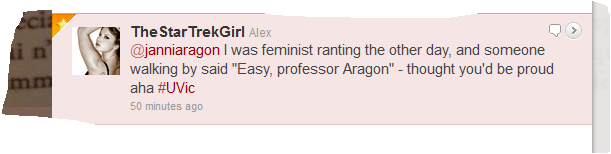
Feminism for Real: Part Two

Feminism for Real reminds me of This Bridge Called My Back: Writings of Radical Women of Color (1981) edited by Cherríe Moraga and Gloria Anzaldúa and the book is now sadly out of print. This Bridge was written by activists, writers and scholar/activists. And, many were in the early part of their careers. Some had never written before and sure enough the anthology has fielded commentary about the quality of the writing. It was not an academic tome, but as a classic text was used in many Women’s Studies and Feminist Theory courses. I have assigned it in both Women’s Studies and Political Science courses over the years. Feminism for Real is also uneven. Some of the sections offer an important rant and others offer more depth to the section. I would classify Feminism for Real as a must read for the general audience, friends or advocates of feminisms, and for people who actively feel a certain level of distrust or angst with feminisms.

I am a long-time Reader of Racialicious, so I was not surprised at how the Latoya Peterson chapter, “The Feminist Existential Crisis (Dark Child Remix)” was my favourite and the most dog-eared in my book. What does it mean to be a professional feminist? What does it mean to understand something like feminism and also admit to the heavy baggage that comes with it? Peterson wrestles with this in her section. These are important conversations to have. All of the chapters have some merit to them–regardless if they made me walk away from the book for a few weeks. Having a visceral reaction is a good thing.

Students in Women’s Studies or Social Justice Studies have high expectations for the faculty and their classmates. I sense that they might not understand the ways in which faculty (especially pre-tenure) faculty need to balance pedagogy and climate issues in departments and on campus. And, after re-reading certain sections I am convinced that some students will still accuse me of being a Radical Feminist (these students do not know their feminisms) and others will accuse me of being an Asshole Academic, but then another set will note that I challenged their ideas and made a difference. Then, I am doing my job as a self-identified feminist educator. I will add that that the two authors I always go back to for my feminist politics are hooks and Anzaldúa–for whatever that is worth. They are my feminist tome home. I do think that many of us in this line of work–professional feminism, activist politics, higher education–you name it–have certain ideologies that frame our understanding of feminisms. While it’s easy to think about a monolith, I try and argue that there is not.

While some of the chapters of my copy of Feminism for Real is filled with my angry notes or mere comments, I am still grateful to the amazing, Jessica Yee for this anthology. My feminisms is wide enough to know that I can agree with Yee on some counts and then agree to disagree with her in other cases. If a book instills anger, hiding the book for weeks, writing in it, talking about it with students, and friends, then the book is really worth reading. Read the book. It will rock your feminist world (whatever that is for you). The book will also make you think twice as you put your syllabus together—trust me. I revamped one syllabus while reading the book and then took a good look at the other syllabi.

Review of Feminism for Real: Part One

I finally finished Feminism for Real: Deconstructing the Academic Industrial Complex of Feminism (2011) edited by Jessica Yee. I’m not going to mince words—it was hard to read the book. This was the book that I would have loved as an undergraduate student in Women’s Studies at San Diego State University (SDSU). I was a first-generation college student like so many Latinas on campus in the late 80s and early 90s. (And, there are still lots there today—even with the extraordinary budget cuts and tuition hikes.) But, now I wear a different hat. I suppose some would say that now I am the “Asshole Academic Feminist.” Actually, I hope that no one would say this.

This book is written for the student (in and out of the university experience) who has ever felt that s/he did not fit in and was an outsider in the classroom. Other readers will love this book based on its pointed indictment about the at times vacuous nature of academe and jargon-laden discourse. I remember not feeling like I fit in and that I was the only non-white student in the classroom. I also remember the familial demands that I had that no one else seemed to have. But, by the time I graduated I knew I had my academic home and no home is completely perfect. And, I knew that my career was going to be in higher education.

I do take issue that Yee and others argue that the book is not a “hate on” feminism or Women’s Studies. The book is clearly an attack on mono-feminism (as if this exists!) and Women’s Studies. But, how can feminisms or Women’s Studies evolve if there are not the occasional moments of calling out so that introspection can take place! Now, before I get further in my commentary, I need to be more specific. I do have my BA in Women’s Studies from SDSU and a MA in Liberal Arts and Sciences from State. I ended up earning a MA and PhD in Political Science. I like to say that I’m over educated and under-paid, but that is a different blog post.

Getting back to the book, it’s not uncommon that a discipline has foundational texts and ideas. I saw this in Women’s Studies and Political Science. I did feel badly for some of the essayists in the anthology, as it sounds like a few of them had poor instructors, and some bad classmate experiences. But, I do think that it is important to understand how important foundational texts are in a discipline. They serve to provide the frame of reference. This does not mean that you have to agree or even like it, but being familiar with it is helpful for dialogue. And, having a frame of reference is useful for constructive criticism. As much as I hated the statistics series in graduate school, I also know that they made me a better teacher and scholar. Likewise, being able to counter Liberalism or Liberal Feminism required that I first know the concepts—even if they did not speak to me and my experience.

Again, maybe I have been immersed too long in higher education that what is plainly obvious to me that we learn about different things that at times do not speak to our specific experience. Then we usually (hopefully) can respond to it. Certain sections of the Feminism for Real had me frustrated. I felt like the particular author did not give the ideas, classroom or book a chance to see that there could have been something useful there to learn. Some of the sections were problematic to me, as I felt that the author was not familiar with the topic that s/he was responding to! I’m well aware of the fact that gatekeeping exists in academe and I am not supporting this. My work in the classroom, office hours, and elsewhere attempt to break this method. However, I also want people to understand that learning is not always fun—it makes you angry at times. Causes moments of disbelief for the student or reader and I know this, as I see myself as a life-long student. Learning is messy. It makes us uncomfortable. Feminism for Real made me uncomfortable. Yee and the contributors were successful. They made me think. Made me react.

Challenge Update

I am participating in a challenge with some of my colleagues at the University of Venus ( @UVenus ). We are taking special care to network and meet people across our campus. Given that I am the Chair of the Academic Women’s Caucus this provides me an easy way to do this, but I have also had a few coffee meetings to meet with different colleagues across the campus and would like to speak to how helpful this has proven during these last two months.

Most recently I met with the coordinator for the Anti-Violence Project and we are working on a shared conversation about safe spaces on campus and the university support of safety. These are just the early conversations, but it was great to have this meeting that caused us to find out that we share some of the same professional networks.

Last month I had coffee with Dr. Jentery Sayers from the English Department at UVIC and I was so impressed and envious with his courses and current area of research. I was happy to get some of the flyers for his course, “How to Network a Novel.” It looks like an amazing course and I have since shared the flyer with the students enrolled in my courses.

For the second year I am sitting on the December 6th memorial planning committee, and the committee is made of some different staff from last year and I have the opportunity to work with a great group of women from all over campus. And, I look forward to the events that we are planning.

I have also met informally and formally with different staff from the UVIC Communications team and have repeatedly found the team helpful and professional. If your campus has a communications team and you haven’t met them yet—get to it. They can help get you on the Experts Database (if your campus has one) and make sure that you are included in media releases.

And, the last thing that I spearheaded was the nomination of a colleague for a teaching award. This turned into more work than I anticipated, but it was a great process for my involvement. I contacted probably upwards of 60 people for the dossier and the file fielded some strong, personal assessments. Ultimately, I felt honored to play a small role in this nomination. It is important for me to note that this nomination was based on my position as the Chair of the Academic Women’s Caucus. I hope that next year the Caucus can nominate another woman on the Steering Committee. Part of my self-imposed mandate is mentoring and this includes peer to peer mentoring and support.

I have had a productive first few months for the challenge and look forward to the next few months!

Managing the Workplace

This post is not so much about teaching and higher education or even popular culture. Those are common themes in my blog. Instead this post is more of a commentary on working with interesting and difficult people in the workplace. As I work with more people across campus I’ve learned many things these over the years. And, I’m going to place these in numbered points and respond to them.

1. Never send an email when you are frustrated, tired or mad. You might regret that email later. This is really important advice and I know that there are moments when you just want to respond and fire off your response. Instead, forward the email to yourself and say what you would like or open a Word document and vent. Then, respond to the email later.

2. Never send an email that you are not prepared for other people to forward. While forwarding colleagues’ emails without permission is unprofessional, note that some people will not blink at forwarding emails to share some funny or juicy information. But occasionally there is the colleague who might use the forwarded email as an attempt to get you in trouble. Now, I use the word trouble loosely, as it could refer to someone sharing something embarrassing or something innocuous. So, always be careful with emails. A colleague in the Law Faculty had once told me to take special careful with using specific names in emails due to Freedom of Information Act. And, I took her advice to heart. I use phrases like: our esteemed colleague, the interesting person in emails, in these few instances.

3. Be honest and fair. I have found that it is much easier to think before I say something and offer what I feel is my honest opinion. I might weigh what I am going to say more carefully if a meeting has already had some awkward or tense moments. But, I think it is more important for me to start from a place of honesty.

4. If you have a difficult colleague, try and document the interactions in case you have to report him/her. When things are documented it will make things easier.

5. Make allies. This is not about Empire Building, but instead is a suggestion to try and meet like minded people across units. You can get more done if you network and know more people across campus or your workplace. Likewise, it is good to have a colleague who is not in your unit or immediate division to chat with about plans or policies. It’s also very important to network for the sake of community building.

6. For those of us working in higher education, it’s an interesting place. A place of higher learning; however, all the pettiness of any workplace exists. Patience is important. Things do not change quickly.

I imagine that this sort of post will evolve. I was ruminating over some of these points the other day and thought I would share them. Hopefully, you have some other points to add or thoughts on what I’ve shared. Last thing—this post is not responding to recent event or person! ;-0

Fri Fun Facts: Student Evaluations

This week’s Fun Fri Facts is a response to students’ informal evaluations of courses. Normally I offer students an opportunity to give me feedback about my classes. I also explain to the class that I take these evaluations seriously and will often change things in a course based on the thoughtful comments.

How do I do it? I do one of two things. I ask them to take out a piece of paper and list the readings that they liked or did not like or I borrow shamelessly from Dr. Heather Tapley and ask them to list what they would like me to start doing, stop doing and continue doing. I am going to refer to some of the common student comments during the last 12 months.

1. You assign too much reading. It is hard for most professors to not smirk at this comment. My job is to assign work that will cause us to think and chat about the ideas. During the last year, I have actually cut one to two readings in my 300-400 level courses. But, the students might know this! I did re-think the course allowing more time to chat about the readings.

2. The blank assignment is worth too much or not worth enough. With these sort of comments, I really can’t make all of the students happy. I could move things around and another few would complain that they want the paper worth more (or less)!

3. You are awesome. Do not change a thing. This class is like a mental hug, massage, best part of my day. I have to admit that the handful of statements of this sort do make me smile. And, I am thankful when the same person has given me constructive comments about what I can do better. I have previously noted that my teaching is not static, it’s fluid. And, I don’t pretend to not learn from the students. So, the positive comments are appreciated and weighed with the less than positive ones!

4. The blogging assignment is great, hard work, too much work. The students who have commented on the blogging assignments during the last two years have mostly been positive. And, a few of them acknowledged that they now read all the assignments and think: How would I blog about this? Fist in air! Now, as far as the blog being too much work in most classes they have to write a series of 4-6 blog posts, but this term the class has to write 6 over the course of 12 weeks. I’m hesitant to change this that much. I see that more students understand the expectation for the assignment, so I was more clear compared to 9 months ago.

5. I like that you offer us discussion time. I don’t like the discussion time and I want to hear you lecture more. This is a tough one. I use a combination of lecture and discussion in my courses and I find that more students prefer the balance. However, there will always be the 1-2 who want to hear me lecture more. I might need to dedicate one day to 100% lecture and the next day to lecture and discussion.

6. A student or two usually comments on my office hours. I don’t have enough or that I’m not available enough for him/her. As it stands, I have as many office hours as last year and I’m teaching one less course. Compared to my colleagues I actually have more office hours, but I know that I teach more students and I do make appointments as needed. My availability is not an issue in my humble opinion. And, during the busy times of the term I will add 1-2 more hours of office hour time.

Overall, I do think it’s an important exercise to check in with the students and see what is working or not working. I always hope that my classes are successful, but I also know that I am only one part of the class. The students are an integral part of the class.

Explanation for an Assignment

I did something a little different in my class on Tuesday. I walked in and gave them what I felt was a good explanation for an assignment. I distributed the guidelines and reviewed them with the students. But, what I did differently was explaining WHY they had to do this assignment. I don’t think we do this enough. Our syllabi notes how the students will be evaluated.

But, do we explain why each assignment is important or why it is necessary? These are not cheeky, deep questions that I pose here. I do think that there are times when you need to put your cards on the table and explain to them:

This assignment will make your next assignment easier. I know that some of you get uncomfortable that I am evaluating your writing, but this evaluation is not about you as a person. I know that I walked in to the classroom wanting to do this based on a few difficult office hour meetings during the last two days. A few students shed tears and were not completely able to separate their marks from who they are as a person. Their mark is not them, but for some students (especially the first year students) it is really hard to separate the mark from their identity.

Perhaps some of the third and fourth year students in my afternoon class found my explanation tedious? I don’t know, but I wanted to remind them about the why for the next assignment. And, I also wanted them to realize that I know that they feel vulnerable when they submit their written work for review. How many of us has shuddered when we’ve opened up the email that includes reviewers’ comments? I know that for some of them my purple pen is like a weapon of personal destruction and I don’t want them to feel like that. Their grade and my comments is not a rant. It’s an assessment of following directions, critical thinking, and overall presentation.

Do you give your students the why explanation?