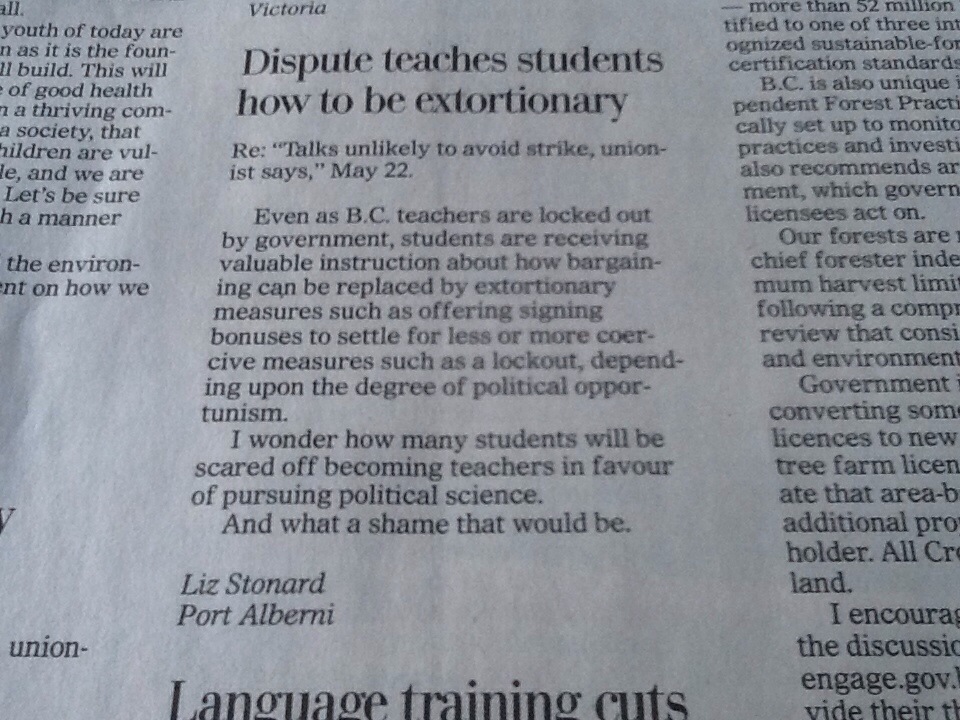
Study Political Science

20140524-085648-32208419.jpg

My normal routine is to read the local paper and then one of the national papers. I was on my third cup of coffee and came across the above letter to the editor. I had to smile. I was in a former student’s class earlier this week speaking to the upcoming American mid-term elections and social media in politics. My former student is finishing up his student teaching and had taken courses with me in Political Science. He is one of many former students who has chosen to go into secondary or post-secondary teaching. Many of my former students are also serving in public office or doing other non-partisan work for the government. The letter writer’s binary is a false one and I am sympathetic to her easy comparison; however we cannot assume that all politicians have a Political Science degree.

Over the course of 17 years of teaching my students have gone into virtually every sector of the economy. I am seeing more work in communications and the tech industry lately, but overall, they are everywhere and hold a Political Science degree. And, many of them are double majors or took a minor in another field in order to round out their education or pursue multiple areas of interest. During my next 17 years, I hope to see this continue. When students ask me, “What can I do with my degree?” I answer that they can do almost anything–it’s up to them. The classroom or office hour experience is only one part of their education. My hope is that they will get involved in campus and local opportunities.

Political Science is diverse field with many sub-fields and I am proud to call myself a Political Scientist. I am also proud of my Political Science students. Keep up the good work!

The Online Academic Community: Enterprise WP Environment

This post ran almost two months ago on Inside Higher Education for the University of Venus. I have revised it.

I would like to speak to  my use of our Online Academic Community (OAC) at the University. This is the enterprise WordPress site on our campus. It is in its first year of “real” (non-pilot) use and my hope is that more users were join the OAC for teaching, learning, research, and community building for scholars and student groups.

I had used the OAC during Summer 2013 term, but the 2013 Fall term was the first regular term in which I used the OAC. The OAC is our internal WordPress site. What makes it better than the regular WordPress site is that the cloud is on our campus. We only use themes, widgets, and plugins that comply with the provincial privacy regulations that keep my students’ data and all information in Canada. While I encourage my students to occasionally Google themselves and mind their digital footprint, it is important in the learning environment that any education technology tools I ask them to use as part of their evaluation maintains the integrity of their information. The other advantage of the OAC is that WordPress is my preferred blogging platform and I am quite comfortable with it. Plus, how can I say no to technical support from colleagues on campus? They are a tweet, email or phone call away from helping resolve a student query or the occasional odd troubleshooting. You cannot put a price on having technical support–it is priceless.

 What are we doing with the OAC? My students are blogging, vlogging, and uploading Wikipedia entries into the OAC. We are also using the OAC environment as portfolios for all of their work. Their blogs are academic research assignments that require the same care of an assignment that is submitted as a hard copy. Some of the students opt to make a particular post or vlog private, and this is acceptable. Given that the nature of my courses focus on issues of gender, politics, and sexuality, it is not uncommon that the students are blogging or vlogging about sensitive issues. The last major assignment is a research paper related to the course materials, and this also is uploaded into the OAC.

During this time, I have thoroughly enjoyed seeing their writing and analysis improve on their sites. Many of the students have been in my office working on their sites and discussing their work. In the beginning there were growing pains for some of the students as they figured out the technology and I helped them figure out the themes, widgets or overall set up of their blog site. And, this term the students are group blogging, placing their apps, and their TS Talks on their group sites.

The students are getting their fair share of writing opportunities, but they are thinking critically and learning transferable skills at the same time. The transferable skill really is the ability to use the OAC, publish on Wikipedia, and use Vimeo or YouTube for their vlogs. In previous terms, when we have used the regular WordPress site or other blogging platforms, I usually hear from a few students that using the technology was lots of work, but others note that the skills they learned were useful with their current job or their search for work.

 I am hopeful that the OAC site and technical support continues to make these assignments dynamic for my students. I am optimizing technology in the classroom in a way that works for most of them. While I have offered blogging assignments during the last six or seven years, I am more cognizant of protecting my students’ privacy and more familiar with effective social media platform use in the classroom. I like to try new things and I find that many students are open to using technology in different ways.

OAC

Revise and Resubmit

What would you do if you had a second chance? In my line of work, when I submit an article or proposal I can often get the opportunity to revise and resubmit the article or proposal. Well, a rejection requires assessing where the article goes next!  But, this post isn’t really about me. Instead, I am thinking of students and their need for second chances. There are moments when a second chance is needed. I do not like to think of myself as heartless when it comes to special situations; however, I also do not like feeling like I am someone’s rube.

There are these moments, when I have to step back and think about what is the cost of allowing a revision for a student. The revision might offer the student the chance for success or the opportunity to try to do better on the particular assignment. Ultimately, I do want students to learn and feel success. However, the means by which this is done is through their hard work. Then, I need to balance the entire group and think about my willingness to offer a second chance to 20-200 people. This is when it get tricky.

One thing that I am having to grapple with is the trickle of students who come to my office hours informing me that they did not do well on an assignment based on not just feeling prepared or some other issue that sounds like mere excuse. Here, I am not speaking to an illness or other major issue. Part of life is managing multiple stressors and responsibilities; yet, a cold before a major assignment is supposed to make a major difference. I cannot comprehend this as an excuse. Perhaps I am contradicting my last post. I feel patient, but less patient due to excuses. And, my syllabi include all the due dates and all the assignments. Is this a rant post? Tilts head and thinks–yes, but a short one.

I love Grumpy Cat and I suppose it is well-known. A colleague from another unit gave this to me and I keep on taking photos of it–knowing that Grumpy Cat would hate it.

20140208-220515.jpg

Patience and Mid-Terms

I come to my classes with a sense of compassion. The first week is a major clusterbug for everyone. And, we can ratchet this higher for the new students. What I find that I need to work on is my sense of patience during the upcoming weeks. No matter how many times I gently remind students, some will not bother to review the syllabus and email me queries that can be answered ever so quickly with a glance to the course syllabus. This term I have done something different–the quiz and the mid-term have a question related to the syllabus.

I also am aware that my class is one of four or five and once the students get into the routine, they will have a better idea regarding the protocol on campus. Until then, I read the emails, pause, smile and reply that, “As the syllabus states…” If anything, the flip side, is that the student is bothering to care to make sure that s/he gets the right information and reads the material, shows up to class on time, comes to my office hours at the right time, right? And, let’s be honest, there are moments when a keen student eye finds an error on the syllabus and I appreciate it! So, I am not perfect and I know that my students aren’t either.

I also wish that patience worked the other way. Students need to remember that I am one person serving many. My office hours are limited to some 4 because I have to teach my classes, get some administrative work, prepare for my courses, and possibly steal time for my own work. We are at the start of month two of the new term, and I am sure it will be another great, busy one. At this moment, I am thinking of Guns and Roses. Smiles. This is a reference to their song.

Students with an Edge

In my sixteen years of teaching, not one term has gone by when I do not have at least one student athlete in one of my classes. One thing that I have noticed with the vast majority of the student athletes is that they have drive. These students usually want to excel on the class. Their competitive edge extends into the classroom. They know that their coaches and education team (whoever this may be at the respective institution) expects them to show up to class and to practice. Most of these students will introduce themselves to me during the first week or two and my standard practice is to ask that their contact send me any invitational or team related travel dates. While I have taught at four different institutions none have been at a major sports school–no top ten football programs, which is often a marker for a “big name” institution. I have taught at Division 1 institutions; however, this was at the start of my teaching career.

I truly wish that more of my students had this same drive and felt accountable to their coach or team. This does not mean that my students who are not athletes are slackers! Not true. The typical student wants to do well, but knows that among their array of courses some get more effort. The student athletes are generally more competitive and want to do well in all of their courses, so it is not a big surprise to see at the annual fundraising breakfast that many of them have strong grade point averages. Can I just spend a quick moment to say that I am proud of them. Very proud. And, I know that my colleagues are, too.

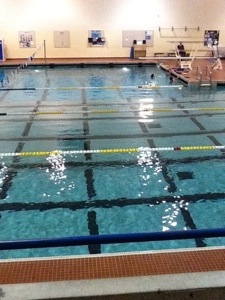
It is less common for one of the student athletes to phone it in with their coursework. When I have had a student athlete under-perform, the student has immediately contacted me via email, come to office hours, or in one instance the basketball coach called me to meet with him. When I met with the coach, he made no excuses for the student and said, “His first job is being a student. Do not go easy on him.” I wasn’t going to, but let me tell you that walking into the office was an intimidating experience. I felt empowered and I know that many of my colleagues will counter with examples of grade changes or pressure by the administration to change grades; however, this is not my experience. Getting back to the students–when they under-perform they want to know what they can do to fix it. Thankfully, the student athlete under-performing in my classes is not very common. They are competitive through and through and want to do well. I do not give them any extra credit or leeway. What I want to see is more students with that fire in their belly. Be competitive and humble. The photo below is one I took at the McKinnon Pool–one of the pools where the student athletes swim.

20131230-210921.jpg

2013 The Year of Reflection

I’m reading lots of top ten posts about 2013 and thinking about the last year. The last year was consumed with having to find balance. This was not having some idealistic want for balance, but rather out of necessity. What have I learned in these last 12 months? Well, I’m going to share my top ten thoughts from 2013.

1. Stay Healthy–this includes exercise, sleep, and eating right

2. Say no strategically

3. Work smarter–this meant rethinking my productivity

4. Make time for family and friends

5. Say yes strategically

6. Read, relax, and run

7. Be firm

8. Honesty is important

9. Unwind

10. Happiness is more important than just about everything

The list is in no particular order. I will say this there is nothing like a health emergency to force you to rethink everything. I am forever grateful to the family and friends who were supportive during the last year, as we coped. I am looking forward to 2014. I am sure it will hold lots and I look forward to tackling it with my family by me.

20131230-055223.jpg

Make a Difference

I bought a writing prompt book and I do not use it as much as I would like to do so. This post is a response to, “Believe with all your heart that how you live your life makes a difference” by Colin Beavan. This quote made me think about work and university life in general. I use the quotes as a writing response and try to put pen to paper (yes, I hand write them out first) my first thoughts to the particular quote. Here are my first thoughts about Beavan’s quote.

Some people like to think of the university as this quaint place where professors reside in Ivory Towers or perhaps silos and are completely shut off from the rest of society. In fact, some opine that professors are clueless about the so-called real world. We professors are at times depicted as this uber-privileged class who are disinterested in students and teaching. Our students are often depicted as this group of youth who are hiding out in university learning about books or issues that will not help them get a job. Yes, that coveted job is the end result or want for our students. These depictions might offer an accurate view of some of my colleagues and some students; however, I would argue that for most these stereotypes or caricatures are false based on 16 years of teaching in universities in the US and Canada. Yes, this is my opinion.

The reality could not be further from the truth. Many professors are engaged in a myriad of work related projects that stem from research, teaching, service, governance in their units or across campus, as well as some community building in their disciplines or the wider community in which they live in locally. Sure, there are research intensive colleagues who are focused on that next book and their army of graduate students that they supervise. The university needs these different types of professors. This post is not about the army of exploited contingent faculty, as that deserves a monograph or at least its own post. It speaks volumes that I have this footnote or sidebar note in my scrawl on the writing prompt sheet.

Many do not understand that prior to smart-phones and other advances with digital technology, professors’ flexible schedules means that there is always work to do. There are always assignments that require marking, emails to get to, research to do, writing to think about and maybe do, and then more emails to respond to from students, colleagues, and others. With the advent of increased use of technology, people expect to hear back faster and in many instances you will get follow up emails about an email that was sent 15 minutes earlier or perhaps a few hours earlier. I have been emailed three times within my lunch hour by an administrative assistant about a meeting. The meeting was not a life threatening situation; however, my lunch hour meant that I was available. I did not respond until I was done with my lunch and my errand across campus. But, let me say that I was not keen to see a flurry of emails about something that was not pressing. My point is that boundaries are thin. Perhaps you think that I have moved away from the quote. But, I’m sitting here thinking about work and how I try to live my work life as if it makes a difference to those around me: my students. Do not get me wrong, I like my colleagues across campus, but my primary role right now is teaching and mentoring. This means that I need to go in each day and remember this quote. The little things that we do can make a difference.

20131105-082156.jpg

Academic Conferences: Discussants Discuss

I have spent many years involved with different academic conferences. This has provided ample opportunities for networking and the next phase is giving back and serving as a chair or a discussant on panels. I have had the distinct displeasure of having some terrible discussants and then some wonderful discussants. I remembered each and have channeled the good examples and make sure that I do a few things. This list is a suggestion and certainly is not exhaustive.

1. Give the panelists as much as time as possible to get their draft to me. I’m usually traveling to the conference and I am perfectly fine with reading papers and making comments on the plane. I know that many prefer the papers a week prior; however, I rather have a more complete draft.

2. Explain to the panelists how much time they will have prior to the conference starting, so that they are aware of this prior to the actual conference. Then, reminding them at the panel and having a five minute and one minute warning. This is good to make sure that everyone gets ample time to present. There is nothing worse than the last panelist getting half as much time.

3. Read the paper closely and try to place it within the proper sub-field and make constructive comments and suggestions. This includes offering possible places for publication and other general supportive points. By reading the papers closely, the discussant should also tie the panel together with the preliminary comments to the audience.

4. Show up on time to the panel and make sure that the technology is in working order and that the panelists all have water. These little things are important and the panelists might vary from the seasoned presenter to the undergraduate co-presenting with their mentor.

5. Make your comments and then field the question and answer period with the audience. Thank everyone for coming and then give the hard copy of the papers back to the panelists or email them the copy with track changes or other comments.

An organized discussant can really help the panelists’ conference experience. We go to conferences to network, but the presentations are incredibly helpful to share works in progress or other research with our colleagues. The conference experience should be positive and a good discussant will contribute to this. Let me add that I now really understand certain conference policies about getting faculty to serve as a discussant. The discussant role is a time intensive one and this person should have some expertise if not more than familiarity about the area of research. I welcome other suggestions to my five points.

20131027-140446.jpg

Frosh Chants and Consequences

In the last few weeks, three Canadian universities have made headlines within days of one another and not the way that development officers like to see. Students at St. Mary’s University (SMU) in Halifax, NS chanted a truly unfortunate chant at a university sanctioned event. Students from the University of British Columbia Sauder School of Business said the same chant during some Frosh activities. Then, the Engineering students at Memorial used an unfortunate term on their mugs for their pub crawl. Student leaders at SMU and UBC have resigned. All three schools have noted that investigations will take place and awareness campaigns or sensitivity training workshops are forthcoming.

As a feminist social scientist I was not surprised that the students felt it was acceptable to engage in the chants. We live in a hypersexualized world where social justice activists, rape crisis workers, and academics working in Women’s Studies or other fields continually explain that rape culture thrives. During the last sixteen years, I have dedicated my career in Political Science and Women’s Studies to teaching courses related to gender and difference in an academic setting. I work with undergraduate students and I see and hear things on campus. While the chants are offensive–these are not isolated events, we need to ask why students feel compelled to participate in the chants. I have seen posters on campuses for different student events, like a sailing club’s pub crawl event called: “outrigger and gold digger” pub crawl. One only has to walk around a university to find some very interesting posters for events usually held off campus.

Thanks to the chants we are talking more about Rape Culture. But, what is Rape Culture? Rape Culture is the end product of the hypersexulization of women and men and excuses harassments, chants, and acts of violence against women and men. Rape culture causes people to think that joking about having non-consensual sex with a minor is not rape–but a light hearted moment. Rape Culture allowed the sexualized violence of Steubenville to take place, where at first the town appeared to defend the young men involved and attacked the victim. And, I argue that this hypersexualized culture makes posting questionable photos on Facebook acceptable, but a photo of a nursing mother objectionable. Rape culture also educates boys and men that girls and women are always sexually available to them. We need to have more conversations about consent and sexualized violence. We also need to discuss what make up the components of healthy sexuality.

What is telling about these episodes is the varied reactions. For instance, the comments online on newspaper sites or other platforms. My students chide me and say, “Don’t look at the comments.” I try to not do so, but then occasionally I wonder what people are saying.  The comments are at times instructive and then illuminating about the sheer depth of rape culture. Why do I say this? Well, when people post that they should be able to joke about sexual assault and that it’s just a joke, I take issue with that. There are certain things that we should not joke about and instead understand that violence against women is not a joking matter. I have a great sense of humor, but there are some issues that deserve serious conversations. Let’s continue the learning and the conversation.

Career Advice: Redux

This is an old post that I have tweaked (not twerked) for the start of a new academic year.

You’re in your last year of university and getting nervous as the school year starts, hits the half way point or is ending. But, for the sake of ease, let’s pretend it’s the start of your last year of university. I’m going to make some suggestions for you. And, these are my opinions alone and not endorsed by my employer. This advice comes from my university experience, 16 years of teaching, and years of advising unofficially and officially.
1. Get yourself to the Career Center or the Career offices. Your campus should have an office with extremely competent staff who are there to help you. But, understand that they aren’t there to help you get a job, rather they are there to give you the skills so that you get yourself that job. They will empower you, but it’s all about your own skills and your own file. Have a Career Counselor review your CV or resume.

2. Speak with your departments Undergraduate Advisor. Believe it or not, s/he might have some good advice to give you. The advisor might know of additional job boards in your area of interest.

3. Speak to trusted peers who are in your situation or who have recently graduated. Your peers are a useful resource, too. Ask them if they can introduce you to anyone else–that is you need to network.

4. Confer with other faculty or mentors that you have in the campus community or community at large. Now is not the time to feel shy. You have to reach out and make some effort.

5. If it works for your field (and which fields does it not work for?) get on social media. Yes, join Linked in and establish your profile there and meet others on the platform. Ask people questions—especially those in the industry that you’re interested in.

6. Are you blogging or on Twitter? Will these platforms be useful for you? If so, then do it. But, always be very careful with your digital footprint. Google yourself and see what is out there. That photo of you in residence engaging in naked beer sliding—might need to be deleted! OK, you really don’t have compromising photos, but do take a look and see what photos and status updates you’ve had so that you won’t have a future employer “creep” and find something that they don’t like.

Particular to Victoria, I suggest to students that they not only look at the local job boards (BC Public Service, municipality job boards, and UVIC’s U-Hire, but also VIATEC’s. You never know what you might find in many of these. I also explain to students that they most likely won’t get hired right out of their undergrad as a senior policy analyst. The truth is that you’re going to have to work your way up and this might mean that you’re working in a position that requires data entry, filing, and “gofer” work. You have to cut your teeth in a job and be prepared for this.

If you’re interested in working in Victoria, I suggest that you keep abreast of when there are Chamber of Commerce events (Victoria or Westshore) and attend some of the events to network and meet local members. Note that members of this organization aren’t only local business owners, but government types, elected officials, and just regular people who are interested in the community. Also, attend other local events and get to know the community. This might mean registering with Meet Up and looking for events that will allow you to meet other like minded people. The thought of doing this might make you feel uncomfortable, but you need to get out and meet more people and realize that the limited discomfort can pay off with a mentor, community building, contacts, and possibly a job connection.

I have seen students take 4-8 months to find work after they graduate and this is pretty common. The students who are willing to take risks or start at the entry level position are the ones who have been the most successful. What are you doing to do?