
Anti-Bullying Workshop: Part 2

I previously blogged about an Anti-Bullying held on March 31st, 2012 that I attended in San Diego. The workshop was sponsored by Voices of Women and was for the local Somali community. The latter half of the panel included a community member and the local Police. The first presenter was Ramla Sahid, community organizer. Yes, I smiled when I heard this descriptor and after hearing her presentation I was so impressed. Did I share that she’s also a SDSU alum?! Yes, she is. This young woman is working for social change. “We are accountable to one another.” Hearing her say this was important. She was reminding the mothers and daughters in attendance. Yes, the audience was predominantly sex segregated and I will speak to this later.  She also gave a polite yet scathing commentary on how the tough on crime legislation and policies in California were counter-productive.

The other speakers were two police officers: one Lieutenant and one Detective. I am not using their names–both of them work in the community and I will leave it at that. The two really spoke to the intricacies of the laws regarding bullying and harassment. There were a few moments when I wondered if the presentation was right for this audience, but nonetheless their presentation was good. I also was at times fascinated by their guns. The guns looked out of place–I know that they were on duty, but after years in Canada I am not as used to seeing lots of guns around. (Humor). The officers noted that if bullying begins in primary school it only worsens in junior high and high school, so it’s important that we respond.

“Respect is universal.” Lots of head nodded when the Lieutenant made this statement. Farah noted that we need to get the men involved and that they need men only workshops. I am not sure if I agree, but then again I am not taking into the cultural considerations. Perhaps he is on to something and these male only workshops can also speak to the importance of fatherhood. More workshops is definitely something work thinking of given the proliferation of bullying and need to curb it in schools.

When the question and answer period took place Agin Shaheed noted that we must get the fathers involved. There were only mothers in attendance. He also noted that across the US 87% of teachers are women. (Is this why we keep on hearing the press and experts pick on teachers? Is there bullying against teachers because this is still viewed as women’s work? Maybe that is another post).
Anti-Bullying Workshop: Part 1

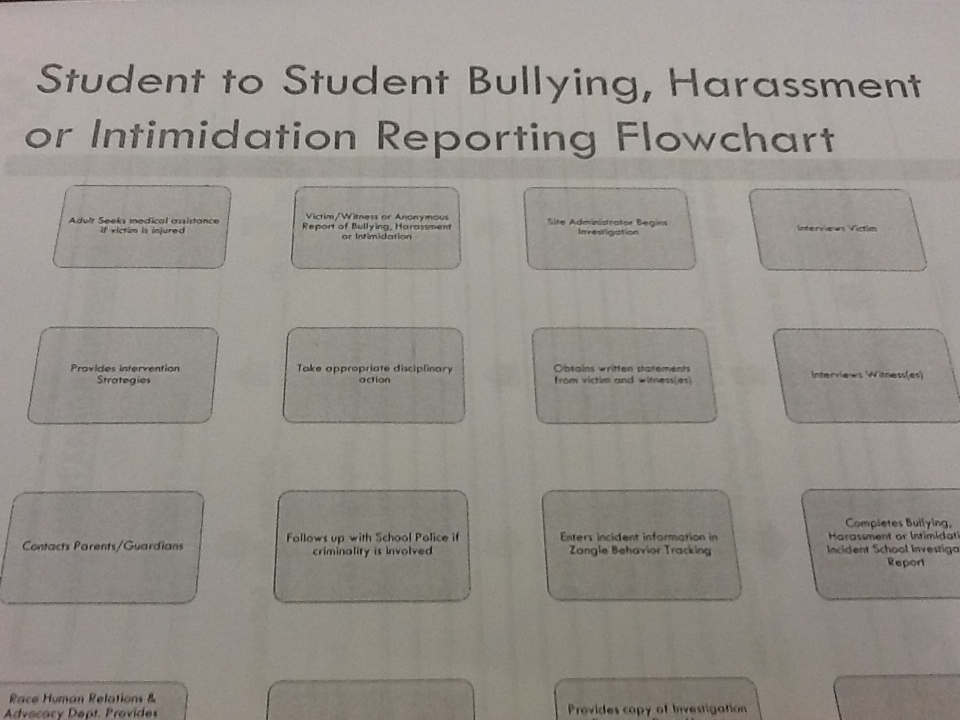
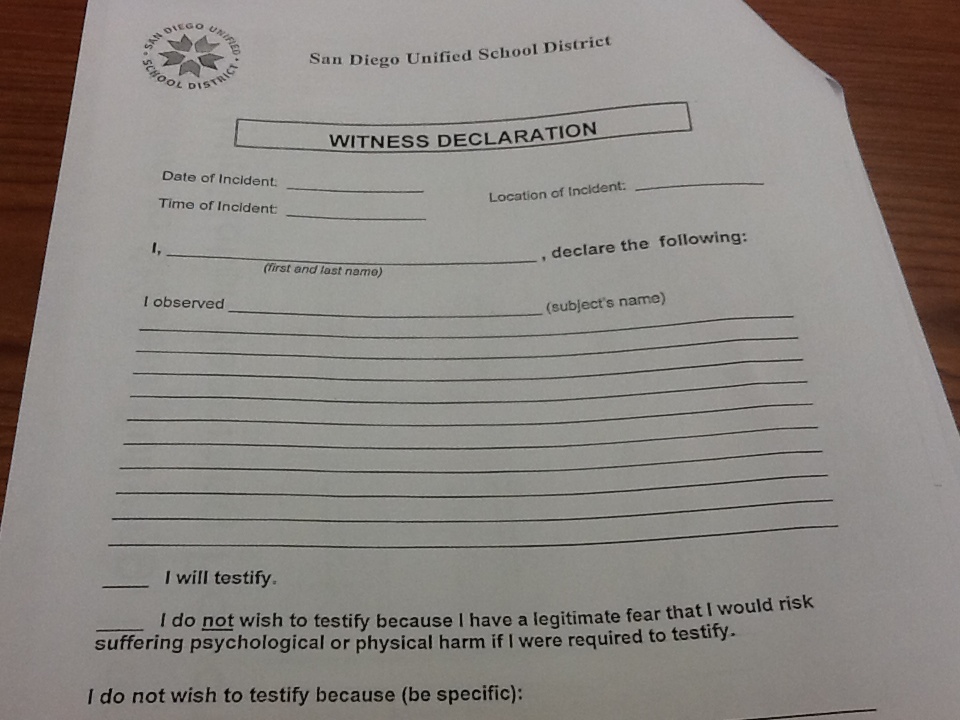
I had the distinct pleasure of the Voices of Women’s (VOW) Anti-Bullying workshop in San Diego, California on March 31st 2012. VOW collaborated with the United Women of East Africa for this workshop. I was quite pleased to be in the minority in the crowd. The majority of the attendees were women from the Somali community in City Heights neighborhood in San Diego. The array of panelists provided insight into the policies and realities of anti-bullying today in San Diego and more specifically the San Diego Unified School District (SDUSD). The array of handouts that SDUSD uses with documenting bullying and the anti-bullying efforts impressed me. I kept multiple copies so that I could share them at home. And, here I include my screen shots.

The first speaker, Agin Shaheed, is an administrator with the SDUSD. His exact position focuses on Race Relations. I couldn’t help but think that his job must be incredibly rewarding and exhausting. Shaheed noted that the SDUSD is the largest school district in San Diego County and second largest in the state. This would make it behind the Los Angeles Unified School District (LAUSD). Shaheed opened up his remarks reading a moving poem he wrote. He reminded the audience of 50 about the murders of Shaima and Trayvon. I was glad I packed my tissues. Shaheed made a germane point about cyberbullying and the way it invades the home–it makes this form of bullying more invasive. Victims of cyberbullying are not safe anywhere.

The next speaker Maslah Farah, Director of the Neighborhood Unity Foundation shared that he was bullied and got into trouble while he was in school. He shared that the bullying stays with you for the rest of your life. He also opened up my eyes to how important cultural issues are. He noted that in Somalia families really look to the teachers as a second parent and that corporal punishment is more common in the schools or other forms of discipline that are not allowed here. (I could hear some warm laughter as he noted this). What I took from his talk is that he was kicked out of high school and is now successful and using his community work to mentor others in the community. He reminded us that we need to move away from a mainstream culture that enjoys witnessing misery.

This portion of workshop really made me think about the ways that we think about bullying. I also wondered what sorts of policy the local schools in Victoria (where I live) have regarding bullying. We can talk until we’re blue in the face about how bullying is bad, and that kids should not do it. But, until we practice this and don’t encourage bullying among adults we unfortunately model bad behavior. Just turn on some reality television shows and we can see and hear bullying. Look at some of the news magazine shows and we can also see the bullying nature by the hosts. We live in a society where bullying is rampant. Not to seem trite–but we  need to model better behavior.

Collegiality via Email: Suggestions for Students

Last week I wrote about collegiality on campus and was really thinking about colleagues. Today I am thinking about students. Most of the original post applies; however, it is markedly different for students. I advise students and  I supervise students. But, I also assess student work and worth with graduate and undergraduate students in different capacities. I am in contact with lots of students and I had some interesting conversations with colleagues at #ISA2012 I know that email communication is a sore spot for lots of us.

I’ll list in no particular order some suggestions:

Never send an email that you have initial misgivings with or give you pause. Don’t send it. You might have a smartphone, but that doesn’t mean that you are making smart decisions. The tendency is to be less formal and send an incomplete sort of email.

Never send an email in anger or frustration concerning a mark. These situations really requires a face to face meeting. And, then you and the recipient have the record of your angry or frustrated email. Avoid sending an email that you might later feel sheepish about or regret.

Never send an email making statements that you wouldn’t say to someone’s face. We get brave  behind the screen or with the phone, so think before you send. Remember that your instructor or boss is not your peer and you should error on being more formal than informal.

What you should do if you feel you need to send an email: Send yourself the email and wait. Then, review the email. Practice smart computing and communicating.

Blogging Assignments: Yes, I’m Sold on Them

For the last four to five years I have included a blogging assignment in my Women’s Studies or Political Science courses. During the last three years the blogging assignment is mandatory and I have found that most students find the assignment(s) liberating in that it offers them a place to combine analysis with a creative assignment. However, I find that it is good to offer some flexibility with the assignment. Last Summer students had an opportunity to blog, put together a zine or make an iMovie that responded to a series of course readings. Six to eight of them put together zines and more opted to blog. For the second year in a row–no one opted to complete the iMovie assignment. However, one person did vlogging for her assignment and I was pleased with her vlogs.

These creative assignments are coupled with class participation, and lots of writing–a major research paper. The students get ample opportunity to think and write. My expectations are that the series of blogs helps the student hone her/his analysis of the course readings and my comments, then, help them improve so that the final paper is not merely an extension, but the final product for their thoughtful analysis related to the course material. I will continue to offer them this opportunity to blog.

The blogging assignment also allows the student to become familiar with a blogging platform and I find that most students enjoy learning how to add different matter (photos, video clips and the like) to their posts. The students experience some pride of ownership with their particular blog and then they get to do that practical thing—add familiarity to said platform to their resume. That said, there is also a growing area of literature that is examining blogging as a genuine assignment in the classroom and the benefits of blogging. I do think that we will continue to see social media use in our classrooms and here I do not mean that student laughing or smiling into their hands, as they text one another. No, we will see more colleagues using social media platforms in the classroom assignments. How are you using Web 2.0 in your classroom?

Remembering to Breathe

On Saturday, March 17th I had the distinct pleasure of participating in a Mom panel on Real Parenting with Shirley Broback and two of the three co-founders and organizers of Breathe Now. The interview was focused on parenting tweens and teens and what this means for us. It was a great interview and I was reminded how almost two years ago we decided that we wanted to organize a conference for women.

The idea was that we have all attended work-related conferences, mom conferences, and social media conferences, but we did not feel like there was a conference dedicated to the three in such a way that also dealt with issues unique to women. And, as I noted on Real Parenting the fateful meeting at Murchie’s was when we came up with the name, Breathe Now. We wanted to remind women that it’s important to inhale, exhale and breathe. We need to be nice to one another and more importantly to ourselves.

My involvement with Breathe Now has offered me opportunity to get to know the other three co-founders well. And, with that I’ve also met so many wonderful people in the local community. We see the conference as part of our project to build connections for women. We run the gamut, though, with a former government worker–turned personal chef, communications consultant, a hotel industry executive, and an academic. What we share with this conference is an acknowledgement of the importance of women supporting one another. There is so much knowledge that we can share with one another–but the only way this will be done is by taking the time to talk and chat.

Breathe Now offers a weekend of events that is sure to inspire. We are proud that Rona Maynard is our opening keynote and Bif Naked is our closing keynote. The array of our panels reminds women that it is OK to take time for yourself. We are also setting up our slate of panels to look at the theme of It’s OK.  For instance, it’s OK to take time out for yourself, it’s OK to be successful…this theme is important, as women often apologize for taking time out for themselves or for their success.

I’ll end saying that I hope to see you at the conference on April 14 and 15 2012 at the beautiful University of Victoria!

Revisiting Conferences and Making it Worth It

An academic conference provides the more than the venue to present your work and hear other presentations. It also is a great place to network and make connections, as well as learn from colleagues in the field. This post makes suggestions for a successful conference appearance. I know that the Western is this week and ISA is at the start of April. My hope is that this post will be useful for most.

If you are presenting and need technology (a video data projector), do make a point of making sure that your needs are met. Likewise, always have a Plan B if the technology does not work. This means copies of your slides for you to refer to and handouts of any pertinent slides or related matter is also copied (introduction, findings and conclusion) for distribution. I gave a talk on campus last week and had my iPad, thumbdrive, Slide Rocket and Drop Box versions of the presentation; however, everything worked fine with my iPad.

For graduate students, you should come with some business cards in hand. The standard in my areas of familiarity (Women’s Studies and Political Sciences) are that you can use the university crest and get cards printed. Please note that when you are writing your thesis, you are a candidate (for instance MA Candidate) otherwise you are a Graduate Student. When you have defended your prospectus for you dissertation, you are a PhD Candidate. You cannot put PhD on your card until you have defended or have your PhD in hand. I see that a few people have PhD on their Twitter profiles or blogs and they do not have this degree earned yet. This is misleading and unprofessional to do—don’t do it!

Practice your presentation in front of a mirror or a friendly audience. There is nothing harder to do than to sit by and pay to attention to a terrible or wooden presentation. Don’t stare at your computer. If you must, place phrases in your document that read: scan the room, breathe, smile, look up, etc. This will help you add some semblance of connection with your audience. Speaking of which you could present to one person or have no one in your audience, but this still counts as a presentation for your vitae. Enjoy your presentation!

Make sure that you take time to attend some of the receptions. This is a good place to network or catch up with others. Make sure that you are available to attend some of these events. The conference is not a vacation, but a working series of meetings. Take some time off, but your main job is to use the conference experience to help you share your research and meet people in your discipline. It is worth the time to meet people, too. I have found that some of my publications were thanks to a conference presentation, when an editor was in the audience or another panelist invited the panel to submit a special issue to a journal.

Before your trip you also want to peruse the conference program well so that you can organize your daily itinerary of what you have to do. If your advisor, mentor or other faculty in the department are attending the conference, go to some of their talks. Ask them to introduce you to some people at an event. A good committee member or mentor, will do this naturally, but some people need the little nudge to do so. Also, try and meet other graduate students. These people will provide the cohort of scholars you will see at the conferences and it is worth getting to know them.

The next few things are obvious: have fun, eat, sleep and exercise. Conferences are often 12 hour days and you want to make the most of them, but not work too hard that you return home exhausted or sick. Have a great time, but be careful to not drink too much. You are presenting yourself to others in your field. Likewise, be careful what you say on social media during the conference.

Remember that your first academic conference might appear a daunting experience, but it is not if you plan well and take the time to network and attend conference events. Also, engage with others online via social media–this way you can also meet people prior to the conference and have a meet up.

For the established academic, all of the above is obvious. But, let me add that we need to remember to make time to mentor. I try and take grad students out for a drink, coffee or a meal to chat with them about their progress. These brief meetings make a difference. I know that they did when I was a grad student.

Young Adult Lit in the College Classroom and Beyond

I was looking forward to an article in the paper about Yong Adult (YALit) and was disappointed that it really didn’t offer anything new. I’ve been reading YALit for years, as  a matter of fact probably before it was given the moniker. I think it’s filled with theory, politics, messages, and more than just entertainment. It is literature.

Young Adult  (YA) Literature as a genre is not new; however, its popularity has sustained the weakening publishing market. The  YA genre has kept many a publisher in the black, as the genre has a wide crossover appeal. Frankly, we have witnessed the genre balloon during the last ten years. Many have thanked J.K. Rowling and her Harry Potter Series for this. I thank her for the great series and more. And, I look forward to her next project.

I never really stopped reading YA lit. I think I dove into the genre more so once my eldest daughter became interested in the genre. Here my interest was really two-fold: my love of reading and want to discuss literature with her. Win-win. However, as an educator I have to say that I have found YA lit useful in the classroom. The genre has politics, gender, class, race, sexuality, nation, democracy and more discussed within its pages. And, the students really enjoy re-reading a book with a different theoretical lens. I have also had a chance to meet new people online and in real life (IRL) and have had great conversations about YA lit.

In my Women’s Studies and Political Science courses, I have actually offered a paper option that required students to read pre-approved YA Lit books and discuss course concepts in the books. Depending on the class, these assignments have been popular. The best part for me is the assessment of the assignment and reading how a student has reassessed a much-loved book in a different fashion and has a different feel for the book.

I have also spoken at Political Science conferences and in my local community about YALit and politics. I am repeatedly energized by the positive reception by colleagues and youth. People are reading YALit and noting the messages, politics, feminisms, and more. My fascination with dystopic YALit is not unique and I have had animated discussions with middle school students and high schoolers about protagonists we like or the way in which Lord of the Flies is germinal to many a plot. Connecting over books never gets old.

How cool is that?

Parts of this post ran in Oct 2010 I was compelled to revisit it based on the article about YALit being a new thing.

Continuing the Conversation about Guilt: Academics on Academia

I’ve enjoyed my conversations with Liana Silva. Her last post really touched me and troubled me. I was not frustrated with Liana, but with the truths she spoke about the ways in which academics allow the constant blurring of our work and personal lives. She made me look into the mirror and think about my work and the infamous to do lists that I keep. I spent all last week thinking about guilt. The guilty way I feel when I think about my day and the constant struggle to get all the tasks completed.

There is always a paper to write, assignments to grade, lectures to work on and other work. Then, add to that projects, publications, and service in the department, faculty and wider campus. The reality is that most academics do not work a 40 hour work week. No, we work easily work 50-60 and during the crunch periods more than this. And, this doesn’t include all the time responding to emails or thinking about the job. Alas, we do not get to bill by the fifteen minute increments!

Continue reading

Mentoring Grad Students: A Revisit

I was looking at my blog posts and see that this one from not quite two years ago is timely. I have taken the liberty of revising the post.

I have been having more conversations with graduate students about life after graduate school. Not all of them are interested in the traditional career path in academe. Can you blame them? The job market for full-time work in higher education is dismal. There is lots of work for contingent (part-time) faculty, but that doesn’t really provide a stable income. I know this well, as for most of my academic career, thus far, I worked part-time. Sometimes this work was between three different departments and most seasoned graduate students know this.

I do think that we need to be more responsible with our mentoring of graduate students and part of this includes not suggesting graduate school as a viable option to some students. There, I said it. Graduate school is not for everyone; however, some will figure this out on their own. I am referring more so to being honest about the psychic and financial instability of graduate school. Lately, I am seeing more undergraduates entertain what they are referring to more “practical” programs like advanced degrees in Public Administration and even a few are entertaining MBA programs. I think this is a good thing–let them branch out into different degree programs. An advanced degree in Political Science is useful, but it is not the only option.

I have been pleased to see an ongoing thread on Twitter under the hashtag #NewPhD. These short conversations are interrogating degree programs and what we think needs to change. These are important conversations. We also need to provide more support to graduate students. This includes support for when they need more help. And, this includes protecting them from yes-itis. You can say yes to too many project or overall commitments and then not give any of them the full effort they require.

We need to be more honest with our graduate students and make sure that our institutions offers different types of job training or workshops. And, if the student does want to go into higher education, we need to do a better job of training them to work with students. This can be tedious, but meeting one on one with the students is really worth the time. This is part of an ongoing train of thought for me. Graduate students also have to willingly want to learn and realize that professional development is important. This is the best case scenario–where their institution offers workshops and they have good mentors. We all have stories where things went awry. But, let’s try to make it better for the current cohort of students.

Organization Matters: Fri Fun Facts

Recently I had a student in my office who had his next two years planned out–typed and ready for my review. I get this. I did this. OK, it was hand written, but I also planned like this. Today’s Friday Fun Facts is dedicated to planning your post-secondary education. And, here I assume that this plan is after the first year, so that the student has at least taken several course as they figure out what they like or don’t.

1. After you’ve met your undergraduate requirements for the degree review the requirements for the degree programs that you’re the most interested in for your major and or minor.

2. Related to the above point, I actually suggest to students that they at the very least have a major and a minor. Preferably, I’d suggest a double major. For some the preference might work best as a major, minor and co-op. The students who are focused on graduate school should look if the department has an Honors Program.

3. You should meet with the Undergraduate Advisor(s). This will vary at campuses. In some the office might be in the department (your major area) or there might be an Advising Center. Either way–these professional staff or faculty are there to help you. They can best help you when you are well informed and when you have questions for them.

4. Talk to other students to find out what they suggest. They will also be useful to find out which departments and professors you should look into for your degree program.

5. Remember that this is your education and you need to own it. You must be your best advocate in and out of the classroom. This means that you need to keep an eye out for deadlines and make meetings with the appropriate people or offices for information.

6. And, if you’re like the student from earlier this month and me, you can map out your courses for your degree program. It’s useful to actually see what you need and what you can take. Do it! It’s not in stone, but it makes you organize what you need to do.

May I suggest that you get a copy of the rules and add post its and highlight all the key information. Nowadays so much of this information is online and somehow you need to get familiar with the information regarding your degree program. Bookmark the appropriate webpages.