Make a Difference

I bought a writing prompt book and I do not use it as much as I would like to do so. This post is a response to, “Believe with all your heart that how you live your life makes a difference” by Colin Beavan. This quote made me think about work and university life in general. I use the quotes as a writing response and try to put pen to paper (yes, I hand write them out first) my first thoughts to the particular quote. Here are my first thoughts about Beavan’s quote.

Some people like to think of the university as this quaint place where professors reside in Ivory Towers or perhaps silos and are completely shut off from the rest of society. In fact, some opine that professors are clueless about the so-called real world. We professors are at times depicted as this uber-privileged class who are disinterested in students and teaching. Our students are often depicted as this group of youth who are hiding out in university learning about books or issues that will not help them get a job. Yes, that coveted job is the end result or want for our students. These depictions might offer an accurate view of some of my colleagues and some students; however, I would argue that for most these stereotypes or caricatures are false based on 16 years of teaching in universities in the US and Canada. Yes, this is my opinion.

The reality could not be further from the truth. Many professors are engaged in a myriad of work related projects that stem from research, teaching, service, governance in their units or across campus, as well as some community building in their disciplines or the wider community in which they live in locally. Sure, there are research intensive colleagues who are focused on that next book and their army of graduate students that they supervise. The university needs these different types of professors. This post is not about the army of exploited contingent faculty, as that deserves a monograph or at least its own post. It speaks volumes that I have this footnote or sidebar note in my scrawl on the writing prompt sheet.

Many do not understand that prior to smart-phones and other advances with digital technology, professors’ flexible schedules means that there is always work to do. There are always assignments that require marking, emails to get to, research to do, writing to think about and maybe do, and then more emails to respond to from students, colleagues, and others. With the advent of increased use of technology, people expect to hear back faster and in many instances you will get follow up emails about an email that was sent 15 minutes earlier or perhaps a few hours earlier. I have been emailed three times within my lunch hour by an administrative assistant about a meeting. The meeting was not a life threatening situation; however, my lunch hour meant that I was available. I did not respond until I was done with my lunch and my errand across campus. But, let me say that I was not keen to see a flurry of emails about something that was not pressing. My point is that boundaries are thin. Perhaps you think that I have moved away from the quote. But, I’m sitting here thinking about work and how I try to live my work life as if it makes a difference to those around me: my students. Do not get me wrong, I like my colleagues across campus, but my primary role right now is teaching and mentoring. This means that I need to go in each day and remember this quote. The little things that we do can make a difference.

20131105-082156.jpg

Academic Conferences: Discussants Discuss

I have spent many years involved with different academic conferences. This has provided ample opportunities for networking and the next phase is giving back and serving as a chair or a discussant on panels. I have had the distinct displeasure of having some terrible discussants and then some wonderful discussants. I remembered each and have channeled the good examples and make sure that I do a few things. This list is a suggestion and certainly is not exhaustive.

1. Give the panelists as much as time as possible to get their draft to me. I’m usually traveling to the conference and I am perfectly fine with reading papers and making comments on the plane. I know that many prefer the papers a week prior; however, I rather have a more complete draft.

2. Explain to the panelists how much time they will have prior to the conference starting, so that they are aware of this prior to the actual conference. Then, reminding them at the panel and having a five minute and one minute warning. This is good to make sure that everyone gets ample time to present. There is nothing worse than the last panelist getting half as much time.

3. Read the paper closely and try to place it within the proper sub-field and make constructive comments and suggestions. This includes offering possible places for publication and other general supportive points. By reading the papers closely, the discussant should also tie the panel together with the preliminary comments to the audience.

4. Show up on time to the panel and make sure that the technology is in working order and that the panelists all have water. These little things are important and the panelists might vary from the seasoned presenter to the undergraduate co-presenting with their mentor.

5. Make your comments and then field the question and answer period with the audience. Thank everyone for coming and then give the hard copy of the papers back to the panelists or email them the copy with track changes or other comments.

An organized discussant can really help the panelists’ conference experience. We go to conferences to network, but the presentations are incredibly helpful to share works in progress or other research with our colleagues. The conference experience should be positive and a good discussant will contribute to this. Let me add that I now really understand certain conference policies about getting faculty to serve as a discussant. The discussant role is a time intensive one and this person should have some expertise if not more than familiarity about the area of research. I welcome other suggestions to my five points.

20131027-140446.jpg

Wente: Redux

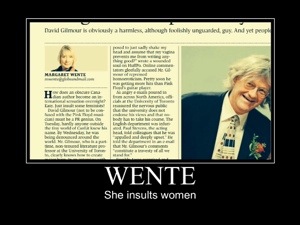
Margaret Wente is in the business of getting more clicks, commentary, and raising her profile. This does not mean that she has anything great to say–in my honest (notice I didn’t say humble) opinion. I think that Wente does a great job of repeatedly insulting women. I took it upon myself to use the “Motivation” app for this last article in the Globe and Mail.

20130928-180003.jpg

Frosh Chants and Consequences

In the last few weeks, three Canadian universities have made headlines within days of one another and not the way that development officers like to see. Students at St. Mary’s University (SMU) in Halifax, NS chanted a truly unfortunate chant at a university sanctioned event. Students from the University of British Columbia Sauder School of Business said the same chant during some Frosh activities. Then, the Engineering students at Memorial used an unfortunate term on their mugs for their pub crawl. Student leaders at SMU and UBC have resigned. All three schools have noted that investigations will take place and awareness campaigns or sensitivity training workshops are forthcoming.

As a feminist social scientist I was not surprised that the students felt it was acceptable to engage in the chants. We live in a hypersexualized world where social justice activists, rape crisis workers, and academics working in Women’s Studies or other fields continually explain that rape culture thrives. During the last sixteen years, I have dedicated my career in Political Science and Women’s Studies to teaching courses related to gender and difference in an academic setting. I work with undergraduate students and I see and hear things on campus. While the chants are offensive–these are not isolated events, we need to ask why students feel compelled to participate in the chants. I have seen posters on campuses for different student events, like a sailing club’s pub crawl event called: “outrigger and gold digger” pub crawl. One only has to walk around a university to find some very interesting posters for events usually held off campus.

Thanks to the chants we are talking more about Rape Culture. But, what is Rape Culture? Rape Culture is the end product of the hypersexulization of women and men and excuses harassments, chants, and acts of violence against women and men. Rape culture causes people to think that joking about having non-consensual sex with a minor is not rape–but a light hearted moment. Rape Culture allowed the sexualized violence of Steubenville to take place, where at first the town appeared to defend the young men involved and attacked the victim. And, I argue that this hypersexualized culture makes posting questionable photos on Facebook acceptable, but a photo of a nursing mother objectionable. Rape culture also educates boys and men that girls and women are always sexually available to them. We need to have more conversations about consent and sexualized violence. We also need to discuss what make up the components of healthy sexuality.

What is telling about these episodes is the varied reactions. For instance, the comments online on newspaper sites or other platforms. My students chide me and say, “Don’t look at the comments.” I try to not do so, but then occasionally I wonder what people are saying.  The comments are at times instructive and then illuminating about the sheer depth of rape culture. Why do I say this? Well, when people post that they should be able to joke about sexual assault and that it’s just a joke, I take issue with that. There are certain things that we should not joke about and instead understand that violence against women is not a joking matter. I have a great sense of humor, but there are some issues that deserve serious conversations. Let’s continue the learning and the conversation.

Welcome Back

Welcome Back to the new school year! We all start off the term with high hopes of losing bad habits and starting anew. I know that I do. My big issue is my continued effort to have better work/life balance. For students, balancing courses, work, and their personal lives is also an issue. I am going to suggest that keeping a schedule in a calendar (analog or digital) is key to staying organized. I know that I have previously suggested that you organize your study time. It is worth repeating.

Every Fall students contact me and ask me, “How should I study?” My answer is usually the same, but the first thing that I note is that this is what I see the strong students do. Not all of us can cram and have success. I know some can do this, but I am not speaking to them. I suggest that you place study time in your calendar and that you guard this. Then, note all your due dates and place time for research and writing in your calendar. Once you have done this, think about your work schedule and what is really manageable for you. I also suggest that each day you set up time to read. I like to divide my time by hours. One of my mentors used to be a lawyer and he is now an academic. He sets up his time in 15 minute increments. The billing method from the law firm endures! What this also does for him is that he can block out multiple blocks of time for a project.

Once you have your study time figured out it is important to also add down time. Note time for coffee, walk around the building, and take a break. Keep to the break time, though. Do not let it turn to taking the entire afternoon off, as you will pay the price for this if this becomes part of your pattern. I am not suggesting that you turn into rigid Rita, but that you keep better track of your study time. You will be surprised with the amount of time that you can have if you are better with your time management. With this, I wish everyone a great term. I am going to try to keep to my deviceless Monday evening and set some time to read.

20130918-110347.jpg

Career Advice: Redux

This is an old post that I have tweaked (not twerked) for the start of a new academic year.

You’re in your last year of university and getting nervous as the school year starts, hits the half way point or is ending. But, for the sake of ease, let’s pretend it’s the start of your last year of university. I’m going to make some suggestions for you. And, these are my opinions alone and not endorsed by my employer. This advice comes from my university experience, 16 years of teaching, and years of advising unofficially and officially.
1. Get yourself to the Career Center or the Career offices. Your campus should have an office with extremely competent staff who are there to help you. But, understand that they aren’t there to help you get a job, rather they are there to give you the skills so that you get yourself that job. They will empower you, but it’s all about your own skills and your own file. Have a Career Counselor review your CV or resume.

2. Speak with your departments Undergraduate Advisor. Believe it or not, s/he might have some good advice to give you. The advisor might know of additional job boards in your area of interest.

3. Speak to trusted peers who are in your situation or who have recently graduated. Your peers are a useful resource, too. Ask them if they can introduce you to anyone else–that is you need to network.

4. Confer with other faculty or mentors that you have in the campus community or community at large. Now is not the time to feel shy. You have to reach out and make some effort.

5. If it works for your field (and which fields does it not work for?) get on social media. Yes, join Linked in and establish your profile there and meet others on the platform. Ask people questions—especially those in the industry that you’re interested in.

6. Are you blogging or on Twitter? Will these platforms be useful for you? If so, then do it. But, always be very careful with your digital footprint. Google yourself and see what is out there. That photo of you in residence engaging in naked beer sliding—might need to be deleted! OK, you really don’t have compromising photos, but do take a look and see what photos and status updates you’ve had so that you won’t have a future employer “creep” and find something that they don’t like.

Particular to Victoria, I suggest to students that they not only look at the local job boards (BC Public Service, municipality job boards, and UVIC’s U-Hire, but also VIATEC’s. You never know what you might find in many of these. I also explain to students that they most likely won’t get hired right out of their undergrad as a senior policy analyst. The truth is that you’re going to have to work your way up and this might mean that you’re working in a position that requires data entry, filing, and “gofer” work. You have to cut your teeth in a job and be prepared for this.

If you’re interested in working in Victoria, I suggest that you keep abreast of when there are Chamber of Commerce events (Victoria or Westshore) and attend some of the events to network and meet local members. Note that members of this organization aren’t only local business owners, but government types, elected officials, and just regular people who are interested in the community. Also, attend other local events and get to know the community. This might mean registering with Meet Up and looking for events that will allow you to meet other like minded people. The thought of doing this might make you feel uncomfortable, but you need to get out and meet more people and realize that the limited discomfort can pay off with a mentor, community building, contacts, and possibly a job connection.

I have seen students take 4-8 months to find work after they graduate and this is pretty common. The students who are willing to take risks or start at the entry level position are the ones who have been the most successful. What are you doing to do?

Welcome to the New Term

I live my life according to the academic year. This means the Fall term, Winter term, then the Summer term are my work cycles. A new term is right around the corner and I am thinking about what I want this term. I am going to refer to a previous post about my want to not glorify busy. Academics love lists. This includes explaining in an exasperated way that we are very busy, and then listing the number of items that we must get to before we go into the sun and sparkle like a Cullen vamp or worse yet, explode like a vamp in True Blood.

I am trying to have better work life balance and hope that I can continue this in the next term. What am I doing? I am taking special care to not check my phone the first thing in the morning, and this is a major coup. I will start with my stretches, coffee, and paper, and then get to the phone (this translates into checking my email accounts and Twitter feed). I do not know about you, but I can go down the social media rabbit hole and suddenly be late for the gym or to take my spawnlette to school. This past Spring, I was better at leaving emails and Twitter for last, and no one complained about email response times, and I bet my Twitter followers gave a sigh of relief to see fewer tweets.

By not glorifying busy, I might post/share that I got something done, but I am done with listing and trying to prove that I am busy. I know that I am and I know that you are also busy. I also am not engaging those conversations where it feels like a colleague online or in real life is glorifying busy. For Petra’s sake, those of us on the tenure track have: great job flexibility, a job, and yes, we have to teach and publish in order to keep our jobs. But, overall, we get paid to think and talk. I am not competing in the Busy Olympics and if you feel that you have to, you might want to re-think that. How do I model this, though? I have to tell myself to not respond so quickly to emails and not email colleagues during the weekend. I am trying to have better boundaries. I explain to my Teaching Assistants that emails over the weekend are meant to be thought of as a Monday morning email. I also schedule emails so that they are sent Monday-Friday during the workday. These smart devices keep us connected, but also do not allow us to have time off without feeling guilty.

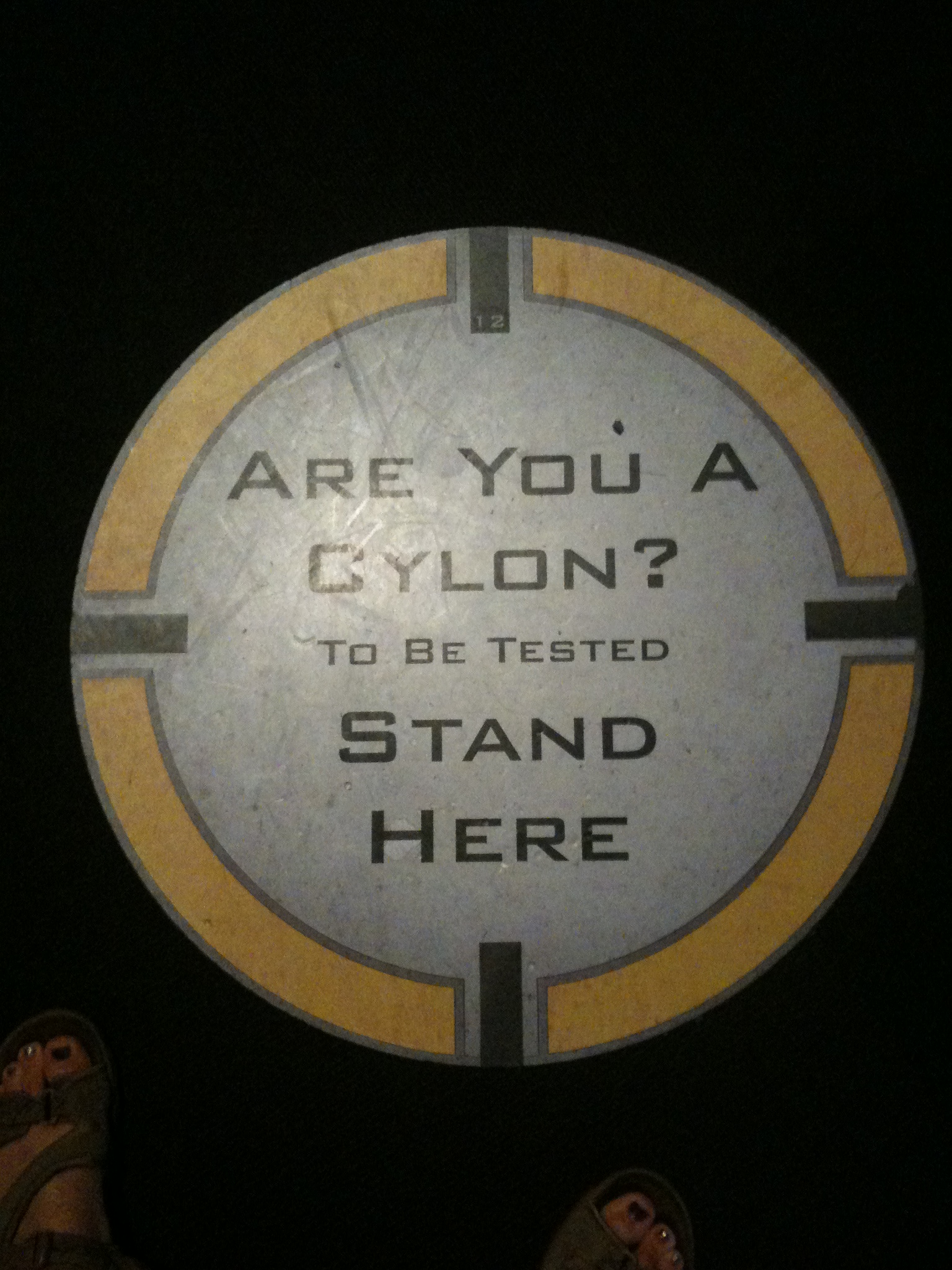
The new term is starting and I am not going to feel guilty that my to-do list is long, as I chip away at it. But, my job’s priority is teaching and I promise to not phone that in, as students do not appreciate that. When they come to class, ready to discuss the readings, they want me there ready to teach and facilitate. I am ready. Oh, and I am not a Cylon. I am human and have to remember this…I am not a machine. Well, my daughter says, “How do you know? You could be a sleeper agent.” I am going to assume that I am not a Cylon.

IMG_1569

I took the above photo at the EMP in Seattle, Washington. It was part of a Battlestar Galactica exhibit. So say we all!

Thinking Like a Student

I was lucky enough to participate in a university photo shoot for national recruitment brochures. I had an opportunity to chat with the student “models” during the mock office hours and mock classroom lecture. One of the things that I was struck with was that the students wanted to know what made a student a favorite of mine. I was polite and tried to explain that I do not really think of my students that way. Instead, I think about how I want students to be successful and learn. I really did not understand the question at first. Then, it hit me, they wanted to know what do I like in a student.

I appreciate it when a student is prepared, on time, demonstrates familiarity with the course materials, and current events. I appreciate it when a student is trying and seems to care about doing well for the sake of learning the material or more about Political Science. Do I have favorites, though? I thought about this over the course of the next week, and my first reaction was: no. I still think that I do not have favorites.I have had students announce that he is my favorite student, and usually that student is not. I am not sure why he (the student has usually been a male student) has pronounced this. I have responded with, “I don’t have favorites.” Admittedly, this sort of student is usually a well-meaning, class clown type and is usually poking fun at both of us. I’m OK with this.

I have students who I get to know better by virtue of them taking more courses with me, my honors students, and then the students who I am mentoring in a stronger capacity thanks to office hours, and additional chats. Then, there are the students who have different issues: crises, help navigating support on campus or other issues, and I get to know them better. I think that the students that I know better are the ones who I light up when I see and these students are not favorites, but students who I merely know better. To answer the question: No I do not have favorites. I have students who I know better for various reasons. I do think, though, that the students who have had special circumstances have a special place in my mind, though. They have overcome some hardship and their success means something different to me. These are the students who make me want to tear up in happiness or even anger when things do not go their way. But, this does not make them favorites. Like I said, I do not completely understand the question. I would frame it differently. What makes a student stand out? What type of students do I prefer? Those are questions that make more sense to me, but I do not think like a student. I am on the other side of the table, desk, and classroom.

20130816-125148.jpg

20130816-125248.jpg

Lean In Keynote: Blog Her 13

I am at Blog Her 13 in Chicago and this morning attended Sheryl Sandberg’s keynote and then attended the Lean In Circle workshop. Where to start. The keynote was more of a discussion between Lisa Stone, Blog Her, and Sheryl Sandberg, Facebook COO. Sandberg was on the floor taking photos with delegates, signing books, and just meeting people. I had a chance to take a photo and talk to her for a few precious minutes about her book, Lean In. She was gracious with the crowd and was eventually pulled away for the keynote. As I waited in line for my moment with her, I was reminded of my Comic-Con experiences and felt like a fan girl.

Her keynote hit on the points outlined in the book and Stone asked some great questions. She also shared that the Blog Her Visionaries survey was filled out quickly within hours. I am one of these people and was happy to fill out the short survey about the book and movement. What I enjoyed most was how honest Sandberg came across. On the table sat some Lean In branded sheets to write down what you would do if you were not afraid. Sandberg shared her’s: Write a book about feminism. Yes, you read that correctly. She also seemed comfortable with embracing the term, feminism. It is clear that she is a strong advocate for women and men and their success. She made a point to share that some male executives have told her, “You have cost me lots of money.” Why? Because women are asking for raises!

I have previously blogged about her book and the movement. I am registered with the Lean In site and in an Education circle. I will blog later about the Lean In Circle workshop. It was amazing and I am still processing it. I have a page of notes to mull over, as I think about my workshop experience. Overall, I was glad that I woke up early to get a rock star seat at the keynote. And, I got to finally meet Veronica Arreola, Professional Feminist! We had a good chat about the book, too.

20130727-145846.jpg

20130727-145910.jpg

At BlogHer 13

I’m enjoying my second Blog Her. This year’s event is at Chicago, and thus far I’ve been able to enjoy the sights of the city. I walked around for almost two hours yesterday and then participated in the Blog Her 5K today and saw more of the city. I’ve been here before, so it’s great to be back in the Windy City. I’m quite happy to share that I’ve met some other bloggers, who I have first met on Twitter! It’s nice to have the real face to the Twitter handle or blog URL.

I also find it instructive to be surrounded with other people who get social media. This conference is clearly focused on blogging, but many are on multiple social media platforms. It is also comforting to see such a diverse crowd in terms of race and ethnicity. There are clearly lots of so-called Mommy Bloggers and today’s opening keynote definitely spoke to that niche; however, there are other types of bloggers here who self-identify as writers, style bloggers, and have walked away from the Mommy title. To be clear, I am a mom of two kids and I have nothing against mommy bloggers. I do not self identify as such.

The exhibit has been fun. I have only walked through half of it and appreciate the ways in which the vendors can just scan my registration barcode. However, I imagine that my friends who write about security would smirk about the high level of data mining. I actually walked away from the AT&T vendor, when they wanted my cell number. My email and name was not enough to fill out the form. I smiled and said, “No, thank you.” Don’t get me wrong, I like the free swag and have a bag filled with freebies, but I draw the line at sharing my cell number. I do not like getting calls/texts from businesses on my work land line or cell number.

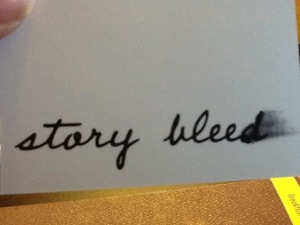
This is my first of a few posts about Blog Her 13. I was comforted to hear the Blog Her team discuss numbers and trends about blogging and their website. Blogging and social media is here to stay and not some passing fad. I’d like a shirt with that sentence! The Blog Her team is doing a great job. I am including a screen shot of my favorite business card, so far. I met the founder Meghan Jordan at the Peoples Party last night.

20130726-110423.jpg