
Parenting, Community Building, and Email

I never thought I’d post about something as mundane as trying to get birthday invites to my elementary aged daughter’s friends. Previously she was enrolled at a private school and not only did we have an online family directory, but we also had class representatives who collated a parents’ email, address, and phone list. This made birthday or play date invites extremely easy. This also allowed for socializing among the families–yes, for community building and did so in a way that many of us appreciated. We could email and connect or choose to call and coordinate.

I have booked my daughter’s birthday party and given that she’s two months into a new public school I thought that I should find out what the protocol is for birthday invites. Actually, I walked into the office assuming that I would get the contact information for the classroom parents or an email for the class representative. Well, I could not even get the teacher’s email. Nope. This violates privacy laws in the province, allegedly. No information about the child can be disseminated via email. Whether or not this is true is not my bone of contention. The fact that in 2013 I could not get the work email for my child’s teacher was absolutely ridiculous. I was politely told that my daughter can distribute the invites at lunch or recess. This is a great exercise for kids to see who is invited and not invited. Big sigh. The e-vites allows for no paper waste.

The staff suggested that I speak with the teacher to see what she prefers. So, off we trundled down the hall. I spoke with the teacher and she would not give her email. She asked if I could just come in. I explained that I am always near a device, so that email is convenient. I received another polite smile and was told that she’s happy to meet with me prior to school. I’ll have to be happy with that. Apparently, she does not check her email often–and that’s fine. But, I’m still shocked. I inquired about the birthday invites and was again informed that my daughter will need to hand them out during recess or lunch.

I might sound like one of those self-entitled parents who demands that the system works her way, but I’m not sure if that is the case here. My concern is three-fold: ease of communication, access to information (emails) to set up play dates or arrange a pick up swap, and understanding that it’s 2013 and technology is pervasive. So, slap my rear and call me Betsy, because I was shocked with my findings today. Seriously, I have to go old school and have my kiddo pass out invites. This also means that I have to meet the other parents so that we can actually become part of this new community. I have some “let’s arrange a play date” note cards that I can finally use. The good news is that I’m going to be more outgoing at drop off and pick up to meet other parents. I’ll roll with it.

My second to last concern is that the kiddo is not inviting the entire class, so the chances are that some kid will have her or his feelings hurt. We have a set limit for the party and we are inviting a mix of kids from the old school and new school. Thankfully, I can use an e-vite for the kids from the old school. Regarding the hurt feelings, well that’s part of growing up–I know. I will have a chat with the kiddo about how to do this as discreetly as possible. And, my last concern, I’m still troubled by the fact that the nuclear codes were not made available to me as a parent– I don’t have the teacher’s email address. An email address is something so basic in my world as an educator. But, then again, maybe the teacher is drawing boundaries and really prefers only face to face interaction. At this point in time, I’m expressing my surprise via the blog post, but I’m not about to write the school board. This is not official complaint worthy. Thoughts?

Adding–of course–I googled the teacher. Her email was not found and she is off the grid. Boundaries, time management or teaching philosophy…
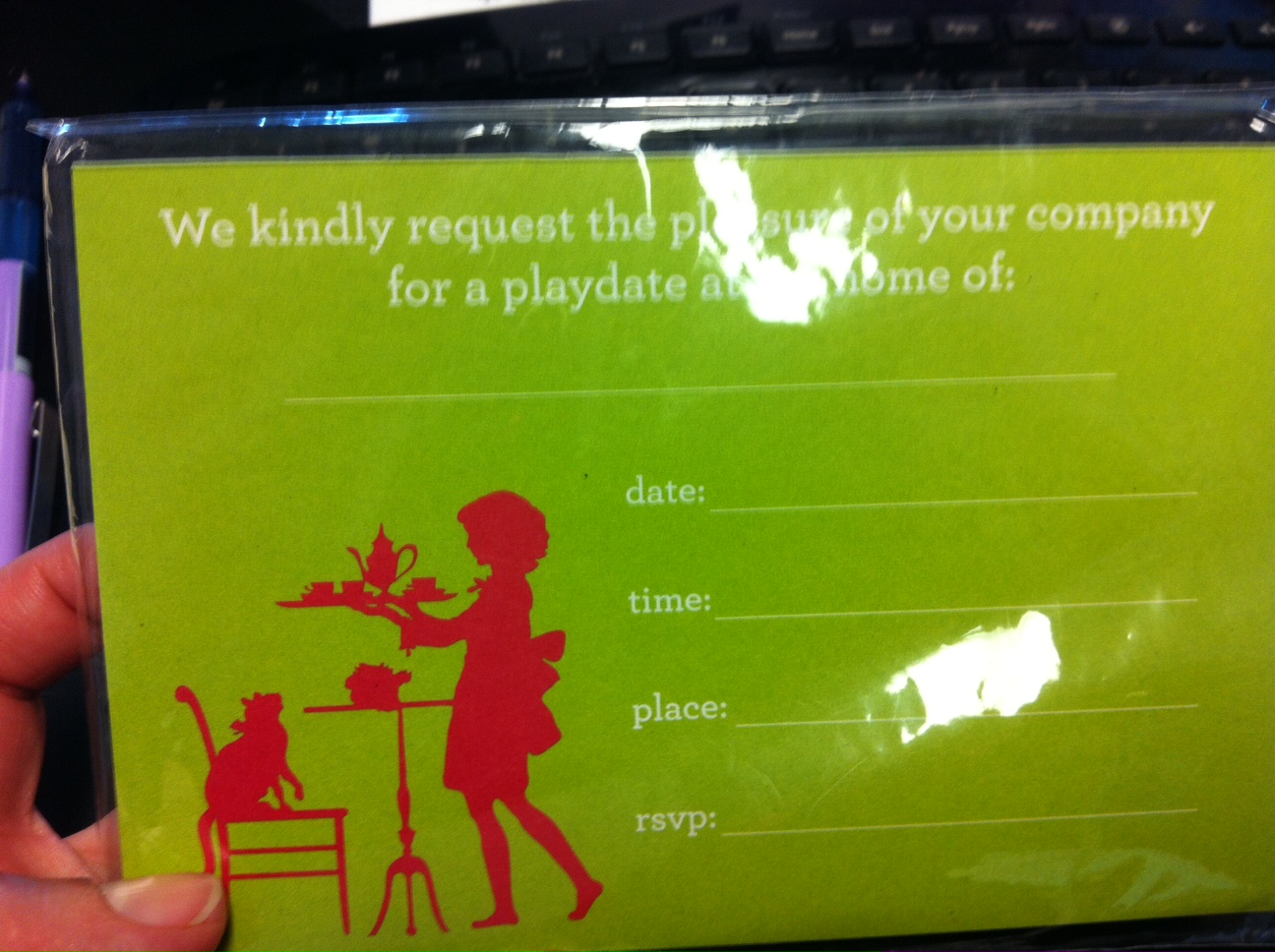
playdate image

Boundaries: Hard for This Workaholic

I’m always very honest in my blog posts and I have to admit that I don’t like seeing email in my queue. I try to get to the emails as quickly as possible. And, I don’t like seeing several hundred emails on Monday mornings. This means that I do respond to work emails during the weekend. Now, I don’t respond to all of them, as I will flag some noting that they are higher priority come Monday and then others I will respond to in a timely (immediately through the next 24 hours) manner. I have now taken to responding to some student emails and stating that I will get to their email (answer their query) on Monday and also state, “It’s the weekend, I hope that you enjoy it.”

I know that I’ll hear from people who swear that they don’t respond to students’ emails over the weekend or that no one at their campus does. Cue Bill Cosby acting like Noah and saying, “Riiiight” at the 58 second mark or 1.17.  It’s not that I don’t believe these people–it’s just that my reality is that if I don’t respond in about 24 hours, I hear repeatedly from the student. I rather say that I got the email and will attend to it. I also will make a point of responding to all emails when an assignment is due the next Monday. It’s the nature of my job and the students who I work with in the department. I also am responsible for this access, I know. Some will tweet me or Facebook message me. I am a heavy user of social media and this is one cost–access to me and my time. I am not going to complain, but I will try to have some work life balance.

I am trying to set a good example for my kids, co-workers, and the Teaching Assistants who report to me. I explain to my team of Teaching Assistants that they also do not have to respond to emails from students over the weekend and not from me, too. I ask them to act as if the email (if one gets sent during the weekend) arrived Monday morning and respond thereafter. I want them to see me encourage boundaries. This takes hard work, but I have to say that during the last year it’s been worth it. I’m protecting my schedule more and I feel happier. I still love my job, and look forward to walking into the classroom, office hours, and other teaching related events. I’m loathe to say that I love meetings, as that’s a lie. I like some meetings and do not look forward to others! How do you deal with your email queue?

UVIC Next? Salary Study

I don’t normally share my emails, but this one is worth doing so.

Dear Colleagues: After the UBC Gender Salary Correction went live on January 21st, I heard from many of you. Then the Globe and Mail covered the issue and noted how women faculty were being “given” a raise. I have some good news to share. On January 25th, I was told that the Administration and Faculty Association had signed a Letter of Agreement (LOA). The LOA notes that the Administration and Faculty Association will investigate gender salary issues at UVIC. This LOA was signed on June 29, 2012. Since I am not part of the Faculty Association’s Negotiating Team, I was not privy to this LOA.

At first you can imagine my frustration finding out six months after the fact. After I had invited a UBC colleague to share their story, and then after spending an all day meeting in Vancouver strategizing with our sister Chairs. However, I realize that this was privileged information and that by having presentations, meetings, and discussion this was a good thing. It kept our membership thinking about what we need to do and our Administration was paying attention to this work. Now, we know that the Administration is going to work with our Faculty Association. The UBC Report through correction took four years. I hope that it doesn’t take as long at UVIC.

There will be a committee including Administration reps, Faculty Association reps, and an AWC rep. The AWC Steering Committee will meet later this month to discuss this issue as well as other ongoing events. This is a sign of good faith from the Administration. I urge us to celebrate this move forward, but to be cautiously optimistic.

Please take a look at our colleague, Richard Pickard’s, blog post about this matter at:

http://notstrategic.blogspot.ca/2013/02/gendered-salary-inequities.html

Richard notes that he is not speaking for the Faculty Association’s Negotiating Team. Also, generally speaking it’s worth taking a look around his other posts.

Hope to see you at next week’s Faculty Association meeting–for the special Valentine’s Meeting! Thursday, February 14 at 3:00pm in Social Sciences and Mathematics Room 102.

~~~~~~

Within minutes of sending the above email I have had numerous positive emails. Thank you! This is not going to be an easy process. But, let’s move forward in good faith.

Reminder: Breathe

Mid-terms are about to begin and I’ve been struck with a few things. I can announce things in class, send messages via our on-line learning platform, hold office hours, and attempt to hold G+ Hangout office hours. But, there are those moments when students just do not pay attention. It’s not yet important, as the assignment or exam is weeks away. Then, snap, suddenly everyone needs me. I had to remind myself of a few things in the last week.

1. Keep the hockey schedule in mind. Some of my students are avid hockey fans and my office hours cannot conflict with the game.

2. Remember that instructors need to remind students. They are taking three to five other courses and have multiple deadlines and are juggling so much. The majority will need the reminder. Move on.

3. Be more patient around this time of the term. Students will appreciate the patience and the last thing they want is for you to chastise them. Really–do I need to put any emotional energy in chastising students? No. I have other places to expend my energy.

4. Related to the previous point, I need to also be more available the week of the mid-term. I am also juggling multiple projects, but my first job is teaching and I know that this week my students need me.

This short  post really serves as a reminder to me–patience, compassion, and support. These are the three things that I must have this week. Wishing all students good luck on their mid-terms. And, sending an extra deep cleansing breath to other instructors, mentors, and ancillary staff who work with students. Ommmm!

These post its work for this week!

These post its work for this week!

Honesty Redux

This post just ran on UVenus and Inside Higher Education and I want to share it here on my personal blog. Saying that honesty is important almost feels like stating the obvious, but in practice it can be quite complicated.

A few weeks back I was chatting with a friend and she asked what my New Year’s Resolution was. I paused and thought about how I do not really believe in these sorts of things, but then realized that my resolutions are formed in late August or September, prior to a new school term starting. Last year my resolution was to continue to make mentoring my mandate. This school year my resolution was for honesty. Now, this honesty works both ways. I mean to continue to offer my honest, helpful comments to my students, mentees, and graduate students who I supervise or coach as my Teaching Assistants. But, it also means that I expect honesty.

What has this meant this last term? I have not responded to emails that crossed the line. I have set up face to face meetings with colleagues or students who sent the email to discuss the matter at hand. Life is too short to not communicate clearly and if I have the opportunity, I would rather clarify an issue face to face. This policy has worked like a charm. I have felt clarity with an honest conversation where all parties really come from a place of “I” and not “you”. I think I have to thank the Human Rights office and the two committees that I have sat on for the last year and a half for the foresight and tools to make me a better communicator and also expect the same from my students and colleagues.

In terms of my blogging and social media visibility, this has also meant that trolls exert no power or emotional energy for me. I am not saying that they took up that much space before, but now they take up zero space. I easily ignore them and move on, and this is quite freeing. I have used this place of honesty as a way to forge productive energies. I do not think that trolls are practicing honesty. No, the keyboard warrior is actually a coward. I have previously heard that I am blunt or brutally honest, and I think that these assessments have been fair. However, I do think that this resolution of honesty is different for me and my interactions with students.

I no longer circle around comments and waste time trying to not offend and choose my words ever so carefully. There are moments when you really cannot find something positive to say about a student’s work. This does not mean that I lack compassion or do not try to help my students perform well.  I offer constructive, honest comments and if this means that I state, “This is not your best work. This is sloppy work. You did not review my syllabus closely.” I will say it. I have said it. The reactions from students have varied and I know that one student thanked me profusely for my honesty. His next two assignments were stronger, and during the holidays he sent a nice thank you note. I was clear that he had not submitted his best work and that I expected more from him. I have told my mentee that I expect her to participate more in class—that she does not get a free pass—no favoritism. Guess what—she started talking more. I raised the bar, and many students responded with better work.

Sure, there was a student or two who noted something to the effect of, “I’ve never had a professor be so forward or speak to me this way.” My response was that I was sorry that no one had taken the time to be honest. I do not live my life by the students’ comments on sites about professors—see I won’t give them a shout out. I prefer to see the student do well, try harder, and graduate. I am not in the department to make friends. I am mentoring students and this includes honesty.  The year is halfway over and I will continue with my resolution of honesty. I really believe that the vast majority of my students appreciate it. Some of them might realize it a year or so later–and their cards or emails are a testament to the importance of honesty.

Word Camp Victoria 2013

I attended my third Word Camp in Victoria AKA #yyj this past weekend. It was another great event, where I learned lots about Word Press and the various functions of the platform. More importantly though, I got to see some of my students in action, as we sat on a panel together about blogging. I’m so impressed with these students and others and just want to send positive energy out there to: Renae Sinclair, Adrienne Sanders, and Alannah James. I’ve placed them in the order of our presentations. Way to go!

If you haven’t had the opportunity to attend a Word Camp, I would suggest that you do or look for a Word Press Meet up in your region. It’s good to bounce ideas off of others and to also hear about the plug ins that are tested or the favorites of the more advanced users. I’m really lucky to live in a tech saturated city–another name for Victoria is Tectoria. And, this May Social Media Camp will take place. Check it out!

Send that Email: Thank Your Mentors

It’s that time of year when students have asked their mentors for letters of reference. While you wait to hear from the graduate, medical, or law school, you need to remember to send a quick update and perhaps thank you email to your letter writers. It’s good to remember to thank the team who helped you during the application process. People who took care of you, reviewed your statement of intent, and wrote you letters of reference.

Once you hear from the programs, make sure that you let your support team (friends, family, and your mentors) know that you got in or that you will be re-applying next year. I know that I appreciate the follow up emails. Also, remember that full-time tenure track faculty usually get paid a living wage and part of our expected duties includes mentoring and writing letters. However, the majority of faculty at universities are now contingent faculty who are exploited and are not paid a living wage–let alone paid to do this extra work. Many of these hard working colleagues write letters, mentor, and go above and beyond their job description. They are teaching work horses. This doesn’t mean that I like this or endorse it, but it is the sad reality of the two-tier system in higher education. Please remember to send them a thank you card, the coffee card or box of chocolates.

Good luck with the “waiting game.”

Before You Email Your Professor: Redux 2013

This was my most popular post in 2012 with more than 600 views. Of all my posts, I didn’t expect that this was the one, but I don’t imagine that the metrics at Word Press are wrong! I have taken the liberty of revising some of this.

I haven’t taken a Netiquette 101 course recently, so I think it’s time to give some tips about sending emails to your instructors. Of course, I assume that my colleagues send concise, well-written, and respectful emails to students. Frankly, that is a given. (Fingers crossed)

1. Always assume that you should be more formal. Each department will vary; however, going with formal is easier than the reverse and then hearing: I expect to be referred to as…

2. Address the person in the email with a hello or even a “dear.” Avoid, “hey. And, use your full name, as your instructor might have many students who share your first name.

Sample~

Dear Instructor: I am emailing to find out information about your Fall class. Do you suggest any prerequisites for the class? I’d also like to talk with you about a paper topic that I have. Do you have any time to meet this Summer?

Thank you,

Student X

Avoid:

Hey, I’m going to enroll in you class. Should I be worried about your feminist bias?

Smitty

3. Never send an email that is incoherent. This is email and not a text to your best-friend. Type out all words, use punctuation, and proper spelling. What I mean is that even if you’re using your smart phone, be smart and use real words and avoid abbreviations. You could even wait to compose the email on your tablet or laptop!

4. Never send an email when you are mad. This goes for all emails. Send yourself the email and then wait a few hours or overnight, and then send the email that you won’t later regret. When you send an angry email, it is very hard to do un-do. I know that I won’t respond and I’ll call a  meeting with you to chat about your problematic email.

5. Be honest. Understand that your instructor might say that this conversation needs to take place face to face. Some conversations really need that human interaction. This really goes for talking about an assignment, reviewing a draft, talking about grad school, and other important conversations.

6. Do not be offended if the instructor corrects your use of their first name or some policy. Most of us will be kind and say–we have a 24 hour policy with emails after work is handed back and it’s in the syllabus or I expect students to call me Prof. Schmitdkins. (Apologies to my colleague who I used for part of this last name!)

7. Read the syllabus before sending the email. Perhaps the syll answers your question or notes that you should take the time to write a coherent email noting who you are and why you are emailing. And, some of my friends won’t even respond to an email if the question is answered in the syllabus. Avoid saying something like, “I don’t have time to read the syllabus, but was wondering…” Read the syllabus and if your question is not answered, then send the email.

Overall, treat email with the same integrity that you would treat an office hour visit. And, yes, I do get lots of emails that start off with “hey” and have been asked about my feminist bias…

The above advice is good for all of us–in and outside of academia.

keyboard

Happy New Year!

Happy New Year! I hope that 2013 bring you joy, happiness, and good health. What else do I hope for with this New Year. Sure, I can say world peace, a cure for Cancer and AIDS, and for the government to really take action with the Fiscal Cliff/Idle No More Movement. And, I truly do wish for all of the above, but this post will instead focus on what I hope for my students in this new year.

The 2012-13 school year is essentially halfway through and I hope that first year students learned how important time-management was during their September term. I also hope that all students realized that office hours are priceless. You might have to queue up and wait for five or fifteen minutes–but those meetings with your Teaching Assistant or Professor really is worth the wait. I have never heard a student tell me that it was a waste of time to see me or one of my Teaching Assistants. In fact, I get follow up emails, note cards, or tweets thanking me for suggesting that we meet or that they met with their Teaching Assistant. So, dear student, please take advantage of our availability!

I also send the gift of reading the syllabus to students. This means highlighting due dates and the instructions for assignments. This is a rich You Tube video about Reading the Syllabus. This made me laugh! Oh, wow. How many of us have had one of these moments?!  There is also a Facebook page about Reading the Syllabus. In all seriousness, the syllabus is the contract between the professor and the student. We expect students to read and review the syllabus.

Get into the library. Attend a workshop about research or citation. Learn how to use the databases and get outside of your Wikipedia or Google comfort zones. Learn other better ways to conduct research. The vast  majority of you are not yet skilled at researching and could use a workshop or two to hone these skills. The A students are the ones who have taken the time to use databases and dig deeper. Do not be embarrassed -go speak to the Reference Librarians and your academic mind will be blown.

My last wish for 2013 is that students stay healthy and this includes their physical well-being and mental health. I feel terrible when a student gets hit with a serious illness that turns their term upside down. I also feel for the student who is dealing with mental health issues and is having a really difficult time. I am not a medical doctor and I certainly am not a mental health professional, so all I can do is be supportive and suggest the health center or the counseling center. Remember, when you’re having a tough time, don’t be embarrassed -contact your professor. We are here to help and it’s much better if we are in the loop.

Happy New Year!

janni 2012