Working in Man’s World: #Breatheyyj

It’s OK to be a Woman in a Man’s World! #Breatheyyj Really looking forward to this preso! Participants are: Marisa Goodwin @organicfoodme Anya Sereda @tinybean and Katie McDonald. What a great panel of woman who are working in male dominated fields. I just want to add that a great majority of the #BreatheNow meetings were held at Discovery Coffee, which Anya Sereda works for as their Green Bean Sourceress!

Sereda speaks to the coffee industry and refers to the baristas–the boys–as the show ponies, while the women are more apt to manage! It’s really interesting to hear about how so many coffee farms owned by women in the countries that she’s visited, but men run the farms. Interesting. I love that she admits to looking young. She’s 26 and looks like she’s 20. (Her words). She has a passion for beans, for coffee. And, after listening to her preso, she really knows coffee!

“Coffee has really taken me on a trip all around the world.” Anya Sereda

Her job sounds amazing. Out in the field doing her work… She noticed the ways that some people have treated her due to the issue of her youth and gender. She acknowledges her strengths and knowledge in the field and how it can at times be difficult for people to take her seriously. Happy sigh that my teen is here listening to this and hope it’s insightful to her and the rest of us in the audience.

The next speaker, Marissa Goodwin, reflected on her experience with her business Organicfair and the farm that she and her family run! She shared compelling stories about the level of sexism within the industry. We have more work to do! Looking at her bio it’s nice to see that their company includes 99% women employees. They are making change day to day in their work and their philosophy. Organicfair is based in Cobble Hill not too far from the Greater Victoria Region. Overall, Goodwin is another trailblazer! You, go!

The last speaker Katie McDonald is a mixologist who works at Veneto Tapa Lounge in Hotel Rialto. She has avoided thinking about being female in her career. She knows it’s there. “This elephant in the room.” I have to say that this is really common with lots of women—ignoring gender. But, she notes that we do need to think about gender. I like that she brought up equality and difference. Oh, those debates have not been resolved years later. Really? Some men call themselves, “Cocktailologist.” OK. She says that she’s a Mixologist or Bartender.

“It’s a dirty job. Lots of heavy lifting.” Katie McDonald

Interesting that for every one resume from a woman they field twenty resumes from men. And, this quote below also speaks to another binary in the job or industry. These quotes are telling. I’ll say it again and again: we have more work to do.

“If I’m the best female bartender on the line…you don’t have to compete with me.” Katie McDonald

She’s right, it’s an idealist view if we insist on saying that we’re all just people. This erases different components of identity. I do think that at times when people say this they are coming from a place of privilege and do not think that any difference exist at all. Again, this is in some instances and not meant as a sweeping generalization. And, McDonald notes that she wants to be just another Bartender and not the fact that she’s the “best woman bartender on the island.” On the flip side, she likes seeing women at competitions so that more women can/will attend these competitions. She’s sharing some honest, good points in her preso. I’m really enjoying the frank anecdotes.

“I do notice my gender.” Katie McDonald
Rona Manynard Rocking it at Breathe Now

I’m sharing my almost live tweets about Rona Maynard’s keynote today at #Breatheyyj. @ronamaynard Wow, great preso. Any keynote coach would say: Brava! #Breatheyyj Thinking about her comments about resentment. She grew up in alcoholic household, but on the outside everything looked fine. Maynard knew that she wanted more–a different type of life. Trailblazer.

She was part of the generation who was trying to do it all. Remember she was the Editor in Chief of Chatelaine. But, it was hard to do it all–hard to keep balance. Lots of head nodding in the room, as she shared these points. We think we have to be Super Women. This can be an issue in a hostile work environment. We will burnout. We will get sick or worse. Maynard left one job and worked at home and slipped into a depression. “With trembling fingers I made the call to a women’s mental health clinic.” I’m glad that she’s sharing this story with us today. We need to get rid of the stigma about mental illness, as it is so common.

“Say no to unreasonable demands.” Rona Maynard

This is really hard to do. People expect us to say yes. Oh, this is important to me right now. I’ve recently said no to a few things and stood my ground much to the surprise of those around me. I said no to protect myself and my integrity and refused to get bullied. Back to Maynard, I really want to read her book, My Mother’s Daughter: A Memoir. I want to read her life story, as I think I have something to learn from her.

“Saying no is not about fighting with people.” Rona Maynard

Her preso is reminding me that I’m not alone in parenting a teen. You do have to pick your battles. You do have to call a truce on certain issues with your teen. Boom. Thinking maybe a family meeting is in order to chat about things. Maynard’s speech is making me think of so many things.

“40 is a magical age for women.” Rona Maynard

Maynard shared that her articles led women to write her letters. She was motivating them. It’s refreshing to hear that she made a difference in so many women’s lives. I am impressed. What a perfect fit for @BreatheNow. I am so proud of the team of co-founders, sponsors, and volunteers in making this possible. This is our little slice of community building in Victoria #yyj.

“My gift is building community through stories…” Rona Maynard

I really love her comments about resentment. Makes me think of the resentment olympics. It’s important to protect your time, so that you don’t feel resentful. You need to keep the well-spring full. We need certain mantras to stay happy. It’s work. Can’t say, “Accio balance. Accio happiness.” You have to work on it and keep your boundaries in order to do it. And, I will be honest, I do keep the positive emails and when I need to–I will review them. It’s grounding after a tough day.

Thank you, Rona for giving me food for thought.

Anti-Bullying Workshop: Part 2

I previously blogged about an Anti-Bullying held on March 31st, 2012 that I attended in San Diego. The workshop was sponsored by Voices of Women and was for the local Somali community. The latter half of the panel included a community member and the local Police. The first presenter was Ramla Sahid, community organizer. Yes, I smiled when I heard this descriptor and after hearing her presentation I was so impressed. Did I share that she’s also a SDSU alum?! Yes, she is. This young woman is working for social change. “We are accountable to one another.” Hearing her say this was important. She was reminding the mothers and daughters in attendance. Yes, the audience was predominantly sex segregated and I will speak to this later.  She also gave a polite yet scathing commentary on how the tough on crime legislation and policies in California were counter-productive.

The other speakers were two police officers: one Lieutenant and one Detective. I am not using their names–both of them work in the community and I will leave it at that. The two really spoke to the intricacies of the laws regarding bullying and harassment. There were a few moments when I wondered if the presentation was right for this audience, but nonetheless their presentation was good. I also was at times fascinated by their guns. The guns looked out of place–I know that they were on duty, but after years in Canada I am not as used to seeing lots of guns around. (Humor). The officers noted that if bullying begins in primary school it only worsens in junior high and high school, so it’s important that we respond.

“Respect is universal.” Lots of head nodded when the Lieutenant made this statement. Farah noted that we need to get the men involved and that they need men only workshops. I am not sure if I agree, but then again I am not taking into the cultural considerations. Perhaps he is on to something and these male only workshops can also speak to the importance of fatherhood. More workshops is definitely something work thinking of given the proliferation of bullying and need to curb it in schools.

When the question and answer period took place Agin Shaheed noted that we must get the fathers involved. There were only mothers in attendance. He also noted that across the US 87% of teachers are women. (Is this why we keep on hearing the press and experts pick on teachers? Is there bullying against teachers because this is still viewed as women’s work? Maybe that is another post).

Anti-Bullying Workshop: Part 1

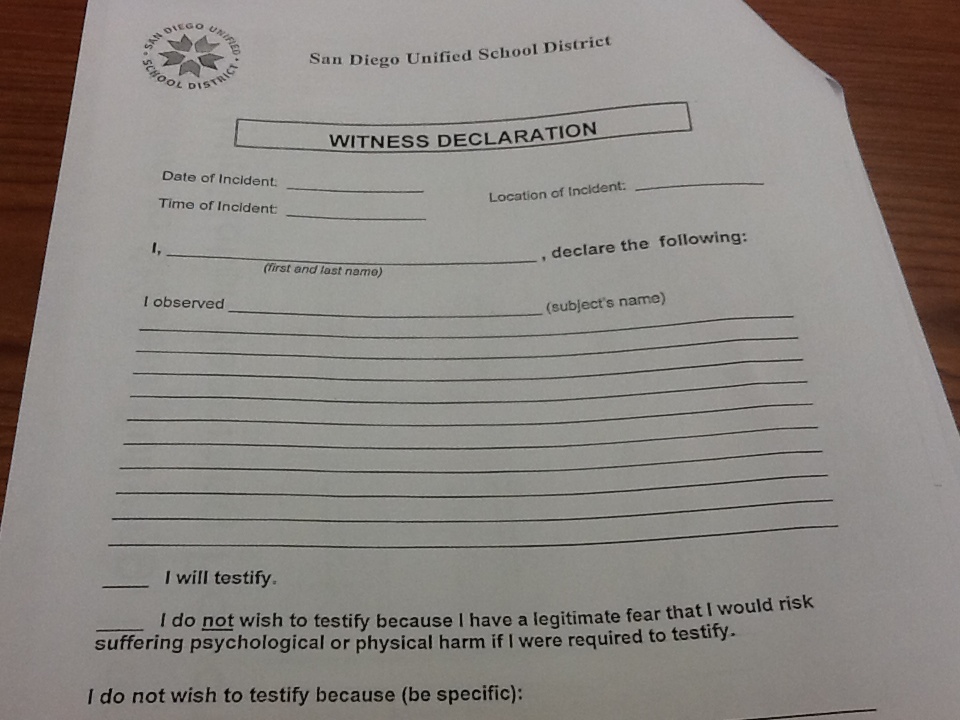
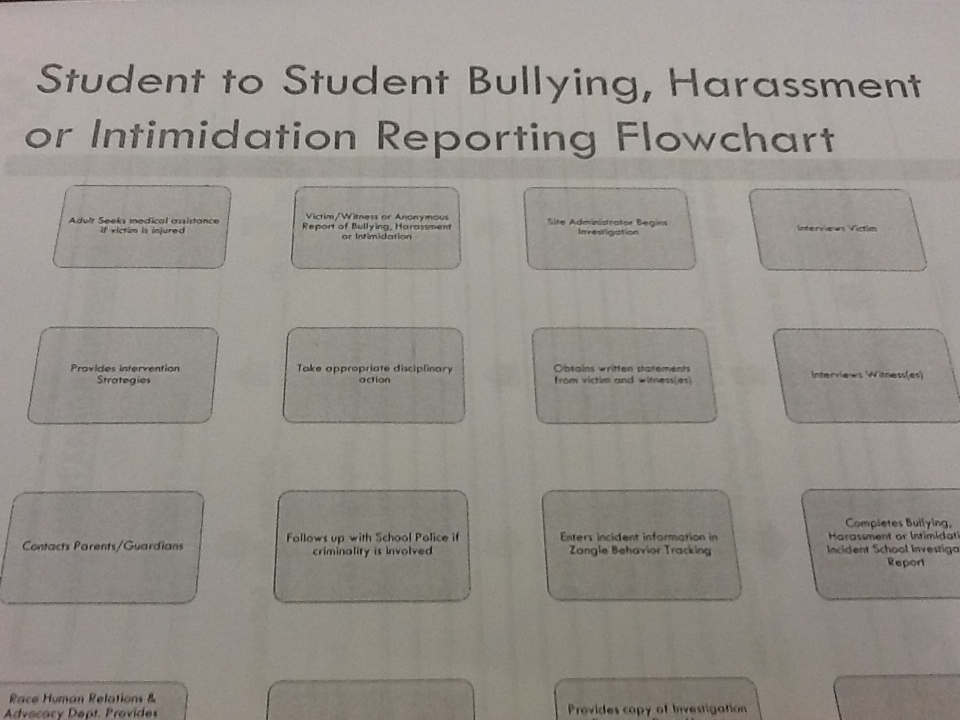
I had the distinct pleasure of the Voices of Women’s (VOW) Anti-Bullying workshop in San Diego, California on March 31st 2012. VOW collaborated with the United Women of East Africa for this workshop. I was quite pleased to be in the minority in the crowd. The majority of the attendees were women from the Somali community in City Heights neighborhood in San Diego. The array of panelists provided insight into the policies and realities of anti-bullying today in San Diego and more specifically the San Diego Unified School District (SDUSD). The array of handouts that SDUSD uses with documenting bullying and the anti-bullying efforts impressed me. I kept multiple copies so that I could share them at home. And, here I include my screen shots.

The first speaker, Agin Shaheed, is an administrator with the SDUSD. His exact position focuses on Race Relations. I couldn’t help but think that his job must be incredibly rewarding and exhausting. Shaheed noted that the SDUSD is the largest school district in San Diego County and second largest in the state. This would make it behind the Los Angeles Unified School District (LAUSD). Shaheed opened up his remarks reading a moving poem he wrote. He reminded the audience of 50 about the murders of Shaima and Trayvon. I was glad I packed my tissues. Shaheed made a germane point about cyberbullying and the way it invades the home–it makes this form of bullying more invasive. Victims of cyberbullying are not safe anywhere.

The next speaker Maslah Farah, Director of the Neighborhood Unity Foundation shared that he was bullied and got into trouble while he was in school. He shared that the bullying stays with you for the rest of your life. He also opened up my eyes to how important cultural issues are. He noted that in Somalia families really look to the teachers as a second parent and that corporal punishment is more common in the schools or other forms of discipline that are not allowed here. (I could hear some warm laughter as he noted this). What I took from his talk is that he was kicked out of high school and is now successful and using his community work to mentor others in the community. He reminded us that we need to move away from a mainstream culture that enjoys witnessing misery.

This portion of workshop really made me think about the ways that we think about bullying. I also wondered what sorts of policy the local schools in Victoria (where I live) have regarding bullying. We can talk until we’re blue in the face about how bullying is bad, and that kids should not do it. But, until we practice this and don’t encourage bullying among adults we unfortunately model bad behavior. Just turn on some reality television shows and we can see and hear bullying. Look at some of the news magazine shows and we can also see the bullying nature by the hosts. We live in a society where bullying is rampant. Not to seem trite–but we  need to model better behavior.

Katniss Rocks

Before Reality TV was reality tv, Stephen King wrote about it giving readers pause about a cold-hearted dystopic future where people would watch poor people fight until the death (Running Man). The contestants wanted to make money and were paired against professional athletes and killers. They didn’t exactly fight, as much as attempt to survive.

Move forward a few decades to the Hunger Games by Suzanne Collins and we have a dystopic society where the totalitarian government has an annual Hunger Games that requires 12 Districts to offer a pair of Tributes to participate in a fight to the death. The one major difference–these Tributes are 12-18 years old. Yes, you read that right. Youth are fighting against one another in hope of being the surviving Tribute so that they can have an easier life after the fact—if they win.

The competition takes place in a controlled environment where the Gamekeeper and his staff can change the light, the weather, start fires, and even add interesting predators to the game. What is interesting to see here is how the more wealthy districts view the games as a moment of entertainment and not a matter of life and death for the contestants. They are amused by the games and this amusement says so much to the reader or person sitting in the cinema.

The protagonist, Katniss Everdeen, volunteers, after she is shocked to hear her 12 year old sister, Prim’s, name called. The movie stays relatively close to the book and is entertaining. I was lucky enough to sit in a sold out theater with an eager audience. Katniss clearly was at odds with how she had to play the game–to make herself desirable to the viewers. You see, the viewers can sponsor and give the Tributes gifts–medicine, food, or other necessities. The movie kept up the anxiety in all the crucial areas thanks to good direction and solid performances by the various actors. The movie was fabulous and I look forward to seeing it again. The movie offers commentary on politics, violence, class, gender, and what constitutes entertainment. Kissing my three middle fingers and raising them in the air for this first installment. I look forward to seeing Catching Fire and Mockingjay in the theater.

I noticed that the midnight line up included a handful of people dressed up as characters from the books. I did have a conversation after the movie regarding the pageantry of Reality TV. My friend said, “Well, I’m going to think more about watching American Idol.” Now, that show is not about the fight to the death, but the whole notion of the sponsorship and pageantry really does make you think. Let’s hope the odds are ever in your favor!

I want to thank Toshiba Canada for the tickets to the preview.

Remembering to Breathe

On Saturday, March 17th I had the distinct pleasure of participating in a Mom panel on Real Parenting with Shirley Broback and two of the three co-founders and organizers of Breathe Now. The interview was focused on parenting tweens and teens and what this means for us. It was a great interview and I was reminded how almost two years ago we decided that we wanted to organize a conference for women.

The idea was that we have all attended work-related conferences, mom conferences, and social media conferences, but we did not feel like there was a conference dedicated to the three in such a way that also dealt with issues unique to women. And, as I noted on Real Parenting the fateful meeting at Murchie’s was when we came up with the name, Breathe Now. We wanted to remind women that it’s important to inhale, exhale and breathe. We need to be nice to one another and more importantly to ourselves.

My involvement with Breathe Now has offered me opportunity to get to know the other three co-founders well. And, with that I’ve also met so many wonderful people in the local community. We see the conference as part of our project to build connections for women. We run the gamut, though, with a former government worker–turned personal chef, communications consultant, a hotel industry executive, and an academic. What we share with this conference is an acknowledgement of the importance of women supporting one another. There is so much knowledge that we can share with one another–but the only way this will be done is by taking the time to talk and chat.

Breathe Now offers a weekend of events that is sure to inspire. We are proud that Rona Maynard is our opening keynote and Bif Naked is our closing keynote. The array of our panels reminds women that it is OK to take time for yourself. We are also setting up our slate of panels to look at the theme of It’s OK.  For instance, it’s OK to take time out for yourself, it’s OK to be successful…this theme is important, as women often apologize for taking time out for themselves or for their success.

I’ll end saying that I hope to see you at the conference on April 14 and 15 2012 at the beautiful University of Victoria!

Young Adult Lit in the College Classroom and Beyond

I was looking forward to an article in the paper about Yong Adult (YALit) and was disappointed that it really didn’t offer anything new. I’ve been reading YALit for years, as  a matter of fact probably before it was given the moniker. I think it’s filled with theory, politics, messages, and more than just entertainment. It is literature.

Young Adult  (YA) Literature as a genre is not new; however, its popularity has sustained the weakening publishing market. The  YA genre has kept many a publisher in the black, as the genre has a wide crossover appeal. Frankly, we have witnessed the genre balloon during the last ten years. Many have thanked J.K. Rowling and her Harry Potter Series for this. I thank her for the great series and more. And, I look forward to her next project.

I never really stopped reading YA lit. I think I dove into the genre more so once my eldest daughter became interested in the genre. Here my interest was really two-fold: my love of reading and want to discuss literature with her. Win-win. However, as an educator I have to say that I have found YA lit useful in the classroom. The genre has politics, gender, class, race, sexuality, nation, democracy and more discussed within its pages. And, the students really enjoy re-reading a book with a different theoretical lens. I have also had a chance to meet new people online and in real life (IRL) and have had great conversations about YA lit.

In my Women’s Studies and Political Science courses, I have actually offered a paper option that required students to read pre-approved YA Lit books and discuss course concepts in the books. Depending on the class, these assignments have been popular. The best part for me is the assessment of the assignment and reading how a student has reassessed a much-loved book in a different fashion and has a different feel for the book.

I have also spoken at Political Science conferences and in my local community about YALit and politics. I am repeatedly energized by the positive reception by colleagues and youth. People are reading YALit and noting the messages, politics, feminisms, and more. My fascination with dystopic YALit is not unique and I have had animated discussions with middle school students and high schoolers about protagonists we like or the way in which Lord of the Flies is germinal to many a plot. Connecting over books never gets old.

How cool is that?

Parts of this post ran in Oct 2010 I was compelled to revisit it based on the article about YALit being a new thing.

Continuing the Conversation about Guilt: Academics on Academia

I’ve enjoyed my conversations with Liana Silva. Her last post really touched me and troubled me. I was not frustrated with Liana, but with the truths she spoke about the ways in which academics allow the constant blurring of our work and personal lives. She made me look into the mirror and think about my work and the infamous to do lists that I keep. I spent all last week thinking about guilt. The guilty way I feel when I think about my day and the constant struggle to get all the tasks completed.

There is always a paper to write, assignments to grade, lectures to work on and other work. Then, add to that projects, publications, and service in the department, faculty and wider campus. The reality is that most academics do not work a 40 hour work week. No, we work easily work 50-60 and during the crunch periods more than this. And, this doesn’t include all the time responding to emails or thinking about the job. Alas, we do not get to bill by the fifteen minute increments!

Continue reading

Academics on Academia: Supportive Networks

I sat on Liana’s last post thinking about how important support networks were to me during the various phases of my academic career thus far: undergraduate, new graduate student in Liberal Arts, new graduate student in Political Science, ABD in Political Science, Adjunct, Sessional, and now tenure-track faculty. Support networks never go out of style. They serve an important role helping the academic traverse through the morass of academia. There are multiple reasons why we have legions of ABDs. One major reason, in my opinion, is the lack of supportive networks or people in the student’s life. This includes personal life and professional life.

It’s important to remember that we need camaraderie, mentorship, and support. I have previously shared how lucky I was to be a member of a woman’s academic support group. This group made me realize that I would have to find support networks in Political Science. And, like Liana previously blogged, I had to get outside of my comfort zone and network. This meant attending conferences (debt) and making connections. Then, at the next conference people recognized me and things and I became part of the academic community.

You can’t snap your fingers and have a network of people who are your academic posse. You have to cultivate it and I would argue that you have to have multiple networks to keep sane in this game. There is so much competition and you are rife to have moments of self-doubt, you networks will keep you grounded and focused. Likewise, you need to have supportive networks outside of academe. Gasp. This means you need to try to have a rounded laugh. Oh, stop laughing or smirking. It’s true. You need to take time for yourself, too. This seems antithetical to academe, but it’s important to take care of you!

How do you find the seedlings for supportive networks? One place is via social media. You might find that the professional organization related to your field(s) is the first place to start, but don’t stop there. Look on Facebook, Twitter, Linked In and blogs, too. Don’t think that the conferences are the only place to connect with like minded people in your field. See if you can make some early connections via social media sites and then meet up IRL at the conferences. The time investment in meeting people is worth it. Academic communities are incestuous at times and everyone in your discipline knows someone else. This can work to your favor when you’re applying for scholarships, post-docs, and jobs. It can also work to your disadvantage if you’ve been foolish or have burned a bridge via bad behaviour. So, always be professional and collegial.

When you’re at the conferences, business meetings for the sections or groups that you’re interested are worth attending. This is if they are open to the general membership. Find a friendly face and sit near them or hover and listen and learn. You have to make the effort to reach out and hopefully someone will see this and connect with you. Good luck as you look for supportive networks and as you build them, too.

Academics on Academia: We Belong

I am happy to have ongoing conversations about higher education with my friend and colleague Liana Silva. Our first one is really about that sense of belonging or fitting in academe. Reading Liana’s  piece reminds me of my experience as an undergraduate and then later as a graduate student. I was a first generation college student, who graduated with strong grades from high school. I took the array of Honor’s and Advanced Placement courses during high school and participated in sports and other activities.

But, nothing prepared me for the other side of the university experience–the culture of academe. Everyone assumed that I had money, since I was in university. I don’t know where this came from and I certainly was not going away for Spring Breaks or Summer vacations. Add to this that as a Latina, I noticed that suddenly I represented the “woman of color” in class and the expectations in the classroom varied among my different professors. I was at an institution with a good number of Latinas/os, but not enough to be more than a small minority. When I began to entertain graduate school the process seemed alien. I was fortunate to connect with Graduate Women Scholars of Southern California. It was in Scallops (slip of the tongue by our faculty advisor who hailed from Boston. She meant to say Scholar and Scallops slipped out and it stuck) that I learned about how things worked in academe. This peer mentoring group was one of the best things that happened to me during the last year of my undergrad, as it made the transition into grad school that much easier.

After I earned an MA in Liberal Arts and Sciences and entered grad school in Political Science, I learned that most did not have the strong mentoring that I had and almost no one in the cohort had presented at a conference, had a CV, and were familiar with the vagaries of the tenure track process. Wow. My mind was blown. While I felt like the step-cousin in the department with my areas of research, I was ahead of the curve with my knowledge of academia, which proved useful. I also noticed that Political Science was also very conservative methodologically and politically, and very white. If I thought that Women’s Studies was not that diverse–well, Political Science was a completely different terrain.

Reading Liana’s post really stirred up some memories for me and makes me once again realize how important mentoring (peer and otherwise) is crucial to successful experiences in academe. When you don’t have the mentoring network, it is so easy to feel that you don’t belong…that you are an imposter. Add to this the incredible whiteness of academia and this becomes more complicated for people of color. I will never forget my first experience at the American Political Science Association ( #APSA ). I felt lost and kept on telling myself, “You belong here.” I attended meetings related to Women and Politics and the meetings for the nascent Race, Ethnicity and Politics section. I went outside of my comfort zone and tried to network on my own. It worked. I was emboldened by the good mentoring I had, but at the back of my head occasionally was–do I belong here?

I remember those moments and now make a special point to speak to people new to the conference–especially graduate students. So, Liana, I think we have started an important conversation.