The Way You Work: Revisited

Academic work requires so much solitary work and this makes it flexible and at times impossible. Work always beckons and the to do list can become burdensome. We are at the start of Summer term at the campus where I work, and it is the perfect time to think about how you can re-focus on the way you work. What works for you?
Right about now academics are thinking about the long list of things to accomplish during the Summer. Honestly, though, how do you work?

I find that I need some white noise when I am doing certain tasks and other tasks requires quiet or music at a low volume. At the day’s end when I am completely alone this is the time that I listen to music set high. I like to chunk out as many tasks as I can during these evenings alone at work. My job requires lots of meetings and this means that I have to catch up from the meetings. I am an early riser and tend to get lots completed before anyone else in my family wakes up.

I have blogged previously about the importance of having good work and life balance and boundaries. I know that this is extremely important, but the reality of work is that some months are more busy than others. I am also trying to think about the way I work and what keeps me organized and able to get things done. I love coffee and the entire process of making and savoring it. This ritual is part of my morning and reading the papers. I also realize that the caffeine is necessary most days.

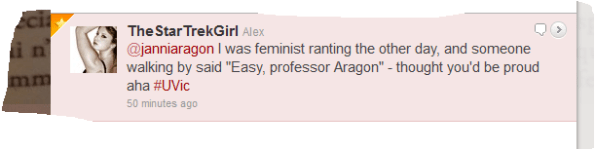
I need desk time to plan and think, and I need to walk around and will find myself in walking meetings. <They are awesome!>  . I will talk into my phone and dictate notes from a meeting or send myself emails to update. I also use this time to clear my head and plan for the next meeting, task, or day. I need some alone time to organize my day. I use Todoist to organize my tasks and I have found this tool works well for me. While this is not a feminist rant, I was thinking about this quote and feel it fits.

Aragon Rant_Twitter


Epiphanies

Most instructors have likely experienced this. You get your mail in the department and you have a card from a former student that essentially says the following: I took your class a number of years ago and wanted to say thank you. I thought you were crazy, but now that I’ve been working I find that I think of you and the class fondly. I am sorry for being a jerk. Your class was important. Thank you. I appreciate the thanks, and I also appreciate the apologies for sarcasm or making the class discussion more difficult. These notes are quite meaningful.

Approximately ten times per year, I get emails, cards or Facebook messages like the above from my former students. Funny enough the cards are from an array of students and it is sloppy to say it is from the haters. The cards come from former students who are being honest. Some might think  that they were difficult, but I find that their memory and my memory vary. I can think of two very difficult groups over the years, and I have heard from one person out of that group, and the apology appeared honest at first. I say that, as that former student appeared lots in my social media being rather antagonistic. I wish I could say that the above is pure hyperbole. It is not.

Lately, this has happened more than most years. I think it’s the fact that the numbers of students that I have taught has increased or maybe it is the fact that I just finished my tenth year at the fourth university. They know how to contact me via snail mail, email or social media.

My point here is I have found that the students who send these notes surprise me. I am happily surprised that they contacted me. I am happily surprised with the thanks, and reminded about the privilege that I have working with them in the classroom. But, each card notes that I was approachable, enthusiastic or that my playing devil’s advocate made a difference. My students are not jerks. They are diligent, hard-working, exhausted, balancing lots, and do what they can. They are imperfect. And, so am I.

Great caption, excuse the f bomb


What My Students Have Taught Me

I submitted my students’ grades and I have now completed my 18th year of teaching. I want to reflect on this year, but also begin to think about the next school term. This post offers some thoughts about what my students have taught me.

What have I learned from my students?

  1. Some of them are at university as a placeholder. Everyone tells them it was next for them. For many of them they are in the right place, but for some they will need some time off or to do other things, and this is fine. We have to support them.
  2. Their first year is hard. They are acculturating to university life and possibly living away from their parents. You have to treat the students with extra patience during the first term. Be firm, but patient.
  3. They are excited. You really want to keep that enthusiasm up, as it will for them when they are exhausted, homesick or second guessing themselves.
  4. You are part of their university experience.
  5. Working with first years for the bulk of my years, you are one of many who have impact on their ability to get through the first year. It is important to set guidelines, but be kind.

Overall, my first years have taught me humility. They are the hardest students to work with, as they demand the most of me. They also offer the most harsh quantitative and qualitative assessment of my teaching. It is ironic that a class full of people who are for the most part new to university are assessing my ability to teach. Who are they comparing me to? But it is important to hear from all my students, and learn from them. They make me smile with their compliments and criticism. It’s interesting to see that three students might like my use of “keener,” but one thinks that it is offensive. Yes, offensive. I cannot please everyone, and I do not try to do so. It is impossible!

I really look forward to year 19, which starts next month with the new term. I include a photo of my favorite Supreme Court Justice, Ruth Bader Ginsburg, who is also known as the Notorious RBG.

notorious rbg


Dear Professor: My Parents are Lost at Sea and I Need an Extension

I have revised this post. Today’s Fri Fun Facts is about keeping it real. I give lots of advice on the Fri Fun facts and today it’s about not crafting elaborate stories in order to get an extension on work. During the last several school years I am seeing that the grandparents are safe and not dying at the high rates that they used to and this might be related to how clear my syllabus is about providing proof. And, the proof about a death in the family usually is from the service—the funeral home or church typically puts together a program for the service. This might seem like an onerous request, but I find that it has kept many grandparents safe! In the last three years, I have stopped asking for this and have met one on one with the student who needs an extension. I just do not have enough mental capacity to ask for the proof. I need to come from a place of trust, and take my student’s word.

I am giving some quick advice about due dates and managing your time. In case you’re wondering, I did get a student email about parents lost at sea. I contacted tthe Coast Guard. The student was embellishing and did not get an extension. Today, I likely would not contact the Coast Guard–who has the time? I offer some advice, though.

1. Manage your time well. In my courses the paper assignments are included in the syllabus, so from day one the students know what the assignments are and when they are due.

2. If you’re in over your head, make an appointment or come to your instructor’s office hours. I’ll be honest, I do think that I am more likely to be more flexible when a student “owns” their education and sense of overwhelm and talks to me face to face and asks for an extension. I do not always give the extension, but I think I am more apt to weigh the request differently than a last minute email.

3. Rely on resources around campus. At UVIC the library has an assignment calculator and students can type in the due date and a schedule is calculated that helps students organize their time. Attend class, go to tutorial, office hours, and schedule the time to conduct research and writing time.

4. Re-read points 1-3. I cannot emphasize how much guidance you will get from your professor if you ask for it. There is a reason why I had 8 hours of office hours this last week and that there was a line up–I care and I’m here to help. The only way that you’ll get guidance from your professor is if you talk to her/him.

With this—I ask that you finish your term on a high note and organize your time before the final exams begin. Good luck!

Disclaimer: This post has nothing to do with any of my current courses or students. It is merely the time of year when a post of this nature is appropriate. Again, this is not about my current class! You are rocking it.

Book Recommendation– Stalled: The Representation of Women in Canadian Governments

I am going to use this book for my Gender and Politics class this Summer. This post is worth sharing again. This last month I had the pleasure of reading a book that was well-written, researched, and presented an important argument for and about women in Canadian politics. This book is a must-read for people interested in Canadian Politics, Canadian History, and Gender and Politics in Canada. I cannot say enough about this book, Stalled: The Representation of Women in Canadian Governments, edited by Linda Trimble, Jane Arscott, and Manon Tremblay. The book is a 2013 publication via UBC Press and includes chapters written by some well-known names and a strong cross-section of scholars within Canadian Political Science. Yes, you can see that I am enthusiastic about this book.

The book covers virtually each province and territories, and includes the different constituent groups within a Canadian context. Each chapter tackles where we have been and where we can possibly go within the Canadian context. The informational boxes at the start of the chapters offers a sketch of the history and perhaps at times lack of progress for women in Canadian politics. This might explain the telling name of the book: Stalled. The book is well-written and appropriate for the lay or academic audience. This book is the perfect addition to a Gender and Politics class, Canadian upper division course or a Comparative Politics course focused on the status of women and politics. The chapters convey the difference and similarities between the provinces and territories, but also offers a great argument for why the Senate should not be abolished. Why? Many gains for women in Canadian politics have been made through Senate appointments. And, this only scratches the surface about the book’s contents.

There are dedicated chapters to the House of Commons, Senate, and Indigenous Women and their status within formal Canadian Politics. The foreword by Sylvia Bashevkin does a fine job of setting up the book and the “Canadian political landscape.” The meta-backdrop of the book: we have made gains, but not enough. The various chapters offers the reader glimpses about what is needed, but ultimately we need to understand that the candidates, parties, electoral system, and socialization all are at play with the status of women in Canadian politics. We have lots of work left to do. I will offer a more scholarly review of the book later in a regional Political Science journal. This is a must-read book for Canadianists, Historians, and anyone interested in Gender and Politics!

20131124-151723.jpg

Fill the Right Cup: Revisit

cloudsinmycoffee

Ray Bradbury explained, “We are all cups, constantly and quietly being filled. The trick is, knowing how to tip ourselves over and let the beautiful stuff out.” This metaphor works for me. And, I have taken care to surround myself with people who fill the cups, and not only take away from you. 

Which cups do you fill? Do you fill the cups of optimism, pragmatism, or pessimism? It is important to think about where you expend your mental energy. Thinking back to my grad school days there were moments when the pessimism cup was the cup that I filled and that was not a good thing, but those moments of overwhelm and impostor syndrome were intense. I have to thank my peer mentors and faculty mentors for helping me fill the other cups.

My networks helped me stay grounded during grad school. Sure, we had our moments when would complain about our workloads and our financial situations, but overall it was pretty fabulous to read, research, teach, and write for a living. My peer mentors were primarily from the cohorts ahead of me and to this day some of my closes friends are from my grad school days. I met both of my best-friends in grad school.

Related to this, peer mentors listened. The listening cup was overflowing and there are times when I miss that interaction–the ability to have long conversations. The cup that we need to keep filling is the listening cup. Listening is an important part of a supportive and honest network. As I am working with undergraduates through graduate students, I am thinking about the importance of them finding good peer networks. I am only one part of the puzzle and know that the rest of the puzzle must include peers.

I knew that at home I had support, and my friends and networks at work in the department and larger academic community helped me through my grad school days. Peer mentoring is invaluable and if your cohort does not feel supportive, seek out peers ahead of you for guidance or go outside of your department. This advice is appropriate for those of us years out of grad school, too. And, if you are years into your career remember to connect your students to other students and to other faculty. Expand your students’ networks–this is part of the mentoring or coaching process.

 Fill the cups! Confer, trust, connect, mentor, listen, and celebrate your success…and by all means surround yourself with your friends and family.


Points of Contact

It’s the first week of the term and I am thinking lots about interactions with people. I have been in line and heard someone tell a staff member that something minor was unacceptable. I was behind a student who kicked two doors open, instead of using his hand or forearm to open the door. These are only two examples, but I could share more about poor behavior. In both instances that I noted, I intervened. Is this one thing really unacceptable? Can you respect the library and not kick our doors, but use your hand or arm?  In both instances I was ignored, but the people around me commented positively. And, honestly, the poor service worker was quite thankful. She certainly does not set the price of food. 

How do you react when you see an adult having a tantrum or otherwise rude behavior toward another in public?  I include my screen shot of Entertainment Weekly with Rey on the cover. What type of Jedi are you? Hey it’s a new year and my post cannot be only heavy–it needs some levity. 


Reflections: No Glares

Now that another term has almost ended, I can look over my shoulder at the previous school year and think reflect. Each year I reflect and try to learn from the previous year and then resolve to make some changes in the next year in the classroom, for my professional development or my ongoing efforts to mentor/coach students and peers. What did I do differently last year in the classroom, office hours or other interactions with my students? I resolved for more honesty. I was blunt. I was diplomatic, but more so, I was blunt. I am helpful and professional; however, I refuse to waste my students’ time with circular conversations. I do them no favors if I try to sugar-coat conversations.

What were the repercussions for me, if any? I heard more of these comments:
Thank you for being honest. I’ve never heard this before. Why am I almost done and no one has told me this? I didn’t know that this was plagiarism. Thank you for your time.

I did not have any incidents where someone stormed out of my office or a conversation escalated. If anything, I had meaningful conversations about assignments, interactions, writing, grad school, and other issues. As I have noted on numerous occasions, part of my job means that I have the good fortune to work with young people in the classroom or in my office. I love it. I would not trade this job for another as I get to teach, mentor, coach, and lead.

This last year I also thought more about my time. I strategically chose to focus my time differently. Part of it is that I had to, given a job change, but that is cause for a different post. I was not as available for extended office hours and the world did not fall apart. I expected a few day’s notice for extra appointments. What I am saying is that I established better boundaries for office houring and mentoring students. I had to protect my time thanks to the job change and I was working more. I managed my time effectively and accomplished more. And, at the same time I did not field complaints from my students. If anything, the change was better, as they commanded my full attention at times that were not pressed between meetings and I could listen.

My writing prompt for this post comes from a Swedish Proverb, “Fear less, hope more; whine less, breathe more; talk less, say more; hate less love more; and all good things are yours.” This last school year was filled with so much good and change. I welcome the change with a big smile and an open mind. The 2015-16 school year is half way through and I am in a great place. And, I’ll add that my little Grumpy Cat agrees and has her head on the desk!

Hacking the Classroom

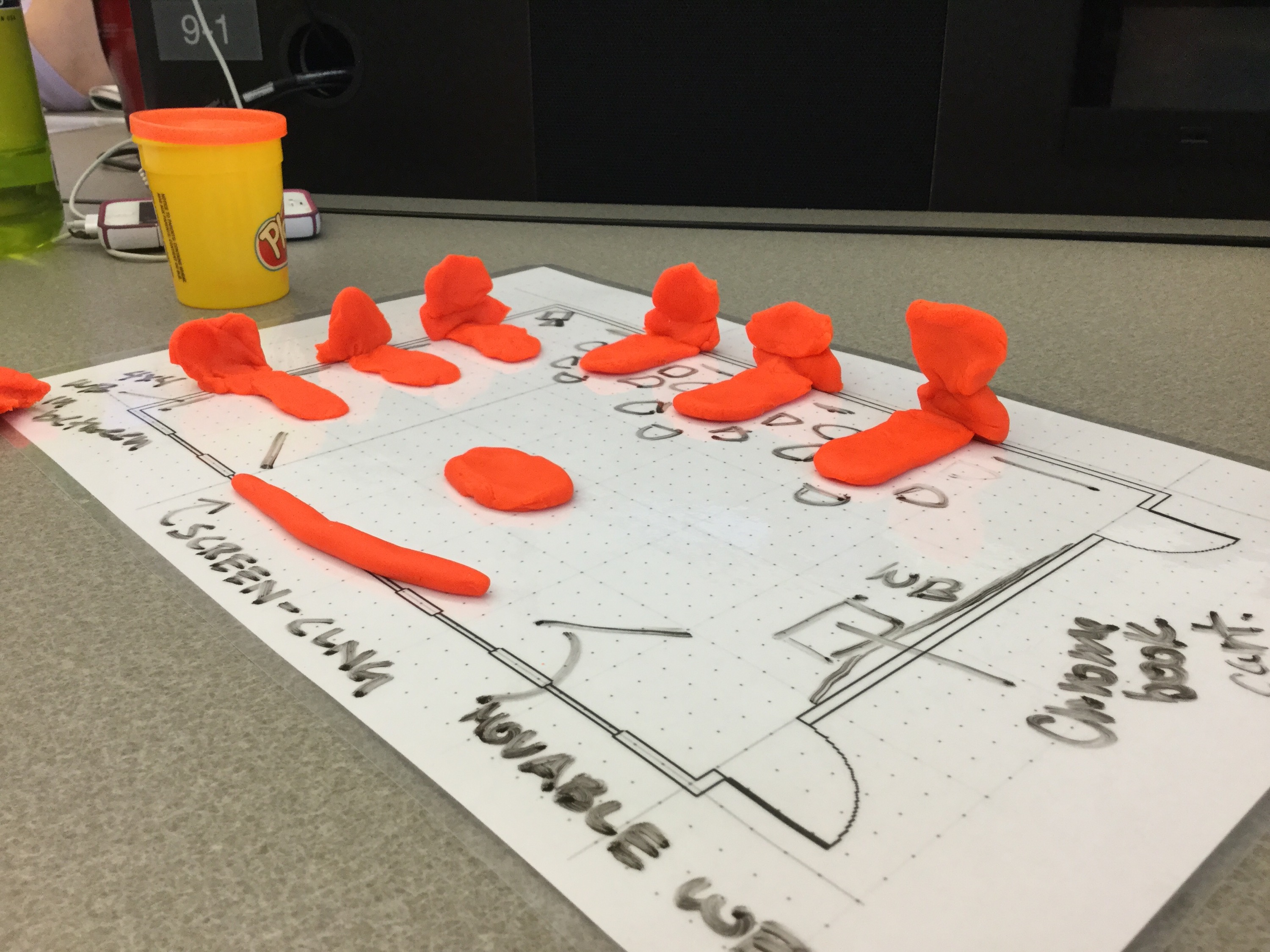
Every instructor has likely walked into a room and thought, “Oh, no. How am I going to teach in this room?” The classroom might be in the basement and have no light or have more chairs shoved into it than it truly fits. I am used to hacking the classrooom and making it work. This might mean working with what I have and making the best of it. I have to walk and work the classroom and it is imperative that I have a place to move–to pace. 

I also need to see students’ faces. I am pretty good at reading a room and I need to see the ephiphanies or looks of boredom so that I can respond. I will ask students to not sit in the very back or if they must multi-task to do so in the back of the classroom. I try to set up the etiquette guidelines during the first week. I explain my expectations, then what they can expect from me. I have moved our classroom furniture, booked lab space for one day, and booked a different classroom for group exercises. I will do what it takes to the make the classroom ours, and make it work.  

The image below is from the National Forum on Active Learning Classrooms. We were using playdough to make our ideal learning space. 


Gratitude

A long weekend has started here in Canada. Technically it starts after work today for me, but campus sure is more quiet today. This is the Canadian Thanksgiving weekend, and I am pausing between meetings to share thoughts about gratitude. 

1. I have gratitude to the team of people who have kept me healthy this year, and this includes the family doctor, physiotherapist, dentist, and oral surgeon. 

2. I have gratitude for my family. I am noting that this is for my kin and my made family. My family supports me and I do not thank them enough. 

3. Deep gratitude for my in laws. I could not manage my week without the help that they offer. I am extremely lucky to have them five minutes away from us. Our family Excel spreadsheet is a thing of beauty and if they did not do a drop off or pick up it would make things more difficult for me. Thank you. 

4. I have gratitude to my co-workers. Here I am thinking those who I report to, later colleagues, my staff, and other colleagues across campus. I know that I am lucky to have a job that is my career. I have a privileged life enjoying my work, and feeling satisfied. 

5. I cannot finish this list without thanking about my students, and other students across campus. Thank you for making all of this worth it. Your energy makes me smile. Your questions motivate me. And, working with you is a pleasure. OK. It’s a pleasure most of the time! 

6. Thank you to my many mentors! I include a photo of Dr. Kathy Jones. I worked with her at SDSU–back when I was an undergrad and we have kept in touch. She’s one of the many amazing mentors I have had. Thanks, Kathy! 

It might not be Thanksgiving for you, but what is in your gratitude list?