Fri Fun Facts: Welcome Back!

I took a few months off during the Summer Session and then Summer Break from my weekly Friday Fun Facts! This week’s Fri Fun Facts is about finding balance. Oh, now, stop that smirk or snort! You can find balance or attempt to do so.

1. Schedule in your lunch, workout, and study/reading time. You need to protect your time and part of this is investing in your sanity. If you have more balance–you are happier.

2. Related to the above point–do make sure that you are eating right, sleeping enough, and getting in some exercise. These are all building blocks for your health and happiness.

3. Schedule in some down time or fun time. It might be the gym, fun reading (what’s that?), and time with your family or fictive kin.We schedule in our dates. And, my family uses an Excel Spreadsheet to track our schedules and the kids’ after school activities. It keeps us organized.

4. Be organized. Work smart and not too hard. Maybe use an application that turns off your  internet access or the fun social media apps that suck away at your time. Set a timer for your writing or studying.

5. Find a network. This network might be from your seminar, department, or other colleagues on campus. You need people around you to occasionally bounce ideas off or to chat with about the insanity of higher education.

I hope that this first installment of Friday Fun Facts is useful to you. Welcome back to the Fall term.

The Professor Who Has Expectations

Taking care of the classroom is not just about standing at the podium giving a lecture or leading a lecture and discussion session with your students. And, it’s not just about grading lots of assignments. Instructors are helping students manage their time, learn material, and offering them opportunities to interact with their peers and the instructor.

Part of the instructor’s responsibility is to maintain the integrity of the classroom, and this might mean a host of things. This means that the instructor provides a clear syllabus that notes the expectations for the class and carefully explains student evaluation. This way the students know exactly what they are assessed on for the class. Another responsibility for the instructor is maintaining a good learning environment for all students. While I’ve blogged previously about emotional labor, codes of conduct, and non-academic misconduct, I do think that this post is different.

The instructor is responsible to all the students to ensure a positive learning environment. The instructor will come to class on time and ready to teach/lead discussion. The instructor will also treat students with respect and encourage learning. In a similar vein, the instructor needs to also ensure that student behavior does not negatively influence other students’ learning or the overall learning environment of the classroom. My syllabus is clear about avoiding multi-tasking, watching videos or the overall misuse of the network per the university guidelines. But, I have now come to realize that I have to add an additional point to my syllabus. Drum roll~ in January my syllabi will now include a sentence about not wearing ear buds or headphones during lecture.

Part of the university experience for students is about the ability to acculturate to department or university norms. Hopefully, these exercises will be useful in the workplace–public speaking skills, writing, critical thinking, and working well with co-workers. A major part of being in an undergraduate program includes working well with others and following the rules, procedures, deadlines, and other expectations regarding student behavior. These norms—be it deadlines for assignments and understanding the importance of managing one’s time or being respectful of one’s peers and instructor are part of the university experience. I certainly do not think it is too much to ask a student to only come to class if they want to do so–especially when roll is not taken.

Likewise, I do think that it’s important for students to not come into class remembering that their instructors hopefully have had ample training and want to see them do well. However, instructors are also professionals who are at work and expect mature behavior. Save the eye rolling, sighing, and raising your voice for your friends and family. Seriously–your instructors are your future job references, mentors, and possible letter writers. People often say that the university isn’t the real world. It is a slice or microcosm of it. It doesn’t get more real than this. So, the next time your instructor asks you to please stop talking during her lecture or when other students are giving a presentation. Pause for a moment and think about your behavior.

Faculty In Residence: Part 1

I was contacted this Summer by the Student Residence Program to find out if I wanted to participate in this new program on campus: Faculty In Residence. What this entails as far as I know, is meeting with students who live on campus and discussing different topics. The time commitment is up to me. This project will have students meet professors in a non-classroom environment.

I’ve participated before in talks to students who live in residence, which were more informative talks about research or how to be a good student. This initiative though is meant to get the students to establish a better or perhaps different relationship with faculty. Perhaps–demystify the professor. I don’t know everything about the initiative, but I did agree to it. As I have repeatedly blogged about, mentoring is my mandate and I take mentoring and coaching students and peers seriously. I also have mentors and friends who I go to, so mentoring/coaching never really ends.

And, to the students who suggested me for this program, I thank you.

This short post is one of hopefully several about the Faculty in Residence program.

Civility in the Classroom: Emotional Labor Redux

This Spring I wrote a blog post for the University of Venus about Emotional Labor in Academe and this post is a follow-up and will hopefully continue the conversation, as we approach a new school year. Emotional Labor takes many forms for instructors. Some of us teach topics that are provocative or outright controversial and this can energize the classroom environment, but it also can offer the instructor difficult moments. Likewise, some faculty teach topics that are not necessarily controversial, yet the classroom environment can be influenced by strong student personalities. How do you manage these situations. If you’re teaching at an institution new to you, see if there is a Code of Conduct for the campus. You might find that there is nothing, mish mash of policies or a Student Code of Conduct. Check with the department that you work for and find out if faculty include the code or other wording regarding collegiality in the classroom in the syllabus. Having the code or some verbiage related to the classroom behavior is useful as the class contract.

I’m not suggesting that you plan for the worst to take place. No, instead I’m suggesting that you prepare yourself accordingly. You hope for the best, and prepare for those interesting situations that occasionally present themselves in a classroom. Encourage good behavior by ensuring that the classroom provides a supportive environment. Here, I also assume that you will treat your students with respect and foster a civil environment. When I’ve had one of those moments when a student has said something troubling, I will often repeat what the student has said (within reason), and just this act often gets most students to hear what was said and want to clarify. Then, I give the student the opportunity to clarify the earlier statement. Usually a wave of hands go up just as the student made the comment, and I have to remind the class that we’ll discuss the matter at hand in a respectful way.

The above is a composite of different situations. Now, I am not referring to those moments when a student has used Hate Speech in the classroom. That is different and in my experience requires a different sort of reaction. I have usually stopped the student and asked that we speak outside. Then, outside we will talk about what just took place. In some situations the student will apologize and apologize to the classroom. And, in some instances the student refuses to admit that there was a problem. In the latter situation, I have asked the student to leave the classroom. Then, the protocol is to have a meeting. The meeting could be with just the student or the department head, me, and the student. You should verify what the policy is in your department or campus, and you should document everything immediately. You should also find out what the university policy is regarding these outlier situations. Do you have to report the student to Public Safety or to another student office? Confer with the department, the faculty association or your union representative.

Once the student is out of the classroom, I normally make one statement to the class about the need to have a collegial or civil, inclusive environment and then I move on. However, in my experience you need to be prepared for students to weigh in about the occurrence. Some will feel violated by their peer’s statement and it’s important that you listen and explain what the protocol is. Essentially, you’re explaining that you’re taking care of it–that there is a process. I have found that most students really want to make sure that their learning environment is supportive and this means different things to different students. And, some students will feel violated by the Hate Speech or offending comments and might want to chat with you individually.

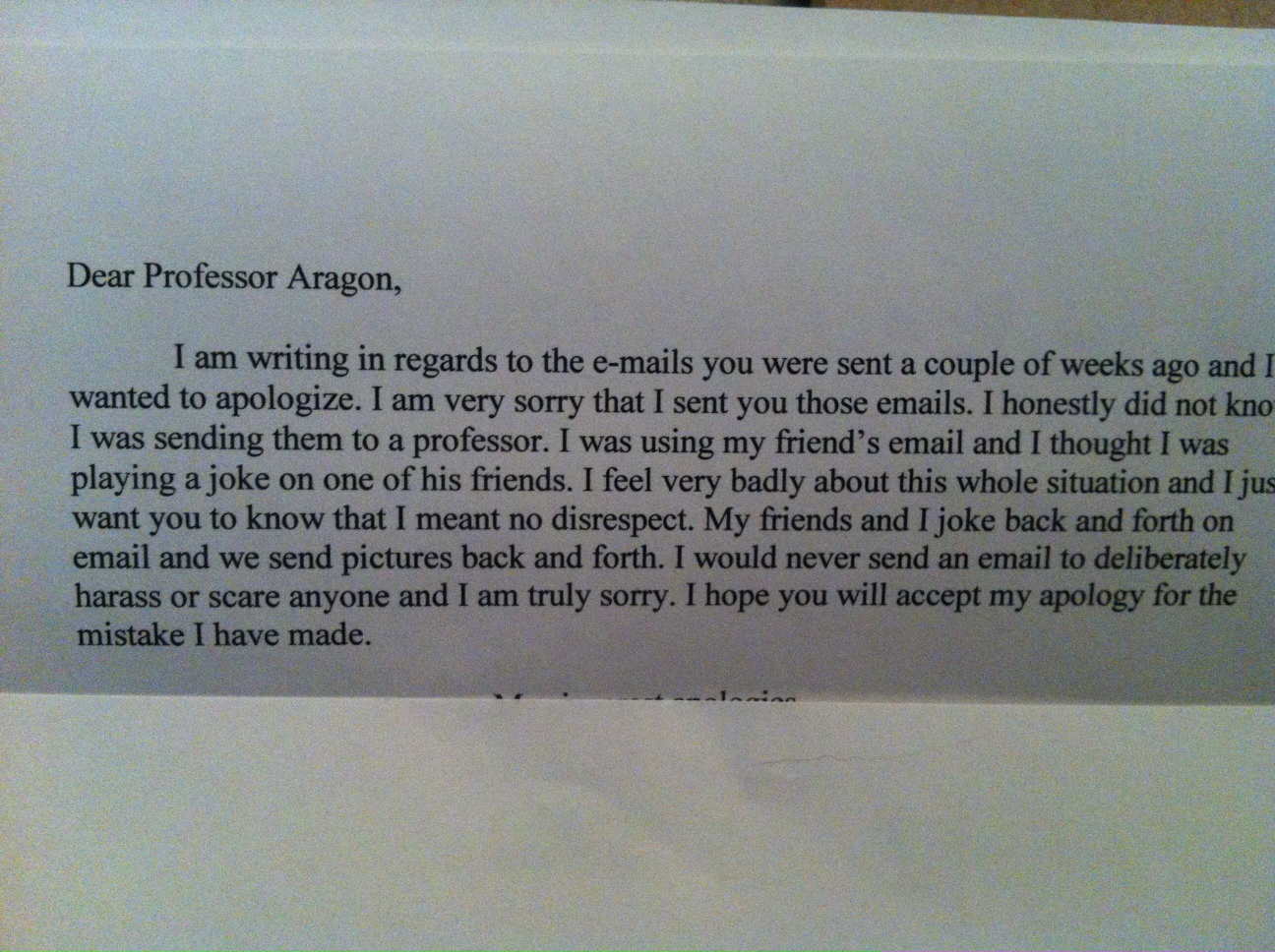
This Summer I cleaned and reorganized the home office and I found one of two letters of apology. The short story is that one of my male students left his computer email open and his roommate and another decided to send lewd and threatening emails via my student’s Hotmail account. They also changed his password and were able to repeatedly send emails over the course of two days unbeknownst to my student. I reported the emails to the Chair and to the Campus Police. My student was banned from the classroom until this was sorted out. He bumped into me on campus and explained the situation. He was quite embarrassed and contrite and I realized that this was all some cruel stunt. The other students (roommate and friend) were contacted by the Campus Police and Student Affairs and had to write letters of apology. The letter below is the better of the two. I’m sure that this student never pulled a stunt like this again. Overall, I was thankful for the Chair, Campus Police, and university support.
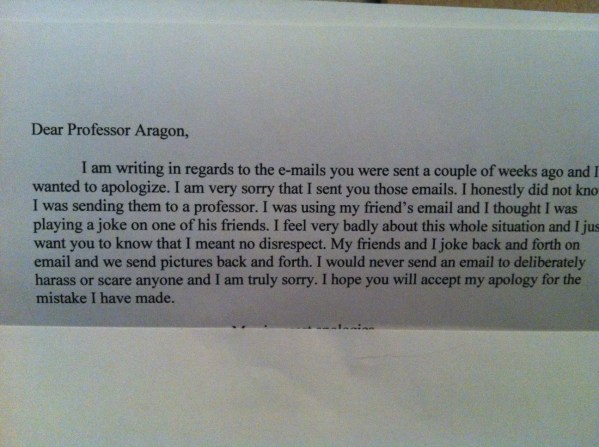
Hopefully my post will help you maneuver the tricky situations that faculty face on campus. You want your classroom to be a place of learning and not have some side dramas drop like little bombs. If you have these situations in the classroom with student behavior, deal with it immediately and by all means document, document, and document. Make sure that you have followed the university norms and confer with a trusted colleague about the protocol. Also, verify what the Code of Conduct states. And, remember that it is not always about you. Chances are it really is about the student who made the comment(s). Good Luck!

Open Political Science Courses at UVIC

I don’t normally do this, but what the heck. Here is a screen shot of Political Science courses at UVIC that have room for students! Be bold and take a course:

As you can see we have some new courses, too! Remember that getting on the waitlist can work to your advantage–just go to class. Many students enroll in 6-10 courses, but “shop” during the first two weeks. Good luck!

Managing Projects: Having More Balance

I did something radically different this Summer with my writing. I didn’t have a strict schedule and I worked daily on different projects. Normally I would have spent 60-120 minutes on different projects over the course of the day and work on multiple projects each day. This Summer was one per day–OK occasionally 1.5 per day. I have not decided which I preferred. Moments have taken place where I’ve wondered the veracity of this tactic. But, overall it’s freeing to try something new and then think about if it worked for me.

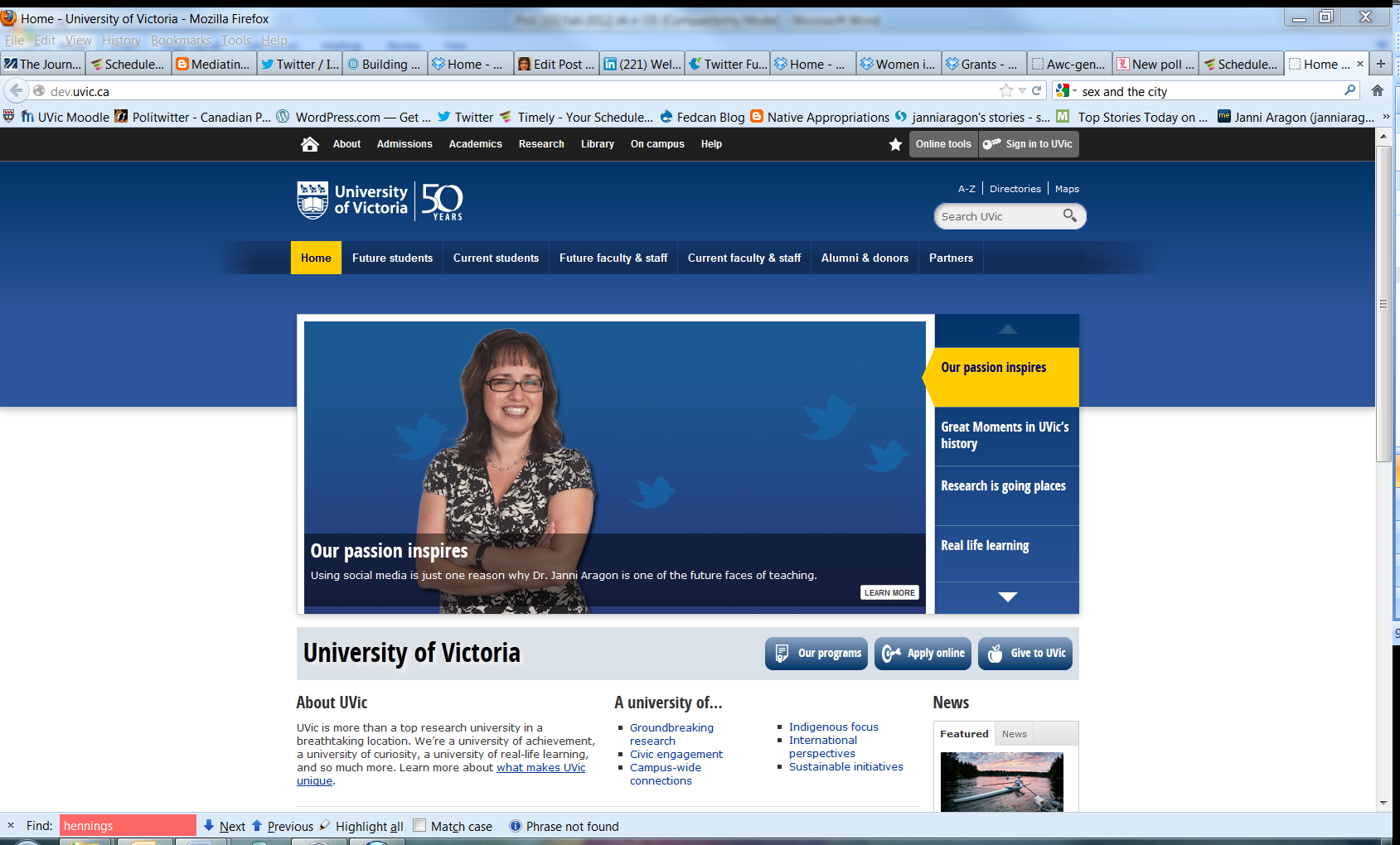
I’ve also made a point of taking some time off during my vacation this year. I ran twice a week with two close friends and kept this date firm in my schedule. I also was not the usual office rat. What this meant was that I did not go into the office every darn day, too. I was in the office 2-3 days per week. What I did differently–I worked at libraries, coffee shops, and outdoors. This meant more distractions and more conversations with people. And, looking at my bank account it also was a little more pricey. But, another way to look at this is that I was able to actually turn myself off from work. Some might say that this sounds unproductive or maybe less productive. Occasionally someone looked over my shoulder and would ask me some questions–even though I had my ear buds and music going. I was polite and engaged in some conversations. These interruptions were usually good. The best part was always the senior citizen who never believed that I was old enough to be a professor. I joked that they could go to the website and see me on the homepage. The screen shot below is of the new site that goes live in a few days, but the photo is the same one that has scrolled on the university website this Summer.

In all seriousness, I also spent as much time as I could outdoors–running helped me stay outdoors. I read outdoors–even if it was for only an hour. I am a Summer person and usually go back to Southern California for the Summer. I didn’t this year, so I tried to get as much Vitamin D as possible in Victoria, BC. This takes effort, as occasionally if you shower, you could miss Summer! No offense to fellow Victorians, but our Summer is sometimes forgetful. It seemed appropriate to try something different, since I was at home for the Summer.

I’ve thought about this again and again and at the end of the Summer I will evaluate what it meant for me and my productivity. To clarify, I am in a teaching tenure-track position and due to my heavy teaching load (8 courses per school year)–it really means that I have to write during the Summer months. Now, I realize that this situation is common for my colleagues who are lucky enough to teach half as much and more than common for my colleagues who don’t really get that much time off, since they have to teach year round to survive. Regardless, this Summer meant a few thing: write and relax! Oh, academe, thank you for these gifts! I know–I have a full-time job and should not complain. But, I’d like to remind that I did my time adjuncting (we call this sessional work in Canada) for more than 10 years.

Now that I’m in the last push before the term resumes, I can honestly say that I got less work done. I didn’t fret about it either. Oh, maybe I did a few times, but then I’d look at my kids and remember that I have to do better, as they observe and learn.  I had more balance in my life during these last two months. I spent lots of quality time with my family and by myself. Sure, I was in the office a day or two per week, but on my terms. The papers were revise (not ready to resubmit) and projects are further along, but I am happy. I won’t put a price on happiness, and all the time I spent with my two daughters. I also took up golf. Can you believe that? It was a great Summer!

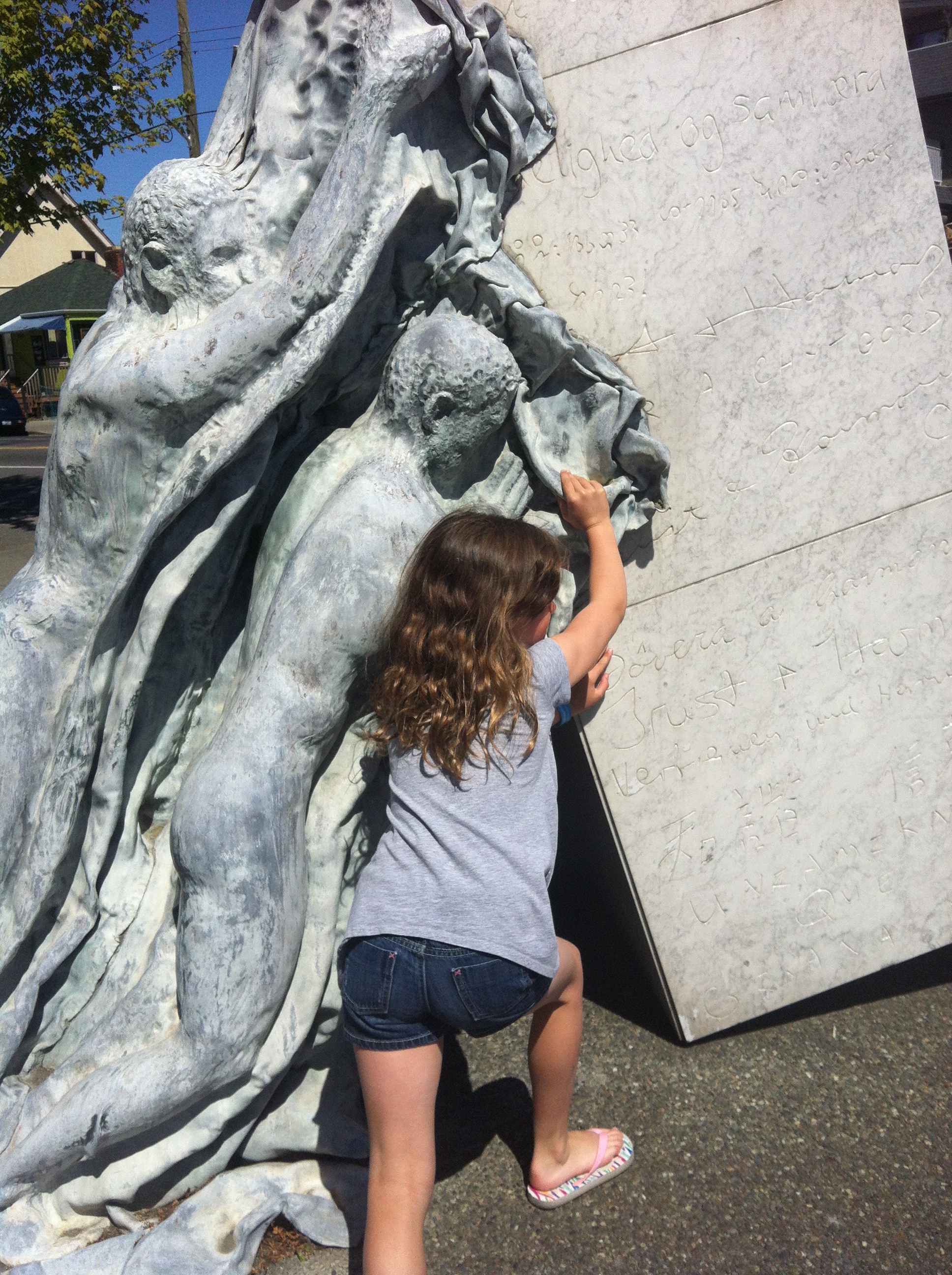
The two photos are shots of my girls. I don’t post photos of them on my blog, so these are not direct face shots. My two loveys.

Reminder for Grad School Applications

It is that time of year, before the term begins or before it gets really hairy…this is the perfect time for students to think about their grad school options. My words of advice is to be organized. Most students will approach faculty in October or later and this is when professors are writing lots of students letters of reference for graduate school. Be organized. You should hopefully have put together a list of schools that you’re going to apply to. Remember to include more than one school with this list! You should have a sure bet school, the programs you would really like, and then the dream options.

How can you make this application process easier?

1. Ask professors weeks before the letters are due.

2. Provide us all the information we need.

This includes~ Who, What, Where, and When, Fill out all necessary forms. Really organized students provide me a Word or Excel file with the schools, deadlines, and any additional information.

I ask for a copy of your letter of intent and cv/resume. I might even meet with you and ask what your motivation is for continuing your education.

3. Remind us. Send an email a few days before a due date.

4. Thank us. This can be an email or a note. It’s not necessary to do more. Remember that your tenure line faculty actually get paid to mentor and do things like write letters. Keep in mind that part-time faculty do not get compensated for this extra work. Remember to thank them profusely–a card, bottle of wine or a face to face thank you is nice.

Good luck with this process! And, remember this process is nerve wracking!

Looking for Work: There is a Book for That

I stumbled upon a shelf or two at the bookstore filled with career advice books for undergrads and other job seekers. I was quite curious and leafed through some. And, I took photos of a few of them. I’m sure that many of these books dispense good advice for job seekers, and given my penchant to read as much as I can I think it’s good to do your homework. But, there is a part of me that also hopes that students go to the Career Center or whatever name it’s called on campus. Here are some screen shots of some of the books that I leafed through the other day.

I didn’t see anything Earth shattering in the above book–but it does have a snazzy title and will definitely cause some to buy it hoping that the right equation is there for them. I’m not dismissing the book or endorsing it. But, it does catch the eye! I wonder how many copies of this book have sold? You, too can use Social Media to help you get a job. Yes, you can, but just being on social media is not enough. Big smile. Mind your digital footprint. It’s always good to occasionally Google yourself and see what is out there. Clean up your presence if you must. There are reputation management companies to assist you with this, too! Hopefully, most won’t need to resort to the consultant to clean up the digital footprint!

I’ve read the Parachute book and back in the day found it helpful. No wonder it’s been repeatedly published. Many people have no clue what they want to do and books like it are useful to get you thinking about the possibilities and the reality of your own skills and interests. And, nothing beats talking with a career educator, mentor, coach or trusted person in your life. Which brings me to my next thought–I really hope that students scouring the shelves in the university bookstore look to their network as a rich resource, too. Start off with your friends, family, profs, employers, and the career center! Set up coffee meetings and ask that contact to introduce you to a person or two so that you can increase your networks.

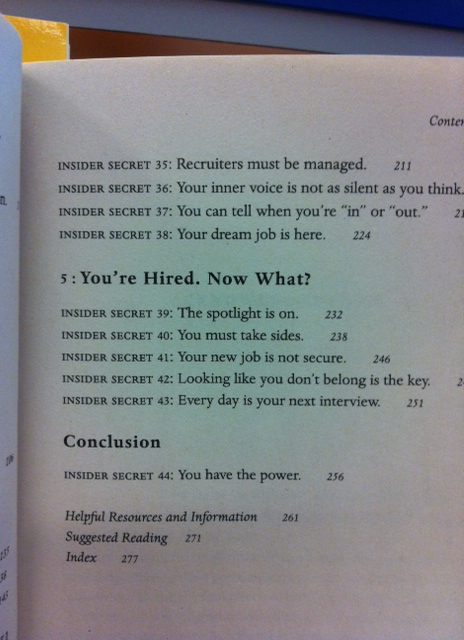
Another screen shot of a book and its secrets!

44 Secrets! Now, some of them make me think of Captain Obvious, but I’ve been working since I was 16. I do think that the book has lots of great hints/information for the job seeker. It looks helpful in a cheeky sort of way. I should have taken more photos of the table of contents, as this book really made me laugh out loud.

I liked the section about: You’re Hired, Now What? This is also an important part of the job seeking process. What to do when you get hired. Some of the best advice that I’ve heard about once you’ve been hired is that you act and dress for the job you want. I’ve had other great advice, too. You know–keep your head down and work hard, avoid landmines, make good allies, and don’t piss off the more senior people. This is a quick list of some of the advice and certainly not exhaustive.

I have lots of former students on the job hunt right now and I wish each and every one of them good luck. If any of these books look promising, stop by a bookstore and leaf through it before you buy it. And, remember that we have a great Career Center on campus! Have one of the career educators review your resume and a sample cover letter. The staff or mentors on campus are here to help and you want to represent yourself in the best way that you can. Good luck!

Boundaries: Saying No

I have had a hard time saying no. This is the nature of one dozen years as adjunct or sessional faculty–what many refer to as the New Faculty Majority. Now, I’m about to start my fourth year as tenure line faculty and this will mark the fourth year out of fifteen when I shut my door. My door is only open during office hours. I make no apologies for this. I am open and available for consultations during my office hours or appointments. Truthfully, a senior colleague insisted that I shut my door to get my work done. To this day, I thank him for his honesty.

Likewise, I’ve  become better at allowing myself to take a vacation. This means not responding to student emails and more importantly not feeling guilty about it. Of course, I never got the sheer volume of emails previously. This changed when I got my tenure line job and was also made an Undergraduate Advisor. Students need advising year round. The department where I work has assigned other faculty during my vacation, but that doesn’t stop the emails from trickling in. Perhaps it helps the deluge!

This May I started an email to myself where I remind myself of my professional declines. I cannot do everything and anything. I note my achievements via my CV, but what about those moments when I protect my time and sanity and say, “no.” Well, I have an email to self that shares my no accomplishments. I started this in May and I’m only at 18, but each one of these declines allowed me to spend more time on teaching, advising, myself, and work/life balance. So, I suggest that we remember to celebrate boundary keeping and those moments when we must politely decline.Don’t get me wrong–I say yes to lots of meetings and opportunities. I do believe the department head would concur that I am a good citizen in the department and for the faculty at large.

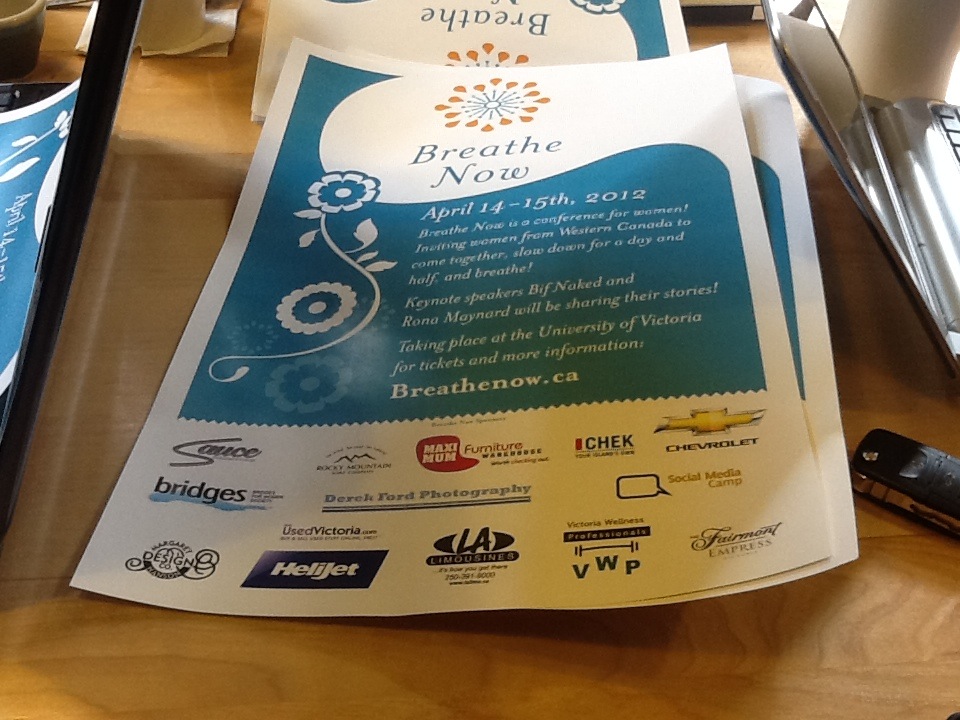
But, the department head has also encouraged me to say no more. I’ve had colleagues who have a printout that read: Just say NO within their field of vision as a reminder when they are on the phone. Oh, that reminds me to add another point. I’m at 19! And, I am also reminded me of themes at Breathe Now, a conference that I co-coordinated with Janice Mansfield, Angela Rafuse-Tahir, and Yukari Peerless. Many of our speakers noted that it’s important to take time for yourself–breathe. Say no, when you need to!

Mentoring and Coaching: Post-Graduation

I’ve blogged lots about mentoring and coaching. I’ve differentiated the ways that some students require more hands on approach–ergo the mentoring, and some require less and I view this as more of the coaching strategy. I decided to do something different and buy some stationery and send some of my mentees (will use just that word) a note. I wrote the notes recently, but will send them prior to the Fall term. Now, I’ve sent emails and messages via other social media platforms, but I’m kicking it old school with the note cards.

Some of them will start or continue graduate school in the Fall, and others will join the working world outside of academe. I bought these note cards at the Papery on Fort St in Victoria, BC and chose something that was not too big, so that the sentiment wasn’t a thesis. My intention was to write something supportive, and dispense some advice. Academics tend to live our lives term by term or maybe even school year by school year. Graduate students get used to this, too. After graduation many of my former students note that they miss college and the schedule. Thus, I felt it was appropriate to send the note card just when a school term starts and the graduate might reminisce about their undergraduate days. (I know that many of them do, as I get the emails or Facebook messages telling me that they miss their university days and their old schedules).

Each note card was personalized to the particular mentee and my wishes for them. I gave them well wishes and felt quite emotional as I wrote the cards. I’ve given cards for graduation during the last several years, but these cards of well-wishes were different. I don’t view them as closure to our relationship, as I see the mentoring or coaching as not having an expiration date. And, to be quite frank a few of these mentees are now actually great friends to me, and my family. Now, for any former students who didn’t get a note and are wondering where is there note card–this was a first time project and I sent out several. I will do this again. I really hope the students who get the note cards appreciate them. I’ve only started this and will see how it works.