Before a New Term Starts

I realize that many of my colleagues in the United States are still teaching. It’s the Spring term for them and they are slogging through those last few weeks or months in some cases. But for me, it’s the last harried week before my Summer term begins. So, it’s that time of year when many of my college students are thinking about the next year’s classes. This is a slow teaching time for most regular faculty (note this doesn’t include the sessional instructors, who usually have to teach full-time in order to stay afloat). One of the things that we forget though, is that this time of year is very busy for advisors and others who help students figure out courses and other important matter that is important to student success.

This quick note is a reminder for patience. In the last week, I’ve had many emails about books and course outlines/syllabi. Students want to know–where are the books? Bookstore. Where is the course outline. In my head, it’s in draft stage and gets distributed on the first day of class and possibly early on Moodle.

Patience for the frantic student who needs a little reassurance about classes. For instance, I am finding that I am fielding more emails where a student really wants advice. “Which classes should I take?” A few have actually said, I want to know your recommendations. This is a big responsibility for me. Typically the student who asks, has already taken a course with me. So, I need to think about his/her interests and weigh my knowledge of the department’s courses. At first I would suggest all our courses, but now I am more careful. This is not based on content, but rather thinking more strategically about the student and her/his interests and possible grad school interests. Students asking for more help with planning their academic career is more common today in my experience.

One common response from students is that they have heard that a colleague is a GPA buster. I always smile at this and explain that if the student wants to focus on Area A, for instance, in grad school that she absolutely needs to have a class with said colleague. The majority of the students come back to my office the next term and thank me for my suggestion. I’m sure that there are some who have opted to not come and complain to me, too! I would have never asked an instructor for advice about which course or professor to take, but from talking to other undergraduate advisors these sort of queries are more apt to take place today. I think that when I am queried–it is acceptable for me to make course suggestions to students. I am one of three undergraduate advisors in the department.

The other thing that happens lots is students want to check in and see where they stand with their programs. I get more queries that essentially are asking, “Am I on the right track” during these Summer term months. Many students have caught their breath after a busy year and are now assessing what they’ve done. I look forward to these conversations, as most students are pleasantly surprised with the progress made. I certainly do wish that more students would check in annually with either Academic Advising or the department advising team to verify where they are in the undergraduate program.

Fri Fun Facts: Performance Reviews

Today’s Fri Fun Facts is about my new use of writing Performance Reviews for the Teaching Assistants. After looking through the Canadian Union of Public Employee’s Agreement between my employer and the local group, I decided that it would behoove me to offer the Teaching Assistants a more formal review.  Today’s Fri Fun Facts will speak to how I will do this every term on.

Performance Review

My intention was to provide each Teaching Assistant with an honest, fair assessment of their work this term hoping that they could use the review in their teaching dossiers or as part of their resume paperwork. Writing the reviews took more time than I thought it would, as I really wanted to convey a personal review for each Teaching Assistant. How did I do this?

When I meet with each Teaching Assistant to review their graded work, I would email myself notes about the meeting and these summaries were useful. When students would see me during office hours and offer unsolicited comments about their Teaching Assistant, I would email myself a copy of the comments for my records. These little things were important to providing me a memory of the Teaching Assistant’s performance.

My suggestions:

1. Keep notes or records about the Teaching Assistant’s performance. If there is every tricky situations, these notes are really useful.

2. Check in with the Teaching Assistants to make sure that they are doing well and feel that they are getting enough support from you.

3. Provide them guidelines about your expectations. You might email or verbalize this. I actually provide a dossier: a one to two page expectations letter, sample graded work, exams, grading guidelines for the university, and a copy of the syllabus.

4. Be available. You need to set up times to be available for their questions or be willing to guide and coach the Teaching Assistants as needed. Some will need more of your time and others hit the ground running.

5. With the review, think about the Teaching Assistant’s grading, effort, interaction with the team, students, and comment on this. Note any areas for improvement and be willing to note if you think that you could have supported the Teaching Assistant more.

6. Be honest. The review should be helpful, but it does not need to only be positive. Constructive comments are sometimes needed, but offer them in a helpful manner.

Overall, the Performance Review should be helpful for you, the Teaching Assistant, and any future employer who sees the document. Remember that the arrangement is really an apprenticeship and you need to mentor or coach the graduate student, as this is not “free” grading for you. The cost is really supervising and helping the Teaching Assistant perform the duties. I have to remind myself of this occasionally! How do you evaluate your graduate students?

Patience Works Both Ways

There are easy terms and there are terms that make you earn a every penny. About three years ago I was in a car accident over the Summer and when the Fall term started I was quite aware that this would not be a normal term. I tried to work my schedule so that I could make a good impression on the job and meet the needs of my students. I was partially successful. And, this post offers me an opportunity to reflect on what I could have done better.

In most situations in life we do not get a change for a “do-over,” but it’s good to occasionally have the chance to think about the what if situation. Thinking about that Fall term I wish I had moved my afternoon class to earlier in the day, so that I would have had full use of my mind and body. That term was one of the toughest ever, as by about 4pm I was absolutely exhausted and could barely walk across campus. It was a rough. I was mildly embarrassed, but did announce to the class that I had a car accident and that I would not be my usual self. I stood by the podium must of the term and didn’t walk around and was not my usual peppy self. I found that most students were quite patient with me and I thank this for them. The morning class got the regular me, but the afternoon got the extremely tired, stiff version.

I have found that some students, though, have no patience for anything short of perfection from their instructor. And, this makes things interesting. You see, I have to accommodate students who are registered with the Resource Center for Students with a Disability, have notes from Health Services, are student athletes, and the like. And, I have no problem with flexibility, when it’s warranted. Some students are a little thick to understand that an instructor could have an illness or some other issue in their personal life. And, I learned that term to just roll with it and let it go. I also think that if I could go back I would have reminded the students more than once that I was struggling. I tried to act like things were fine. I’m not going to lie, though, the student evaluation that noted, “We don’t care if you were in a car accident–keep your personal life out of the classroom” really stung when I read it a few months later. I hope that person is never in a car accident or faces any physical hardship. This is really the only negative reaction that I recall.

My morning evaluation numbers were normal; however, the afternoon class numbers were slightly lower than the previous four times that I taught that class. Was the .7 difference because of my health? Maybe. What I do know is that term taxed my patience and I bet that some students felt the same way! My advice to other faculty–honesty. Let your students know if you are facing an unusual term. Most students will understand and offer you some compassion.

Thinking about the Term: Fri Fun Facts

The term just ended and it’s fresh in my mind. For students, staff, and faculty this is the best time to think about how the term ended. What can you do to make the next term better? And, more importantly what did you do well that you need to do again?

  1. I keep track of my emails and hold on to them for more than a year. I do this to protect myself and the students. I will continue to do this
  2. I had students blog in my seminars and I will continue to offer this as an assignment. The student blogs were good to strong.
  3. I did something different this school year and I had separated my office hours between my advanced class (the seminar) and my first year course. The seminar students enjoy having their own slated consultation time. I will continue to do this.
  4. I allowed one Teaching Assistant to run a series of writing workshops and I think that was a great use of his hours. The first session was small, but the next two included lots of students and they gave me positive feedback.
  5. There are instances when I photocopy work that gives me or the Teaching Assistant pause. I photocopied some work this time, but will take special care to to photocopy any work that requires “strict scrutiny.”

Overall, it was a great term and I look forward to Summer School.

Taking Time For Yourself: Fri Fun Facts

I used to have a hard time saying no to students. The infamous, “Do you have a minute” moments would eat away at my day. During the last four years I became more comfortable saying  no. This meant that I referred students to my office hours or encouraged them to email me to set up another time. The first few times that I said no I was a little excited. Did I actually say no?!

You’re probably wondering what is so liberating or dangerous about saying no. Well, when you’re part-time or junior faculty saying no can be an issue. Are you a team player? Do you carry your weight in the department and are you dependable. My Fri Fun Facts speaks to taking time for yourself.

1. In order to have a decent lunch step away from the compute or invite a colleague to your office for lunch. If not you might do what I often do (but try to do less) and eat at your keyboard and not really take a lunch break.

2. Walk around the building or to another building to get outside of the department. I have scheduled e-lerts that say, get outside, walk to DSB (another building), go visit so and so. Seriously.

3. Schedule coffees with friends across campus so that you have to walk across the campus. It’s OK to take 30-60 minutes and catch up with a friend. If you’re anything like me, it will be work-related. It will.

4. Say no and don’t feel guilty about it. Now, when I say no, I am going to picture Rona Maynard’s keynote at #breatheyyj Saying no is acceptable. Saying no can protect your time.

I’ll end noting that I have never had a student get mad that I said no. They are usually good about emailing to schedule a meeting or come  back during my office hours. With that–it’s OK to say no.

Reviewing Student Work: Teachable Moments

Reviewing graded work with students is not an easy task. This typically happens when a student wants to contest the mark, complain about the Teaching Assistant or about my assessment. Some students come in and they really want to learn from the assignment and do better the next time. Other students want to have an opportunity to complain. They merely want someone to listen to them. To be heard. I do not blame them–we all want someone to listen to us. It’s like Festivus–the airing of the grievances.

Educators need to remember that for so many of the students coming to office hours to chat with you is hard. Most students are a little nervous to come into the office and it’s best to immediately explain what the process is with the review. The student needs to know that you might lower or raise the grade. The student needs to know that they might have the option to revise and resubmit or contest the grade. The process will vary in different departments or different campuses.

All of this said, what I will do is re-grade the work and then review the graded work line by line or paragraph or by paragraph so that the student has a complete understanding of the grade. I also refer to the university grading system, so that the student understands that I am referring to the standards outlined by the institution. This is actually important as I feel it allows the student to understand that the grade is not personal–it is about the work and the guidelines for the assignment. This is also the appropriate time to review the assignment with the student.

Likewise, during the meeting in my office, I will allow the student to share her or his thoughts. This is the time to listen and to then respond as needed. I always end noting that the grade reflects the assessment of the assignment and not a judgement about the student as a person. I do think it’s important to add this last part, as many students really do think that the grade represents them and their effort. It does not.

Now, the last point that I want to speak to is effort and grade. I am hearing more students discuss how the grade does not reflect the effort that they put into the assignment. I listen to their explanation and think: I deserve to be paid more, but I am not. Effort does not entitlement to a better or strong grade. Some students will spend lots of time (revisions, office hour visits) and earn a B. Others will cram and pull an all nighter and earn an A-. It is not fair, but it happens. In my classes, the papers need to offer coherent analysis and follow directions. The assignment stipulates all the guidelines and some will not do well solely because they waited until the last minute or did not follow directions. Other papers will earn a weak grade due to the poor organization and writing.   Effort does not equal a strong grade.

Now there will be times when you review student work and you think that you might have been too hard. If so, admit it and raise the mark. My dad used to tell me, “I’m not perfect, you’re not perfect, nobody is perfect.” He’s right. Sometimes we make mistakes or are too harsh with a mark. Re-assess the work and move on. Explain why you are revising the mark and change the grade while the student is in your office, so that you don’t forget. Have fun grading and reviewing graded work!

It’s OK to Talk About Mental Health

Airdrie Miller @airdrie_miller Public School Teacher http://www.talkingtoair.com
It’s OK to Talk About Mental Health #Breatheyyj

Miller is sharing her experience with panic attacks in university. At first she kept quiet about her experience, but later sought help from the university mental health services. She has a 1998 baby, too. Awwww. “Nowadays we’re not putting pictures in albums–we’re putting them online.” She stopped her therapy and later had another baby. Then, postpartum depression hit. This is so common for many women.

She realized that she suffering from depression and resumed therapy. She got better and then resumed work after nine months. Oh, I love the Wonder Woman slide. She was doing it all…you know where this is going to go. Love her slide of the WHO’s definition of Mental Health. It’s telling and we need to stop and assess. Are we healthy? Are we pushing ourselves to attempt to be perfect?

Miller notes that mental illness does not discriminate! Twenty percent of Canadians will suffer from mental health issues in their life. This number is important to think about, as we all know many who are living with mental illness. Miller shares that she began to have serious thoughts about self-harm. She then quit her job and became what she calls a Desperate Housewife, but still suffering from depression.

She was very brave and ultimately was placed in the psych ward. This turn of events changed her life. Her experience with the outpatient therapy was positive. She went back to work part-time and tried to keep balance in her life. Then, her dear husband contracts colon cancer. Sigh. Derek Miller. After four years he succumbed to cancer. I’m so glad I heard her share her truths. She ends noting: It’s OK to not talk about it. Do what is right for you–so true.

Fri Fun Fact: Finals

Final exams are here. This means lots of cramming for some students. Let me assume that you have attended class, taken notes, and read the readings. You now need to review your notes and the readings. People will study in different ways. I’m going to make some suggestions for prepping for the final.

  1. See the instructor or Teaching Assistant and talk about the final exam. Find out what the instructor is looking for with the final.
  2. I used to re-type all my notes so that the information would sink in deeper. If the class required learning lots of terms, I would use index cards and I would handwrite the answers and quiz myself with the index cards.
  3. Form a study group and work together with your classmates. This allows you to pool your knowledge and quiz one another as needed. Plus, some of the group members might have strengths in some areas that you do not.
  4. Study. Sleep. Eat. Exercise. Repeat.
  5. If you don’t know where your grade is prior to the final, confer with the instructor and find out what your mark is to date. This is a great incentive to help you figure out how much you really want to dedicate to studying for the final exam. Yes, I realize that students often do a cost-benefit analysis to figure out how much time or energy that they will dedicate toward a final.
  6. On the day of the final exam, sit down to write the exam. Close your eyes and picture your notes, the books, and think back to the lectures. If you’ve studied, the information is there, but you need to articulate it. You can do it.

Good luck!

Anti-Bullying Workshop: Part 2

I previously blogged about an Anti-Bullying held on March 31st, 2012 that I attended in San Diego. The workshop was sponsored by Voices of Women and was for the local Somali community. The latter half of the panel included a community member and the local Police. The first presenter was Ramla Sahid, community organizer. Yes, I smiled when I heard this descriptor and after hearing her presentation I was so impressed. Did I share that she’s also a SDSU alum?! Yes, she is. This young woman is working for social change. “We are accountable to one another.” Hearing her say this was important. She was reminding the mothers and daughters in attendance. Yes, the audience was predominantly sex segregated and I will speak to this later.  She also gave a polite yet scathing commentary on how the tough on crime legislation and policies in California were counter-productive.

The other speakers were two police officers: one Lieutenant and one Detective. I am not using their names–both of them work in the community and I will leave it at that. The two really spoke to the intricacies of the laws regarding bullying and harassment. There were a few moments when I wondered if the presentation was right for this audience, but nonetheless their presentation was good. I also was at times fascinated by their guns. The guns looked out of place–I know that they were on duty, but after years in Canada I am not as used to seeing lots of guns around. (Humor). The officers noted that if bullying begins in primary school it only worsens in junior high and high school, so it’s important that we respond.

“Respect is universal.” Lots of head nodded when the Lieutenant made this statement. Farah noted that we need to get the men involved and that they need men only workshops. I am not sure if I agree, but then again I am not taking into the cultural considerations. Perhaps he is on to something and these male only workshops can also speak to the importance of fatherhood. More workshops is definitely something work thinking of given the proliferation of bullying and need to curb it in schools.

When the question and answer period took place Agin Shaheed noted that we must get the fathers involved. There were only mothers in attendance. He also noted that across the US 87% of teachers are women. (Is this why we keep on hearing the press and experts pick on teachers? Is there bullying against teachers because this is still viewed as women’s work? Maybe that is another post).

Anti-Bullying Workshop: Part 1

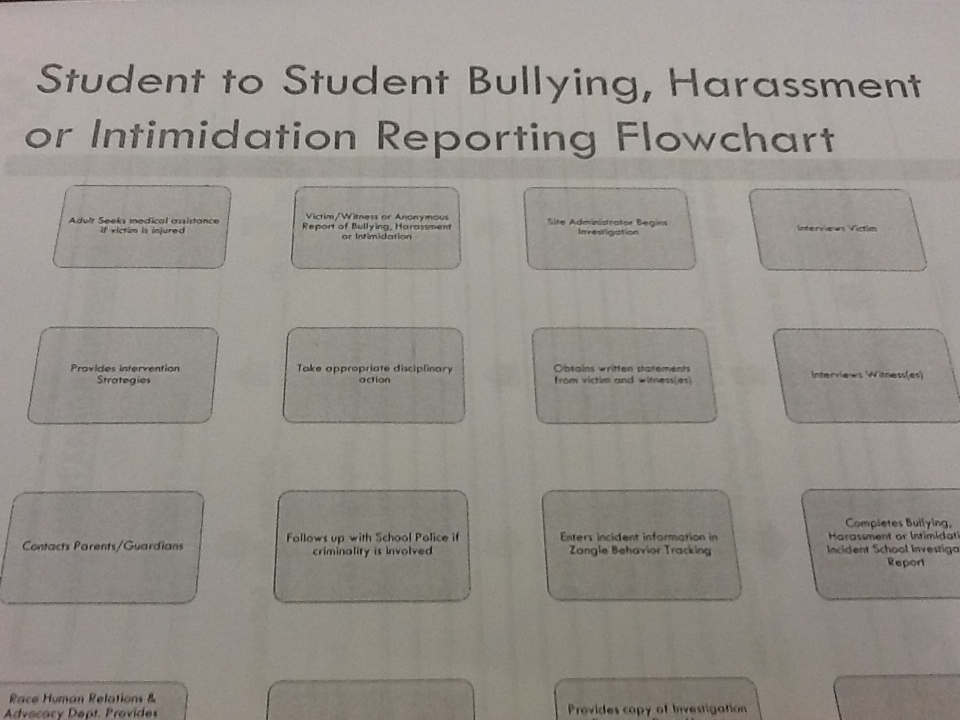
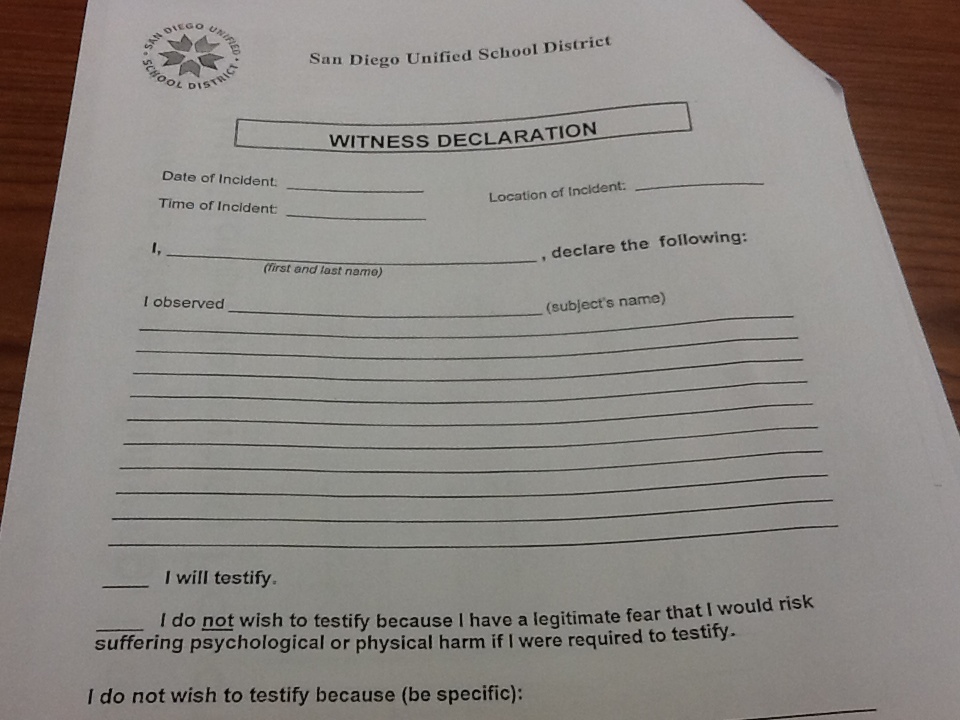
I had the distinct pleasure of the Voices of Women’s (VOW) Anti-Bullying workshop in San Diego, California on March 31st 2012. VOW collaborated with the United Women of East Africa for this workshop. I was quite pleased to be in the minority in the crowd. The majority of the attendees were women from the Somali community in City Heights neighborhood in San Diego. The array of panelists provided insight into the policies and realities of anti-bullying today in San Diego and more specifically the San Diego Unified School District (SDUSD). The array of handouts that SDUSD uses with documenting bullying and the anti-bullying efforts impressed me. I kept multiple copies so that I could share them at home. And, here I include my screen shots.

The first speaker, Agin Shaheed, is an administrator with the SDUSD. His exact position focuses on Race Relations. I couldn’t help but think that his job must be incredibly rewarding and exhausting. Shaheed noted that the SDUSD is the largest school district in San Diego County and second largest in the state. This would make it behind the Los Angeles Unified School District (LAUSD). Shaheed opened up his remarks reading a moving poem he wrote. He reminded the audience of 50 about the murders of Shaima and Trayvon. I was glad I packed my tissues. Shaheed made a germane point about cyberbullying and the way it invades the home–it makes this form of bullying more invasive. Victims of cyberbullying are not safe anywhere.

The next speaker Maslah Farah, Director of the Neighborhood Unity Foundation shared that he was bullied and got into trouble while he was in school. He shared that the bullying stays with you for the rest of your life. He also opened up my eyes to how important cultural issues are. He noted that in Somalia families really look to the teachers as a second parent and that corporal punishment is more common in the schools or other forms of discipline that are not allowed here. (I could hear some warm laughter as he noted this). What I took from his talk is that he was kicked out of high school and is now successful and using his community work to mentor others in the community. He reminded us that we need to move away from a mainstream culture that enjoys witnessing misery.

This portion of workshop really made me think about the ways that we think about bullying. I also wondered what sorts of policy the local schools in Victoria (where I live) have regarding bullying. We can talk until we’re blue in the face about how bullying is bad, and that kids should not do it. But, until we practice this and don’t encourage bullying among adults we unfortunately model bad behavior. Just turn on some reality television shows and we can see and hear bullying. Look at some of the news magazine shows and we can also see the bullying nature by the hosts. We live in a society where bullying is rampant. Not to seem trite–but we  need to model better behavior.