Time Management: Own It

If I could give students some advice this time of the term it would focus on the importance of time management. Sound time management should pervade all aspects of your life right now. Students are on a specific schedule with classes, tutorials, and paid work. You add to this the need to study more and time to think. Thinking time is time to strategize about assignments and writing.

It’s really hard to schedule writing time, as you might have the time window, but not be in the writing mood. Use that time to research, mind map or outline your paper. Then, when you are ready to write you will have a plan for the next step. I realize that it’s hard to “schedule” writing–trust me–I really do understand. One of my mentors told me to try to write a page everyday and this was excellent advice. For undergrads, I suggest that managing your time means that you set up time almost rigidly for studying and planning for the term.

As I have suggested before, use an assignment calculator. UVIC has a great one that I emphasize (I use this term and others might say recommend or nag) to students. It’s a great way of setting up mini-deadlines for the research process. Another important thing to do is to schedule down time, sleep, exercise, and eating properly. You can’t function at your best consistently if you’re not taking of yourself. I like to say that a major part of being a student is managing your time well and demonstrating that you can start and finish a project–this includes coursework. Please don’t be too surprised if your instructors aren’t too sympathetic when you ask for a deadline and note that you have other assignments due around the same time. We are well aware of this and will most likely note that students have had the due dates noted in the syllabus weeks or months in advance.

Managing time is something that everyone needs to do well. Teaching is a major part of my job, but I am also advising, sitting on various committees, chairing the Academic Women’s Caucus, sitting on Senate, and working on different professional organizations or boards. I use Outlook and appreciate its functionality to invite other Outlook users to book meetings. My point here is that my schedule is like a well-oiled machine. Try to do the same with your schedule–stay on top of it. Stay focused. Highlight due dates, go to class, read, and meet with your instructors.

Pink says, “We’ve had a shit day…” This is going to happen to all of us, but try to lessen it by managing your time better.
Fri Fun Facts: Welcome Back!

I took a few months off during the Summer Session and then Summer Break from my weekly Friday Fun Facts! This week’s Fri Fun Facts is about finding balance. Oh, now, stop that smirk or snort! You can find balance or attempt to do so.

1. Schedule in your lunch, workout, and study/reading time. You need to protect your time and part of this is investing in your sanity. If you have more balance–you are happier.

2. Related to the above point–do make sure that you are eating right, sleeping enough, and getting in some exercise. These are all building blocks for your health and happiness.

3. Schedule in some down time or fun time. It might be the gym, fun reading (what’s that?), and time with your family or fictive kin.We schedule in our dates. And, my family uses an Excel Spreadsheet to track our schedules and the kids’ after school activities. It keeps us organized.

4. Be organized. Work smart and not too hard. Maybe use an application that turns off your  internet access or the fun social media apps that suck away at your time. Set a timer for your writing or studying.

5. Find a network. This network might be from your seminar, department, or other colleagues on campus. You need people around you to occasionally bounce ideas off or to chat with about the insanity of higher education.

I hope that this first installment of Friday Fun Facts is useful to you. Welcome back to the Fall term.

The Professor Who Has Expectations

Taking care of the classroom is not just about standing at the podium giving a lecture or leading a lecture and discussion session with your students. And, it’s not just about grading lots of assignments. Instructors are helping students manage their time, learn material, and offering them opportunities to interact with their peers and the instructor.

Part of the instructor’s responsibility is to maintain the integrity of the classroom, and this might mean a host of things. This means that the instructor provides a clear syllabus that notes the expectations for the class and carefully explains student evaluation. This way the students know exactly what they are assessed on for the class. Another responsibility for the instructor is maintaining a good learning environment for all students. While I’ve blogged previously about emotional labor, codes of conduct, and non-academic misconduct, I do think that this post is different.

The instructor is responsible to all the students to ensure a positive learning environment. The instructor will come to class on time and ready to teach/lead discussion. The instructor will also treat students with respect and encourage learning. In a similar vein, the instructor needs to also ensure that student behavior does not negatively influence other students’ learning or the overall learning environment of the classroom. My syllabus is clear about avoiding multi-tasking, watching videos or the overall misuse of the network per the university guidelines. But, I have now come to realize that I have to add an additional point to my syllabus. Drum roll~ in January my syllabi will now include a sentence about not wearing ear buds or headphones during lecture.

Part of the university experience for students is about the ability to acculturate to department or university norms. Hopefully, these exercises will be useful in the workplace–public speaking skills, writing, critical thinking, and working well with co-workers. A major part of being in an undergraduate program includes working well with others and following the rules, procedures, deadlines, and other expectations regarding student behavior. These norms—be it deadlines for assignments and understanding the importance of managing one’s time or being respectful of one’s peers and instructor are part of the university experience. I certainly do not think it is too much to ask a student to only come to class if they want to do so–especially when roll is not taken.

Likewise, I do think that it’s important for students to not come into class remembering that their instructors hopefully have had ample training and want to see them do well. However, instructors are also professionals who are at work and expect mature behavior. Save the eye rolling, sighing, and raising your voice for your friends and family. Seriously–your instructors are your future job references, mentors, and possible letter writers. People often say that the university isn’t the real world. It is a slice or microcosm of it. It doesn’t get more real than this. So, the next time your instructor asks you to please stop talking during her lecture or when other students are giving a presentation. Pause for a moment and think about your behavior.

Taking Chances: Applying for an Academic Job

Another Fall and another season for academic job seekers. The calls for applicants are going out in full force and I want to offer some points of advice for applicants. I’ve previously blogged about this issue, but this post is slightly different and will speak more so to the fact that so much of this process is out of your control. Seriously, it is. Part of the vetting process is the committee looking at the files and thinking, “Do I want to work with this person.” That is really outside of your control–it’s essentially gleaned from the overall file.

You have control over most of your file. You need to write a great cover letter and put together an overall strong dossier. You hope that your references are strong and that the entire package stands out to the committee. But, unless you are part of the long list or lucky short list—it’s really out of your control. A great dossier makes it clear that you have looked closely at the call for applications and that you have done your homework. You have included teaching evaluations, publications, a research statement, and teaching statement. (I’m assuming here that these documents or parts of the dossier were requested in the call).

The department or faculty unit has put together a call that might be rather vague and offer them a “let’s see what we get” expectation or the call is so specific that they either have a candidate or two in mind or have made it so that the pool of applicants will be a small one. This is tricky. If the call is vague, you don’t know what they really want and they might not either! Try to find out more about the position–maybe send the department head an email. If it’s specific and it speaks to your fit, then go for it.

Remember to do thorough research about the department. Review the courses that they offer and speak to both the call and the courses that you are prepared or willing to teach. Also, explain where your current research is at and where you see your research progressing during the next 3-5 years. You should demonstrate that you are not only prepared to hit the ground running when you’re hired, but that you bring something special or specific to the department. You might also note why you would want to move to the region or join the department. Overall, be concise and promote yourself wisely.

Now, for the things that are beyond your control: there might be different factions in the department and Faction A wants a generalist and Faction B wants a niche candidate, then Faction C doesn’t particularly like your file,your dissertation, and/or your letter writers due to the pedigree and sub-field. There are some moments that you just have no control over, when you’re applying for a job. The other important thing to understand is that no job is “your job.” Be careful. You don’t want to go on public record diminishing the application process and you also don’t want to possibly piss off the hiring committee. Even if you have an inside track (occasionally this does happen) be careful. You need to impress the department, the Dean, and the Provost (in most hiring instances).

And, yes, one time I did apply to a department and was told that I was a sure thing for an interview by several people close to the department. I didn’t get an interview. I kept my chin up and was very quiet about it. Everyone around me—librarians, colleagues, and friends were pissed off. Hell, I was pissed off for a few weeks, but kept quiet. It was the best thing that  I could have done. I got over it.

Related to this, if you don’t get short-listed or do and don’t get offered the job—please, please, please don’t be filled with sour grapes and insist that the “winner” was hired based on her gender, race, or connections. First of all, that sounds very unprofessional and do you really want to be that person making possibly false and hurtful assertions? You might in fact be correct or just plain wrong, but be the consummate professional. Each discipline and sub-discipline is smaller than you think and words always seem to make the rounds and then you might feel really embarrassed when your claims of discrimination or just plain sour grapes makes it way around to the person who got the job, around the campus or the discipline. Looking for work in higher education requires patience, thick skin, and good luck. Well, this is in my experience in the Humanities, Arts, and Social Sciences.

With that–I do wish anyone on the job market in higher ed or other wise–some good luck!

Faculty In Residence: Part 1

I was contacted this Summer by the Student Residence Program to find out if I wanted to participate in this new program on campus: Faculty In Residence. What this entails as far as I know, is meeting with students who live on campus and discussing different topics. The time commitment is up to me. This project will have students meet professors in a non-classroom environment.

I’ve participated before in talks to students who live in residence, which were more informative talks about research or how to be a good student. This initiative though is meant to get the students to establish a better or perhaps different relationship with faculty. Perhaps–demystify the professor. I don’t know everything about the initiative, but I did agree to it. As I have repeatedly blogged about, mentoring is my mandate and I take mentoring and coaching students and peers seriously. I also have mentors and friends who I go to, so mentoring/coaching never really ends.

And, to the students who suggested me for this program, I thank you.

This short post is one of hopefully several about the Faculty in Residence program.

Civility in the Classroom: Emotional Labor Redux

This Spring I wrote a blog post for the University of Venus about Emotional Labor in Academe and this post is a follow-up and will hopefully continue the conversation, as we approach a new school year. Emotional Labor takes many forms for instructors. Some of us teach topics that are provocative or outright controversial and this can energize the classroom environment, but it also can offer the instructor difficult moments. Likewise, some faculty teach topics that are not necessarily controversial, yet the classroom environment can be influenced by strong student personalities. How do you manage these situations. If you’re teaching at an institution new to you, see if there is a Code of Conduct for the campus. You might find that there is nothing, mish mash of policies or a Student Code of Conduct. Check with the department that you work for and find out if faculty include the code or other wording regarding collegiality in the classroom in the syllabus. Having the code or some verbiage related to the classroom behavior is useful as the class contract.

I’m not suggesting that you plan for the worst to take place. No, instead I’m suggesting that you prepare yourself accordingly. You hope for the best, and prepare for those interesting situations that occasionally present themselves in a classroom. Encourage good behavior by ensuring that the classroom provides a supportive environment. Here, I also assume that you will treat your students with respect and foster a civil environment. When I’ve had one of those moments when a student has said something troubling, I will often repeat what the student has said (within reason), and just this act often gets most students to hear what was said and want to clarify. Then, I give the student the opportunity to clarify the earlier statement. Usually a wave of hands go up just as the student made the comment, and I have to remind the class that we’ll discuss the matter at hand in a respectful way.

The above is a composite of different situations. Now, I am not referring to those moments when a student has used Hate Speech in the classroom. That is different and in my experience requires a different sort of reaction. I have usually stopped the student and asked that we speak outside. Then, outside we will talk about what just took place. In some situations the student will apologize and apologize to the classroom. And, in some instances the student refuses to admit that there was a problem. In the latter situation, I have asked the student to leave the classroom. Then, the protocol is to have a meeting. The meeting could be with just the student or the department head, me, and the student. You should verify what the policy is in your department or campus, and you should document everything immediately. You should also find out what the university policy is regarding these outlier situations. Do you have to report the student to Public Safety or to another student office? Confer with the department, the faculty association or your union representative.

Once the student is out of the classroom, I normally make one statement to the class about the need to have a collegial or civil, inclusive environment and then I move on. However, in my experience you need to be prepared for students to weigh in about the occurrence. Some will feel violated by their peer’s statement and it’s important that you listen and explain what the protocol is. Essentially, you’re explaining that you’re taking care of it–that there is a process. I have found that most students really want to make sure that their learning environment is supportive and this means different things to different students. And, some students will feel violated by the Hate Speech or offending comments and might want to chat with you individually.

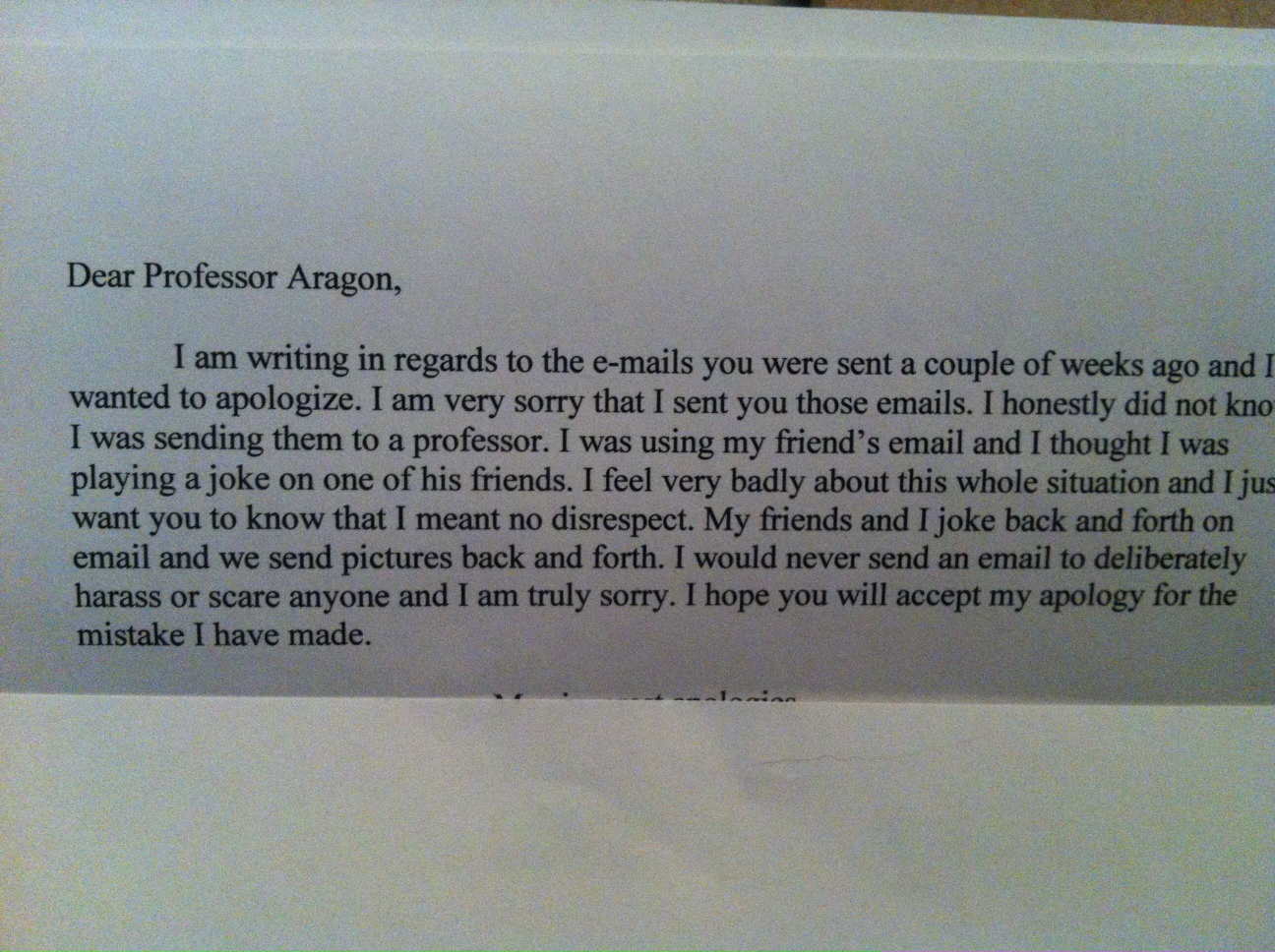
This Summer I cleaned and reorganized the home office and I found one of two letters of apology. The short story is that one of my male students left his computer email open and his roommate and another decided to send lewd and threatening emails via my student’s Hotmail account. They also changed his password and were able to repeatedly send emails over the course of two days unbeknownst to my student. I reported the emails to the Chair and to the Campus Police. My student was banned from the classroom until this was sorted out. He bumped into me on campus and explained the situation. He was quite embarrassed and contrite and I realized that this was all some cruel stunt. The other students (roommate and friend) were contacted by the Campus Police and Student Affairs and had to write letters of apology. The letter below is the better of the two. I’m sure that this student never pulled a stunt like this again. Overall, I was thankful for the Chair, Campus Police, and university support.

Hopefully my post will help you maneuver the tricky situations that faculty face on campus. You want your classroom to be a place of learning and not have some side dramas drop like little bombs. If you have these situations in the classroom with student behavior, deal with it immediately and by all means document, document, and document. Make sure that you have followed the university norms and confer with a trusted colleague about the protocol. Also, verify what the Code of Conduct states. And, remember that it is not always about you. Chances are it really is about the student who made the comment(s). Good Luck!

Reminder for Grad School Applications

It is that time of year, before the term begins or before it gets really hairy…this is the perfect time for students to think about their grad school options. My words of advice is to be organized. Most students will approach faculty in October or later and this is when professors are writing lots of students letters of reference for graduate school. Be organized. You should hopefully have put together a list of schools that you’re going to apply to. Remember to include more than one school with this list! You should have a sure bet school, the programs you would really like, and then the dream options.

How can you make this application process easier?

1. Ask professors weeks before the letters are due.

2. Provide us all the information we need.

This includes~ Who, What, Where, and When, Fill out all necessary forms. Really organized students provide me a Word or Excel file with the schools, deadlines, and any additional information.

I ask for a copy of your letter of intent and cv/resume. I might even meet with you and ask what your motivation is for continuing your education.

3. Remind us. Send an email a few days before a due date.

4. Thank us. This can be an email or a note. It’s not necessary to do more. Remember that your tenure line faculty actually get paid to mentor and do things like write letters. Keep in mind that part-time faculty do not get compensated for this extra work. Remember to thank them profusely–a card, bottle of wine or a face to face thank you is nice.

Good luck with this process! And, remember this process is nerve wracking!

Boundaries: Saying No

I have had a hard time saying no. This is the nature of one dozen years as adjunct or sessional faculty–what many refer to as the New Faculty Majority. Now, I’m about to start my fourth year as tenure line faculty and this will mark the fourth year out of fifteen when I shut my door. My door is only open during office hours. I make no apologies for this. I am open and available for consultations during my office hours or appointments. Truthfully, a senior colleague insisted that I shut my door to get my work done. To this day, I thank him for his honesty.

Likewise, I’ve  become better at allowing myself to take a vacation. This means not responding to student emails and more importantly not feeling guilty about it. Of course, I never got the sheer volume of emails previously. This changed when I got my tenure line job and was also made an Undergraduate Advisor. Students need advising year round. The department where I work has assigned other faculty during my vacation, but that doesn’t stop the emails from trickling in. Perhaps it helps the deluge!

This May I started an email to myself where I remind myself of my professional declines. I cannot do everything and anything. I note my achievements via my CV, but what about those moments when I protect my time and sanity and say, “no.” Well, I have an email to self that shares my no accomplishments. I started this in May and I’m only at 18, but each one of these declines allowed me to spend more time on teaching, advising, myself, and work/life balance. So, I suggest that we remember to celebrate boundary keeping and those moments when we must politely decline.Don’t get me wrong–I say yes to lots of meetings and opportunities. I do believe the department head would concur that I am a good citizen in the department and for the faculty at large.

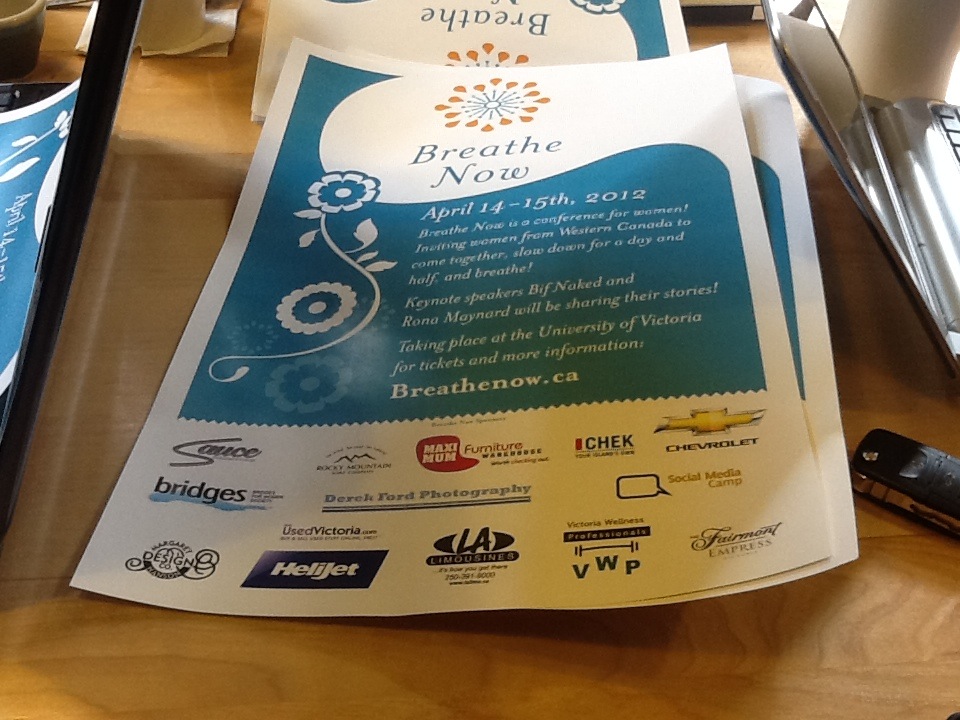
But, the department head has also encouraged me to say no more. I’ve had colleagues who have a printout that read: Just say NO within their field of vision as a reminder when they are on the phone. Oh, that reminds me to add another point. I’m at 19! And, I am also reminded me of themes at Breathe Now, a conference that I co-coordinated with Janice Mansfield, Angela Rafuse-Tahir, and Yukari Peerless. Many of our speakers noted that it’s important to take time for yourself–breathe. Say no, when you need to!

Are you serious? When Social Media Loudly Triggers

The interesting thing about social media is not just the immediate means of communicating with people locally and internationally, but you also learn more abou behavior. There are moments when things are rather serious in terms of discussion about education, politics, violence, and other hot button sorts of issues. There are also those moments, when things can get light-hearted and interesting. It isn’t all doom and gloom, and erudition. But there are times when you have to shake your head and wonder about the bravery, and cowardice demonstrated on social media platforms.

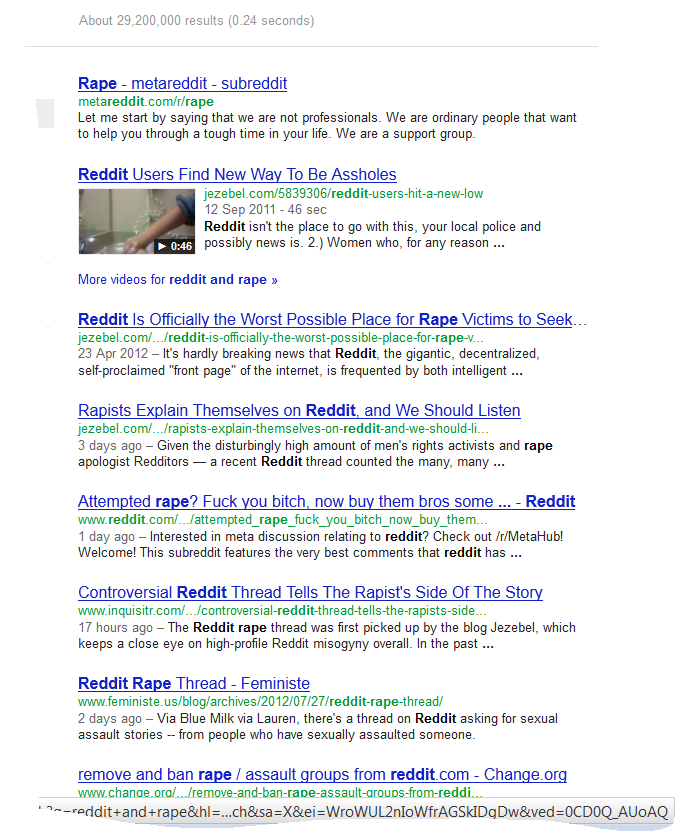
All of the above banter, though, doesn’t begin to explain my sheer frustration and anger over the continual dismissal of rape and rape victims on Reddit by some Reddit users. Here, I might as well place big red target on my chest. But, Googling Reddit and rape is illuminating, as there is a pattern of conversations about rape that second-guess survivors of both sexes. The pages of comments responding to posts is mind-numbing. I’m going to just say it–most of these posts drip with misogyny, and this saddens me. Perhaps I am painfully naive to expect more from people, but this is a serious issue.

The above image is from a screen shot of a Google search Reddit and Rape from July 30, 2012. Notice that there are hits from April related to rape discussions on Reddit.

The thing that really pisses me off about the out of control comments is that some of those commenting seem to not care that the survivors are speaking their truth. And, it’s cowardly to attack the survivors, and second guess the veracity of their statements. Rape statistics are notoriously under-reported. Whatever the exact statistics are for the country, state or province that you reside in–the number is actually higher. Why? There is a still a stigma with rape and violence. And, we know that in many instances the assailant is an acquaintance, which can complicate reporting.

So, Reddit I usually don’t weigh in on my problems with some of the posts, but today I’m calling out all the malcontents and cowards who used their strength behind their monitors, tablets, smart phones to attack survivors. Daniel Tosh (will not link to him) learned that joking about rape caused a reaction–but the fact that he joked about the gang rape of a heckler also speaks volumes. Please don’t shirk that we don’t live in rape culture. We do. We see it rear its ugly head more online, though. Remember this.

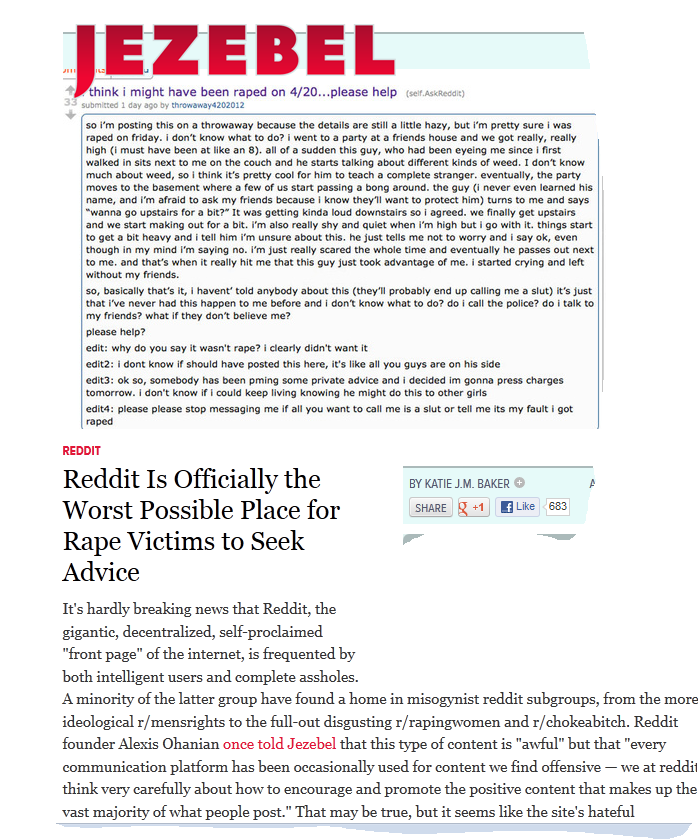
Jezebel has also weighed in again and again about misogyny on Reddit. Here is a screen shot from one post last week. As you might have noticed, I have not connected to the exact Reddit or Jezebel articles. I feel like I should, but then I don’t want to send people to the site for more hits. You are free to Google the articles!

I really hope that the next time there is a discussion about violence on Reddit or other social media platforms people will think before they second-guess the survivor and say even worse. The reality is that all of us knows a survivor of violence–she or he might not have shared it with you, yet.

Mentoring and Coaching: Post-Graduation

I’ve blogged lots about mentoring and coaching. I’ve differentiated the ways that some students require more hands on approach–ergo the mentoring, and some require less and I view this as more of the coaching strategy. I decided to do something different and buy some stationery and send some of my mentees (will use just that word) a note. I wrote the notes recently, but will send them prior to the Fall term. Now, I’ve sent emails and messages via other social media platforms, but I’m kicking it old school with the note cards.

Some of them will start or continue graduate school in the Fall, and others will join the working world outside of academe. I bought these note cards at the Papery on Fort St in Victoria, BC and chose something that was not too big, so that the sentiment wasn’t a thesis. My intention was to write something supportive, and dispense some advice. Academics tend to live our lives term by term or maybe even school year by school year. Graduate students get used to this, too. After graduation many of my former students note that they miss college and the schedule. Thus, I felt it was appropriate to send the note card just when a school term starts and the graduate might reminisce about their undergraduate days. (I know that many of them do, as I get the emails or Facebook messages telling me that they miss their university days and their old schedules).

Each note card was personalized to the particular mentee and my wishes for them. I gave them well wishes and felt quite emotional as I wrote the cards. I’ve given cards for graduation during the last several years, but these cards of well-wishes were different. I don’t view them as closure to our relationship, as I see the mentoring or coaching as not having an expiration date. And, to be quite frank a few of these mentees are now actually great friends to me, and my family. Now, for any former students who didn’t get a note and are wondering where is there note card–this was a first time project and I sent out several. I will do this again. I really hope the students who get the note cards appreciate them. I’ve only started this and will see how it works.