Patience and Mid-Terms

I come to my classes with a sense of compassion. The first week is a major clusterbug for everyone. And, we can ratchet this higher for the new students. What I find that I need to work on is my sense of patience during the upcoming weeks. No matter how many times I gently remind students, some will not bother to review the syllabus and email me queries that can be answered ever so quickly with a glance to the course syllabus. This term I have done something different–the quiz and the mid-term have a question related to the syllabus.

I also am aware that my class is one of four or five and once the students get into the routine, they will have a better idea regarding the protocol on campus. Until then, I read the emails, pause, smile and reply that, “As the syllabus states…” If anything, the flip side, is that the student is bothering to care to make sure that s/he gets the right information and reads the material, shows up to class on time, comes to my office hours at the right time, right? And, let’s be honest, there are moments when a keen student eye finds an error on the syllabus and I appreciate it! So, I am not perfect and I know that my students aren’t either.

I also wish that patience worked the other way. Students need to remember that I am one person serving many. My office hours are limited to some 4 because I have to teach my classes, get some administrative work, prepare for my courses, and possibly steal time for my own work. We are at the start of month two of the new term, and I am sure it will be another great, busy one. At this moment, I am thinking of Guns and Roses. Smiles. This is a reference to their song.

Dr. Seuss

“Be who you are and say what you feel because those who mind don’t matter and those who matter don’t mind.” Dr. Seuss

I used my writing prompt book and I have to say that I appreciate this quote from Dr. Seuss. It speaks to me at the moment. I’ve read lots of his books to my kids and remember reading the books a long, long time ago. There is something about the books and reading them aloud that is soothing. It’s the wit and the nonsensical stories that entertain. I also think that Dr. Seuss holds a place in my memory as an academic due to the collection at the UCSD Library.

I spent many days at the library working on my grad school papers and my dissertation. The foyer occasionally displayed some of Dr. Seuss collections and I would at times procrastinate and pore through the holdings. Well, Dr. Seuss also had some war propaganda pieces and part of my work focused on Mass Political Behavior–I was doing research! In all seriousness, this quote is an important one for reflection. People who care about you  aren’t apt to take offense at what you say. The people who care about you get you and are more willing to accept you and your quirks. And, well the people who have problems with what you say…they might not be worth your time. I know that this is not a truth; however, it is worth thinking about when you interact thoughtfully with people.

Students with an Edge

In my sixteen years of teaching, not one term has gone by when I do not have at least one student athlete in one of my classes. One thing that I have noticed with the vast majority of the student athletes is that they have drive. These students usually want to excel on the class. Their competitive edge extends into the classroom. They know that their coaches and education team (whoever this may be at the respective institution) expects them to show up to class and to practice. Most of these students will introduce themselves to me during the first week or two and my standard practice is to ask that their contact send me any invitational or team related travel dates. While I have taught at four different institutions none have been at a major sports school–no top ten football programs, which is often a marker for a “big name” institution. I have taught at Division 1 institutions; however, this was at the start of my teaching career.

I truly wish that more of my students had this same drive and felt accountable to their coach or team. This does not mean that my students who are not athletes are slackers! Not true. The typical student wants to do well, but knows that among their array of courses some get more effort. The student athletes are generally more competitive and want to do well in all of their courses, so it is not a big surprise to see at the annual fundraising breakfast that many of them have strong grade point averages. Can I just spend a quick moment to say that I am proud of them. Very proud. And, I know that my colleagues are, too.

It is less common for one of the student athletes to phone it in with their coursework. When I have had a student athlete under-perform, the student has immediately contacted me via email, come to office hours, or in one instance the basketball coach called me to meet with him. When I met with the coach, he made no excuses for the student and said, “His first job is being a student. Do not go easy on him.” I wasn’t going to, but let me tell you that walking into the office was an intimidating experience. I felt empowered and I know that many of my colleagues will counter with examples of grade changes or pressure by the administration to change grades; however, this is not my experience. Getting back to the students–when they under-perform they want to know what they can do to fix it. Thankfully, the student athlete under-performing in my classes is not very common. They are competitive through and through and want to do well. I do not give them any extra credit or leeway. What I want to see is more students with that fire in their belly. Be competitive and humble. The photo below is one I took at the McKinnon Pool–one of the pools where the student athletes swim.

20131230-210921.jpg

2013 The Year of Reflection

I’m reading lots of top ten posts about 2013 and thinking about the last year. The last year was consumed with having to find balance. This was not having some idealistic want for balance, but rather out of necessity. What have I learned in these last 12 months? Well, I’m going to share my top ten thoughts from 2013.

1. Stay Healthy–this includes exercise, sleep, and eating right

2. Say no strategically

3. Work smarter–this meant rethinking my productivity

4. Make time for family and friends

5. Say yes strategically

6. Read, relax, and run

7. Be firm

8. Honesty is important

9. Unwind

10. Happiness is more important than just about everything

The list is in no particular order. I will say this there is nothing like a health emergency to force you to rethink everything. I am forever grateful to the family and friends who were supportive during the last year, as we coped. I am looking forward to 2014. I am sure it will hold lots and I look forward to tackling it with my family by me.

20131230-055223.jpg

Make Sure that Your Girls Aren’t Too Ambitious

One of my students shared the Cosmo Special Report in the October 2013 issue. I photo copied the article, read it, and have carried it around for two months. I wanted to blog about it immediately, but alas, grading and other work related responsibilities got in the way of a response. Here I am just weeks before a new year begins and I am finally ready to comment on the nine page article, “The Ambition Gap” by Lorie Gottlieb. The Cole’s Notes version is that single women are more ambitious and successful than their male cohort and consequently are having a hard time finding an equal. It is more complicated than this, but this article speaks to the supposed crisis of heterosexual masculinity (see Michael Atkinson for an informed position), women’s success, and the alleged post-feminist era. Yes, the article assumes that the coupling is between a heterosexual couple.

The first point that I want to make is that we are not in a post-feminist era. We are not in a feminist era. We are in an era that extols the importance of equality, but we wring our hands when we talk about the reality of who is successful, who sits at the table, and who are the high earners. Now, clearly, happiness and ambition are not mutually exclusive. What Gottleib is getting at, though, is that men are “losing their drive” (144). She recounts story after story of the young, single, successful woman who is more successful than their male partners or former partners. Thanks to the success of Liberal feminisms, we see more women working, buying homes, and in managerial positions (Gottleib 145). However, I want to ask: which women? Surely, we need to disaggregate and examine these numbers. Lots of statistics in the US and Canada illustrate that more single headed households are women headed households. We are also quite familiar with the fact that men, on average, make more money than women. And, when we look at upper management, board of directors, and chief executive officers the picture becomes more homogenous–male and white.

On page 147, Gottlieb has a column dedicated to “Watch Out for These Red Flags.” And, what are they?
1. He has no plan 2. He doesn’t communicate 3. He’s envious of your success 4. He takes advantage 5. He’s resistant to change

I am no dating expert; however, I think that these are red flags for most in their 20s and older and not so much about an ambition gap. Gottleib offers a shallow examination, but at the same time does not ask more important questions regarding race, class, sexual orientation, education, and types of career. Women might earn 60% of the undergraduate and graduate degrees (148), but she does not break this down enough for me. Why do I care? My experience as a university professor and one who has continued to look at women, politics, leadership, and higher education, I know that women tend to gravitate to certain fields of study that do not translate into higher earning jobs. We see women over-represented in Education, Humanities, and Social Work and under-represented in Engineering, Sciences, and Computer Sciences. This, then, influences the earning power for women.

What do I like about the article? Well, it was provocative and I read it closely several times. I also appreciated her column about “How You Can Bridge the Gap.” She pulls from Sheryl Sandberg’s Lean In (my thoughts on the Lean In movement).

She offers some points of advice: 1. Prescreen 2. Establish boundaries 3. Accept trade-offs 4. Give him a nudge

This advice is timeless and part of having a healthy partnership for heterosexual or same-sex couples. What do we do? Encourage people to think about what they want and how they want to pursue their dreams. Encourage girls to go into the STEM fields and work on the leaky pipeline for women and work. I am also concerned with this notion that women are too ambitious. There are parts of the article that equate being single with too much work success. This message is problematic.


Before The New Term Begins: Redux

This is a revised post that is still applicable. It’s that time of year when most college students are thinking about the next year’s classes. This is a slow teaching time for most regular faculty (note this doesn’t include the sessional instructors, who usually have to teach full-time in order to stay afloat). One of the things that we forget though, is that this time of year is very busy for advisors and others who help students figure out courses and other important matter that is important to student success.

This quick note is a reminder for patience. Patience for the frantic student who needs a little reassurance about classes. For instance, I am finding that I am fielding more emails where a student really wants advice. “Which classes should I take?” A few have actually said, I want to know your recommendations. This is a big responsibility for me. Typically the student who asks, has already taken a course with me. So, I need to think about his/her interests and weigh my knowledge of the department’s courses. At first I would suggest all our courses, but now I am more careful. This is not based on content, but rather thinking more strategically about the student and her/his interests and possible grad school interests.

One common response from students is that they have heard that a colleague is a GPA buster. I always smile at this and explain that if the student wants to focus on Area A, for instance, in grad school that she absolutely needs to have a class with said colleague. The majority of the students come back to my office the next term and thank me for my suggestion. The other thing is that most students will do better in a course that interests them. I usually do not feel that this is a good excuse to not take a course. Also, our sub-fields are small and prospective grad schools and or entrance committees get used to seeing the same names and marks and they might understand that Prof. X is a tough marker.

I think that when I am queried–it is acceptable for me to make course suggestions to students. But, that pesky need of having the syllabi done–not completed! Eeeps, yes, those syllabi will not write themselves.

Read the Syllabus, Please

The syllabus is the course contract. This statement sounds like a simple one, but alas, it is not. The statement might sound legalistic, but it is not. The truth is that the syllabus is our guide for the course, not a guideline, but the rules. The thing that I try to remember is that while I take special care with crafting the syllabus and the ways in which I will evaluate my students, I do not have control over their time. I need to make sure that my syllabus clearly states the all the necessary information for student success. I also know that students have multiple courses with multiple deadlines. And, as much as I want to get frustrated that they are not reading the syllabus, it is a waste of time to get frustrated about them not reading. Instead, I am prepared to re-read and revisit the syllabus as necessary prior to assignment due dates. Plus, I must remember that they have three to four other syllabi to keep track of during the term and that my class is one of many.

No, instead, I remind them about the information on the syllabus and refer them to it. Each term many will say something to the effect, “Oh, I must have missed that.” I typically smile and say, “I know that you have four other courses, it is easy to get the information mixed up.” This is a better use of my time and emotional energy. My job is not to chastise or scold. Frankly, I do not like scolding unless I absolutely have to do so. My job is to give the information and move on to the next query or item. Sure, I chat with colleagues about how syllabi are not read. I am sympathetic and am the first to talk to a colleague about what we can do to make this better. However, each term it is the same song and dance. This term I noted in two different places on my syllabus that class would not meet during our Reading Break. The note is in bold, too. My Teaching Assistants went to the class and found almost half of my class sitting in the lecture hall. They looked at the students and said, “You need to read the syllabus. There is no class today.” I  am guessing that my students really liked the material and were keen for another lecture.

What can we do? Review the syllabus with the students and review it more than once. Remind them of the deadlines and refer them repeatedly to the appropriate resources on campus. My syllabi are considerably longer than before, but I am OK with that. This means that I have as much helpful information as possible and I am doing my job. The other half of this is that the students must do their job and review the syllabus–highlighting due dates and keeping an organized calendar. Yes, I am speaking to the students owning part of this and that might require a different blog post. And, I probably should work on that blog post, but now, I am thinking about the syllabi for next term and how I need to be as clear as the water in Maui. I am pining for warmer weather–can you blame me it is almost winter and I know that in just a week I will start three weeks of intensive marking and occasionally write on papers: you should have read the syllabus and followed directions.

on the syllabus baby

Please note that the above  photo of “Sassy Syllabus Baby” is from a former student who did get permission from his family to use the photo. And, Kevin always read the syllabus. May he have a great post-university life!

Make a Difference

I bought a writing prompt book and I do not use it as much as I would like to do so. This post is a response to, “Believe with all your heart that how you live your life makes a difference” by Colin Beavan. This quote made me think about work and university life in general. I use the quotes as a writing response and try to put pen to paper (yes, I hand write them out first) my first thoughts to the particular quote. Here are my first thoughts about Beavan’s quote.

Some people like to think of the university as this quaint place where professors reside in Ivory Towers or perhaps silos and are completely shut off from the rest of society. In fact, some opine that professors are clueless about the so-called real world. We professors are at times depicted as this uber-privileged class who are disinterested in students and teaching. Our students are often depicted as this group of youth who are hiding out in university learning about books or issues that will not help them get a job. Yes, that coveted job is the end result or want for our students. These depictions might offer an accurate view of some of my colleagues and some students; however, I would argue that for most these stereotypes or caricatures are false based on 16 years of teaching in universities in the US and Canada. Yes, this is my opinion.

The reality could not be further from the truth. Many professors are engaged in a myriad of work related projects that stem from research, teaching, service, governance in their units or across campus, as well as some community building in their disciplines or the wider community in which they live in locally. Sure, there are research intensive colleagues who are focused on that next book and their army of graduate students that they supervise. The university needs these different types of professors. This post is not about the army of exploited contingent faculty, as that deserves a monograph or at least its own post. It speaks volumes that I have this footnote or sidebar note in my scrawl on the writing prompt sheet.

Many do not understand that prior to smart-phones and other advances with digital technology, professors’ flexible schedules means that there is always work to do. There are always assignments that require marking, emails to get to, research to do, writing to think about and maybe do, and then more emails to respond to from students, colleagues, and others. With the advent of increased use of technology, people expect to hear back faster and in many instances you will get follow up emails about an email that was sent 15 minutes earlier or perhaps a few hours earlier. I have been emailed three times within my lunch hour by an administrative assistant about a meeting. The meeting was not a life threatening situation; however, my lunch hour meant that I was available. I did not respond until I was done with my lunch and my errand across campus. But, let me say that I was not keen to see a flurry of emails about something that was not pressing. My point is that boundaries are thin. Perhaps you think that I have moved away from the quote. But, I’m sitting here thinking about work and how I try to live my work life as if it makes a difference to those around me: my students. Do not get me wrong, I like my colleagues across campus, but my primary role right now is teaching and mentoring. This means that I need to go in each day and remember this quote. The little things that we do can make a difference.

20131105-082156.jpg

Wente: Redux

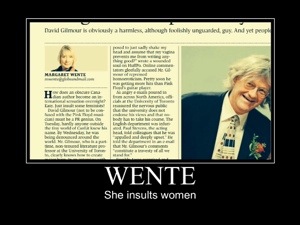
Margaret Wente is in the business of getting more clicks, commentary, and raising her profile. This does not mean that she has anything great to say–in my honest (notice I didn’t say humble) opinion. I think that Wente does a great job of repeatedly insulting women. I took it upon myself to use the “Motivation” app for this last article in the Globe and Mail.

20130928-180003.jpg

Frosh Chants and Consequences

In the last few weeks, three Canadian universities have made headlines within days of one another and not the way that development officers like to see. Students at St. Mary’s University (SMU) in Halifax, NS chanted a truly unfortunate chant at a university sanctioned event. Students from the University of British Columbia Sauder School of Business said the same chant during some Frosh activities. Then, the Engineering students at Memorial used an unfortunate term on their mugs for their pub crawl. Student leaders at SMU and UBC have resigned. All three schools have noted that investigations will take place and awareness campaigns or sensitivity training workshops are forthcoming.

As a feminist social scientist I was not surprised that the students felt it was acceptable to engage in the chants. We live in a hypersexualized world where social justice activists, rape crisis workers, and academics working in Women’s Studies or other fields continually explain that rape culture thrives. During the last sixteen years, I have dedicated my career in Political Science and Women’s Studies to teaching courses related to gender and difference in an academic setting. I work with undergraduate students and I see and hear things on campus. While the chants are offensive–these are not isolated events, we need to ask why students feel compelled to participate in the chants. I have seen posters on campuses for different student events, like a sailing club’s pub crawl event called: “outrigger and gold digger” pub crawl. One only has to walk around a university to find some very interesting posters for events usually held off campus.

Thanks to the chants we are talking more about Rape Culture. But, what is Rape Culture? Rape Culture is the end product of the hypersexulization of women and men and excuses harassments, chants, and acts of violence against women and men. Rape culture causes people to think that joking about having non-consensual sex with a minor is not rape–but a light hearted moment. Rape Culture allowed the sexualized violence of Steubenville to take place, where at first the town appeared to defend the young men involved and attacked the victim. And, I argue that this hypersexualized culture makes posting questionable photos on Facebook acceptable, but a photo of a nursing mother objectionable. Rape culture also educates boys and men that girls and women are always sexually available to them. We need to have more conversations about consent and sexualized violence. We also need to discuss what make up the components of healthy sexuality.

What is telling about these episodes is the varied reactions. For instance, the comments online on newspaper sites or other platforms. My students chide me and say, “Don’t look at the comments.” I try to not do so, but then occasionally I wonder what people are saying.  The comments are at times instructive and then illuminating about the sheer depth of rape culture. Why do I say this? Well, when people post that they should be able to joke about sexual assault and that it’s just a joke, I take issue with that. There are certain things that we should not joke about and instead understand that violence against women is not a joking matter. I have a great sense of humor, but there are some issues that deserve serious conversations. Let’s continue the learning and the conversation.