Revise and Resubmit

What would you do if you had a second chance? In my line of work, when I submit an article or proposal I can often get the opportunity to revise and resubmit the article or proposal. Well, a rejection requires assessing where the article goes next!  But, this post isn’t really about me. Instead, I am thinking of students and their need for second chances. There are moments when a second chance is needed. I do not like to think of myself as heartless when it comes to special situations; however, I also do not like feeling like I am someone’s rube.

There are these moments, when I have to step back and think about what is the cost of allowing a revision for a student. The revision might offer the student the chance for success or the opportunity to try to do better on the particular assignment. Ultimately, I do want students to learn and feel success. However, the means by which this is done is through their hard work. Then, I need to balance the entire group and think about my willingness to offer a second chance to 20-200 people. This is when it get tricky.

One thing that I am having to grapple with is the trickle of students who come to my office hours informing me that they did not do well on an assignment based on not just feeling prepared or some other issue that sounds like mere excuse. Here, I am not speaking to an illness or other major issue. Part of life is managing multiple stressors and responsibilities; yet, a cold before a major assignment is supposed to make a major difference. I cannot comprehend this as an excuse. Perhaps I am contradicting my last post. I feel patient, but less patient due to excuses. And, my syllabi include all the due dates and all the assignments. Is this a rant post? Tilts head and thinks–yes, but a short one.

I love Grumpy Cat and I suppose it is well-known. A colleague from another unit gave this to me and I keep on taking photos of it–knowing that Grumpy Cat would hate it.


20140208-220515.jpg

Make a Difference

I bought a writing prompt book and I do not use it as much as I would like to do so. This post is a response to, “Believe with all your heart that how you live your life makes a difference” by Colin Beavan. This quote made me think about work and university life in general. I use the quotes as a writing response and try to put pen to paper (yes, I hand write them out first) my first thoughts to the particular quote. Here are my first thoughts about Beavan’s quote.

Some people like to think of the university as this quaint place where professors reside in Ivory Towers or perhaps silos and are completely shut off from the rest of society. In fact, some opine that professors are clueless about the so-called real world. We professors are at times depicted as this uber-privileged class who are disinterested in students and teaching. Our students are often depicted as this group of youth who are hiding out in university learning about books or issues that will not help them get a job. Yes, that coveted job is the end result or want for our students. These depictions might offer an accurate view of some of my colleagues and some students; however, I would argue that for most these stereotypes or caricatures are false based on 16 years of teaching in universities in the US and Canada. Yes, this is my opinion.

The reality could not be further from the truth. Many professors are engaged in a myriad of work related projects that stem from research, teaching, service, governance in their units or across campus, as well as some community building in their disciplines or the wider community in which they live in locally. Sure, there are research intensive colleagues who are focused on that next book and their army of graduate students that they supervise. The university needs these different types of professors. This post is not about the army of exploited contingent faculty, as that deserves a monograph or at least its own post. It speaks volumes that I have this footnote or sidebar note in my scrawl on the writing prompt sheet.

Many do not understand that prior to smart-phones and other advances with digital technology, professors’ flexible schedules means that there is always work to do. There are always assignments that require marking, emails to get to, research to do, writing to think about and maybe do, and then more emails to respond to from students, colleagues, and others. With the advent of increased use of technology, people expect to hear back faster and in many instances you will get follow up emails about an email that was sent 15 minutes earlier or perhaps a few hours earlier. I have been emailed three times within my lunch hour by an administrative assistant about a meeting. The meeting was not a life threatening situation; however, my lunch hour meant that I was available. I did not respond until I was done with my lunch and my errand across campus. But, let me say that I was not keen to see a flurry of emails about something that was not pressing. My point is that boundaries are thin. Perhaps you think that I have moved away from the quote. But, I’m sitting here thinking about work and how I try to live my work life as if it makes a difference to those around me: my students. Do not get me wrong, I like my colleagues across campus, but my primary role right now is teaching and mentoring. This means that I need to go in each day and remember this quote. The little things that we do can make a difference.

20131105-082156.jpg

Welcome to the New Term

I live my life according to the academic year. This means the Fall term, Winter term, then the Summer term are my work cycles. A new term is right around the corner and I am thinking about what I want this term. I am going to refer to a previous post about my want to not glorify busy. Academics love lists. This includes explaining in an exasperated way that we are very busy, and then listing the number of items that we must get to before we go into the sun and sparkle like a Cullen vamp or worse yet, explode like a vamp in True Blood.

I am trying to have better work life balance and hope that I can continue this in the next term. What am I doing? I am taking special care to not check my phone the first thing in the morning, and this is a major coup. I will start with my stretches, coffee, and paper, and then get to the phone (this translates into checking my email accounts and Twitter feed). I do not know about you, but I can go down the social media rabbit hole and suddenly be late for the gym or to take my spawnlette to school. This past Spring, I was better at leaving emails and Twitter for last, and no one complained about email response times, and I bet my Twitter followers gave a sigh of relief to see fewer tweets.

By not glorifying busy, I might post/share that I got something done, but I am done with listing and trying to prove that I am busy. I know that I am and I know that you are also busy. I also am not engaging those conversations where it feels like a colleague online or in real life is glorifying busy. For Petra’s sake, those of us on the tenure track have: great job flexibility, a job, and yes, we have to teach and publish in order to keep our jobs. But, overall, we get paid to think and talk. I am not competing in the Busy Olympics and if you feel that you have to, you might want to re-think that. How do I model this, though? I have to tell myself to not respond so quickly to emails and not email colleagues during the weekend. I am trying to have better boundaries. I explain to my Teaching Assistants that emails over the weekend are meant to be thought of as a Monday morning email. I also schedule emails so that they are sent Monday-Friday during the workday. These smart devices keep us connected, but also do not allow us to have time off without feeling guilty.

The new term is starting and I am not going to feel guilty that my to-do list is long, as I chip away at it. But, my job’s priority is teaching and I promise to not phone that in, as students do not appreciate that. When they come to class, ready to discuss the readings, they want me there ready to teach and facilitate. I am ready. Oh, and I am not a Cylon. I am human and have to remember this…I am not a machine. Well, my daughter says, “How do you know? You could be a sleeper agent.” I am going to assume that I am not a Cylon.

IMG_1569

I took the above photo at the EMP in Seattle, Washington. It was part of a Battlestar Galactica exhibit. So say we all!

Lean In Keynote: Blog Her 13

I am at Blog Her 13 in Chicago and this morning attended Sheryl Sandberg’s keynote and then attended the Lean In Circle workshop. Where to start. The keynote was more of a discussion between Lisa Stone, Blog Her, and Sheryl Sandberg, Facebook COO. Sandberg was on the floor taking photos with delegates, signing books, and just meeting people. I had a chance to take a photo and talk to her for a few precious minutes about her book, Lean In. She was gracious with the crowd and was eventually pulled away for the keynote. As I waited in line for my moment with her, I was reminded of my Comic-Con experiences and felt like a fan girl.

Her keynote hit on the points outlined in the book and Stone asked some great questions. She also shared that the Blog Her Visionaries survey was filled out quickly within hours. I am one of these people and was happy to fill out the short survey about the book and movement. What I enjoyed most was how honest Sandberg came across. On the table sat some Lean In branded sheets to write down what you would do if you were not afraid. Sandberg shared her’s: Write a book about feminism. Yes, you read that correctly. She also seemed comfortable with embracing the term, feminism. It is clear that she is a strong advocate for women and men and their success. She made a point to share that some male executives have told her, “You have cost me lots of money.” Why? Because women are asking for raises!

I have previously blogged about her book and the movement. I am registered with the Lean In site and in an Education circle. I will blog later about the Lean In Circle workshop. It was amazing and I am still processing it. I have a page of notes to mull over, as I think about my workshop experience. Overall, I was glad that I woke up early to get a rock star seat at the keynote. And, I got to finally meet Veronica Arreola, Professional Feminist! We had a good chat about the book, too.

20130727-145846.jpg

20130727-145910.jpg

Presence as a Gift

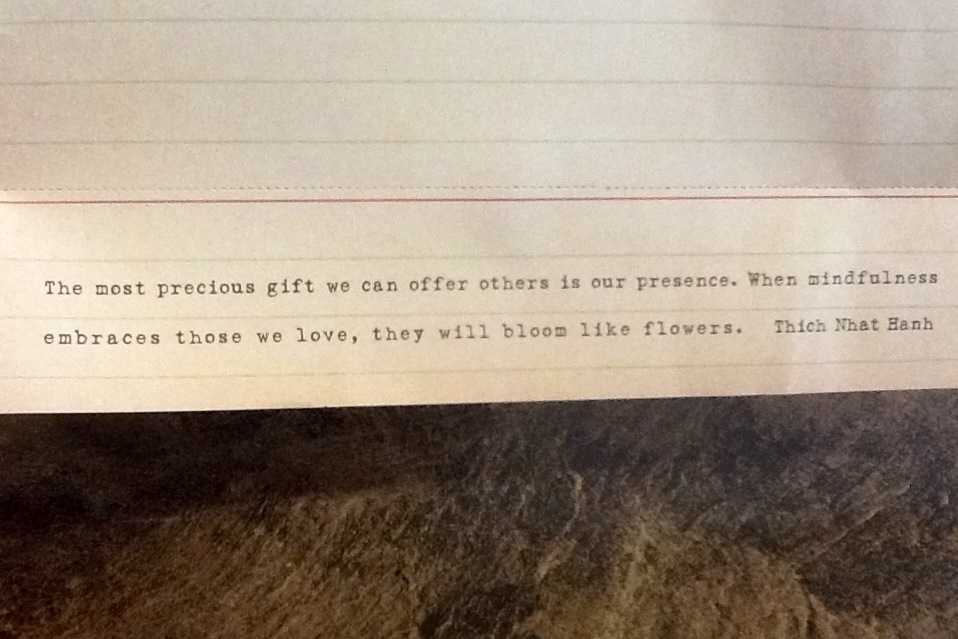
This quote reminds me what a gift mindful listening is. I refer to being present and communicating. We are all so busy and giving the gift of our time is a real present. This is really about the gift of mindfulness when we are with others. Are you a good listener? Are you present when you are with your loved ones, friends, and co-workers? I remember one of my professors from my undergraduate days could never be bothered to actually look at me or near my direction during office hours. She was too busy doing her mail and putting together her next lecture. I never felt like I had her attention. I learned something from those visits to her office, though.I learned that I would never do this during my office hours. I am present.

I have my limits and know what times of day that I am best for better listening or office hours, for instance. It is important to know when you are productive for the work that you need to do. As much as I would love to have my office hours one day a week, like some of my friends, I just can’t do that. I need about an hour or hour and a half at tops to focus, listen, and help. Then, I need to take care of the paperwork from the meetings, and get to the next task. I feel that I can offer my full presence two to three designated times per week and then for appointments as needed another hour in the week. Now these are the sort of meetings where I am working with my undergrads. I’m not referring to meetings with my graduate students or colleagues.

I attend lots of meetings based on sitting on different committees and I have to say that it is easiest to be present with the focused or organized meetings and most of the university meetings have an organized agenda, which I really appreciate. When the Chair of the meeting leads effectively, the meeting is more successful. One colleague from the Law Faculty would also time the different points on the agenda. These organized meetings kept all of us present. I wish that I was able to follow suit with this tactic, but overall, I learned lots from her. She was present and made sure that we all were present at our meetings.

Thinking of friends and presence is important, too. I really need to feel like the friendship is mutual in order to be present and give my attention. I can recharge after a great coffee or lunch with a good friend and I hope that they feel the same way. And, of course, I try to be present at home with my family. How do you focus? How do you stay present? One easy tactic is to keep the technology at a minimum or to have technology breaks. I will do this with girlfriends, a social media break when we all spend 2-3 minutes checking in or we agree to no phones. My family keeps me on track: they ask me to unplug. How are you mindful?

20130721-194756.jpg

Continuing the Conversation About Leaning In

Many are still responding to Sheryl Sandberg’s Lean In. People have both applauded and attacked the book and Sandberg. I was recently catching up on my magazines and read a review in the April issue of the Atlantic and came across Garance Franke-Ruta’s “Miss Education.” Franke-Ruta notes that women are doing a great job in seeking higher education. Women are leaning in at university, but once they leave they fall behind. In short, we do well at school, but when we get our first job we do not negotiate well. I do not really agree with all of her article. Franke-Ruta uses dating as a metaphor. She explains that women are waiting to be noticed or wooed and this is different for men, since they seek out the job and feel more comfortable negotiating their salaries. Many articles and books point out that women do not negotiate their salaries and benefits well or as well as their male counterparts.

What the author is getting at in an interesting if not problematic way is that women are socialized to not negotiate well and to not find work in the same way that men do. This might explain why some 4.2% of Fortune 500 CEOs are women (28). What we might actually need is more leadership training for women, better mentoring programs in university, and in the workplace. Franke-Ruta is correct that education is not the panacea, but it is not just the formal education that is needed, but re-education of peoples’ expectations about women and men. We need better career education and mentoring all along the education and work pipeline. And, we need stop dismissing the career advice in Lean In and other books. They are targeting professional women and we need to embrace the message and not just attack the messenger. These books are clearly not for everyone–which career book is? I am including a screen shot from the article that assesses other similar books. Many thanks to the Franke-Ruta for her provocative review. You can see that these books share one major point: it’s important to ask for a raise.

20130715-112238.jpg

My Lifetime Listens to Yours. Muriel Ruckeyser

I have a book of quotes that serves as writing prompts and this is prompt two. There is space to write on the page, but I sent the first prompt to a friend in another department. And, have torn out the second prompt. Now, the title of this post comes from part of poem and the lengthy poem says lots. But, what does this excerpt say or how does it speak to you. I am thinking like a Political Scientist or Social Scientist at the moment and how I learn from reading and listening. If I think from a mentor’s point of view, I know that my reading and listening includes what is not said or spoken. People have “tells” for when they lie or feel uncomfortable and these nuances of movement are important to support and understand. What is your tell? I have different tells, but one is to stop and think and take a drink of water. During this short moment, I am thinking of my response–formulating what I want to say next.

We listen with more than our ears. But, do we learn from what we hear and see? I am in the midst of heavy marking and looked forward to this writing prompt and I come back to learning from others. I have also had several hours of office hours and meetings and tried my best to listen intently these past few work days. I firmly believe in life-long learning and this prompt reminds me of the importance of mindfulness. When I think of mindfulness, I always picture Dr. Juliann Allison, as she practices mindfulness in all that she does. This week I am trying to actively practice mindfulness. The Ruckeyser quote was the perfect reminder, as I try to balance out meetings, honors presentations, grading, and planning a conference. And, that is only part of the to do list. I’m breathing in and out and trying to listen.

Happy New Year!

Happy New Year! I hope that 2013 bring you joy, happiness, and good health. What else do I hope for with this New Year. Sure, I can say world peace, a cure for Cancer and AIDS, and for the government to really take action with the Fiscal Cliff/Idle No More Movement. And, I truly do wish for all of the above, but this post will instead focus on what I hope for my students in this new year.

The 2012-13 school year is essentially halfway through and I hope that first year students learned how important time-management was during their September term. I also hope that all students realized that office hours are priceless. You might have to queue up and wait for five or fifteen minutes–but those meetings with your Teaching Assistant or Professor really is worth the wait. I have never heard a student tell me that it was a waste of time to see me or one of my Teaching Assistants. In fact, I get follow up emails, note cards, or tweets thanking me for suggesting that we meet or that they met with their Teaching Assistant. So, dear student, please take advantage of our availability!

I also send the gift of reading the syllabus to students. This means highlighting due dates and the instructions for assignments. This is a rich You Tube video about Reading the Syllabus. This made me laugh! Oh, wow. How many of us have had one of these moments?!  There is also a Facebook page about Reading the Syllabus. In all seriousness, the syllabus is the contract between the professor and the student. We expect students to read and review the syllabus.

Get into the library. Attend a workshop about research or citation. Learn how to use the databases and get outside of your Wikipedia or Google comfort zones. Learn other better ways to conduct research. The vast  majority of you are not yet skilled at researching and could use a workshop or two to hone these skills. The A students are the ones who have taken the time to use databases and dig deeper. Do not be embarrassed -go speak to the Reference Librarians and your academic mind will be blown.

My last wish for 2013 is that students stay healthy and this includes their physical well-being and mental health. I feel terrible when a student gets hit with a serious illness that turns their term upside down. I also feel for the student who is dealing with mental health issues and is having a really difficult time. I am not a medical doctor and I certainly am not a mental health professional, so all I can do is be supportive and suggest the health center or the counseling center. Remember, when you’re having a tough time, don’t be embarrassed -contact your professor. We are here to help and it’s much better if we are in the loop.

Happy New Year!

janni 2012

Fri Fun Facts: Check In

Today’s Friday Fun Facts is dedicated to the check in. Periodically I have to take my car in to get its oil change and Canadian Tire will check the air pressure in my tires, as well as a host of other things. I am lucky to have a good dental plan and get my teeth cleaned twice per year. What about the check in at work? Some employers have annual reviews, and my  employer follows this procedure and some additional ones for the regular faculty.

But, I’m not so concerned with that right now. I’m thinking about the periodic check in that students should do with their schedules and classes. What does this include?

1. Going to class or at least having a plan for attending class. Now, you might work well with attending 75% of the lectures. I’d prefer to see students attend 80%, but hey, I’m on the other end of the equation.

2. Planning your time during the hectic post mid-term craziness. From here on out, my students are bombarded with deadline after deadline and then the final exam schedule. Free time is really an oxymoron, as they should have their time scheduled well in advance for paper writing, blog writing, and exam prep. I suggest you take out your phone or device and seriously plan out a realistic schematic of what you can do between now and December 20th.

3. This is basic–eat right, sleep right, and get some exercise in so that you can function. I’ve said it before–get a flu shot or step up the various routines to stay healthy. One of the best defense is hand washing. Yes, I said it and I’ve said this before on my blog.

4. Check in with your Teaching Assistant(s) and Professors! I wish I could say that I get lonely during my office hours, but I don’t. I have a bench out side my office and during my office hours the bench is kept warm. I have to say that I truly appreciate that my office hours are busy. This means that students are checking in with me to chat about assignments, ask for advice, chat about their schedules, help them in other ways, and overall serve as a mentor or coach to them.

5. Related to the above point–check in with the advising team in your department and Academic Advising.

6. This is really basic, but I have to repeat it: read your syllabus. Please read your syllabi! And, if you haven’t read it, please don’t ever say that to your Teaching Assistant or Professor. We really don’t like hearing that.

Enough! Check in–don’t check out!

Fri Fun Facts: Thanksgiving

Today is the Friday prior to Canadian Thanksgiving. Given this, it’s an appropriate time to think about what you are thankful for this Fall. I am very thankful for my family, friends, health, and my job. What your thankful for?

Make a list and write down five to ten things that make you feel content.

Make another list and write down where you would like to see yourself in the next six months or the next year. Think about what you can do to get yourself there.

Make a companion list to see what is holding you back from meeting the above goals.

After you’ve made these lists, spend a few minutes thinking about them. Here, I mean mindful thinking. You might listen to music, meditate, walk, enjoy a cup of coffee or tea and try to spend these minutes thinking about your goals and your sense of contentment.

It is important to spend time to celebrate your accomplishments and what makes you feel happy. A related part of this is thinking about your goals–this might keep you focused and happy.

But, I ask again–what are you thankful for?