Presence as a Gift

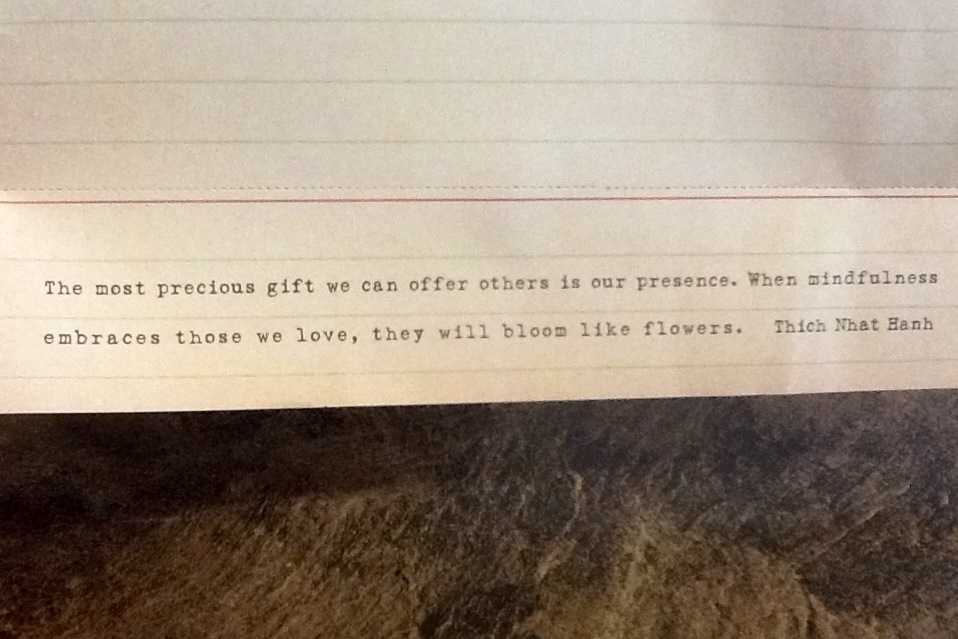
This quote reminds me what a gift mindful listening is. I refer to being present and communicating. We are all so busy and giving the gift of our time is a real present. This is really about the gift of mindfulness when we are with others. Are you a good listener? Are you present when you are with your loved ones, friends, and co-workers? I remember one of my professors from my undergraduate days could never be bothered to actually look at me or near my direction during office hours. She was too busy doing her mail and putting together her next lecture. I never felt like I had her attention. I learned something from those visits to her office, though.I learned that I would never do this during my office hours. I am present.

I have my limits and know what times of day that I am best for better listening or office hours, for instance. It is important to know when you are productive for the work that you need to do. As much as I would love to have my office hours one day a week, like some of my friends, I just can’t do that. I need about an hour or hour and a half at tops to focus, listen, and help. Then, I need to take care of the paperwork from the meetings, and get to the next task. I feel that I can offer my full presence two to three designated times per week and then for appointments as needed another hour in the week. Now these are the sort of meetings where I am working with my undergrads. I’m not referring to meetings with my graduate students or colleagues.

I attend lots of meetings based on sitting on different committees and I have to say that it is easiest to be present with the focused or organized meetings and most of the university meetings have an organized agenda, which I really appreciate. When the Chair of the meeting leads effectively, the meeting is more successful. One colleague from the Law Faculty would also time the different points on the agenda. These organized meetings kept all of us present. I wish that I was able to follow suit with this tactic, but overall, I learned lots from her. She was present and made sure that we all were present at our meetings.

Thinking of friends and presence is important, too. I really need to feel like the friendship is mutual in order to be present and give my attention. I can recharge after a great coffee or lunch with a good friend and I hope that they feel the same way. And, of course, I try to be present at home with my family. How do you focus? How do you stay present? One easy tactic is to keep the technology at a minimum or to have technology breaks. I will do this with girlfriends, a social media break when we all spend 2-3 minutes checking in or we agree to no phones. My family keeps me on track: they ask me to unplug. How are you mindful?

20130721-194756.jpg

Continuing the Conversation About Leaning In

Many are still responding to Sheryl Sandberg’s Lean In. People have both applauded and attacked the book and Sandberg. I was recently catching up on my magazines and read a review in the April issue of the Atlantic and came across Garance Franke-Ruta’s “Miss Education.” Franke-Ruta notes that women are doing a great job in seeking higher education. Women are leaning in at university, but once they leave they fall behind. In short, we do well at school, but when we get our first job we do not negotiate well. I do not really agree with all of her article. Franke-Ruta uses dating as a metaphor. She explains that women are waiting to be noticed or wooed and this is different for men, since they seek out the job and feel more comfortable negotiating their salaries. Many articles and books point out that women do not negotiate their salaries and benefits well or as well as their male counterparts.

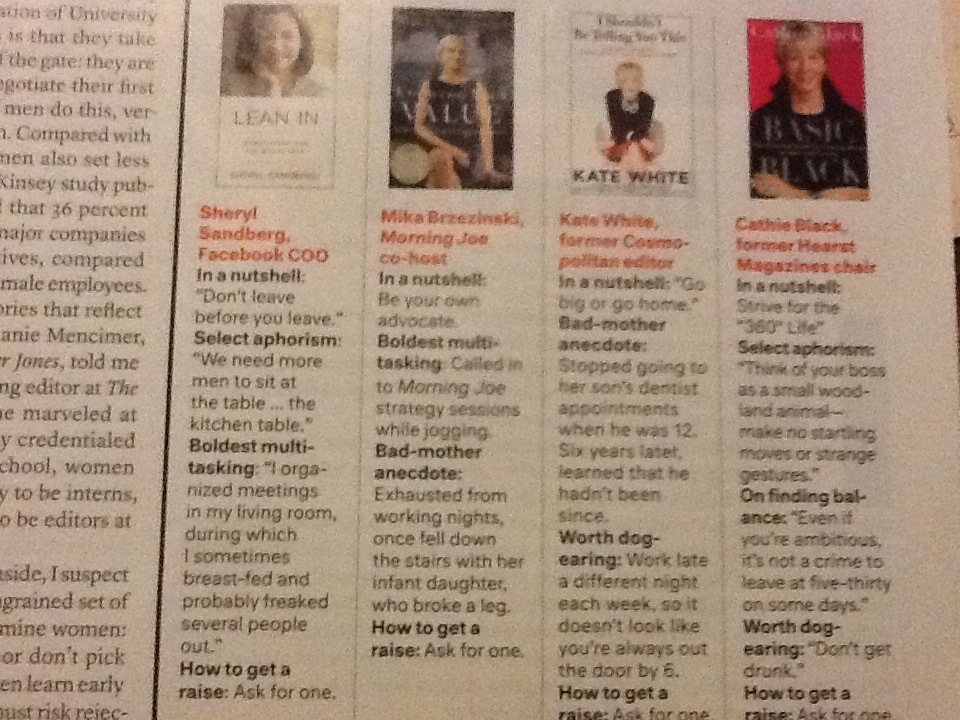
What the author is getting at in an interesting if not problematic way is that women are socialized to not negotiate well and to not find work in the same way that men do. This might explain why some 4.2% of Fortune 500 CEOs are women (28). What we might actually need is more leadership training for women, better mentoring programs in university, and in the workplace. Franke-Ruta is correct that education is not the panacea, but it is not just the formal education that is needed, but re-education of peoples’ expectations about women and men. We need better career education and mentoring all along the education and work pipeline. And, we need stop dismissing the career advice in Lean In and other books. They are targeting professional women and we need to embrace the message and not just attack the messenger. These books are clearly not for everyone–which career book is? I am including a screen shot from the article that assesses other similar books. Many thanks to the Franke-Ruta for her provocative review. You can see that these books share one major point: it’s important to ask for a raise.

20130715-112238.jpg

The Art of Phoning It In

What does it mean to “phone it in.” Generally speaking this means to give something little effort. To phone it in means that you made an attempt to do something. This does not mean that you tried hard, as you merely phoned it in. There are the occasional work outs that I phone in and hopefully get inspired to do more half way through the work out. There are days at work when I phone it in at a meeting or go through the motions, when I am not feeling well. However, I do not make a habit of doing this, as my job is too important to me to do this. Plus, students are smart. They know when a professor is phoning it in, and frankly, they do not like it. Can I blame them? This is my job. But, alas, I have expectations for them, too.

When do you phone it in?

I’m done teaching for about seven weeks and I am thinking about the last school year and the moments when I have phoned it in or when my coworkers or students phone it in. People say that Cs and Ds earn degrees, while this is true these sort of grades do not normally expedite getting jobs. Some students are clearly going through the motions, and I understand that. Some students do not want to be at the university or are not ready to do the work. But, there is something to say about a focused, hard worker who might have those occasional moments of phoning it in, but does not make a habit of phoning it in at work. Yes, I am saying that school is work. Students learn critical thinking, writing, time management, and hopefully get opportunities to collaborate with classmates. School is work and work is school. Success in university does not necessarily correlate into success off campus, and many college drop outs in the tech industry can attest to this. But, I have a word of advice for the rest of us:

Do not phone it in.

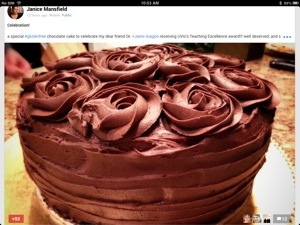
The photo below is a beautiful cake made my Real Food Made Easy, @toots11, Janice Mansfield. She never phones it in!

20130704-154626.jpg

Helpful Info for Women in Political Science

Orgs, Books and More!

CPSA: http://www.cpsa-acsp.ca/ (French: http://www.cpsa-acsp.ca/postings-f.shtml)

Société Québécoise de Science Politique: http://www.sqsp.uqam.ca/

APSA, Women’s Caucus for Political Science: http://www.apsanet.org/content_2907.cfm (Organization webpage: http://www.apsanet.org/)

ISA—Feminist Theory and Gender Studies: http://www.isanet.org/ISA/Sections/FTGS.aspx

WPSA, Caucus for Women and Gender Justice: http://wpsawomen.com/Home_Page.html (Organization webpage: http://wpsa.research.pdx.edu/)

Websites

Eduseed: Promoting Higher Education Among Historically Disadvantaged Communities: http://www.eduseed.org/

Mama Phd (IHE): http://www.mamaphd.com/

Ontario Womens Liberal Commission: http://owlc.liberal.ca/news-2/women-queer-women-politics-involved-earth-problem/

Sister Mentors: Promoting Higher Education Among Women and Girls of Color: http://www.sistermentors.org/home.htm

The Chronicle of Higher Education: http://chronicle.com

Fear of Feminism: http://chronicle.com/article/Fear-of-Feminism/138631/

Gay Mentors in Modern Academe: http://chronicle.com/article/Gay-Mentors-in-Modern-Academe/130883/

Rejection and Its Discontents: http://chronicle.com/article/RejectionIts-Discontents/139403/

Self-Sabotage in the Academic Career: http://chronicle.com/article/Self-Sabotage-in-the-Academic/138875/

The Professor Is In: http://theprofessorisin.com/

The Thesis Whisperer http://thesiswhisperer.com/

Tomorrow’s Professor: http://cgi.stanford.edu/~dept-ctl/cgi-bin/tomprof/postings.php

TP Msg. #1259 Motherhood: How Faculty Manage Work and Family

http://derekbruff.org/blogs/tomprof/2013/05/30/tp-msg-1259-motherhood-how-faculty-manage-work-and-family/

TP Msg. #1250 Let’s Make a Deal—Six Myths About Job and Salary Negotiations

http://derekbruff.org/blogs/tomprof/2013/04/30/tp-msg-1250-lets-make-a-deal-six-myths-about-job-and-salary-negotiations/

TP Msg. #1241 The Chair’s Role in Facilitating a Collegial Department

http://derekbruff.org/blogs/tomprof/2013/03/28/tp-msg-1241-the-chairs-role-in-facilitating-a-collegial-department-2/

University of Venus (Inside Higher Education): http://uvenus.org/

Women in Higher Education: http://www.wihe.com/

Women Suffrage and Beyond: Confronting the Democratic Deficit: http://womensuffrage.org/

WMST-L Archives http://userpages.umbc.edu/~korenman/wmst/wmsttoc.html

Journals of Interests and Journal Articles

Cambridge Journal of Education

Gender and Education

International Feminist Journal of Politics

Journal of Feminist Scholarship

Journal of Women, Politics & Policy

Politics and Gender

The Review of Higher Education

Women’s Studies in Communication

Acker, Sandra, and Grace Feuerverger. “Doing Good and Feeling Bad: the work of womenuniversity teachers.” Cambridge Journal of Education 26, no. 3 (1996): 401-422, doi: 10.1080/0305764960260309.

Bower, Glenna G. “Gender and Mentoring: A Strategy for Women to Obtain Full Professorship.”

Collins, Gail. “‘The Feminine’ Mystique at 50.” New York Times, January 23, 2013. http://www.nytimes.com/2013/01/27/magazine/the-feminine-mystique-at-50.html?pagewanted=all.

Elley-Brown, Margaret J. “The Significance of Career Narrative in Examining a High-Achieving Woman’s Career.” Australian Journal of Career Development 20, No. 3 (Spring 2011): 18-23, doi: 10.1177/103841621102000304.

Gaze, Beth. “Working Part Time: Reflections on Practicing the Work – Family Juggling Act.” Law and Justice Journal 1, no. 2 (2001): 199-212. http://search.informit.com.au/documentSummary;dn=755722715628569;res=IELHSS.

Goeke, Jennifer, and Emily J. Klein and Pauline Garcia-Reid and Amanda S. Birnbaum et. al. “Deepening Roots: Building a Task-Centered Peer Mentoring Community.” Feminist Formations 23, no. 1 (2011): 212-234. http://muse.jhu.edu/.

Kreider, Tim. “The ‘Busy’ Trap.” New York Times, June 30, 2012. http://opinionator.blogs.nytimes.com/2012/06/30/the-busy-trap/.

Mills, Melanie Bailey. “Intersections between Work and Family: When a Playpen Can be Office Furniture.” Women’s Studies in Communication 31, no. 2 (Summer 2008): 213-217, doi: 10.1080/07491409.2008.10162535.

Samek, Alyssa A. and Theresa A. Donofrio. “‘‘Academic Drag’’ and the Performance of the Critical Personae: An Exchange on Sexuality, Politics, and Identity in the Academy” Women’s Studies in Communication 36, no. 1 (2013): 28-55, doi: 10.1080/07491409.2012.754388.

Books

Armstrong, Sally. Ascent of Women. New York: Random House, 2010.

Baker, Maureen. Academic Careers and the Gender Gap. Vancouver: UBC Press, 2012.

Cote, James E., and Anton L. Allahar. Ivory Tower Blues: A University System in Crisis. Toronto: University of Toronto Press, 2007.

Evans, Elrina, and Caroline Grant, eds. Mama PhD: Women Write about Motherhood and Academic Life. New Brunswick. N.J.: Rutgers University Press, 2008.

Jalalzai, Farida. Shattered, Cracked, or Firmly Intact?: Women and the Executive Glass Ceiling Worldwide. Oxford: Oxford University Press, 2013.

Krull, Catherine and Justyna Sempruch, eds. A Life in Balance? Reopening the Family-Work Debate. Vancouver: UBC Press, 2011.

Newman, Jacquetta, and Linda A. White. Women, Politics, and Public Policy. Oxford: Oxford University Press, 2012.

Noddings, Nel. Happiness and Education. Cambridge: Cambridge University Press, 2003.

Noddings, Nel. The Maternal Factor. Berkeley and Los Angeles: University of California Press, 2010.

Osbord, Tracy L. How Women Represent Women. Oxford: Oxford University Press, 2012.

Robinson, Ken. How Finding Your Passion Changes Everything. New York: Penguin, 2009.

Sandberg, Sheryl. Lean In: Women, Work, and the Will to Lead. New York: Knopf, 2013.

Valian, Virginia. Why So Slow?: The advancement of women. Cambridge: MIT Press, 1999.

Twitter Handles to Follow (Working List!)

@AMaioni Antonia Maioni, President of Congress, McGill, Political Science

@ideas_idees Federation

@ATRWibben Annick T.R. Wibben, University of San Francisco, International Studies

@janniaragon, UVIC, Political Science

@partnershipuvic, UVic Corporate Relations

@JLisaYoung, Lisa Young, Dean of Graduate Studies, University of Calgary, Political Science

@OrsiniMichael, Michael Orsini, University of Ottawa, Political Science

@ChristineNLewis, Christine Lewis, Congress Coordinator, UVic

@UA_magazine, University Affairs, Ottawa, ON

@EmmMacfarlane, Dr. Emmett MacFarlane, University of Waterloo, Political Science

@uvicpoli, Uvic, Political Science Dept.

@pmlagasse, Philippe Lagasse, University of Ottawa, Political Science

@thedaleykate, Kate M. Daley, York University, Political Science (PhD Candidate)

@geoffsal, Geoff Salamons, University of Alberta, Political Science (PhD Candidate)

@Mireille2013, Mireille Paquet, University of Montreal, Political Science (PhD Candidate)

@SuleTomkinson, Sule Tomkinson, University of Montreal, Political Science

TED Talks

Huffington, Arianna. “Arianna Huffington: How to succeed? Get more sleep.” Filmed December 2010. TED video, 4:11. Posted January 2011.

Katz, Jackson. “Jackson Katz: Violence against women—it’s a men’s issue.” Filmed November 2012. TED video, 17:41. Posted May 2013.

Koyczan, Shane. “Shane Koyczan: “To This Day” … for the bullied and beautiful.” Filmed February 2013. TED video, 12:04. Posted March 2013. http://www.ted.com/talks/shane_koyczan_to_this_day_for_the_bullied_and_beautiful.html.

Lemmon, Gayle Tzemach. “Gayle Tzemach Lemmon: Women entrepreneurs, example not exception.” Filmed December 2011. TED video, 13:16. Posted January 2012. http://www.ted.com/talks/gayle_tzemach_lemmon_women_entrepreneurs_example_not_exception.html.

Pierson, Rita. “Rita Pierson: Every kid needs a champion.” Filmed May 2013. TED video, 7:48. Posted May 2013. http://www.ted.com/talks/rita_pierson_every_kid_needs_a_champion.html.

Robinson, Sir Ken. “Ken Robinson: Changing education paradigms.” Filmed October 2010. TED video, 11:41. Posted December 2010. http://www.ted.com/talks/ken_robinson_changing_education_paradigms.html.

Sandberg, Sheryl. “Sheryl Sandberg: Why we have too few women leaders.” Filmed December 2010. TED video, 14:58. Posted December 2010. http://www.ted.com/talks/sheryl_sandberg_why_we_have_too_few_women_leaders.html.

Stokes, Colin. “Colin Stokes: How movies teach manhood.” Filmed November 2012. TED video, 12:53. Posted January 2013. http://www.ted.com/talks/colin_stokes_how_movies_teach_manhood.html.

Zimbardo, Philip. “Philip Zimbardo: The demise of guys?” Filmed March 2011. TED video, 4:47. Posted August 2011. http://www.ted.com/talks/zimchallenge.html

Many thanks to Ms. Sylvia Alves for her assistance in curating this array. This is a draft and please share, but note that this is from the two of us!

Putting Your Best Foot Forward: Interviewing

I serve as an instructor and undergrad advisor to many and then to another group I am also a mentor or coach. I have also cultivated relationships with employers locally and outside of the city. I take these relationships seriously and they know that I try to send them strong candidates. Likewise, I try to check in with some of these contacts periodically to keep the connection fresh and to also ask them questions. I want to know  what is the profile of a strong candidate. Who are they looking for? And, they know that when they call to check references, they will get an honest reference about the candidate.

During the last month or so, I have met with some of my contacts and even made some new ones. I’m going to share some points from these conversations. This list is not an exhaustive list of advice, but a start. Now, it’s not uncommon to have an interview with more than one person and I refer to this group as the interview panel.

You got the Interview! Congratulations to you. Now, you need to impress them so that they call your references and then hire you.

Dress to impress. Ignore those articles on Linked In and elsewhere to dress how you are comfortable and don’t worry about impressing. Nope.You need to dress to impress and try to dress appropriately for the employer. If you’re interviewing for a non-profit, government, or conservative business you should dress according to the culture of that workplace.

Prepare for the interview. Google interview questions and review them and your answers in the mirror or hopefully with some trusted friends, mentor or sponsor. Also, do your research about the company. Why do you want to work with the organization? Make sure that you have a question or two for them, too. You do not want to make it painfully obvious that you haven’t taken the time to research the company and what they do. What is their mission statement? Who do they serve? Make sure that you have these basics down pat.

Be humble. You got the interview and you do not want to turn off the interview panel with arrogant responses. None of us are perfect, so think about what you have to learn or work on and how the company can help you grow. I am not suggesting that you downplay your skill set, but remember that you are getting assessed about how you will work with a team of people. I often remind my students about one employer sharing that a candidate was late to the meeting and one person opened the door to an apology asking, “Did you get lost?” The candidate responded with a quick, “No.” Big mistake. She was late to a job interview and needed to apologize for this. She did not and this set the tone for the interview. Remember that you are the short list and anything that you do that makes you look like a less serious candidate can hurt you.

Google yourself and check your digital footprint. The reality is that employers often creep and check you out–especially if they do not have good references or have a gut instinct about a candidate. I have heard from several employers who are honest about doing their research about job candidates. And, reminding you here to Google the company and what they do. This will give you ample information to ask the panel a question or two.

Prepare examples. When answering questions, offer examples from previous employment or volunteer experience that highlights your skills. You must remind the panel that you are more than competent for the job. For instance, if the panel asks you about working under deadlines, you need to refer to a situation that demonstrates your ability to work under a tight deadline and juggle multiple projects. Now, some of you might have a thin resume and could offer that you worked part-time and was enrolled in courses full-time and maintained a good grade point average. The panel will typically ask about working with a difficult situation or person–be prepared to offer a good example that highlights your ability to combine professionalism and team work.

Get a good night’s sleep and show up to the interview 10 minutes early. And, the next day place a thank you card in the mail. Yes, send a thank you card to the panel who interviewed you. Good Luck!

Election Hangover

Here we are a few days post BC Election and I am suffering from an election hangover. This is pretty normal for a political junkie or in my case, a political scientist, who enjoys following elections. Now, I have no issue sharing that the election results were not surprising. I suspected that we’d see the economy and business as usual providing the impetus for votes.  I anticipated strategic, economic voting and suspected we’d see another BC Liberals majority government. This is not endorsing the results.

Let me be clear: I am not happy with the results. Nope. And, for the love of my friend’s dog, please don’t make that giant leap of logic that this is hate speech. (Oh, yes, my person under the bridge loves to give me so much attention–er–get a life). What can we do during these next four years? Wake up. Wake the hell up. This is also making me think about that I might actually need to work on the GOTV campaign, too. I talk about the importance of voting and I do vote federally in the US, but maybe I need to seriously entertain doing more on the island.

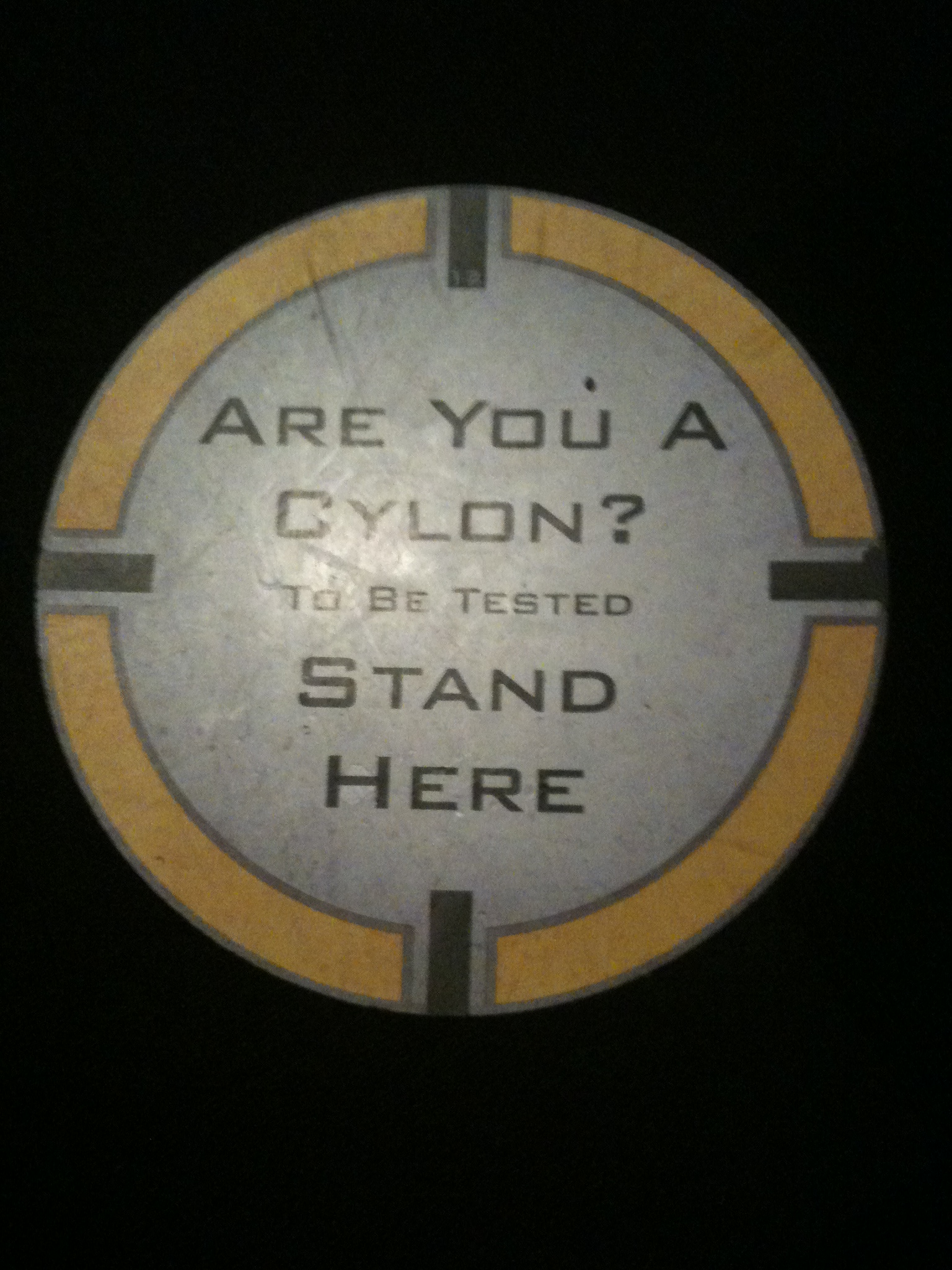
trin-045.jpgDon’t be a robot (a cyclon)–get involved!


Please Stop: Post-Racial America

I am late in responding to Dr_JZs post about how after President Obama was elected in the 2008 suddenly pundits opined that the United States was in a post-racial era. This reminds me of the quote by Meg Sullivan, “I’ll be a post-feminist in the post-patriarchy.” It does not exist. We are not in a post-racial era and to say this is to not acknowledge racism or different forms of privilege. Jordan-Zachery’s eloquent post notes how at this same time we have witnessed an invisibility of Black women in our field of Political Science. Jordan-Zachery spoke to this in her recent article published in Politics, Groups and Identities demonstrating via some statistics that fewer publications are examining Black women as a subject. Why? The answers will vary, but most will carry lots of baggage and will unsettle and make most of us uncomfortable. It is not that Latinos are now the majority minority. It is not that we live in a post-racial United States (although I am living in Canada).

I strongly believe that part of this invisibility stems from editors and reviewers deeming what is worthy of publication. It also stems from the research that is currently conducted and supported on campuses in departments of Political Science, Africana Studies, or Black Studies programs and departments. And, I will not speak for Jordan-Zachery; however, her blog post notes specifically how Intersectionality as method has been hijacked. OK, she does not use those exact words, but the following quote from Jordan-Zachery’s post is telling:

“Simply put, Black women are disappearing as research subjects within our ‘leading’ academic journals (Alexander-Floyd “Disappearing Acts” 2012) and within intersectionality research specifically. Many credit intersectionality research as an outgrowth of Black feminist standpoint theory and remind us that Black feminist standpoint theory is crucial to intersectionality, but in many cases a mere footnote or sentence makes this acknowledgment.” (Bold in the original post).

What can we make of this or should we make of this? Is this the hijacking of a method that is now mainstream within Feminist Political Science research that used to focus on Black women, then women of color. Now, Intersectionality is that catch all for all components of identity. Is it now meaningless? Perhaps Intersectionality as a method is so useful that everyone wants to employ it as a lens of analysis. It begs the question about methods and who can use them? I do not have the singular answer, but I do know that I am hard pressed to not find Intersectionality as a method in journal articles related to my areas of interest and teaching.

Our blog post conversation also stems from a Google Hangout that we had last month catching up on work and more. I am happy and honored to have Julia (now I refer to her as a person and not a super-star academic) in my life. One of the interesting conversations that was about race and racism. Since Obama’s election and re-election we have both witnessed the marked ways that race is discussed or not discussed by the popular press, within the blogosphere, then in academe. It’s complicated. People generally feel a sense of unease when it comes to discussing race or racism. Frankly, I think that our blog posts would make some uncomfortable. This is a start of a longer conversation. Please weigh in–Dr. J_Z and I are waiting! Oh, and the title of my post is my asking that people stop referring to the US as a post-racial society. It’s not.

Mentoring and Coaching: Listening

I work with hundreds of students each term and do my best to help as many as I can. One way that I do this is to set up my course assignments in such a way that each one builds on the next and that the student can learn and improve. I also actively mentor and coach many students from the prospective student who I might take on a tour or chat with in my office through the graduate student teaching her or his first class.

As a mentor or coach, I appreciate those moments when I can celebrate a student’s success. And, those teachable moments, when focus is needed to figure out what is next. What is the next step after there is a set back. These moments provide lessons in coping, crying, and then the strategy. What are Plans B, C, and D? There are also times when you just have to keep quiet and listen. I find that in many instances, the person sitting across from me at the coffee table or in my office needs to articulate aloud what they’re thinking and you have to listen attentively and pause. For me, this occasionally means biting my tongue. I want to help, but the help is to just listen and encourage.

A good mentor/coach must listen. When a student gets closer to their last year, term or graduation a panic can set in for them. I remember this feeling before I graduated, as I wondered what graduate school would be like (that is another post). I’ve bumped into many current and soon to be former students and April was all about listening and encouraging them. They are on the precipice of major change and need to work through this. The best gift I can give is to listen. Today I’m thinking about the importance of listening.

misc-b-004.jpg

My Lifetime Listens to Yours. Muriel Ruckeyser

I have a book of quotes that serves as writing prompts and this is prompt two. There is space to write on the page, but I sent the first prompt to a friend in another department. And, have torn out the second prompt. Now, the title of this post comes from part of poem and the lengthy poem says lots. But, what does this excerpt say or how does it speak to you. I am thinking like a Political Scientist or Social Scientist at the moment and how I learn from reading and listening. If I think from a mentor’s point of view, I know that my reading and listening includes what is not said or spoken. People have “tells” for when they lie or feel uncomfortable and these nuances of movement are important to support and understand. What is your tell? I have different tells, but one is to stop and think and take a drink of water. During this short moment, I am thinking of my response–formulating what I want to say next.

We listen with more than our ears. But, do we learn from what we hear and see? I am in the midst of heavy marking and looked forward to this writing prompt and I come back to learning from others. I have also had several hours of office hours and meetings and tried my best to listen intently these past few work days. I firmly believe in life-long learning and this prompt reminds me of the importance of mindfulness. When I think of mindfulness, I always picture Dr. Juliann Allison, as she practices mindfulness in all that she does. This week I am trying to actively practice mindfulness. The Ruckeyser quote was the perfect reminder, as I try to balance out meetings, honors presentations, grading, and planning a conference. And, that is only part of the to do list. I’m breathing in and out and trying to listen.

Aboriginal Worldviews Response to Coursera April Fool’s Day Joke

This is a copy and paste from an email that I received about a Coursera April Fool’s Day joke. A course on Underwater Basketweaving. Given the course content this was important for the learning team to respond to immediately. I was enrolled as a student in this course, a Massive Open Online Course (MOOC). People of color, racialized people, Indigenous people and their cultures should not be the butt of jokes in education or elsewhere. 

Clip~

Ahniin! We have just come off a week of sacred celebrations including Passover, Holi, Easter, the vernal equinox and the coming of spring. Whatever event you celebrate, we hope it was a good one for you.

Today a learning opportunity fell into our lap. Coursera issued an April Fool’s Day joke course calledUnderwater Basketweaving. 

In order for the joke to work, it relies on deep cultural assumptions about the inferiority of indigenous knowledge. While the writers and performers of the piece likely didn’t even realise or intend the offense it might cause, I’m sure there are keepers of indigenous knowledge who would be offended. I get that it’s meant to be lighthearted and a joke but anyone who has actually spent time learning about basket making processes would realize it’s about more than the finished product. Even the preparations and gathering of materials involve a great amount of knowledge. If there’s any doubt about the meaning of actual basket making, check out these courses on Six Nations Basket Knowledge and Storyweaving. 

Basket making is serious business and there is a lot more to it than the basket that is made. The process more than the product, the human growth and reflection on greater things than the physical object. Not to mention how sacred we hold our traditional languages and burial sites, also mocked in the April Fools Day “joke.”

Should I really be upset about this? In our forums there has been much discussion about a refrain that is used when Aboriginal people talk about colonial policies and practices that is dismissive and hurtful. That phrase is “Get over it!” I would suggest that people who say “Can’t you take a joke?” could benefit from a course to see how the colonial rule over diverse indigenous populations is buttressed by “jokes” like this one that undermine the value of our knowledges and peoples. 

You might be surprised to find that jokes like this one help lead to the misinformation and stereotyping that underlies attitudes and opinions like those expressed in a recent letter to the editor of the Nanaimo Daily News. Taken together over time and in quantity, embedded in schools and media and harmless jokes, these attitudes and opinions in turn can lead to discrimination and the support of racist laws and policies. 

I am sure that the writers of the coursera April Fools’ Day joke did not intend for their comments to cause harm. If only they could enroll in a course to see how this process works. Fortunately such a course exists on Coursera (#aboriginaled). And it’s FREE! Please encourage the learning among coursera staff to continue.

Looking forward to a few more enrollments. 

Respectfully,

Aboriginal Worldviews and Education Course Team

Clip~

I do think that the Professor and Teaching Assistants make some salient points. The joke falls flat for various reasons. The joke is insensitive and I assume that Coursera will later apologize. Hopefully, they won’t pull a Nanaimo Daily News and attempt to say it was human error or martian error (now that is a joke). I stand with the Professor and Teaching Assistants and say: this is not funny. Instead make a joke about MOOCs and incessant emails, students who troll, and other things that are funny or hard-biting.