Boundaries: Hard for This Workaholic

I’m always very honest in my blog posts and I have to admit that I don’t like seeing email in my queue. I try to get to the emails as quickly as possible. And, I don’t like seeing several hundred emails on Monday mornings. This means that I do respond to work emails during the weekend. Now, I don’t respond to all of them, as I will flag some noting that they are higher priority come Monday and then others I will respond to in a timely (immediately through the next 24 hours) manner. I have now taken to responding to some student emails and stating that I will get to their email (answer their query) on Monday and also state, “It’s the weekend, I hope that you enjoy it.”

I know that I’ll hear from people who swear that they don’t respond to students’ emails over the weekend or that no one at their campus does. Cue Bill Cosby acting like Noah and saying, “Riiiight” at the 58 second mark or 1.17.  It’s not that I don’t believe these people–it’s just that my reality is that if I don’t respond in about 24 hours, I hear repeatedly from the student. I rather say that I got the email and will attend to it. I also will make a point of responding to all emails when an assignment is due the next Monday. It’s the nature of my job and the students who I work with in the department. I also am responsible for this access, I know. Some will tweet me or Facebook message me. I am a heavy user of social media and this is one cost–access to me and my time. I am not going to complain, but I will try to have some work life balance.

I am trying to set a good example for my kids, co-workers, and the Teaching Assistants who report to me. I explain to my team of Teaching Assistants that they also do not have to respond to emails from students over the weekend and not from me, too. I ask them to act as if the email (if one gets sent during the weekend) arrived Monday morning and respond thereafter. I want them to see me encourage boundaries. This takes hard work, but I have to say that during the last year it’s been worth it. I’m protecting my schedule more and I feel happier. I still love my job, and look forward to walking into the classroom, office hours, and other teaching related events. I’m loathe to say that I love meetings, as that’s a lie. I like some meetings and do not look forward to others! How do you deal with your email queue?
Reappointment Process for Tenure-Line Faculty

I’ve been thinking lots about this last school year. It was a really amazing one in terms of my academic career. In the Fall I was unanimously endorsed by my colleagues for reappointment. While I hoped and suspected that my reappointment would be smooth to have it behind me was a big relief. I can only imagine the stress involved with the tenure review. I have now loaned my binders to a friend for her own review.

If you’re up for your first review here are some points of advice. I assume and hope that some of my friends will respond and add in their two cents about the review process.

  • Document all that you do. This is easier said than done. Make sure that your CV follows the department or faculty norm.
  •  Speak to a colleague or mentor familiar with the department or faculty process, so that you have an inside view.
  • Review the Faculty Agreement/Contract or similar document to make sure that you are familiar with all the guidelines.
  • Meet with the department Chair to review the process. Get as much input as you can from the Chair.
  • Make sure that someone else (mentor/friend) reviews your dossiers.
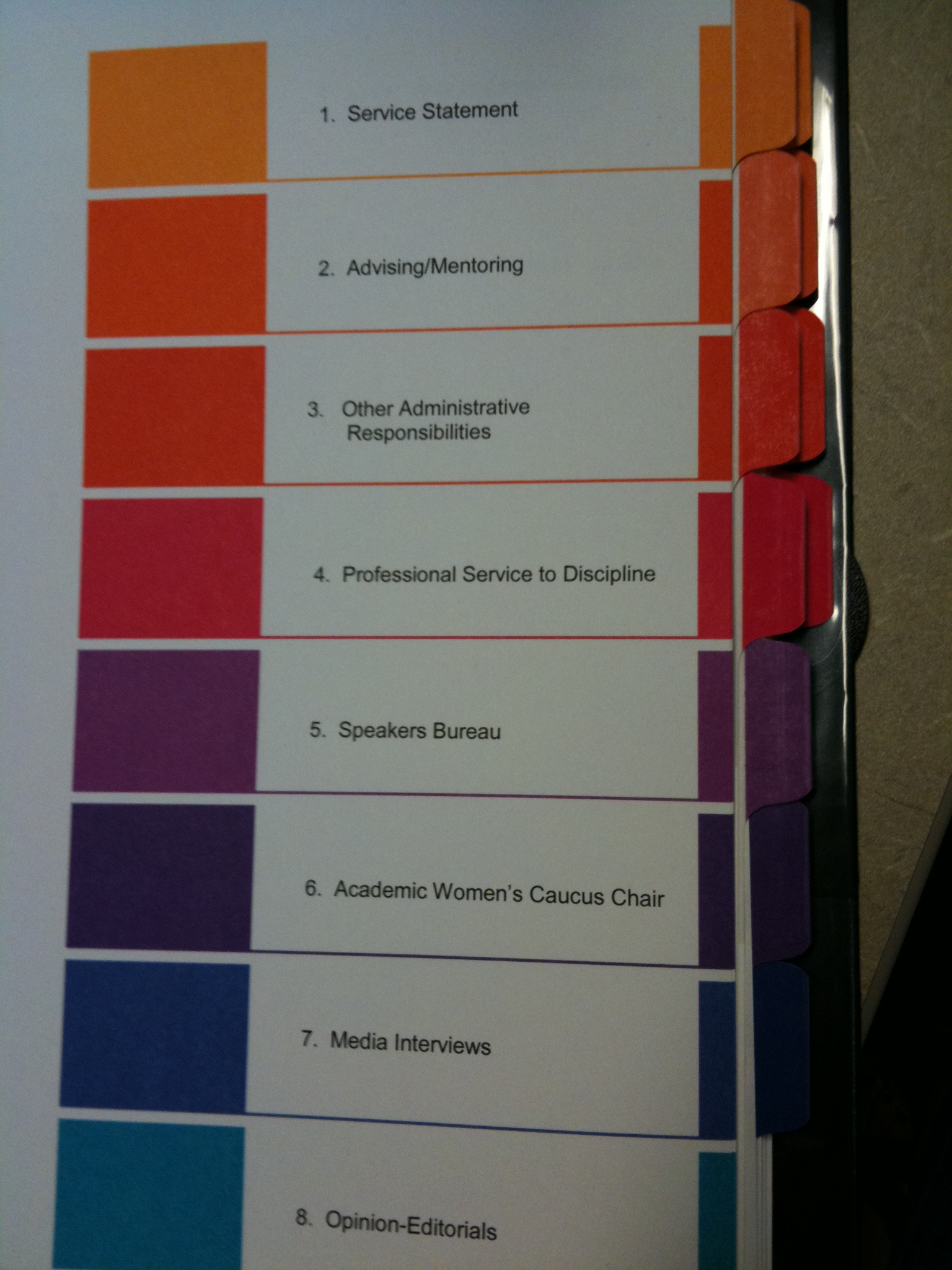
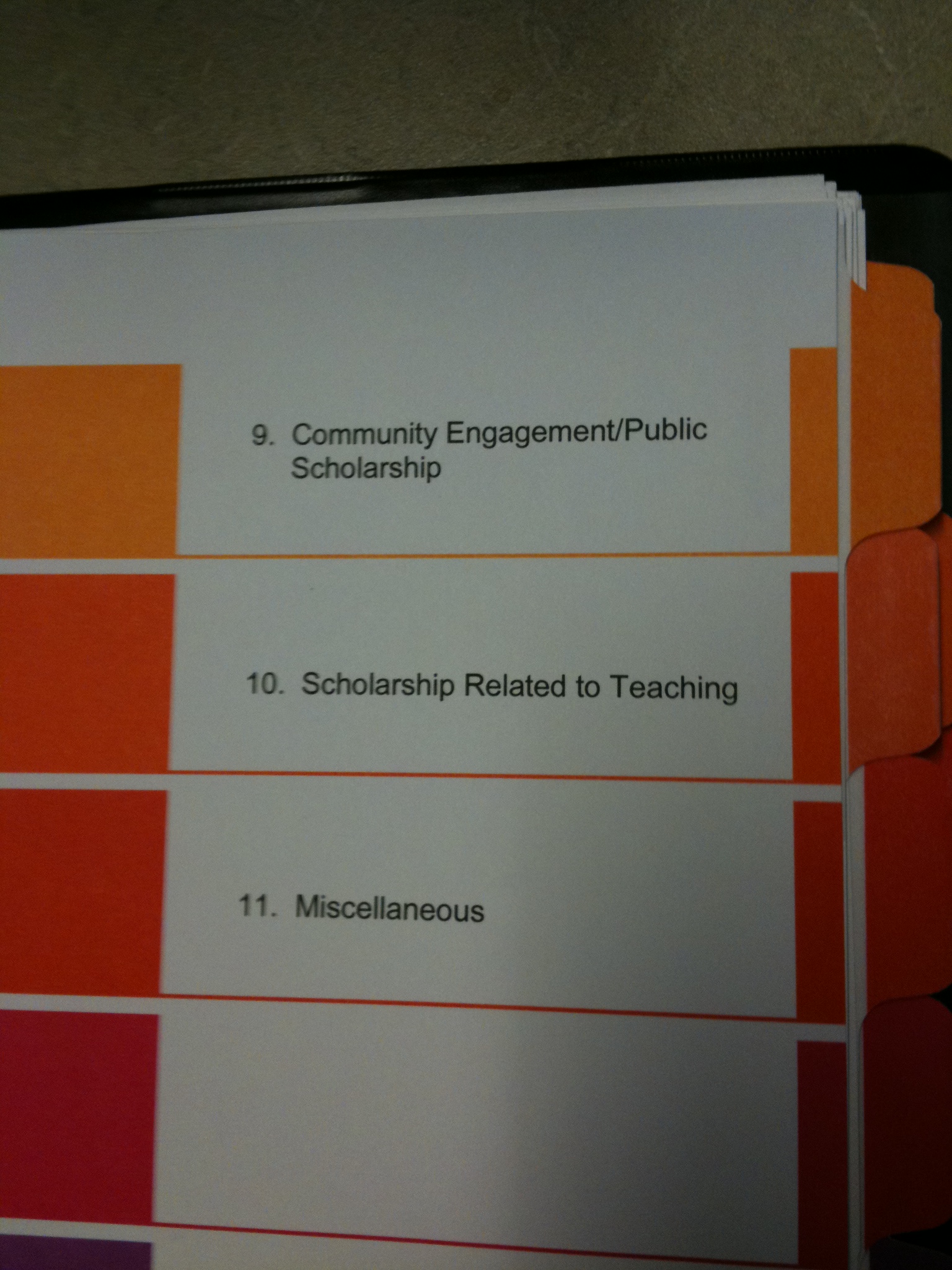
  • I had to put together a Teaching Dossier and Service Dossier. But, most will need a fulsome Research Dossier.
  • I made photocopies of thank you cards and emails from students and included them in the latter part of my Service Dossier. I also contacted some current and former students and asked for some short statements of support. They were (thankfully) willing to do so! I included these in a sub-section entitled, “Solicited letters of support.”
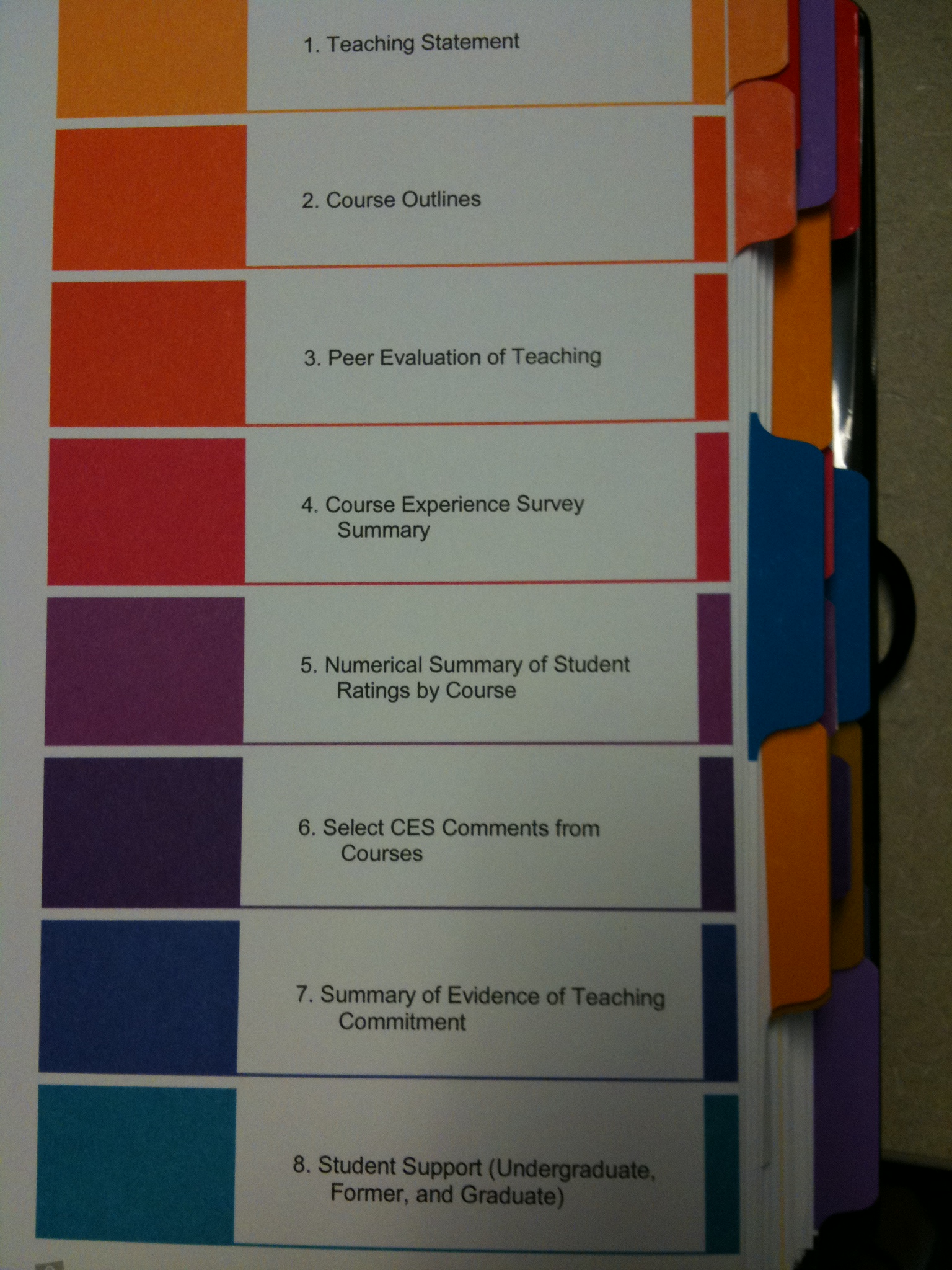
  • I had to include all my course syllabi and Course Experience Surveys. I was also able to include the verbal comments from courses of my choice, but if I included comments I had to include all. I opted to include comments from one 1st year, 3rd year, and 4th year seminar. I teach an array of courses and felt that I needed to demonstrate my effectiveness among all my courses. It’s easy to pick the class with the wholly positive reviews, but you might want to think about the comments that best highlight student learning. (Remember that my position is full-time, tenure-track, and teaching focused). Related to teaching–you might have more senior to you colleagues sit in your class and review your teaching. Review the guidelines, as you should have a choice of who reviews you and when. And, you should have a right of response for the review or be granted another opportunity. I was supposed to have one course reviewed twice. I requested two courses and was glad that I did so. Given that my position is teaching focused, I thought that this would best represent my teaching skills.

I’ve included screen shots of my two sets of Table of Contents. These fit the norm of the department, so verify what is the norm for your department. Overall, I would suggest that you take 2-4 weeks to put together your dossiers. And, during the review process be nice to yourself. Try to not stress about the review and stay focused (word choice) on each step that you have control over–which is little! Good luck!

Interactions with Students~

I’m taking a break from the Fri Fun Facts. Instead, Friday will offer short posts about something that is on  my mind.

Working with young people there are many different opportunities to mentor or coach undergraduates. I find that some of these moments present themselves when you aren’t really expecting it. Each year I get cards or emails from students who have taken one class from me or have seen me in office hours and are graduating or transferring to another university closer to home. And, I’m always a little bit surprised to get the note or email that thanks me for a good class or for some help.

The reason why I’m surprised is that these particular students did not see me lots and only took one class from me. Given that I teach several classes most are apt to have had at least one class with me. My point here is that at times you can make a difference in a student’s experience in a class or in the office and not realize it. I always follow up the contact with an email or face to face chat if I can.

After I started the post, I cleaned up my home office and found a stack of emails or notes from students from 2002-2009! I read each one and remembered the students. I’m thankful that they took the time to contact me. What all of this reminds me is that we have moments in our offices or classroom, when we make a connection with a student. And, sometimes we are not even aware of it.

Reviewing Student Work: Teachable Moments

Reviewing graded work with students is not an easy task. This typically happens when a student wants to contest the mark, complain about the Teaching Assistant or about my assessment. Some students come in and they really want to learn from the assignment and do better the next time. Other students want to have an opportunity to complain. They merely want someone to listen to them. To be heard. I do not blame them–we all want someone to listen to us. It’s like Festivus–the airing of the grievances.

Educators need to remember that for so many of the students coming to office hours to chat with you is hard. Most students are a little nervous to come into the office and it’s best to immediately explain what the process is with the review. The student needs to know that you might lower or raise the grade. The student needs to know that they might have the option to revise and resubmit or contest the grade. The process will vary in different departments or different campuses.

All of this said, what I will do is re-grade the work and then review the graded work line by line or paragraph or by paragraph so that the student has a complete understanding of the grade. I also refer to the university grading system, so that the student understands that I am referring to the standards outlined by the institution. This is actually important as I feel it allows the student to understand that the grade is not personal–it is about the work and the guidelines for the assignment. This is also the appropriate time to review the assignment with the student.

Likewise, during the meeting in my office, I will allow the student to share her or his thoughts. This is the time to listen and to then respond as needed. I always end noting that the grade reflects the assessment of the assignment and not a judgement about the student as a person. I do think it’s important to add this last part, as many students really do think that the grade represents them and their effort. It does not.

Now, the last point that I want to speak to is effort and grade. I am hearing more students discuss how the grade does not reflect the effort that they put into the assignment. I listen to their explanation and think: I deserve to be paid more, but I am not. Effort does not entitlement to a better or strong grade. Some students will spend lots of time (revisions, office hour visits) and earn a B. Others will cram and pull an all nighter and earn an A-. It is not fair, but it happens. In my classes, the papers need to offer coherent analysis and follow directions. The assignment stipulates all the guidelines and some will not do well solely because they waited until the last minute or did not follow directions. Other papers will earn a weak grade due to the poor organization and writing.   Effort does not equal a strong grade.

Now there will be times when you review student work and you think that you might have been too hard. If so, admit it and raise the mark. My dad used to tell me, “I’m not perfect, you’re not perfect, nobody is perfect.” He’s right. Sometimes we make mistakes or are too harsh with a mark. Re-assess the work and move on. Explain why you are revising the mark and change the grade while the student is in your office, so that you don’t forget. Have fun grading and reviewing graded work!

Feminism for Real: Part Two

Feminism for Real reminds me of This Bridge Called My Back: Writings of Radical Women of Color (1981) edited by Cherríe Moraga and Gloria Anzaldúa and the book is now sadly out of print. This Bridge was written by activists, writers and scholar/activists. And, many were in the early part of their careers. Some had never written before and sure enough the anthology has fielded commentary about the quality of the writing. It was not an academic tome, but as a classic text was used in many Women’s Studies and Feminist Theory courses. I have assigned it in both Women’s Studies and Political Science courses over the years. Feminism for Real is also uneven. Some of the sections offer an important rant and others offer more depth to the section. I would classify Feminism for Real as a must read for the general audience, friends or advocates of feminisms, and for people who actively feel a certain level of distrust or angst with feminisms.

I am a long-time Reader of Racialicious, so I was not surprised at how the Latoya Peterson chapter, “The Feminist Existential Crisis (Dark Child Remix)” was my favourite and the most dog-eared in my book. What does it mean to be a professional feminist? What does it mean to understand something like feminism and also admit to the heavy baggage that comes with it? Peterson wrestles with this in her section. These are important conversations to have. All of the chapters have some merit to them–regardless if they made me walk away from the book for a few weeks. Having a visceral reaction is a good thing.

Students in Women’s Studies or Social Justice Studies have high expectations for the faculty and their classmates. I sense that they might not understand the ways in which faculty (especially pre-tenure) faculty need to balance pedagogy and climate issues in departments and on campus. And, after re-reading certain sections I am convinced that some students will still accuse me of being a Radical Feminist (these students do not know their feminisms) and others will accuse me of being an Asshole Academic, but then another set will note that I challenged their ideas and made a difference. Then, I am doing my job as a self-identified feminist educator. I will add that that the two authors I always go back to for my feminist politics are hooks and Anzaldúa–for whatever that is worth. They are my feminist tome home. I do think that many of us in this line of work–professional feminism, activist politics, higher education–you name it–have certain ideologies that frame our understanding of feminisms. While it’s easy to think about a monolith, I try and argue that there is not.

While some of the chapters of my copy of Feminism for Real is filled with my angry notes or mere comments, I am still grateful to the amazing, Jessica Yee for this anthology. My feminisms is wide enough to know that I can agree with Yee on some counts and then agree to disagree with her in other cases. If a book instills anger, hiding the book for weeks, writing in it, talking about it with students, and friends, then the book is really worth reading. Read the book. It will rock your feminist world (whatever that is for you). The book will also make you think twice as you put your syllabus together—trust me. I revamped one syllabus while reading the book and then took a good look at the other syllabi.

Fri Fun Facts: Student Evaluations

This week’s Fun Fri Facts is a response to students’ informal evaluations of courses. Normally I offer students an opportunity to give me feedback about my classes. I also explain to the class that I take these evaluations seriously and will often change things in a course based on the thoughtful comments.

How do I do it? I do one of two things. I ask them to take out a piece of paper and list the readings that they liked or did not like or I borrow shamelessly from Dr. Heather Tapley and ask them to list what they would like me to start doing, stop doing and continue doing. I am going to refer to some of the common student comments during the last 12 months.

1. You assign too much reading. It is hard for most professors to not smirk at this comment. My job is to assign work that will cause us to think and chat about the ideas. During the last year, I have actually cut one to two readings in my 300-400 level courses. But, the students might know this! I did re-think the course allowing more time to chat about the readings.

2. The blank assignment is worth too much or not worth enough. With these sort of comments, I really can’t make all of the students happy. I could move things around and another few would complain that they want the paper worth more (or less)!

3. You are awesome. Do not change a thing. This class is like a mental hug, massage, best part of my day. I have to admit that the handful of statements of this sort do make me smile. And, I am thankful when the same person has given me constructive comments about what I can do better. I have previously noted that my teaching is not static, it’s fluid. And, I don’t pretend to not learn from the students. So, the positive comments are appreciated and weighed with the less than positive ones!

4. The blogging assignment is great, hard work, too much work. The students who have commented on the blogging assignments during the last two years have mostly been positive. And, a few of them acknowledged that they now read all the assignments and think: How would I blog about this? Fist in air! Now, as far as the blog being too much work in most classes they have to write a series of 4-6 blog posts, but this term the class has to write 6 over the course of 12 weeks. I’m hesitant to change this that much. I see that more students understand the expectation for the assignment, so I was more clear compared to 9 months ago.

5. I like that you offer us discussion time. I don’t like the discussion time and I want to hear you lecture more. This is a tough one. I use a combination of lecture and discussion in my courses and I find that more students prefer the balance. However, there will always be the 1-2 who want to hear me lecture more. I might need to dedicate one day to 100% lecture and the next day to lecture and discussion.

6. A student or two usually comments on my office hours. I don’t have enough or that I’m not available enough for him/her. As it stands, I have as many office hours as last year and I’m teaching one less course. Compared to my colleagues I actually have more office hours, but I know that I teach more students and I do make appointments as needed. My availability is not an issue in my humble opinion. And, during the busy times of the term I will add 1-2 more hours of office hour time.

Overall, I do think it’s an important exercise to check in with the students and see what is working or not working. I always hope that my classes are successful, but I also know that I am only one part of the class. The students are an integral part of the class.

Fri Fun Facts: Making the Best Out of Odd Class Times

We have all been there before. You get assigned the early morning class time or your advanced course get the coveted time for a first year course. I have made sure that the early class is interesting and I have at times given them an additional five minutes to get to class to meet them half way!

Another way that I have dealt with this is to shamelessly borrow from a colleague, Dr. Avigail Eisenberg. A few years ago she was also assigned the TWF fifty increments schedule and she opted to lecture on T and W and leave Friday for “seminar.” Half the class attends every other Friday and this allows a better chance for discussion. When she shared this, I immediately changed my course to the same schedule. I’m going to speak to what did not work and what did.

1. I have found that by and large most students do not like change. The first time I adopted this was about one month into the term and some were resistant at first. And, I saw that more than half showed up to the seminar or discussion sessions on Friday.

2. One student even noted in the evaluation that s/he did not pay money to hear classmates speak! This student wanted me to lecture each day. Mind you Friday really turned into the day that the student groups gave presentations and this never changed.

3. Students like this more when immediately know about the class set up in the syllabus. Even so, I find that more than half the class shows up to the seminar or discussion dates.

4. You must be flexible. I divide the class A-M and N-Z and there are Fridays when some show up for the “wrong” week so that they do not have to attend their week. This is fine. I’ll tally up the attendance on Friday and divide by two and calculate!

5. You need to encourage the students to talk if you move to a seminar or discussion class. It cannot just be you. To do this, I have scheduled all of the Student Led Discussions (presentations) on Fridays. This requires that the student groups offer thoughtful questions to their discussions. The student groups are assessed on these discussions, as well.

6. After the class I note the feel of the class discussion and the quality of the comments by the participating students. I also assess the students who lead discussion.

I am in the fifth or more term of using the Friday classes as a seminar or discussion period and thus far I am happy with it.

How do you deal with imperfect class time or classroom assignments?

Fri Fun Facts: Breathe

We are heading in to the height of mid-term writing and grading. But, a gentle reminder is needed. Remember to breathe. You know–those great, deep yoga breaths that cleanse and calm. These are perfect before office hours and before you start grading. Other reminders for dealing with the first year student in the Fall.

1. Most students are really intimidated by the mid-term. They think that they are going to bomb it. Well, at least I find that the conscientious ones feel this way.

2. Most students are also intimidated by office hours. Just the thought of coming to office hours can cause them to feel scared, angry or frustrated. I cannot tell you how many times I have seen flushed faces or pencils shaking in a hand. I’ve also found some students calm and happy.

3. Students forget to breathe, too. And, they get anxious and all worked up about the five or six (ouch) exams or papers that they have to write. Try to not add to the anxiety and give them your full attention, while they are in your office.

4. This might sound silly, but thank them for coming to office hours. They are getting familiarized with your department and university life and they might know that coming to office hours is acceptable and a good practice.

5. Remember to breathe. This is a stressful time for faculty, too. Remember to get exercise, sleep right and eat right. It’s easier to deal with stress if we are at 100!

Now, to grading mid-terms.

Teaching Transformation: Book Review

This blog post was originally posted on Gender Across Borders as part of the Feminism and Education series. It ran yesterday at http://tinyurl.com/45bozm8.  Today, I am posting it on my blog.

Teaching Transformation: Transcultural Classroom Dialogues (2007) by AnaLouise Keating is a much needed book for educators. The book casts a wide net, as those interested in feminism, transformative teaching, pedagogy, race, and sexuality will get something out of this book. The book continues in a long line of great books about pedagogy like Paolo Freire’s Pedagogy of the Oppressed and Teaching to Transgress by bell hooks. Keating unpacks issues of dialogue, power, discussion, and pedagogy in her book.

The major strengths of the book lie in the fact that Keating willingly shares her successes and teachable moments with us. I hasten to say failures, since they were moments when she learned something new and this does not constitute a failure. She also reminds us that you cannot teach about race without also discussing Whiteness. By not including Whiteness, we place it in the place of dominance. Thus, unpacking Whiteness in the classroom is needed. She shares how difficult this can be in the classroom, as it requires serious introspection by students and the instructor. Keating reminds us to think about how the learning environment needs to provide students with a framework. And, this is not just the syllabus, but the way that the class will study the topics, treat one another, and go to the material.

In a similar fashion, Keating acknowledges that teaching gender requires an inclusive framework, too. While the term Intersectionality is only used three times in the book and is in the index, her method is clearly offering an Intersectional approach to her pedagogy. Although, from perusing the index, I see that interdependence, interconnectivity, transformational multiculturalism, and relational teaching strategies are used more. In my opinion, these are fruit from the same tree and make her book well-suited for the feminist instructor.

What this book does that most others have not, though, is include 7 separate appendices which the nascent to seasoned instructor will find useful. Appendix 1 “Dialogue: Some of My Presuppositions” provides a framework for the classroom discussions. What are the rules of engagement for the class? She spells this out with six presuppositions. They vary from social justice exists, our educations have been biased to people have a basic goodness (125-26). In Appendix II “Listening with Raw Openness,” she reminds us that listening is a crucial component of teaching and transformative dialogue. Appendices IV and V relate to Whiteness and the importance of also teaching Whiteness when having discussions about race. The Appendix 6 offers several sample syllabi from different courses she has taught.

The book made me think of my agency as an instructor, but also the students who sit in my classes. They have agency as well and I have to remember to nurture this and allow them to explore it both in class and in their assignments. Learning is not static and as educators we need to keep abreast of new teaching strategies. Feminist educators need a copy of Teaching Transformation on their bookshelf—nestled right beside books by bell hooks.

Each term I re-evaluate my courses and think of the hits and misses. Keating’s book caused me to think about how I will reflect about my courses this term. I have already followed some of her suggestions and will continue to do so as I begin intensive grading this next week. This book speaks to educators in the Humanities and Social Sciences at the high school through post-secondary levels.

Letting Go: Teaching Assistants

This term I did something that I haven’t done before, I am trusting the Teaching Assistants as a group to run workshops and formulate possible mid-term questions. At first it gave me pause, but now it feels quite liberating to offer them this opportunity. I haven’t heard any negative feedback from the first workshop, so I assume that it went well.

And, the students barely had access to the working mid-term questions, so we’ll see what they think of the exam. My philosophy (still) with the TA’s is that they are an apprentice role. This letting go might really be based on the fact that four of my 6 TAs have worked with me before and that I feel comfortable with their work ethic and their knowledge of the material. I’m not sure. But, I do realize that part of our working relationship is to mentor them. What better way, than offering them some more autonomy.

Sure, I’ll still provide grading keys and answer any questions as needed in the hallway, my office, via email as this is part of the deal. But, I will also look to more chances for them to take a leadership role with the students’ learning. I want these TAs to share my excitement with working with students. It’s such an important part of our work and we cannot privilege research–here is their chance to decide if this entire academic “thing” is for them.

I just hope that the next batch of TAs are as good as this current one. Fingers crossed.