
Writing A Love Letter To Someone You Dislike: What?

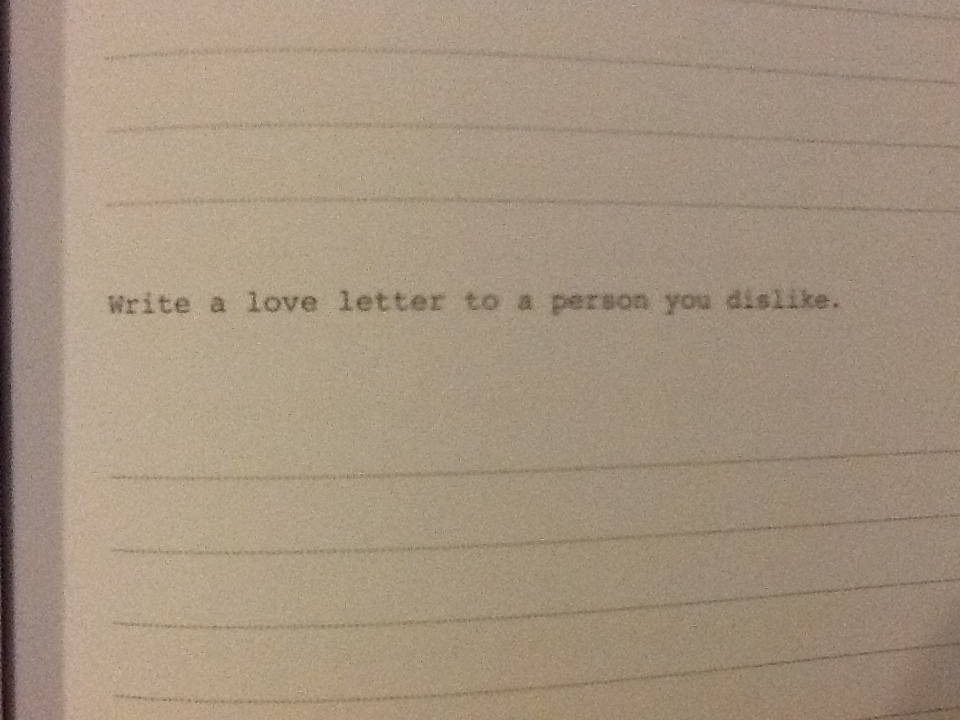
My spawn used some of her birthday money at the Assembly of Text on Sunday. She bought a journal, 642 Things to Write About by Raincoast. My spawn was smitten with it and was quite happy to make this purchase. I leafed through the journal and found some hilarious prompts. The journal is clearly for an adult given that there are a few prompts that speak to alcohol or more life experience, but overall the journal offers some great exercises in creative writing. I’m including a screen shot from one prompt about writing a love letter to a person you don’t like. Now, this post is not a love letter to such person or persons. But, it did make me think about what causes us to like or dislike another person. I am providing a list of traits that I immediately thought of and it is not exhaustive.

Things I like in a person (first six I thought of):

Honesty

Smile

Generosity

Intelligence

Witt

Compassion

Five things that turn me off (first six I thought of):

Dishonesty

Laziness

Arrogance

Disrespectful

Trolls

Patronizing

If I think of these traits and people who I have easily engaged with, I know that they had some or all of the six traits that I noted. We might have met at work, in the community, at a conference or at a kid-related event. And, as far as the turn offs–same places. I will add that I meet so many people each year given my work and family life. I know for a fact that I don’t click well with people who dislike strong women. There, I said it. And, yes, I have found this to be true from about high school onward.

And for the dear, sweet souls who feel that they have to stalk me online, this is not a love letter to any specific person.  That’s right–it’s not about you. The writing prompt made me think about traits. What traits do you like/dislike? Think about it–write them down and get blogging.
love letter

It is the time of the year when students are thinking about what they are going to do next. Some are in their last term or last year of school and wondering if grad school is for them. It is important to have some plans. Yes, I said plans. Plan A, B, C, and maybe even a plan D. Some students want to get organized several months before they have to apply. The grad school process is a frightening one, as it makes most students do something that they are completely unfamiliar with–promoting themselves.

I find that it does not matter if the student is a strong one or one with lots of potential most still have a hard time putting together their grad school dossier. I know that I did, but I was extremely lucky to have some wonderful mentors, and was involved with a peer mentoring group. This post is going to make some suggestions that assume that you are an undergraduate thinking about applying to grad school in the Fall.

Here, we are in the Spring (almost). The firs thing that I tell my students is that the grad school application process is like having another course. You need to research the schools and programs. You need to research potential mentors and their areas of expertise. You really should not just pick a program and land there without having done some research about the courses and the faculty.

Where do you want to live? Seriously. This was a concern for me. I knew that I did not want to leave the West Coast when I was looking at Political Science programs.

What do you want to study? Which courses did you find most interesting during your undergrad career? Which courses were the most fulfilling? These might not be the courses that you did the best in, but rather that rocked your world.

Where do you picture yourself in 1 year? Three years? Five years? There is not one answer for each of these questions. There should be multiple answers and that is perfectly fine.

What do you have to do to get there? To answer any of the above questions and this question, lean on your friends and your mentors. Now, you might not think that you have any mentors. It is not like you sign an agreement with your mentor and there is an understood relationship. No, I have had students send me cards after they graduated and found out that they referred to me as their mentor. There are different levels of mentoring and for some students being at the front of the classroom is enough. And, for other students there is more engaged relationship between the student and the faculty member. My point is that you probably do have a mentor or two! Seek them out and ask them for advice.

You’ve picked a program. Now, make sure that there is 2-3 faculty to work with there. Now, this might seem ridiculous at a smaller program, so maybe you might need to look for 1-2 people to work with at the program. One of the best ways to find out if you will be successful is to chat with current grad students. Find out what the lay of the land is. Also, find out what most graduates of the program do once they finish their theses. What do most of the grads end up doing? Policy work? Continue on with PhD programs?

Now, when you find out what you think you want to do, you need to get your application in order. Who are you going to get letters of support from for your dossier? Who will review your statement of intent? As they say, get your ducks in a row. Once you get your dossier together, you will need someone to review it all. This is where your friends and your mentors are important.

This is part one of a few posts. Good luck!

Grading and Offering Helpful Advice

I have large classes and this means lots of grading for me and my team of Teaching Assistants. I do not have Teaching Assistants for all of my courses, though. What I will say is that grading offers an interesting moment. That moment when you can assess if a student has: followed directions, read the material, organized her/his ideas well, and attempted to do the assignment in a timely fashion. Grading, though, is not about the student. It is about the work. And, this is where things get complicated.

Most of us take issue with people evaluating our work. It’s tough. The evaluation can make you squirm or sit taller in your chair. I’m cognizant of this, when I mark papers. There are moments, when I want to say: you totally kicked ass with this assignment. But, alas, that is not appropriate or even helpful. I might offer something like, it’s obvious that you have spent time thinking about the materials and have successfully articulated your analysis. Then, there are those moments, when you just know that a student did not have enough time to complete the assignment or did not manage his/her time well and you weigh what you need to say. I take no pleasure in offering critical commentary about student work. In most instances, I will offer that the assignment or paper did not meet the requirements. I try to avoid using the word: you. You is personal. The student reads it in a different way.

I have witnessed many students turn the to the last page for the grade. I was the type of student who read page by page the comments and if the grade was on the first or last page it did not matter. I wanted to get the feedback. I tweeted the other day that I was marking and was attempting to balance three things.

1. Firm    2. Fair    3. Compassion

These three things are important to me. The mark can influence a student’s assessment of their work, but also of the class, and the department. Maybe I’m thinking too much about this. But, I really do think that the feedback is important. Even if the assignment is just terrible–feedback is important. When the assignment is a failure, I do ask the student to come see me. I want to know what happened and if I can help. No student wants to earn the F. Usually there are extenuating circumstances and this is when I can offer guidance and compassion. Grading is not easy. I provide my first year students with a paper checklist, so that they can remind themselves of each component. This is a useful exercise for them, but even so it will not translate into 100% of the students using it or using the checklist properly. I continue to mark and think about the marking or grading process.

For my Teaching Assistants, the grading process is similar. I know from talking to them that some take the grading personally. They only want the students to succeed and feel a sense of frustration, when the students do not do well. They say, “I reminded them of this in tutorial. Why aren’t they following directions.” And, then, they are very proud when a student does well. Grading can seem so subjective at times, but ultimately it is not. We have our grading rubric and the grade categorization and explanation from the university. We know what we are looking for and we hope to find as many strong assignments as possible. In the interim, we plug away at the grading and offering useful commentary to our students.

Janni's files 388