Taking Time For Yourself: Fri Fun Facts

I used to have a hard time saying no to students. The infamous, “Do you have a minute” moments would eat away at my day. During the last four years I became more comfortable saying  no. This meant that I referred students to my office hours or encouraged them to email me to set up another time. The first few times that I said no I was a little excited. Did I actually say no?!

You’re probably wondering what is so liberating or dangerous about saying no. Well, when you’re part-time or junior faculty saying no can be an issue. Are you a team player? Do you carry your weight in the department and are you dependable. My Fri Fun Facts speaks to taking time for yourself.

1. In order to have a decent lunch step away from the compute or invite a colleague to your office for lunch. If not you might do what I often do (but try to do less) and eat at your keyboard and not really take a lunch break.

2. Walk around the building or to another building to get outside of the department. I have scheduled e-lerts that say, get outside, walk to DSB (another building), go visit so and so. Seriously.

3. Schedule coffees with friends across campus so that you have to walk across the campus. It’s OK to take 30-60 minutes and catch up with a friend. If you’re anything like me, it will be work-related. It will.

4. Say no and don’t feel guilty about it. Now, when I say no, I am going to picture Rona Maynard’s keynote at #breatheyyj Saying no is acceptable. Saying no can protect your time.

I’ll end noting that I have never had a student get mad that I said no. They are usually good about emailing to schedule a meeting or come  back during my office hours. With that–it’s OK to say no.
Reviewing Student Work: Teachable Moments

Reviewing graded work with students is not an easy task. This typically happens when a student wants to contest the mark, complain about the Teaching Assistant or about my assessment. Some students come in and they really want to learn from the assignment and do better the next time. Other students want to have an opportunity to complain. They merely want someone to listen to them. To be heard. I do not blame them–we all want someone to listen to us. It’s like Festivus–the airing of the grievances.

Educators need to remember that for so many of the students coming to office hours to chat with you is hard. Most students are a little nervous to come into the office and it’s best to immediately explain what the process is with the review. The student needs to know that you might lower or raise the grade. The student needs to know that they might have the option to revise and resubmit or contest the grade. The process will vary in different departments or different campuses.

All of this said, what I will do is re-grade the work and then review the graded work line by line or paragraph or by paragraph so that the student has a complete understanding of the grade. I also refer to the university grading system, so that the student understands that I am referring to the standards outlined by the institution. This is actually important as I feel it allows the student to understand that the grade is not personal–it is about the work and the guidelines for the assignment. This is also the appropriate time to review the assignment with the student.

Likewise, during the meeting in my office, I will allow the student to share her or his thoughts. This is the time to listen and to then respond as needed. I always end noting that the grade reflects the assessment of the assignment and not a judgement about the student as a person. I do think it’s important to add this last part, as many students really do think that the grade represents them and their effort. It does not.

Now, the last point that I want to speak to is effort and grade. I am hearing more students discuss how the grade does not reflect the effort that they put into the assignment. I listen to their explanation and think: I deserve to be paid more, but I am not. Effort does not entitlement to a better or strong grade. Some students will spend lots of time (revisions, office hour visits) and earn a B. Others will cram and pull an all nighter and earn an A-. It is not fair, but it happens. In my classes, the papers need to offer coherent analysis and follow directions. The assignment stipulates all the guidelines and some will not do well solely because they waited until the last minute or did not follow directions. Other papers will earn a weak grade due to the poor organization and writing.   Effort does not equal a strong grade.

Now there will be times when you review student work and you think that you might have been too hard. If so, admit it and raise the mark. My dad used to tell me, “I’m not perfect, you’re not perfect, nobody is perfect.” He’s right. Sometimes we make mistakes or are too harsh with a mark. Re-assess the work and move on. Explain why you are revising the mark and change the grade while the student is in your office, so that you don’t forget. Have fun grading and reviewing graded work!

Bif Naked: Keynote at #Breatheyyj

Bif Naked @BifNaked was the keynote speaker at Breathe Now ( @breathenow #breatheyyj ) in Victoria, BC ( #yyj ) on Sunday, April 15th. I was lucky enough to spend some precious time with her and the Breathe Now co-founders, Janice Mansfield, Angela Rafuse-Tahir, and Yukari Peerless. We shared our truths talking about different topics. But, overall, we repeatedly thanked her for joining us.

She notes that optimism is important and we all start off with it. Somehow we lose our optimism, tho. This is akin to the well-spring that @ronamaynard noted yesterday. Again, we see that taking care of selves is important and this includes emotionally, intellectually, and physically. Naked’s talk is genuine. I think we’re all starstruck honestly, and she’s just so real.

“I started university with the best intentions, like everyone else.” Bif Naked

I imagine that many people understand her statement, but then she met a young man with a mohawk–lots of laughter ensued! The band he was in needed a new singer and she joined the band. Add this to her majoring in Theater and writing poetry and it’s easy to see how she turned to entertainment. She shared anecdotes from her youth, “…what sweet intention there was.”

“Everyone has their own story. Every single story is equally profound.” Bif Naked

The audience is rapt paying attention to Naked’s story about her experience with cancer. Most women’s first thought when they find out that they have cancer is: Will I lose my hair. What does this say about women, our society? Naked speaks to the ways in which she was surrounded by other women, other cancer patients during her treatment. “The power of sisterhood…saved my life.”

Speaking to menopause, “You’re going to have a riot.” Oh, wow. I don’t know what to say. I’m not looking forward to it. Her ovaries were removed as part of her treatment and she subsequently went through menopause as a young woman of 38. She’s clearly at peace with her life and the journey that she’s taken in these 40 or so years. She’s amazing. Just two weeks ago she had a procedure to fix the hole in her heart. Mind blown. Procedure went through her leg and she was awake the entire time. Love that she commented on the good-looking male nurses that were in her room.

Breast cancer was not her medical emergency–instead fixing the hole in her heart was. She made lists. She’s worked on some of the points, but still needs to get the health directive done. During these last two weeks, she’s talked to her mom daily, had lots of dinner parties, kissed Nic (her baby pup), cleaned her car, painted her toe nails, and taken the time for herself. Sigh–important to take the time. Breathe!

Great reminders and what an end to a thoughtful weekend. I’m honored to have had a part in this event and thankful that Naked’s schedule was open so that she could speak at the conference.

It’s OK to Talk About Mental Health

Airdrie Miller @airdrie_miller Public School Teacher http://www.talkingtoair.com
It’s OK to Talk About Mental Health #Breatheyyj

Miller is sharing her experience with panic attacks in university. At first she kept quiet about her experience, but later sought help from the university mental health services. She has a 1998 baby, too. Awwww. “Nowadays we’re not putting pictures in albums–we’re putting them online.” She stopped her therapy and later had another baby. Then, postpartum depression hit. This is so common for many women.

She realized that she suffering from depression and resumed therapy. She got better and then resumed work after nine months. Oh, I love the Wonder Woman slide. She was doing it all…you know where this is going to go. Love her slide of the WHO’s definition of Mental Health. It’s telling and we need to stop and assess. Are we healthy? Are we pushing ourselves to attempt to be perfect?

Miller notes that mental illness does not discriminate! Twenty percent of Canadians will suffer from mental health issues in their life. This number is important to think about, as we all know many who are living with mental illness. Miller shares that she began to have serious thoughts about self-harm. She then quit her job and became what she calls a Desperate Housewife, but still suffering from depression.

She was very brave and ultimately was placed in the psych ward. This turn of events changed her life. Her experience with the outpatient therapy was positive. She went back to work part-time and tried to keep balance in her life. Then, her dear husband contracts colon cancer. Sigh. Derek Miller. After four years he succumbed to cancer. I’m so glad I heard her share her truths. She ends noting: It’s OK to not talk about it. Do what is right for you–so true.

Working in Man’s World: #Breatheyyj

It’s OK to be a Woman in a Man’s World! #Breatheyyj Really looking forward to this preso! Participants are: Marisa Goodwin @organicfoodme Anya Sereda @tinybean and Katie McDonald. What a great panel of woman who are working in male dominated fields. I just want to add that a great majority of the #BreatheNow meetings were held at Discovery Coffee, which Anya Sereda works for as their Green Bean Sourceress!

Sereda speaks to the coffee industry and refers to the baristas–the boys–as the show ponies, while the women are more apt to manage! It’s really interesting to hear about how so many coffee farms owned by women in the countries that she’s visited, but men run the farms. Interesting. I love that she admits to looking young. She’s 26 and looks like she’s 20. (Her words). She has a passion for beans, for coffee. And, after listening to her preso, she really knows coffee!

“Coffee has really taken me on a trip all around the world.” Anya Sereda

Her job sounds amazing. Out in the field doing her work… She noticed the ways that some people have treated her due to the issue of her youth and gender. She acknowledges her strengths and knowledge in the field and how it can at times be difficult for people to take her seriously. Happy sigh that my teen is here listening to this and hope it’s insightful to her and the rest of us in the audience.

The next speaker, Marissa Goodwin, reflected on her experience with her business Organicfair and the farm that she and her family run! She shared compelling stories about the level of sexism within the industry. We have more work to do! Looking at her bio it’s nice to see that their company includes 99% women employees. They are making change day to day in their work and their philosophy. Organicfair is based in Cobble Hill not too far from the Greater Victoria Region. Overall, Goodwin is another trailblazer! You, go!

The last speaker Katie McDonald is a mixologist who works at Veneto Tapa Lounge in Hotel Rialto. She has avoided thinking about being female in her career. She knows it’s there. “This elephant in the room.” I have to say that this is really common with lots of women—ignoring gender. But, she notes that we do need to think about gender. I like that she brought up equality and difference. Oh, those debates have not been resolved years later. Really? Some men call themselves, “Cocktailologist.” OK. She says that she’s a Mixologist or Bartender.

“It’s a dirty job. Lots of heavy lifting.” Katie McDonald

Interesting that for every one resume from a woman they field twenty resumes from men. And, this quote below also speaks to another binary in the job or industry. These quotes are telling. I’ll say it again and again: we have more work to do.

“If I’m the best female bartender on the line…you don’t have to compete with me.” Katie McDonald

She’s right, it’s an idealist view if we insist on saying that we’re all just people. This erases different components of identity. I do think that at times when people say this they are coming from a place of privilege and do not think that any difference exist at all. Again, this is in some instances and not meant as a sweeping generalization. And, McDonald notes that she wants to be just another Bartender and not the fact that she’s the “best woman bartender on the island.” On the flip side, she likes seeing women at competitions so that more women can/will attend these competitions. She’s sharing some honest, good points in her preso. I’m really enjoying the frank anecdotes.

“I do notice my gender.” Katie McDonald

Rona Manynard Rocking it at Breathe Now

I’m sharing my almost live tweets about Rona Maynard’s keynote today at #Breatheyyj. @ronamaynard Wow, great preso. Any keynote coach would say: Brava! #Breatheyyj Thinking about her comments about resentment. She grew up in alcoholic household, but on the outside everything looked fine. Maynard knew that she wanted more–a different type of life. Trailblazer.

She was part of the generation who was trying to do it all. Remember she was the Editor in Chief of Chatelaine. But, it was hard to do it all–hard to keep balance. Lots of head nodding in the room, as she shared these points. We think we have to be Super Women. This can be an issue in a hostile work environment. We will burnout. We will get sick or worse. Maynard left one job and worked at home and slipped into a depression. “With trembling fingers I made the call to a women’s mental health clinic.” I’m glad that she’s sharing this story with us today. We need to get rid of the stigma about mental illness, as it is so common.

“Say no to unreasonable demands.” Rona Maynard

This is really hard to do. People expect us to say yes. Oh, this is important to me right now. I’ve recently said no to a few things and stood my ground much to the surprise of those around me. I said no to protect myself and my integrity and refused to get bullied. Back to Maynard, I really want to read her book, My Mother’s Daughter: A Memoir. I want to read her life story, as I think I have something to learn from her.

“Saying no is not about fighting with people.” Rona Maynard

Her preso is reminding me that I’m not alone in parenting a teen. You do have to pick your battles. You do have to call a truce on certain issues with your teen. Boom. Thinking maybe a family meeting is in order to chat about things. Maynard’s speech is making me think of so many things.

“40 is a magical age for women.” Rona Maynard

Maynard shared that her articles led women to write her letters. She was motivating them. It’s refreshing to hear that she made a difference in so many women’s lives. I am impressed. What a perfect fit for @BreatheNow. I am so proud of the team of co-founders, sponsors, and volunteers in making this possible. This is our little slice of community building in Victoria #yyj.

“My gift is building community through stories…” Rona Maynard

I really love her comments about resentment. Makes me think of the resentment olympics. It’s important to protect your time, so that you don’t feel resentful. You need to keep the well-spring full. We need certain mantras to stay happy. It’s work. Can’t say, “Accio balance. Accio happiness.” You have to work on it and keep your boundaries in order to do it. And, I will be honest, I do keep the positive emails and when I need to–I will review them. It’s grounding after a tough day.

Thank you, Rona for giving me food for thought.

Fri Fun Fact: Finals

Final exams are here. This means lots of cramming for some students. Let me assume that you have attended class, taken notes, and read the readings. You now need to review your notes and the readings. People will study in different ways. I’m going to make some suggestions for prepping for the final.

  1. See the instructor or Teaching Assistant and talk about the final exam. Find out what the instructor is looking for with the final.
  2. I used to re-type all my notes so that the information would sink in deeper. If the class required learning lots of terms, I would use index cards and I would handwrite the answers and quiz myself with the index cards.
  3. Form a study group and work together with your classmates. This allows you to pool your knowledge and quiz one another as needed. Plus, some of the group members might have strengths in some areas that you do not.
  4. Study. Sleep. Eat. Exercise. Repeat.
  5. If you don’t know where your grade is prior to the final, confer with the instructor and find out what your mark is to date. This is a great incentive to help you figure out how much you really want to dedicate to studying for the final exam. Yes, I realize that students often do a cost-benefit analysis to figure out how much time or energy that they will dedicate toward a final.
  6. On the day of the final exam, sit down to write the exam. Close your eyes and picture your notes, the books, and think back to the lectures. If you’ve studied, the information is there, but you need to articulate it. You can do it.

Good luck!

Anti-Bullying Workshop: Part 2

I previously blogged about an Anti-Bullying held on March 31st, 2012 that I attended in San Diego. The workshop was sponsored by Voices of Women and was for the local Somali community. The latter half of the panel included a community member and the local Police. The first presenter was Ramla Sahid, community organizer. Yes, I smiled when I heard this descriptor and after hearing her presentation I was so impressed. Did I share that she’s also a SDSU alum?! Yes, she is. This young woman is working for social change. “We are accountable to one another.” Hearing her say this was important. She was reminding the mothers and daughters in attendance. Yes, the audience was predominantly sex segregated and I will speak to this later.  She also gave a polite yet scathing commentary on how the tough on crime legislation and policies in California were counter-productive.

The other speakers were two police officers: one Lieutenant and one Detective. I am not using their names–both of them work in the community and I will leave it at that. The two really spoke to the intricacies of the laws regarding bullying and harassment. There were a few moments when I wondered if the presentation was right for this audience, but nonetheless their presentation was good. I also was at times fascinated by their guns. The guns looked out of place–I know that they were on duty, but after years in Canada I am not as used to seeing lots of guns around. (Humor). The officers noted that if bullying begins in primary school it only worsens in junior high and high school, so it’s important that we respond.

“Respect is universal.” Lots of head nodded when the Lieutenant made this statement. Farah noted that we need to get the men involved and that they need men only workshops. I am not sure if I agree, but then again I am not taking into the cultural considerations. Perhaps he is on to something and these male only workshops can also speak to the importance of fatherhood. More workshops is definitely something work thinking of given the proliferation of bullying and need to curb it in schools.

When the question and answer period took place Agin Shaheed noted that we must get the fathers involved. There were only mothers in attendance. He also noted that across the US 87% of teachers are women. (Is this why we keep on hearing the press and experts pick on teachers? Is there bullying against teachers because this is still viewed as women’s work? Maybe that is another post).

Anti-Bullying Workshop: Part 1

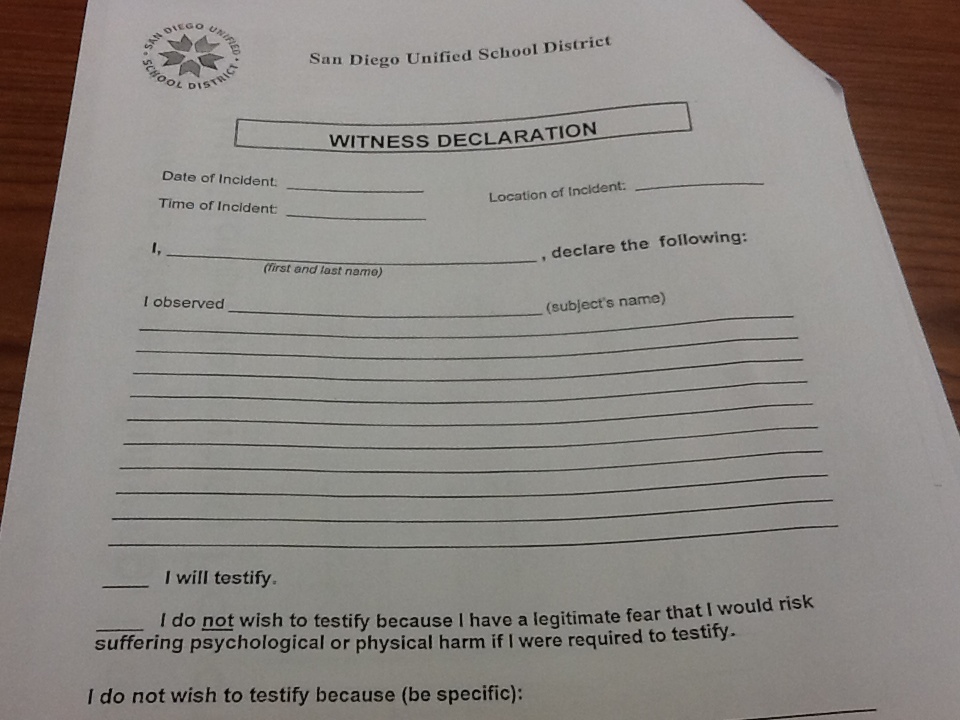
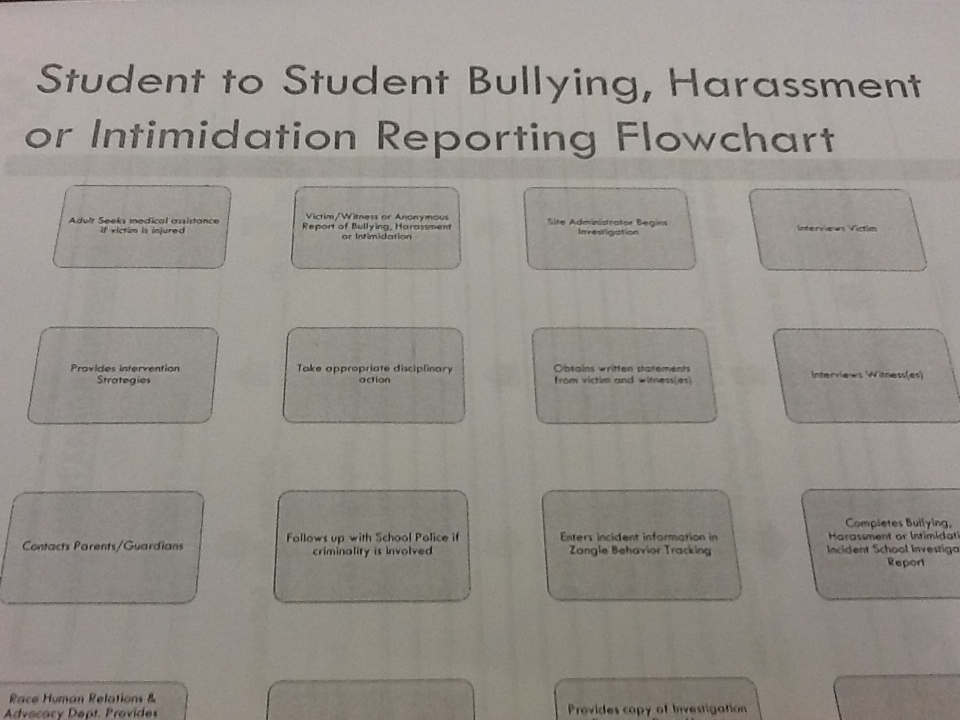
I had the distinct pleasure of the Voices of Women’s (VOW) Anti-Bullying workshop in San Diego, California on March 31st 2012. VOW collaborated with the United Women of East Africa for this workshop. I was quite pleased to be in the minority in the crowd. The majority of the attendees were women from the Somali community in City Heights neighborhood in San Diego. The array of panelists provided insight into the policies and realities of anti-bullying today in San Diego and more specifically the San Diego Unified School District (SDUSD). The array of handouts that SDUSD uses with documenting bullying and the anti-bullying efforts impressed me. I kept multiple copies so that I could share them at home. And, here I include my screen shots.

The first speaker, Agin Shaheed, is an administrator with the SDUSD. His exact position focuses on Race Relations. I couldn’t help but think that his job must be incredibly rewarding and exhausting. Shaheed noted that the SDUSD is the largest school district in San Diego County and second largest in the state. This would make it behind the Los Angeles Unified School District (LAUSD). Shaheed opened up his remarks reading a moving poem he wrote. He reminded the audience of 50 about the murders of Shaima and Trayvon. I was glad I packed my tissues. Shaheed made a germane point about cyberbullying and the way it invades the home–it makes this form of bullying more invasive. Victims of cyberbullying are not safe anywhere.

The next speaker Maslah Farah, Director of the Neighborhood Unity Foundation shared that he was bullied and got into trouble while he was in school. He shared that the bullying stays with you for the rest of your life. He also opened up my eyes to how important cultural issues are. He noted that in Somalia families really look to the teachers as a second parent and that corporal punishment is more common in the schools or other forms of discipline that are not allowed here. (I could hear some warm laughter as he noted this). What I took from his talk is that he was kicked out of high school and is now successful and using his community work to mentor others in the community. He reminded us that we need to move away from a mainstream culture that enjoys witnessing misery.

This portion of workshop really made me think about the ways that we think about bullying. I also wondered what sorts of policy the local schools in Victoria (where I live) have regarding bullying. We can talk until we’re blue in the face about how bullying is bad, and that kids should not do it. But, until we practice this and don’t encourage bullying among adults we unfortunately model bad behavior. Just turn on some reality television shows and we can see and hear bullying. Look at some of the news magazine shows and we can also see the bullying nature by the hosts. We live in a society where bullying is rampant. Not to seem trite–but we  need to model better behavior.

Collegiality via Email: Suggestions for Students

Last week I wrote about collegiality on campus and was really thinking about colleagues. Today I am thinking about students. Most of the original post applies; however, it is markedly different for students. I advise students and  I supervise students. But, I also assess student work and worth with graduate and undergraduate students in different capacities. I am in contact with lots of students and I had some interesting conversations with colleagues at #ISA2012 I know that email communication is a sore spot for lots of us.

I’ll list in no particular order some suggestions:

Never send an email that you have initial misgivings with or give you pause. Don’t send it. You might have a smartphone, but that doesn’t mean that you are making smart decisions. The tendency is to be less formal and send an incomplete sort of email.

Never send an email in anger or frustration concerning a mark. These situations really requires a face to face meeting. And, then you and the recipient have the record of your angry or frustrated email. Avoid sending an email that you might later feel sheepish about or regret.

Never send an email making statements that you wouldn’t say to someone’s face. We get brave  behind the screen or with the phone, so think before you send. Remember that your instructor or boss is not your peer and you should error on being more formal than informal.

What you should do if you feel you need to send an email: Send yourself the email and wait. Then, review the email. Practice smart computing and communicating.