Thinking about Learning Spaces

Almost one year ago, I attended the National Forum on Active Learning Classroom conference held at the University of Minnesota in Minneapolis. It was a truly amazing conference! Between the Society for College and University Planning and this conference, my head is going to explode with all the great information that I heard. The good news is that I feel validated. Validated for my teaching style and the disruption that I cause in the classroom and with my educational technology use.

I understand from my friends and colleagues in many departments that their classroom is everywhere. They teach online and I tend to veer toward a blended or flexible format. I might have two sessions of lecture/discussion style, lab time or online/group learning time. The reality is that learning spaces exist in and outside of the traditional classroom and we need to make sure that we are supportive of the variety of teaching modalities. Likewise, our students are used to making virtually any space a learning space and we need to remember this as we plan space on campus.

One little takeaway was the artful way that the facilities office has suggested that students clean up after themselves. This is the way to encourage students and does not rant or nag at them, which they dislike. And, I cannot blame that. Many colleges are moving to recycling centers outside of classrooms to encourage sorting your garbage and recycling. I took lots of photos at the conference and there are some other great posters in the rooms. 
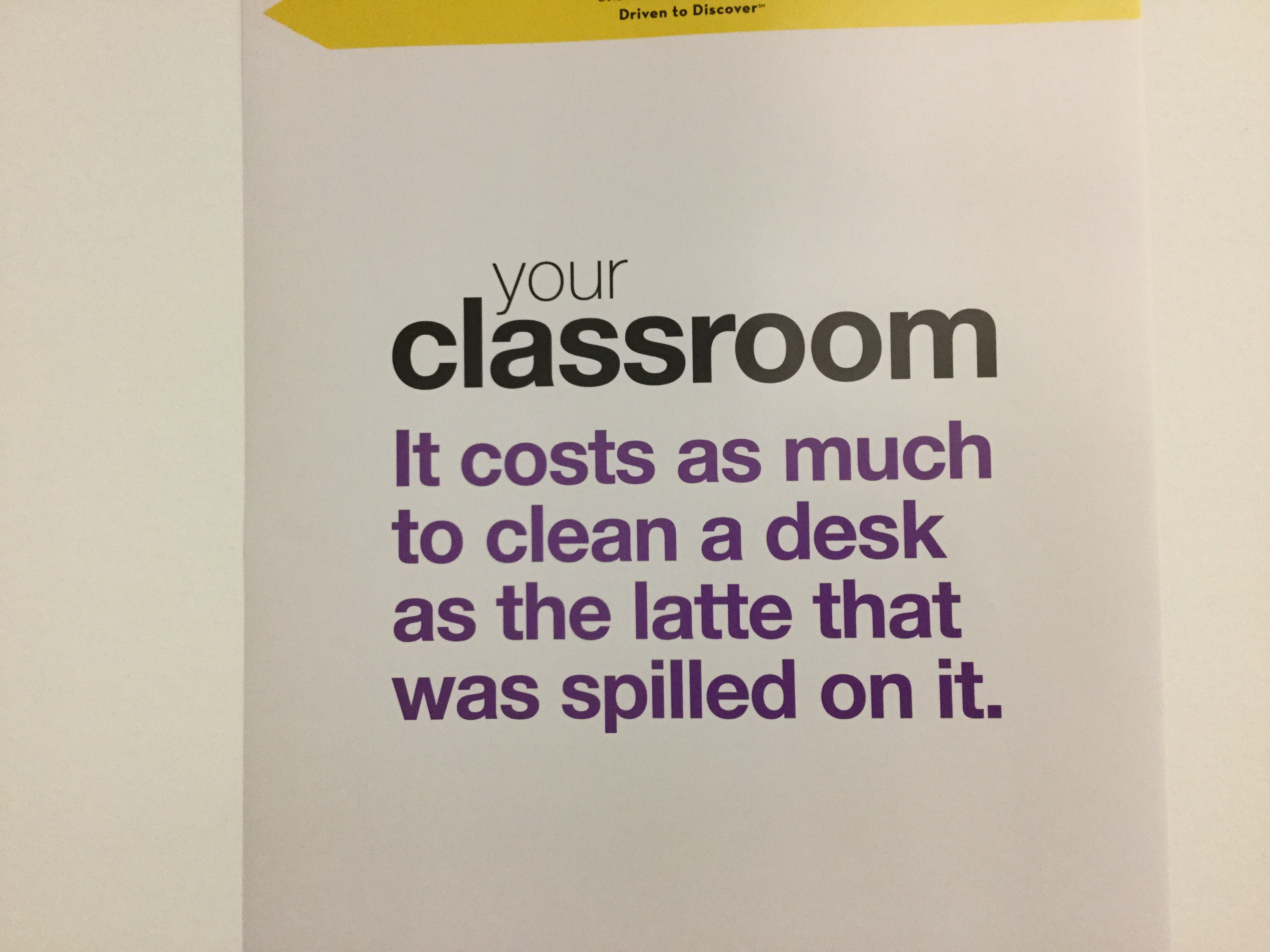
 

U of MN classroom

The conference was small with about 250 attendees and the group was mixed in terms of facilities staff, administrators, and faculty.  However, based on my interactions, it seemed like there were more faculty at this conference. The faculty shared a common interest–dedication to teaching and learning. It is refreshing to interact with large groups of people dedicated to teaching and learning. We talked lots about flipping the classroom and the importance of active learning spaces. The photos below are from the conference sessions. All of the sessions were held in active learning spaces. I have more to say, and this is just one post. Look for more about this topic, and I have more below the photos!

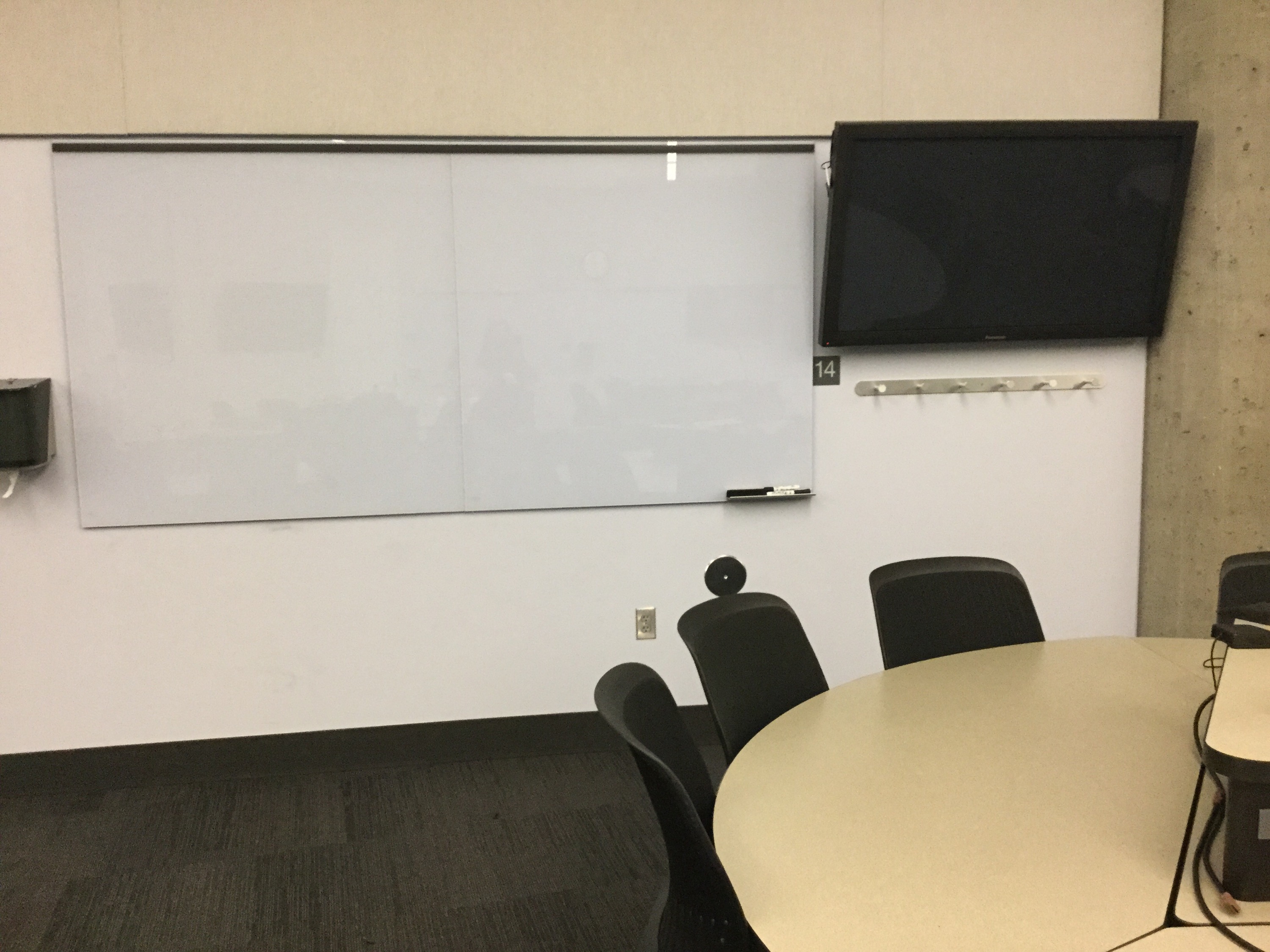
  

A year later I can say that I have learned lots about learning spaces that are planned and found. The first thing is that students will help you “break” a classroom in ways that you may not have thought of during the planning. For instance, we have writable wall space, but did not make every last inch writable. Guess what? Some creative students assumed that every last inch was writable. Yup. If some of the space is writable, you need to make it all writable or have those fancy stickers or posters on the wall noting it’s writable space.

Another thing that I have learned is that a flexible classroom space will not work for every instructor. I fielded requests for four different lecterns. The rooms had one lectern, but there are “favorite” types of lecterns. In short, once a space is remodeled you must expect a year or two of testing, breaking, and consultations in order to assess what worked well or what needs improvement. Overall, working on a committee that is trying to make the face to face classroom space better is a rewarding work.
Fri Fun Facts: Women in #HigherED #IT

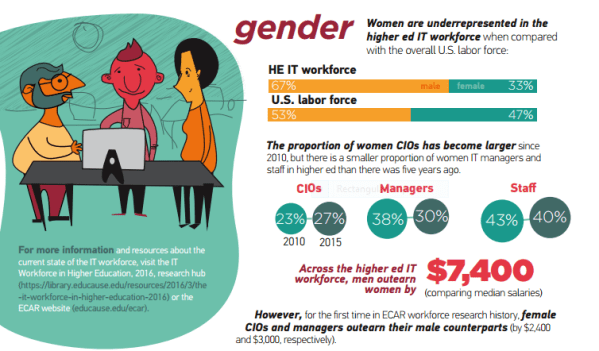
Today’s Friday Fun Fact post is dedicated to women. Women are a minority in higher education information technology workforce. Here is a great infographic from Educause.

educause gender higher ed IT

From the infographic you see that men comprise 2/3 of the higher education information technology workforce. The numbers look accurate based on my experience in higher education. I find that the highly technical work is often completed by men; while the teaching and learning with technology support staff are more likely to be women. There is definitely some interesting data here to think about related to specific areas in higher education.

Great Book: How to Deal with Difficult People

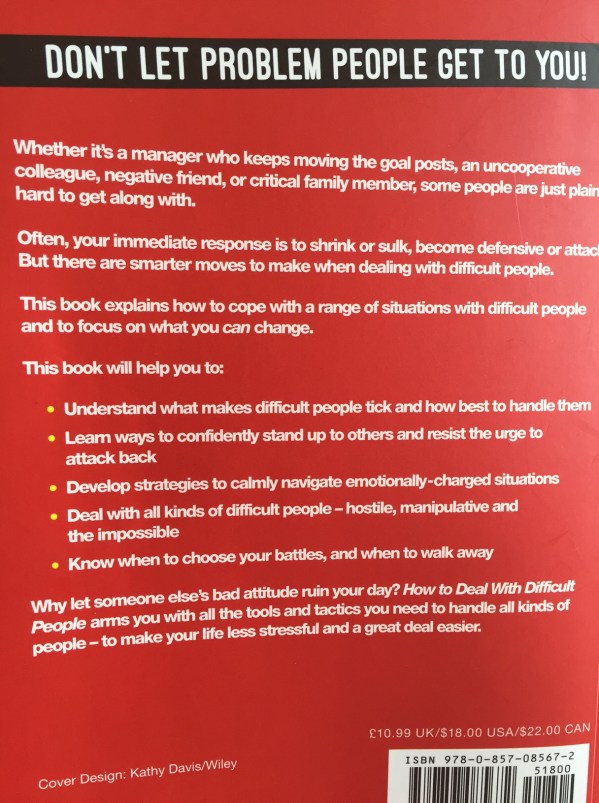
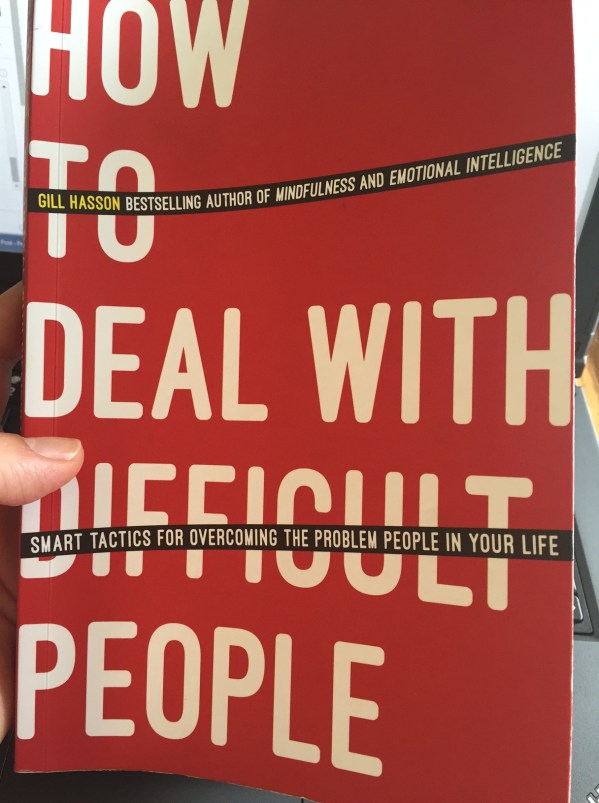
I have found that some books work as great conversation starters. Several months ago I read Gill Hasson’s How to Deal with Difficult People: Smart Tactics for Overcoming the Problem People in Your Life. This book caused more nervous reactions from people in my office than other books. I later moved the book out of eyesight so that people would not nervously asked if I bought the book in preparation for a meeting!

difficult front cover

The truth is that I did buy the book to review the array of skills that are needed to work effectively with difficult situations and difficult people. The book is about communication and it’s a great addition to my library. I have also suggested the book to others. I appreciate the back cover, “This book explains how to cope with a range of situations with difficult people and to focus on what you can change.”

The table of contents is clearly divided into three main areas: Dealing with Difficult People, Putting It into Practice, and When All Else Fails. Each section is about communication; however, the sections also provide opportunity for introspection. What can you do better? And, tips for dealing with different types of hostility. We all have dealt with the co-worker who is unwilling to take on work. “Oh, I’d do it, but I just don’t have the capacity to do one more thing.” And, I know that this is typically a way to not share a work task.

The book also gives some great tips. Listening. I am getting better at listening, but this is a real skill. I have ideas and I am bursting with them, but I have to remember to pause. This takes work! Hasson notes that it’s important to be direct and honest, and offers some assertive phrases:

I need you to…

Can you explain?

Can you tell me more?

I think it would be better to discuss this at another time.

There are certain phrases that many of us understand that can escalate a situation. Using “you” instead of I. Starting off a sentence with: I’m not racist/sexist/homophobic, but. With all due respect. These phrases usually contradict what the person is trying to say and can escalate a conversation. The phrases are anything but part of effective communication. The backdrop of the book is that we need to communicate honestly. Never send an email when you’re angry. Pick up the phone or make time to speak face to face.

Hasson also explains that some people are impossible. That’s right–it’s not that they are difficult, but they are impossible and there is no way to compromise or communicate with them. You need to put on your thick skin and plan how you will communicate and feel about the engagement. And, Hasson notes that with the impossible person, you might want to not engage. The impossible person envelopes themselves in drama and relishes pulling you in. Run. Run as fast as you can and stay away from this person. But, if you must engage, try to make it on your terms.

I try to protect my time and will make sure that I have an immediate other appointment after a meeting with a really difficult or impossible person. I have also protected my personal time from people what some refer to as emotional vampires and seem to only need me. This is not real friendship. Gill Hasson’s book is perfect work and your personal life. The book is filled with lots of tips and I will likely offer a post related solely to one chapter. There is a great chapter on bullies, and that chapter deserves its own post. Here is a screen shot of the back cover.

difficult back cover

Why I Run Review Sessions

I am revisiting this idea. While I am not teaching a large first year course anymore, this post is relevant. I started this post a few years ago and saved it as a draft. Now, I am finishing it and mindful that it is a good reminder for my teaching and learning. I am an advocate of review sessions and workshops for students. We want students to think about how their professor is helpful. I include a screen grab from a search for “my professor is.”

my prof is

I am co-teaching a first year level course with three other faculty and one of the things that I take on as the professor of record is offering review sessions for the exams and other major assignments. I have taught first year courses for most of my academic career and the review sessions are important to helping my students with their learning. Review sessions or re-visiting “how to be successful” is not pandering to our students. It is an important part of active teaching.

Now that I have started my 19th year of teaching, I have come to realize several things. My students want more guidance about assignments. For an array of reasons, when I first started teaching the typical student would come to office hours or ask a question about an assignment in class. Now a majority of them want me to give them more information about the major assignments during class time. They likely feel that the stakes are higher for them and they want to fully understand my expectations.

I have also found that when we are blogging, uploading to Wikipedia or using any educational technology platforms in the classroom they need more than one workshop session to learn the technology. Some colleagues are surprised to hear this, “but they are the digital generation.” Yes, we can refer to our students as such, but when marks are involved it is a different story. This is not an exhaustive list of what I have learned over the years. I will certainly add to this post, as I ruminate why I am fine with clarifying, review sessions or otherwise digging deeper.


Conferences and Conferencing

This Spring is extremely busy or perhaps more busy. I have been to four conferences in less than two weeks. I have had ample opportunity to re-connect or meet new people at each of the conferences and I have some advice for networking. This is not an exhaustive list.

  1. It’s great to introduce yourself, but make sure that you pause and listen to the people that you’re meeting.
  2. You’ll need to re-charge after the networking, and it’s important that you self-care and have some down time.
  3. Try to follow up with the new connections that you’ve made. This might be via an email or liking/sharing something that they’ve said on a social media platform.
  4. See if you can meet new people! At some conferences, work colleagues will congregate and the conference is the perfect opportunity to build your networks. You can meet new people and introduce them to others, who you know at the conference.
  5. Learn. Go to sessions that you’re interested in and be open to learning about new topics.

Regroup after the conference and think about how you can share what you have learned with your colleagues.

The Way You Work: Revisited

Academic work requires so much solitary work and this makes it flexible and at times impossible. Work always beckons and the to do list can become burdensome. We are at the start of Summer term at the campus where I work, and it is the perfect time to think about how you can re-focus on the way you work. What works for you?
Right about now academics are thinking about the long list of things to accomplish during the Summer. Honestly, though, how do you work?

I find that I need some white noise when I am doing certain tasks and other tasks requires quiet or music at a low volume. At the day’s end when I am completely alone this is the time that I listen to music set high. I like to chunk out as many tasks as I can during these evenings alone at work. My job requires lots of meetings and this means that I have to catch up from the meetings. I am an early riser and tend to get lots completed before anyone else in my family wakes up.

I have blogged previously about the importance of having good work and life balance and boundaries. I know that this is extremely important, but the reality of work is that some months are more busy than others. I am also trying to think about the way I work and what keeps me organized and able to get things done. I love coffee and the entire process of making and savoring it. This ritual is part of my morning and reading the papers. I also realize that the caffeine is necessary most days.

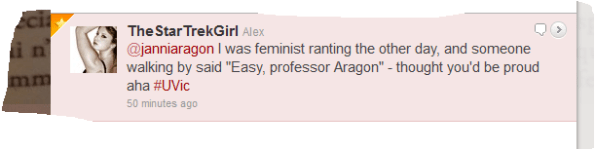
I need desk time to plan and think, and I need to walk around and will find myself in walking meetings. <They are awesome!>  . I will talk into my phone and dictate notes from a meeting or send myself emails to update. I also use this time to clear my head and plan for the next meeting, task, or day. I need some alone time to organize my day. I use Todoist to organize my tasks and I have found this tool works well for me. While this is not a feminist rant, I was thinking about this quote and feel it fits.

Aragon Rant_Twitter


Epiphanies

Most instructors have likely experienced this. You get your mail in the department and you have a card from a former student that essentially says the following: I took your class a number of years ago and wanted to say thank you. I thought you were crazy, but now that I’ve been working I find that I think of you and the class fondly. I am sorry for being a jerk. Your class was important. Thank you. I appreciate the thanks, and I also appreciate the apologies for sarcasm or making the class discussion more difficult. These notes are quite meaningful.

Approximately ten times per year, I get emails, cards or Facebook messages like the above from my former students. Funny enough the cards are from an array of students and it is sloppy to say it is from the haters. The cards come from former students who are being honest. Some might think  that they were difficult, but I find that their memory and my memory vary. I can think of two very difficult groups over the years, and I have heard from one person out of that group, and the apology appeared honest at first. I say that, as that former student appeared lots in my social media being rather antagonistic. I wish I could say that the above is pure hyperbole. It is not.

Lately, this has happened more than most years. I think it’s the fact that the numbers of students that I have taught has increased or maybe it is the fact that I just finished my tenth year at the fourth university. They know how to contact me via snail mail, email or social media.

My point here is I have found that the students who send these notes surprise me. I am happily surprised that they contacted me. I am happily surprised with the thanks, and reminded about the privilege that I have working with them in the classroom. But, each card notes that I was approachable, enthusiastic or that my playing devil’s advocate made a difference. My students are not jerks. They are diligent, hard-working, exhausted, balancing lots, and do what they can. They are imperfect. And, so am I.

Great caption, excuse the f bomb


What My Students Have Taught Me

I submitted my students’ grades and I have now completed my 18th year of teaching. I want to reflect on this year, but also begin to think about the next school term. This post offers some thoughts about what my students have taught me.

What have I learned from my students?

  1. Some of them are at university as a placeholder. Everyone tells them it was next for them. For many of them they are in the right place, but for some they will need some time off or to do other things, and this is fine. We have to support them.
  2. Their first year is hard. They are acculturating to university life and possibly living away from their parents. You have to treat the students with extra patience during the first term. Be firm, but patient.
  3. They are excited. You really want to keep that enthusiasm up, as it will for them when they are exhausted, homesick or second guessing themselves.
  4. You are part of their university experience.
  5. Working with first years for the bulk of my years, you are one of many who have impact on their ability to get through the first year. It is important to set guidelines, but be kind.

Overall, my first years have taught me humility. They are the hardest students to work with, as they demand the most of me. They also offer the most harsh quantitative and qualitative assessment of my teaching. It is ironic that a class full of people who are for the most part new to university are assessing my ability to teach. Who are they comparing me to? But it is important to hear from all my students, and learn from them. They make me smile with their compliments and criticism. It’s interesting to see that three students might like my use of “keener,” but one thinks that it is offensive. Yes, offensive. I cannot please everyone, and I do not try to do so. It is impossible!

I really look forward to year 19, which starts next month with the new term. I include a photo of my favorite Supreme Court Justice, Ruth Bader Ginsburg, who is also known as the Notorious RBG.

notorious rbg


Cyberbullying

I read Sarah Darer Littman’s Backlash. The book’s cover notes, “What happens online doesn’t always stay online…” The book is a mature read in the Young Adult Literature #YALit genre. I read the book in one sitting staying up later than I really wanted to, but the book was a compelling page turner. Unfortunately, there are numerous cases of cyberbullying that make the mainstream news, so we know that this story is too real for so many young people.

The book does a great job of sharing the painful lesson that Cyberbullying is not a victimless crime. I suggest that parents, teachers, and young people read the book and then have discussions about the content. I encourage you to read this book.

backlash.PNG

Don’t Blame Technology

The acceptance letters are going out to all the Grade 12 students. I am reading lots of books about teaching and technology, and reflecting on the ways in which we talk about first year students and technology. I felt it was worth continuing this conversation.

The New York Times article “Growing Up Digital, Wired for Distraction” made the rounds, but since there have been other similar articles. It is to easy to blame technology on the disconnect that educators find with the current cohort of students in our first year courses. I am going to speak to this notion that the Net Gen are artful multi-taskers and think differently. Instead, what we really have is a cohort of young people who are used to using technology all of the time for gaming, fun, communicating, research, school work, and for making connections with others. Of course, some are using technology merely for gaming or social networking, but you get my point.

Part of my job is to acculturate students to the environment of higher education. This is why my course syllabus states that students should be taking notes or checking the course Moodle site, but not gaming during lecture. It’s distracting to those around them and frankly, if you want to game, download music–do that outside of the classroom. This notion of the Net Gen being better at multi-tasking has been disputed on several occasions this year with new research that states that the Net Gen are no better at multi-tasking than previous generations.

I am not a tech Luddite. I have an iPhone and have often been an early adopter of different technology or applications. However, I tire at the sheer number of articles that extol only the virtues of technology in reference to youth. This New York Times article doesn’t do this, but it opens up the door to excuse making for rude behavior in the classroom and in communication. If the Net Gen wasn’t spending hours online gaming or connected to Facebook, they most likely would be on the phone for hours with friends. Technology has replaced other great time vacuums that previous generations used. Here, all of this conversation is directed toward youth who have access to technology. These are really first world concerns and conversations.

We need to remember that ultimately lots of business and human interaction takes place face to face. This is where we need to remind the Net Gen about classroom etiquette and communication etiquette online and offline. In much the same way, though, educators need to be realistic about their teaching and make sure that the material and means of presentation of the information is engaging. And, we need to equip are students with skills to use the technology well. We are all in this together.

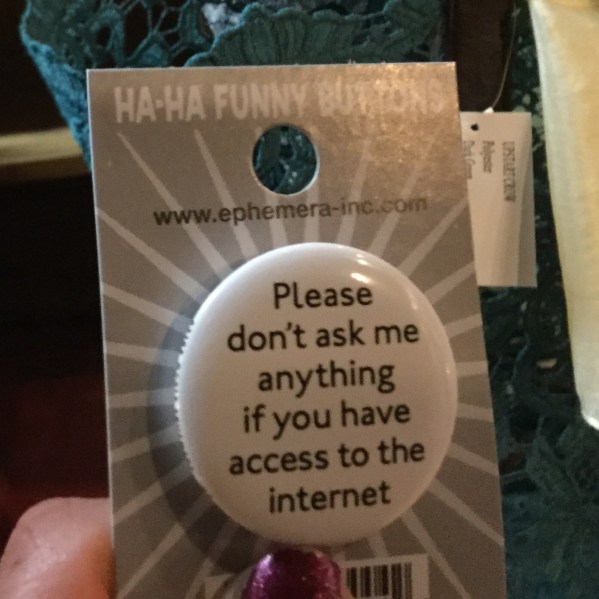
internet button

Sassy Button