Thinking about the Term: Fri Fun Facts

The term just ended and it’s fresh in my mind. For students, staff, and faculty this is the best time to think about how the term ended. What can you do to make the next term better? And, more importantly what did you do well that you need to do again?

  1. I keep track of my emails and hold on to them for more than a year. I do this to protect myself and the students. I will continue to do this
  2. I had students blog in my seminars and I will continue to offer this as an assignment. The student blogs were good to strong.
  3. I did something different this school year and I had separated my office hours between my advanced class (the seminar) and my first year course. The seminar students enjoy having their own slated consultation time. I will continue to do this.
  4. I allowed one Teaching Assistant to run a series of writing workshops and I think that was a great use of his hours. The first session was small, but the next two included lots of students and they gave me positive feedback.
  5. There are instances when I photocopy work that gives me or the Teaching Assistant pause. I photocopied some work this time, but will take special care to to photocopy any work that requires “strict scrutiny.”

Overall, it was a great term and I look forward to Summer School.

Taking Time For Yourself: Fri Fun Facts

I used to have a hard time saying no to students. The infamous, “Do you have a minute” moments would eat away at my day. During the last four years I became more comfortable saying  no. This meant that I referred students to my office hours or encouraged them to email me to set up another time. The first few times that I said no I was a little excited. Did I actually say no?!

You’re probably wondering what is so liberating or dangerous about saying no. Well, when you’re part-time or junior faculty saying no can be an issue. Are you a team player? Do you carry your weight in the department and are you dependable. My Fri Fun Facts speaks to taking time for yourself.

1. In order to have a decent lunch step away from the compute or invite a colleague to your office for lunch. If not you might do what I often do (but try to do less) and eat at your keyboard and not really take a lunch break.

2. Walk around the building or to another building to get outside of the department. I have scheduled e-lerts that say, get outside, walk to DSB (another building), go visit so and so. Seriously.

3. Schedule coffees with friends across campus so that you have to walk across the campus. It’s OK to take 30-60 minutes and catch up with a friend. If you’re anything like me, it will be work-related. It will.

4. Say no and don’t feel guilty about it. Now, when I say no, I am going to picture Rona Maynard’s keynote at #breatheyyj Saying no is acceptable. Saying no can protect your time.

I’ll end noting that I have never had a student get mad that I said no. They are usually good about emailing to schedule a meeting or come  back during my office hours. With that–it’s OK to say no.

Reviewing Student Work: Teachable Moments

Reviewing graded work with students is not an easy task. This typically happens when a student wants to contest the mark, complain about the Teaching Assistant or about my assessment. Some students come in and they really want to learn from the assignment and do better the next time. Other students want to have an opportunity to complain. They merely want someone to listen to them. To be heard. I do not blame them–we all want someone to listen to us. It’s like Festivus–the airing of the grievances.

Educators need to remember that for so many of the students coming to office hours to chat with you is hard. Most students are a little nervous to come into the office and it’s best to immediately explain what the process is with the review. The student needs to know that you might lower or raise the grade. The student needs to know that they might have the option to revise and resubmit or contest the grade. The process will vary in different departments or different campuses.

All of this said, what I will do is re-grade the work and then review the graded work line by line or paragraph or by paragraph so that the student has a complete understanding of the grade. I also refer to the university grading system, so that the student understands that I am referring to the standards outlined by the institution. This is actually important as I feel it allows the student to understand that the grade is not personal–it is about the work and the guidelines for the assignment. This is also the appropriate time to review the assignment with the student.

Likewise, during the meeting in my office, I will allow the student to share her or his thoughts. This is the time to listen and to then respond as needed. I always end noting that the grade reflects the assessment of the assignment and not a judgement about the student as a person. I do think it’s important to add this last part, as many students really do think that the grade represents them and their effort. It does not.

Now, the last point that I want to speak to is effort and grade. I am hearing more students discuss how the grade does not reflect the effort that they put into the assignment. I listen to their explanation and think: I deserve to be paid more, but I am not. Effort does not entitlement to a better or strong grade. Some students will spend lots of time (revisions, office hour visits) and earn a B. Others will cram and pull an all nighter and earn an A-. It is not fair, but it happens. In my classes, the papers need to offer coherent analysis and follow directions. The assignment stipulates all the guidelines and some will not do well solely because they waited until the last minute or did not follow directions. Other papers will earn a weak grade due to the poor organization and writing.   Effort does not equal a strong grade.

Now there will be times when you review student work and you think that you might have been too hard. If so, admit it and raise the mark. My dad used to tell me, “I’m not perfect, you’re not perfect, nobody is perfect.” He’s right. Sometimes we make mistakes or are too harsh with a mark. Re-assess the work and move on. Explain why you are revising the mark and change the grade while the student is in your office, so that you don’t forget. Have fun grading and reviewing graded work!

Anti-Bullying Workshop: Part 2

I previously blogged about an Anti-Bullying held on March 31st, 2012 that I attended in San Diego. The workshop was sponsored by Voices of Women and was for the local Somali community. The latter half of the panel included a community member and the local Police. The first presenter was Ramla Sahid, community organizer. Yes, I smiled when I heard this descriptor and after hearing her presentation I was so impressed. Did I share that she’s also a SDSU alum?! Yes, she is. This young woman is working for social change. “We are accountable to one another.” Hearing her say this was important. She was reminding the mothers and daughters in attendance. Yes, the audience was predominantly sex segregated and I will speak to this later.  She also gave a polite yet scathing commentary on how the tough on crime legislation and policies in California were counter-productive.

The other speakers were two police officers: one Lieutenant and one Detective. I am not using their names–both of them work in the community and I will leave it at that. The two really spoke to the intricacies of the laws regarding bullying and harassment. There were a few moments when I wondered if the presentation was right for this audience, but nonetheless their presentation was good. I also was at times fascinated by their guns. The guns looked out of place–I know that they were on duty, but after years in Canada I am not as used to seeing lots of guns around. (Humor). The officers noted that if bullying begins in primary school it only worsens in junior high and high school, so it’s important that we respond.

“Respect is universal.” Lots of head nodded when the Lieutenant made this statement. Farah noted that we need to get the men involved and that they need men only workshops. I am not sure if I agree, but then again I am not taking into the cultural considerations. Perhaps he is on to something and these male only workshops can also speak to the importance of fatherhood. More workshops is definitely something work thinking of given the proliferation of bullying and need to curb it in schools.

When the question and answer period took place Agin Shaheed noted that we must get the fathers involved. There were only mothers in attendance. He also noted that across the US 87% of teachers are women. (Is this why we keep on hearing the press and experts pick on teachers? Is there bullying against teachers because this is still viewed as women’s work? Maybe that is another post).

Anti-Bullying Workshop: Part 1

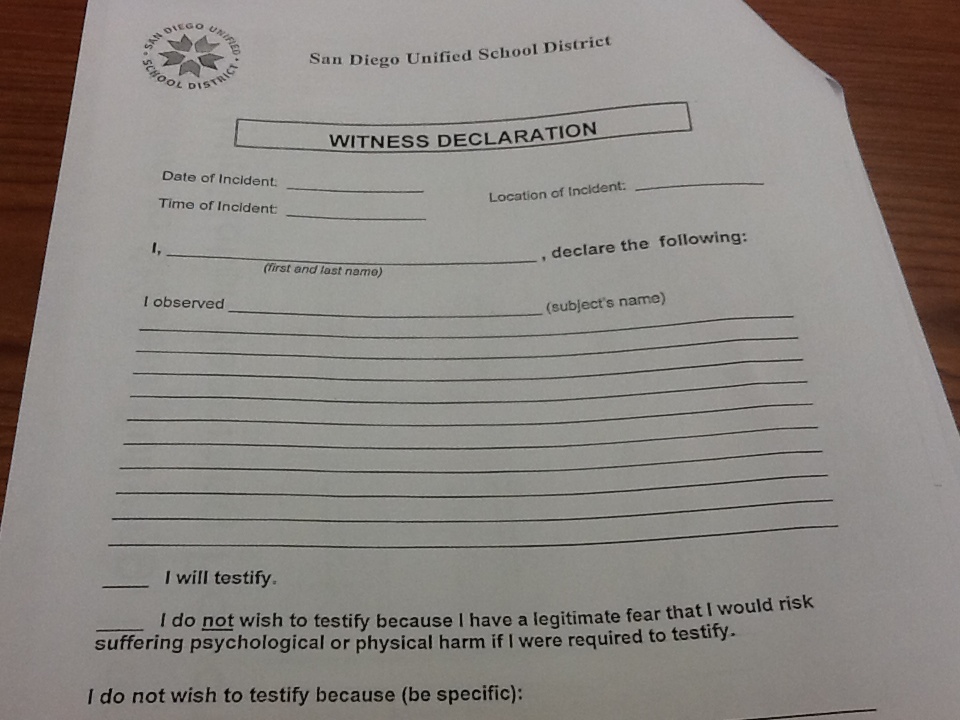
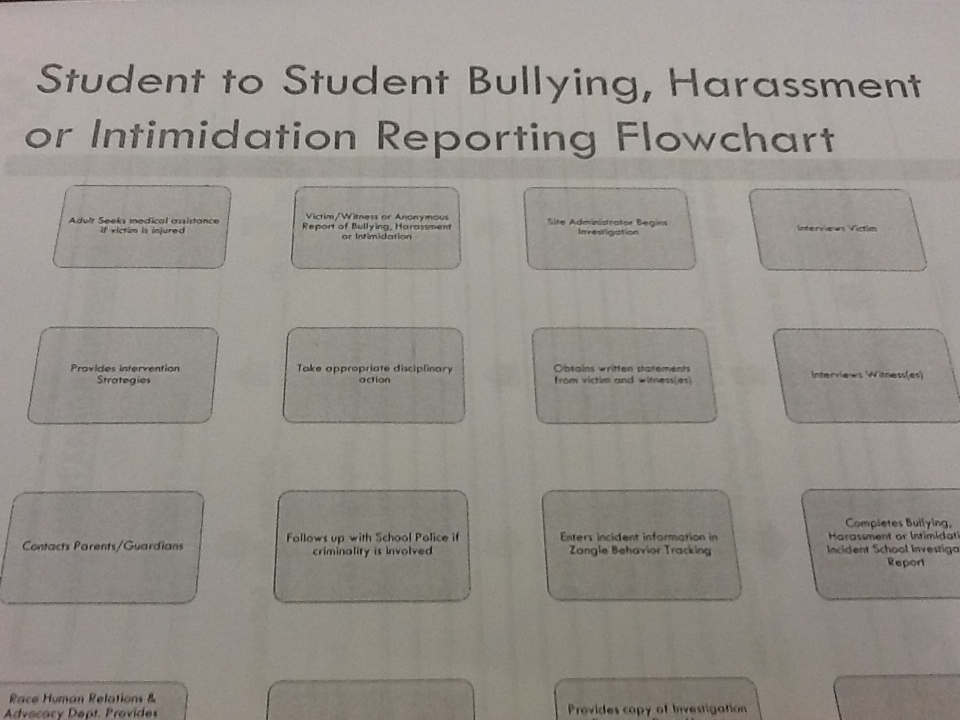
I had the distinct pleasure of the Voices of Women’s (VOW) Anti-Bullying workshop in San Diego, California on March 31st 2012. VOW collaborated with the United Women of East Africa for this workshop. I was quite pleased to be in the minority in the crowd. The majority of the attendees were women from the Somali community in City Heights neighborhood in San Diego. The array of panelists provided insight into the policies and realities of anti-bullying today in San Diego and more specifically the San Diego Unified School District (SDUSD). The array of handouts that SDUSD uses with documenting bullying and the anti-bullying efforts impressed me. I kept multiple copies so that I could share them at home. And, here I include my screen shots.

The first speaker, Agin Shaheed, is an administrator with the SDUSD. His exact position focuses on Race Relations. I couldn’t help but think that his job must be incredibly rewarding and exhausting. Shaheed noted that the SDUSD is the largest school district in San Diego County and second largest in the state. This would make it behind the Los Angeles Unified School District (LAUSD). Shaheed opened up his remarks reading a moving poem he wrote. He reminded the audience of 50 about the murders of Shaima and Trayvon. I was glad I packed my tissues. Shaheed made a germane point about cyberbullying and the way it invades the home–it makes this form of bullying more invasive. Victims of cyberbullying are not safe anywhere.

The next speaker Maslah Farah, Director of the Neighborhood Unity Foundation shared that he was bullied and got into trouble while he was in school. He shared that the bullying stays with you for the rest of your life. He also opened up my eyes to how important cultural issues are. He noted that in Somalia families really look to the teachers as a second parent and that corporal punishment is more common in the schools or other forms of discipline that are not allowed here. (I could hear some warm laughter as he noted this). What I took from his talk is that he was kicked out of high school and is now successful and using his community work to mentor others in the community. He reminded us that we need to move away from a mainstream culture that enjoys witnessing misery.

This portion of workshop really made me think about the ways that we think about bullying. I also wondered what sorts of policy the local schools in Victoria (where I live) have regarding bullying. We can talk until we’re blue in the face about how bullying is bad, and that kids should not do it. But, until we practice this and don’t encourage bullying among adults we unfortunately model bad behavior. Just turn on some reality television shows and we can see and hear bullying. Look at some of the news magazine shows and we can also see the bullying nature by the hosts. We live in a society where bullying is rampant. Not to seem trite–but we  need to model better behavior.

Collegiality via Email: Suggestions for Students

Last week I wrote about collegiality on campus and was really thinking about colleagues. Today I am thinking about students. Most of the original post applies; however, it is markedly different for students. I advise students and  I supervise students. But, I also assess student work and worth with graduate and undergraduate students in different capacities. I am in contact with lots of students and I had some interesting conversations with colleagues at #ISA2012 I know that email communication is a sore spot for lots of us.

I’ll list in no particular order some suggestions:

Never send an email that you have initial misgivings with or give you pause. Don’t send it. You might have a smartphone, but that doesn’t mean that you are making smart decisions. The tendency is to be less formal and send an incomplete sort of email.

Never send an email in anger or frustration concerning a mark. These situations really requires a face to face meeting. And, then you and the recipient have the record of your angry or frustrated email. Avoid sending an email that you might later feel sheepish about or regret.

Never send an email making statements that you wouldn’t say to someone’s face. We get brave  behind the screen or with the phone, so think before you send. Remember that your instructor or boss is not your peer and you should error on being more formal than informal.

What you should do if you feel you need to send an email: Send yourself the email and wait. Then, review the email. Practice smart computing and communicating.

Collegiality on Campus

Today’s Friday Fun Facts is a reminder. A reminder for me and others that when you work on a college campus–all the other employees are your colleagues.
  • At times the environment we work in on a college campus is stressful. The students’ stress vibrates off their bodies during certain points in the term. It’s always wise to confer with colleagues about student needs.
  • When conferring with colleagues across campus, remember that you are on the same side or the same team. We are all working together on this microcosm. And, this microcosm is ultimately smaller than you think.
  • Never say something via email that you would not say to someone’s face. Likewise, never say something on a voice mail or via a phone call that you would not say to someone’s face. I remember this instance a few years ago when a colleague across campus raised her voice at me, when she had incomplete information. I finished the phone conversation and assumed that she was having a bad day. Later, though, I wondered if I should follow up with a memo. I did not–I let it go.
  • Remember that while this is the students’ campus–it is your workplace, so act accordingly. A campus might seem really “chill” and laid back, but it is still your where you work.
  • Get out of your department or silo and meet people across campus. Yes, get out of your comfort zone and network. It’s healthy and you’ll make new friends.
I look forward to you comments about this post.

Blogging Assignments: Yes, I’m Sold on Them

For the last four to five years I have included a blogging assignment in my Women’s Studies or Political Science courses. During the last three years the blogging assignment is mandatory and I have found that most students find the assignment(s) liberating in that it offers them a place to combine analysis with a creative assignment. However, I find that it is good to offer some flexibility with the assignment. Last Summer students had an opportunity to blog, put together a zine or make an iMovie that responded to a series of course readings. Six to eight of them put together zines and more opted to blog. For the second year in a row–no one opted to complete the iMovie assignment. However, one person did vlogging for her assignment and I was pleased with her vlogs.

These creative assignments are coupled with class participation, and lots of writing–a major research paper. The students get ample opportunity to think and write. My expectations are that the series of blogs helps the student hone her/his analysis of the course readings and my comments, then, help them improve so that the final paper is not merely an extension, but the final product for their thoughtful analysis related to the course material. I will continue to offer them this opportunity to blog.

The blogging assignment also allows the student to become familiar with a blogging platform and I find that most students enjoy learning how to add different matter (photos, video clips and the like) to their posts. The students experience some pride of ownership with their particular blog and then they get to do that practical thing—add familiarity to said platform to their resume. That said, there is also a growing area of literature that is examining blogging as a genuine assignment in the classroom and the benefits of blogging. I do think that we will continue to see social media use in our classrooms and here I do not mean that student laughing or smiling into their hands, as they text one another. No, we will see more colleagues using social media platforms in the classroom assignments. How are you using Web 2.0 in your classroom?

Revisiting Conferences and Making it Worth It

An academic conference provides the more than the venue to present your work and hear other presentations. It also is a great place to network and make connections, as well as learn from colleagues in the field. This post makes suggestions for a successful conference appearance. I know that the Western is this week and ISA is at the start of April. My hope is that this post will be useful for most.

If you are presenting and need technology (a video data projector), do make a point of making sure that your needs are met. Likewise, always have a Plan B if the technology does not work. This means copies of your slides for you to refer to and handouts of any pertinent slides or related matter is also copied (introduction, findings and conclusion) for distribution. I gave a talk on campus last week and had my iPad, thumbdrive, Slide Rocket and Drop Box versions of the presentation; however, everything worked fine with my iPad.

For graduate students, you should come with some business cards in hand. The standard in my areas of familiarity (Women’s Studies and Political Sciences) are that you can use the university crest and get cards printed. Please note that when you are writing your thesis, you are a candidate (for instance MA Candidate) otherwise you are a Graduate Student. When you have defended your prospectus for you dissertation, you are a PhD Candidate. You cannot put PhD on your card until you have defended or have your PhD in hand. I see that a few people have PhD on their Twitter profiles or blogs and they do not have this degree earned yet. This is misleading and unprofessional to do—don’t do it!

Practice your presentation in front of a mirror or a friendly audience. There is nothing harder to do than to sit by and pay to attention to a terrible or wooden presentation. Don’t stare at your computer. If you must, place phrases in your document that read: scan the room, breathe, smile, look up, etc. This will help you add some semblance of connection with your audience. Speaking of which you could present to one person or have no one in your audience, but this still counts as a presentation for your vitae. Enjoy your presentation!

Make sure that you take time to attend some of the receptions. This is a good place to network or catch up with others. Make sure that you are available to attend some of these events. The conference is not a vacation, but a working series of meetings. Take some time off, but your main job is to use the conference experience to help you share your research and meet people in your discipline. It is worth the time to meet people, too. I have found that some of my publications were thanks to a conference presentation, when an editor was in the audience or another panelist invited the panel to submit a special issue to a journal.

Before your trip you also want to peruse the conference program well so that you can organize your daily itinerary of what you have to do. If your advisor, mentor or other faculty in the department are attending the conference, go to some of their talks. Ask them to introduce you to some people at an event. A good committee member or mentor, will do this naturally, but some people need the little nudge to do so. Also, try and meet other graduate students. These people will provide the cohort of scholars you will see at the conferences and it is worth getting to know them.

The next few things are obvious: have fun, eat, sleep and exercise. Conferences are often 12 hour days and you want to make the most of them, but not work too hard that you return home exhausted or sick. Have a great time, but be careful to not drink too much. You are presenting yourself to others in your field. Likewise, be careful what you say on social media during the conference.

Remember that your first academic conference might appear a daunting experience, but it is not if you plan well and take the time to network and attend conference events. Also, engage with others online via social media–this way you can also meet people prior to the conference and have a meet up.

For the established academic, all of the above is obvious. But, let me add that we need to remember to make time to mentor. I try and take grad students out for a drink, coffee or a meal to chat with them about their progress. These brief meetings make a difference. I know that they did when I was a grad student.

Advising: #AcAdv

It’s just about that time of year when current students begin to think about their courses for the next year. The thoughts vary from what should I take to what do I want to take. But, for some of the students the backdrop is what can I take to help me more employable. Yes, cue sighs from educators who do not want students to focus solely on employment, but perhaps on the love of learning.

One of the things that I’d like to remind most academic advisor is when you were an undergrad surely you heard from your friends and family–that’s a great program to study and eventually get a job. Alternatively, you might have been like me and fielded odd looks or even condescending comments that  said, “What are you going to do with that?” (I have my BA in Women’s Studies and a minor in Political Science). I do think that many have always looked at a university degree as something that can open the door to a career.

What has heightened this is that more students are also feeling this way that their college education is really meant to help them find a career. This is the reality of higher education today and I’m not going to argue against this point of view. But, I will say that as an undergraduate advisor I am going to try to help each student in my office to the best of my ability. Some students want the practical advice about getting work experience or making sure that each class gets them closer to their next goal. Then, there are other students who treat their education differently and are trying to find their niche or area of interest. And, yet another group of students are convinced that they will work for the UN or become lawyers. I offer these generalizations as examples of some of the student population and know that this is not an exhaustive list of the various student demographics.

These last two weeks and most likely next two months will mean more career counseling and helping students plan out their next school year. I will continue to ask, “What do you want to do.” This simple question helps, scares, and starts important conversations.