
Explanation for an Assignment

I did something a little different in my class on Tuesday. I walked in and gave them what I felt was a good explanation for an assignment. I distributed the guidelines and reviewed them with the students. But, what I did differently was explaining WHY they had to do this assignment. I don’t think we do this enough. Our syllabi notes how the students will be evaluated.

But, do we explain why each assignment is important or why it is necessary? These are not cheeky, deep questions that I pose here. I do think that there are times when you need to put your cards on the table and explain to them:

This assignment will make your next assignment easier. I know that some of you get uncomfortable that I am evaluating your writing, but this evaluation is not about you as a person. I know that I walked in to the classroom wanting to do this based on a few difficult office hour meetings during the last two days. A few students shed tears and were not completely able to separate their marks from who they are as a person. Their mark is not them, but for some students (especially the first year students) it is really hard to separate the mark from their identity.

Perhaps some of the third and fourth year students in my afternoon class found my explanation tedious? I don’t know, but I wanted to remind them about the why for the next assignment. And, I also wanted them to realize that I know that they feel vulnerable when they submit their written work for review. How many of us has shuddered when we’ve opened up the email that includes reviewers’ comments? I know that for some of them my purple pen is like a weapon of personal destruction and I don’t want them to feel like that. Their grade and my comments is not a rant. It’s an assessment of following directions, critical thinking, and overall presentation.

Do you give your students the why explanation?
Art of Listening

This last week my office hours were teeming with students who wanted to get help with their paper proposals. Many wanted more direction about my comments, so that they could improve their assignment. For some students this process is not easy. I can see hands shaking and nervous looks as they sat and chatted with me.

But, I would be remiss if I did not address that a small number of students come to office hours and are somewhat defensive. Again, this is a small amount and I would offer that one common trait with this small number is that they do not really listen. They are typically waiting to talk and respond, but tend to not listen to the advice or direction that I offer.

This small group is also typically convinced that their idea/topic is perfect and does not need any revision. These moments cause interesting conversations, as I am trying to help and I am cognizant of my grading rubric. It is my class!

The best advice I can give is patience. It is hard to review and revision our work and this is also hard for our students. I keep on reminding myself of this when each student enters my office. And, I explain this to my Teaching Assistants, too.

Fri Fun Facts: Making the Best Out of Odd Class Times

We have all been there before. You get assigned the early morning class time or your advanced course get the coveted time for a first year course. I have made sure that the early class is interesting and I have at times given them an additional five minutes to get to class to meet them half way!

Another way that I have dealt with this is to shamelessly borrow from a colleague, Dr. Avigail Eisenberg. A few years ago she was also assigned the TWF fifty increments schedule and she opted to lecture on T and W and leave Friday for “seminar.” Half the class attends every other Friday and this allows a better chance for discussion. When she shared this, I immediately changed my course to the same schedule. I’m going to speak to what did not work and what did.

1. I have found that by and large most students do not like change. The first time I adopted this was about one month into the term and some were resistant at first. And, I saw that more than half showed up to the seminar or discussion sessions on Friday.

2. One student even noted in the evaluation that s/he did not pay money to hear classmates speak! This student wanted me to lecture each day. Mind you Friday really turned into the day that the student groups gave presentations and this never changed.

3. Students like this more when immediately know about the class set up in the syllabus. Even so, I find that more than half the class shows up to the seminar or discussion dates.

4. You must be flexible. I divide the class A-M and N-Z and there are Fridays when some show up for the “wrong” week so that they do not have to attend their week. This is fine. I’ll tally up the attendance on Friday and divide by two and calculate!

5. You need to encourage the students to talk if you move to a seminar or discussion class. It cannot just be you. To do this, I have scheduled all of the Student Led Discussions (presentations) on Fridays. This requires that the student groups offer thoughtful questions to their discussions. The student groups are assessed on these discussions, as well.

6. After the class I note the feel of the class discussion and the quality of the comments by the participating students. I also assess the students who lead discussion.

I am in the fifth or more term of using the Friday classes as a seminar or discussion period and thus far I am happy with it.

How do you deal with imperfect class time or classroom assignments?

Fri Fun Facts: Following Directions

My Friday Fun Facts for today are about following directions. How many times have you looked at some directions and then realized that you read too much into them? I attended a lunch meeting the other day and wondered why they weren’t providing lunch. I showed up with my own bag lunch and lo and behold lunch was served. I verified the email and the email was clear. I just missed it.

I have been marking blogs and paper proposals this week and I am finding that the first error or misstep that many students hit against is following directions. Directions stated in the syllabus and announced in class. Now, there is a marked difference between the stakes involved with my attendance at a meeting on campus and lunch versus students’ marks. Clearly marks are more important. But, this grading experience is making me listen and read more closely than usual!

I have found a few things work best:

1. The directions need to be clear.

2. Include an example of a good or strong assignment. However, do not expect that is a fool-proof solution.

3. Be patient. Some will argue that they were~ being more thorough, did not understand, never read the syllabus, wanted to do the assignment their own way, etc.

4. Learn from each section of the class and augment as needed the next time around!

5. I want to emphasize patience. As some students do not realize that the assignment guidelines apply to them. This can include the topics and due dates.

Directions and marking offer me teachable moments. Back to grading…

Fri Fun Facts: Thinking about First Year Exams

Today’s Friday Fun Facts is about mid-terms and Teaching Assistants.

I have previously blogged about the importance of letting go and giving the Teaching Assistants more autonomy combined with guidance. This last week I facilitated a review session for the large first year class. This is the one thing that I have not let go of in the team-taught course–a sense of going that extra mile for the large first year class.

To be clear, if the course was not team taught with three other faculty, the review session would take place during class time. But the review session I offer is after class. This does add to my workload and I’m fine with this. I am thinking about how I prepare them for the mid-term and the process of working with the Teaching Assistants like a team. My role is to mentor the Teaching Students in this process of assessing student work.

1. I think that first year students need more guidance with their first mid-term. I understand that during the Fall term that the mid-term in my class might be their first mid-term ever.

2. I provide a list of possible exam questions so that they can study during the three to five days before the exam.

3. The exam will pull from the array, but not require them to write on all of them.

4. I grade about 10-20% of the exams in order to provide the Teaching Assistants with some sample marked exams and I also provide them a working key. I say working key since the students might offer us a different point on a question.

5. I view the Teaching Assistants’ work and have any D or F exams include a note that they must visit me during my office hours. I feel that these students should chat with me about their exam. I need to know what happened. And honestly in 14 years of working with first year students those that come to my office generally own their poor grade—didn’t study, didn’t come to class or similar point.

Overall, I do feel that teaching first year requires a more hands on approach. The jump to university work is harder for some students. And each year my students remind me of this. Good luck to all of us writing and marking exams!

Thanksgiving Monday

What are you thankful for in your life? On this Thanksgiving long weekend in Canada, many are thinking about great meals and time spent with family. And, we are reminded to reflect about thanks. I’d like to think about education. I’m thankful for my education and to have a place in my students’ education. I’m also thankful for the great education that my own children are afforded (OK, it’s not that affordable, but that is another post) here in Victoria.

During the last month, I have received the annual array of Facebook messages or emails from former students. These contacts share one major theme: thanks. Now, I’m not going to make this about me. Instead, I want to focus on how these former students are thinking about their university educations and how they are thankful. This puts a smile on my face for numerous reasons. One month into the school year they are reminiscing and somehow reminded that they are thankful for that education and that they miss it–warts and all (assignments/deadlines, oh my).

Well, I’m thankful for the contact. That they remember me and that they look back fondly at their time during university. But, if anything, I am also reminded that an education is a life-long process. And, we all should know that education takes place in other places than the classroom. My education cup runneth over and I feel content.

Fri Fun Facts: Breathe

We are heading in to the height of mid-term writing and grading. But, a gentle reminder is needed. Remember to breathe. You know–those great, deep yoga breaths that cleanse and calm. These are perfect before office hours and before you start grading. Other reminders for dealing with the first year student in the Fall.

1. Most students are really intimidated by the mid-term. They think that they are going to bomb it. Well, at least I find that the conscientious ones feel this way.

2. Most students are also intimidated by office hours. Just the thought of coming to office hours can cause them to feel scared, angry or frustrated. I cannot tell you how many times I have seen flushed faces or pencils shaking in a hand. I’ve also found some students calm and happy.

3. Students forget to breathe, too. And, they get anxious and all worked up about the five or six (ouch) exams or papers that they have to write. Try to not add to the anxiety and give them your full attention, while they are in your office.

4. This might sound silly, but thank them for coming to office hours. They are getting familiarized with your department and university life and they might know that coming to office hours is acceptable and a good practice.

5. Remember to breathe. This is a stressful time for faculty, too. Remember to get exercise, sleep right and eat right. It’s easier to deal with stress if we are at 100!

Now, to grading mid-terms.

Teachable Moments: Part 1

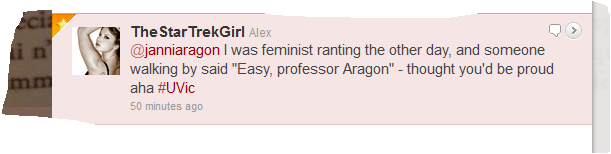
Recently I had the opportunity to give a talk related to Gender and Public Policy. I spent the talk really talking about the elephant in the room—patriarchy and sexism. I figure that if the students should have an honest conversation about the existence of systemic issues that influence their lives and influence public policy. When I have these conversations with students several things typically happen. There are nodding heads among the students and several who have had sociology or women’s studies and are cognizant of readings or other information. Some people will cross their arms and stop listening—they see women in their classes and as a woman she might not have ever experienced any sexism/racism/classism and what am I talking about in class? This is not her experience. Others are open to the conversation and want to understand where the disconnect it—lots of women on campus, yet not in the workforce. And, then others sit in the class enjoying the question and answer period and are not sure where they stand. They want to see where the chips fall. This is a quick and easy description and certainly not exhaustive.

And, some will offer that women just do not want to be engineers, doctors, politicians, and the like. Their opinion is generally this: if women really wanted to do these things—we would see more women in this array of professions. That is, it’s women’s fault for their lack of success. If women were more ambitious they could have it all, they could do it all.

Well, where do you go with a statement like that? There are so many layers to cut through with that sentiment and logic. And, understand that the student who makes this statement is not looking for a fight or using sarcasm. In my experience, the comment is a common one and usually said without any malice. So, it is not conducive for me to pull a Dana Carvey and say, “No, you’re wrong and here is why.” (This dates me, but I’m thinking of his bit on SNL when he starts saying wrong or no. See this: http://www.youtube.com/watch?v=E0Yr9XyBdnI&feature=related). The truth is that the person who raised this point is not right or wrong. This person is offering an opinion and the opinion might be based on life experience or just what s/he thinks.

This is ripe teachable moment and my reaction is important for a few reasons:
1. I represent all feminists on the planet in the classroom.
2. If they like my response then I’m OK, but if they don’t, then I’m one of those mean fill in the blank feminists.
3. If I disagree it is read as critical or attacking and I am biased or have a closed mind.
4. If I my explanation is something they can work with then things are salvageable.

Now, those four points are said in a tongue in cheek fashion. You see, it is easier to recover or move on with a conversation when you have a few months with a group, but when you have 50-90 minutes each minute is precious.

What I have attempted to do is respond in such a way that I am open to the statement, but offer an alternative point of view and then call on the audience to participate in the discussion.

What do I do in this situation? I attempt to offer that there are systemic reasons for the different numbers of women in leadership positions, but do not rely on the “they just are not ambitious.” I know too many ambitious women who have left their fields due to the sticky floor and glass ceiling. I know too many young women facing hardship at work and their ambition hits against the reality of issues that are typically outside of their control.

How do you deal with the generalized question about what women want? I look forward to your points.

Learning to Say No: Boundaries

I am still learning how to say no at work and in my personal life. I am an energetic person and I like to do things and have a sense of giving back—be involved in the communities that I belong to. This includes on campus, off campus, both kids, and other communities that I engage with in my daily life. The only problem—there are only 24 hours in the day and I am not cloned, yet!

I am venturing into year three of working with my door completely shut at work. It took me a good six months or so to feel completely comfortable with that. I really thought that my previous open door policy was sound and important. Then, I came to realize that I had to get work done and that as an Undergrad Advisor I had students at my door all the time. The best advice was from a colleague who suggested that I shut my door. Now, I no longer have any issues with the door shut and establishing boundaries when I am available and not for office houring.

The virtual advising, though, is something that I’ve had to come to grips with, as students will email at all hours of the day and advising questions are important and in some instances time intensive. This Summer, like most, I was in California for a month and was not available for advising. I had the usual auto-email explaining my absence. I made a special point of acknowledging emails and directing most students to the department for the advisor of the week. And, this year I didn’t feel guilty about it.
This is an ongoing process for me, though. I find that I’m getting better at saying no and directing the student or other request to a more mutually convenient time. I have to say that most reactions are fine. No one is put out that I cannot make a coffee date for two weeks or that they have to wait a week for my office hours.

As a fan of sci-fi and fantasy I will admit that the cloning in #BSG intrigues me. I would have a clone to do certain work, but I would save the real me for enjoying life!

Fri Fun Facts: How to Use the Calendar

My Fri Fun Facts is about how to use the #UVIC Calendar in the most efficient way. To get you up to speed, the Calendar includes the rules or requirements regarding your area of study at #UVIC

1. Find your major or your department and place a post it in the calendar

2. Read and highlight as needed

3. Check your courses taken with the department requirements

4. Review the list of courses offered in the department and flag the ones that you are interested in taking.

5. Verify which ones meet the stated (if any) requirements with the courses that you have taken or want to take.

6. Sketch out a realistic time frame for completing your degree program.

7. Take a look at the current schedule and understand that some courses in the calendar might not be offered by the department.

8. Be flexible (look at number 7 again).

9. Once you have this sketched out–verify your findings with the department undergraduate advisor. It’s better to be safe.

10. Have you visited Academic Advising? You should do so annually, in my opinion. Don’t wait until it’s time to apply to graduate.

11. Did you know that as a student you can designate or “make” your own minor?! Yes, you can. See your department contact for information.

These are my top ten fact for successful use of calendar. You can, of course, access the calendar online. But, with something this important–a hard copy is something that you can write on and take with you to the advising appointment. Good luck!