
Do Not Burn that Bridge: Collegiality

get hired

I am in the throes of letter writing and giving job references for former students and staff. This post is not a book review of the book in the photograph. I took the screen shot and of the book and add my post as a suggestion for a job applicant or new employee. One of the things that I have heard from prospective employers is the ways in which a candidate or hired employee fails miserably and burns a bridge. In my line of work as an instructor, advisor, mentor, coach or supervisor, I also occasionally see a student or staff member burn a bridge. Occasionally this is done with a positive attitude or the expectation that rewards are instantaneous upon merely doing the job.

I have heard repeatedly that a good attitude can help a new employee. If you are new to a job that you are not sure about make sure that during your shift you act like you care. This job could turn into something else for you and it is hard to shake off a bad impression. Be careful with social media. Do not post negative statements about your employer or co-workers. Nothing is private online and the worst thing that you can do is make you or your employer look bad. Likewise, if you have some terrible customers you also do not want to post information about them. Be careful and smart.

Make sure that you are dressing in a way that fits the environment. If there is a dress code, follow it. If there is not a dress code, ask your immediate manager what she or he suggests. There is nothing more embarrassing than having a manager speak to you about your clothing. In my early twenties, this happened to me twice and I never wore that blouse or the skirt again. Both seemed fine with the ensemble, but giving further thought I realized that they did not meet the conservative norms of that work place. I always suggest to my students who have job interviews to think about the dropped pen exercise. If you have to pick up a pen, will you feel comfortable as you lean in to grab the pen. Bend with your knees–not your back!

Other hints for looking for work–keep in contact with people who are well-connected or who you might want a reference from at a later date. This might be a bi-annual email that updates or an occasional hand written note. Make sure that you keep your circle of references up to date with all the wonderful things that you are doing. Related to this, be careful on social media. There are numerous examples of poor use of social media. I imagine that the communications staff at one East Coast university spent part of this last Monday chatting about a student’s racist post and the follow up posts that only made his original tweet worse. While his Twitter account is now deleted, many screen-shotted the tweet. Plus, the response against his racism was swift. That original tweet could haunt him.

Overall, be smart while you are looking for work and new on the job. Even if you do not have a probationary period, your first few days, weeks, and months are scrutinized. Check in with your co-workers and manager. If you do not have regular performance reviews, ask if you could have some assessment. Think of it as a work tune up. Reflect and learn. And, if you have questions–ask them.

The Academic Interview: Visit, Talks, and Politics 

  The last time I had a job interview for a tenure-track job, I was successful and got the job. I had spent 2/3 of my academic career as contingent faculty and felt like I caught the golden snitch. Now, that I am several years past the job interview I am thinking more about the process. I have some points to share based on my experience as the job candidate and sitting on numerous hiring committees between two universities. 

You can never be over-prepared. Do your research about the university and the department. You need to speak to the classes you can teach and how you can add to the teaching, learning, research, and overall community in the department. Practice your job talk and teaching talks with friends, who can offer you advice about your presentation and “working” the room. Choose what you’re going to wear for the trip with special care. Be prepared for a jam packed day or days at the campus. You will be scheduled from dusk to dawn to meet everyone on campus. 

You likely will meet with students in the department. Make sure that you give them the attention that they deserve. They might not have a vote on your position, but these are the students who you might work with come the next term. Have questions for the students. Some of the student are really invested in who you are and are likely interested in who will join the department. 

When you are done with the process, send the department chair a thank you note for the opportunity. 

Odd things that happened to me during my last interview process:

1. A student came up to me and let me know that he supported my candidacy, but the student course union did not. I smiled and reminded him that the course union does not have a vote. However, I will say this. The student leaders with their closed arms during my talk was something that I remembered for the next school year, and then let go. When some of them later approached me for letters of reference, I was surprised. Their behavior was rude. 

2. Hiring brings out the best and worst in the hiring committee and you have little control over this. There is often different factions in a department and this is not about you, but perhaps your supervisor or old arguments in the department. 

3. If you work at the campus where you’re interviewing, you will see the other candidates getting escorted around campus, at lunch, and elsewhere. Roll with it. 

4. If someone falls asleep during your job talk, do not take it personally. I have seen this happen and was surprised, and felt terrible for the job candidate. If you do something silly, recover. I recall one job applicant coughing out his mint. He recovered well. I don’t remember his name, but I remember how smooth he was with the issue. 

5. Be prepared for things you cannot control, people coming to your presentation late, texting during it, and making sour faces after you answer a question. While this behavior is uncollegial, at times it is really not about you. 

Related to the five brief points: be gracious. If you get an interview, you will feel like you won the lottery. Do not lose the ticket, and prepare for the interview. 

Good Luck! 

This is the first of a few posts related to the interview process. 

Fill the Right Cup: Revisit

cloudsinmycoffee

Ray Bradbury explained, “We are all cups, constantly and quietly being filled. The trick is, knowing how to tip ourselves over and let the beautiful stuff out.” This metaphor works for me. And, I have taken care to surround myself with people who fill the cups, and not only take away from you. 

Which cups do you fill? Do you fill the cups of optimism, pragmatism, or pessimism? It is important to think about where you expend your mental energy. Thinking back to my grad school days there were moments when the pessimism cup was the cup that I filled and that was not a good thing, but those moments of overwhelm and impostor syndrome were intense. I have to thank my peer mentors and faculty mentors for helping me fill the other cups.

My networks helped me stay grounded during grad school. Sure, we had our moments when would complain about our workloads and our financial situations, but overall it was pretty fabulous to read, research, teach, and write for a living. My peer mentors were primarily from the cohorts ahead of me and to this day some of my closes friends are from my grad school days. I met both of my best-friends in grad school.

Related to this, peer mentors listened. The listening cup was overflowing and there are times when I miss that interaction–the ability to have long conversations. The cup that we need to keep filling is the listening cup. Listening is an important part of a supportive and honest network. As I am working with undergraduates through graduate students, I am thinking about the importance of them finding good peer networks. I am only one part of the puzzle and know that the rest of the puzzle must include peers.

I knew that at home I had support, and my friends and networks at work in the department and larger academic community helped me through my grad school days. Peer mentoring is invaluable and if your cohort does not feel supportive, seek out peers ahead of you for guidance or go outside of your department. This advice is appropriate for those of us years out of grad school, too. And, if you are years into your career remember to connect your students to other students and to other faculty. Expand your students’ networks–this is part of the mentoring or coaching process.

 Fill the cups! Confer, trust, connect, mentor, listen, and celebrate your success…and by all means surround yourself with your friends and family.


Review: danah boyd’s Work

Read More Books

First of all, author danah boyd does not capitalize her name, so this is not a typographical error. I have read her book It’s Complicated: The Social Lives of Networked Teens (2014) a few times and I’m now teaching it in my Technology and Society 400: Technologies of the Future seminar. She does a great job of offering a thoughtful and respectful examination of teens use of social media. The big takeaway is that today teens use social media to socialize with one another. It is their social space.

She is not offering a wagging finger at youth about narcissism or technology addiction. Sure, she covers cyber-bullying and cyber predators, but overall she treats teens with socio-political agency and not as mindless victims to technology. She also speaks to the digital divide and the ways that youth use technology for important personal connection, and establishing their identities.

My students talked about technology use and addiction and one student noted that addiction is serious term and that we should be mindful of the use of the term. The student was correct, and we chatted about technology addiction. When I queried the class about how many sleep with their phones near their pillow, I saw many sheepish smiles.

This book provides a good opener to the seminar. I find it better to start off on a good foot and not jump right into doom and gloom about data mining, terms of service, and surveillance. That is for next week! Seriously, we are going to cover lots of material about technology and culture and very little condemns it. The class has a major project developing a mock up for an app that is needed on campus or in the greater community. Right now some students want to add to the current mobile app and others want to enhance Fitbits or other wearables for students. From my point–the future is bright.

boyd, danah. 2014. It’s Complicated: The Social Lives of Networked Teens. New Have: Yale U P.

Ladies Learning Code: Why the #YYJ Chapter is Great

I am lucky to live in Victoria, BC and work at UVIC. I have met some wonderful people on and off campus. I have been involved with Ladies Learning Code Victoria (#yyj) Chapter as a volunteer, learner, and sponsor. And, here I am again at an event. This weekend’s event is a Python session. We have approximately 40 learners here and a mentor at each pod.

The energy in the room is amazing. My favorite part, though, is the introduction of the mentors. Every mentor is either affiliated with UVIC or is a local business worker/owner who wants to see more women working as a programmer or developer. It’s quite breathtaking to meet the students involved with the Women in Computer Science and Engineering members. The learners vary in age from 15 – retired.

This time the session was held in one of our Active Learning Classrooms. The room is set up with the instructor in the center, and the students in pods. The set up requires lots of interaction between the students, and the instructor. I am happy to share that the attendees were blown away with the room. I do not feel smug, but rather like I am seeing the consequences of months of hard work by the leadership of the local Ladies Learning Code chapter, and the Classroom Infrastructure Committee at UVIC. OK, I take it back, maybe I feel just a little smug. Smug, and very happy.

Whenever I can see some active learning taking place, I feel a sense of pride. And, here I am witnessing the magic take place, as one of our undergrads leads the session. Yes, she’s teaching the session and doing an amazing job. Ladies Learning Code does a great job connecting our students and the local community.


Points of Contact

It’s the first week of the term and I am thinking lots about interactions with people. I have been in line and heard someone tell a staff member that something minor was unacceptable. I was behind a student who kicked two doors open, instead of using his hand or forearm to open the door. These are only two examples, but I could share more about poor behavior. In both instances that I noted, I intervened. Is this one thing really unacceptable? Can you respect the library and not kick our doors, but use your hand or arm?  In both instances I was ignored, but the people around me commented positively. And, honestly, the poor service worker was quite thankful. She certainly does not set the price of food. 

How do you react when you see an adult having a tantrum or otherwise rude behavior toward another in public?  I include my screen shot of Entertainment Weekly with Rey on the cover. What type of Jedi are you? Hey it’s a new year and my post cannot be only heavy–it needs some levity. 


Reflections: No Glares

Now that another term has almost ended, I can look over my shoulder at the previous school year and think reflect. Each year I reflect and try to learn from the previous year and then resolve to make some changes in the next year in the classroom, for my professional development or my ongoing efforts to mentor/coach students and peers. What did I do differently last year in the classroom, office hours or other interactions with my students? I resolved for more honesty. I was blunt. I was diplomatic, but more so, I was blunt. I am helpful and professional; however, I refuse to waste my students’ time with circular conversations. I do them no favors if I try to sugar-coat conversations.

What were the repercussions for me, if any? I heard more of these comments:
Thank you for being honest. I’ve never heard this before. Why am I almost done and no one has told me this? I didn’t know that this was plagiarism. Thank you for your time.

I did not have any incidents where someone stormed out of my office or a conversation escalated. If anything, I had meaningful conversations about assignments, interactions, writing, grad school, and other issues. As I have noted on numerous occasions, part of my job means that I have the good fortune to work with young people in the classroom or in my office. I love it. I would not trade this job for another as I get to teach, mentor, coach, and lead.

This last year I also thought more about my time. I strategically chose to focus my time differently. Part of it is that I had to, given a job change, but that is cause for a different post. I was not as available for extended office hours and the world did not fall apart. I expected a few day’s notice for extra appointments. What I am saying is that I established better boundaries for office houring and mentoring students. I had to protect my time thanks to the job change and I was working more. I managed my time effectively and accomplished more. And, at the same time I did not field complaints from my students. If anything, the change was better, as they commanded my full attention at times that were not pressed between meetings and I could listen.

My writing prompt for this post comes from a Swedish Proverb, “Fear less, hope more; whine less, breathe more; talk less, say more; hate less love more; and all good things are yours.” This last school year was filled with so much good and change. I welcome the change with a big smile and an open mind. The 2015-16 school year is half way through and I am in a great place. And, I’ll add that my little Grumpy Cat agrees and has her head on the desk!

Manager: The Art of Watching & Listening

I know that my official title is Director; however, I do lots of managing. Managing of people, expectations, small to large projects, and managing my performance. Part of managing is not talking, but watching and mindfully listening. My issue is that I have to be present in the office to interact with staff, and some weeks I live meeting to meeting. The way I manage my time is with Outlook and I plan my meetings weeks in advance to carve out time to meet with my staff.

I have given everyone a copy of Thanks for the Feedback. This is for me, and for my staff. I have found that giving my staff tools to communicate with one another and me is is important. We had our annual retreat and what a difference a year makes. This retreat was important to establish the team mission, communicate, and also look forward to what is next for the team.

A good manager or leader needs to plan, watch, listen, and lead.

Hacking the Classroom

Every instructor has likely walked into a room and thought, “Oh, no. How am I going to teach in this room?” The classroom might be in the basement and have no light or have more chairs shoved into it than it truly fits. I am used to hacking the classrooom and making it work. This might mean working with what I have and making the best of it. I have to walk and work the classroom and it is imperative that I have a place to move–to pace. 

I also need to see students’ faces. I am pretty good at reading a room and I need to see the ephiphanies or looks of boredom so that I can respond. I will ask students to not sit in the very back or if they must multi-task to do so in the back of the classroom. I try to set up the etiquette guidelines during the first week. I explain my expectations, then what they can expect from me. I have moved our classroom furniture, booked lab space for one day, and booked a different classroom for group exercises. I will do what it takes to the make the classroom ours, and make it work.  

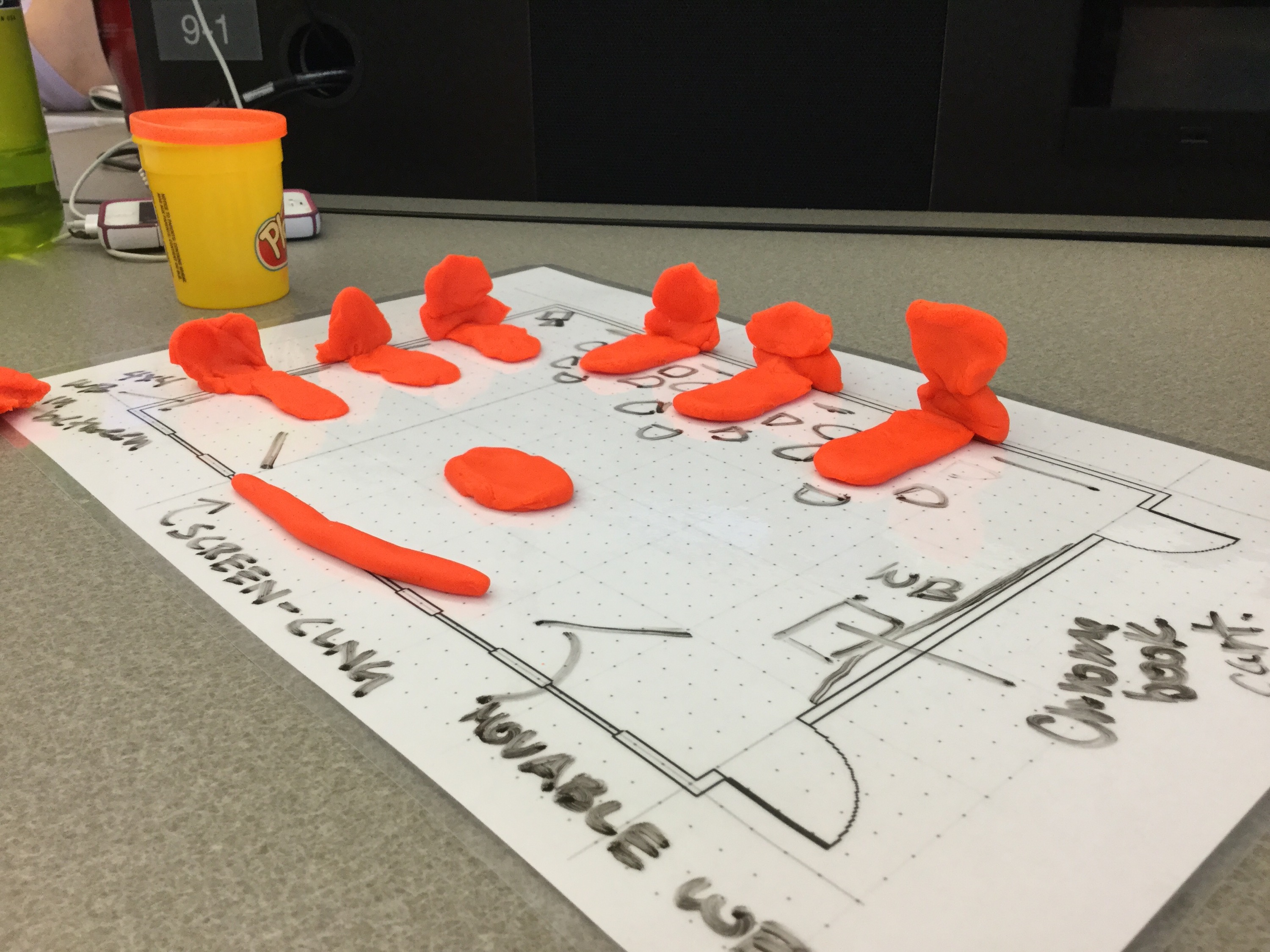
The image below is from the National Forum on Active Learning Classrooms. We were using playdough to make our ideal learning space. 


Gratitude

A long weekend has started here in Canada. Technically it starts after work today for me, but campus sure is more quiet today. This is the Canadian Thanksgiving weekend, and I am pausing between meetings to share thoughts about gratitude. 

1. I have gratitude to the team of people who have kept me healthy this year, and this includes the family doctor, physiotherapist, dentist, and oral surgeon. 

2. I have gratitude for my family. I am noting that this is for my kin and my made family. My family supports me and I do not thank them enough. 

3. Deep gratitude for my in laws. I could not manage my week without the help that they offer. I am extremely lucky to have them five minutes away from us. Our family Excel spreadsheet is a thing of beauty and if they did not do a drop off or pick up it would make things more difficult for me. Thank you. 

4. I have gratitude to my co-workers. Here I am thinking those who I report to, later colleagues, my staff, and other colleagues across campus. I know that I am lucky to have a job that is my career. I have a privileged life enjoying my work, and feeling satisfied. 

5. I cannot finish this list without thanking about my students, and other students across campus. Thank you for making all of this worth it. Your energy makes me smile. Your questions motivate me. And, working with you is a pleasure. OK. It’s a pleasure most of the time! 

6. Thank you to my many mentors! I include a photo of Dr. Kathy Jones. I worked with her at SDSU–back when I was an undergrad and we have kept in touch. She’s one of the many amazing mentors I have had. Thanks, Kathy! 

It might not be Thanksgiving for you, but what is in your gratitude list?