Thinking about 2011-12 Courses

Revisiting this post and thinking about how my focus made a difference for me and for the Teaching Assistants. Giving first year students as much information as possible is helpful, but they need to read the syllabus and come to class prepared. I will say that the Fall term fielded lots of attribution issues–not quite plagiarism, but in the same family.

How did I re-think my courses? This is not going to be specific to  each of the three courses that I will be teaching. Instead, I am re-thinking assignments and other matter in my course syllabi. I realize that with the first year students I have to explain every single detail and contingency. My syllabus is a leviathan at about one dozen pages. It’s length will increase by a page with an example of what a topic sentence outline should look like.

Moving to the more advanced courses, I am emphasizing due dates as well as noting my new policy of not accepting any late research papers. The sheer number of late assignments can throw off the marking schedule. Given that most terms I have almost 300 students, I need to have a good schedule in order to return work back in 6-10 days. However, specific to the research papers, by and large late research papers are usually not strong assignments. Students have waited until the last minute and usually submit  mediocre work. They are exhausted from the entire term’s work load and submit what they could do in a day or two.

The other more cerebral matter is thinking about teaching or learning outcomes. What do I want the students to learn? What can certain readings or assignments offer? These are the more weighty decisions. I review each reading and ask–did this work? Was it successful last term or last year. I hear from some colleagues to not change a thing, but I have never done that. I always tweak and massage, and re-think. I’m still thinking.

Overall, it was a successful year and I’m still processing it.

What single word defines you?

When I was at Social Media Camp earlier this month, one of the keynotes talked about what single word defines you. I think this was part of Erica Ehm’s presentation. It took me a few minutes, but then the word appeared in my head. Passionate. I am passionate about things I do and thing that I support. It was funny that I actually pictured some student evaluations or thank you cards that noted my passion for the material was infectious or kept them awake during the early morning class. This passion has allowed me to have great conversations with people, but also offers me moments of frustration. Passionate people don’t always understand why others don’t have a similar passion for their interests, work, and politics.

What is your single word? I’m sure that the word will vary.

Here I include a photo of me looking at a book. Books and reading are one of my passions. What is your single word for today, tomorrow, or that you live by?

11 Months Later: Revisiting the Life List

I decided to revisit this great exercise from one of the BlogHer 2011 pre-sessions.What do I think differently after this last year. I was reappointed unanimously by my colleagues, applied for an Associate Deanship and was shortlisted, didn’t get the job, had surgery, and then had a pretty rough term. The second term caused me to re-evaluate my priorities. Numbers 16-19 are new and I used a / to add to an original thought.

Life List exercise at the afternoon session for “My Blog as a Life Changer” was hard to do. Here is my first stab and again, unedited.  Try out the exercise. It’s fun.

  1. Go to Hawaii with Jason and both girls / See my family more. More quality time with them at home.
  2. See my family of origin more than one time per year. / Yes, see them more.
  3. Publish my books / I’m working on this and progress has been made.
  4. Get tenure / I was re-appointed, so step one is confirmed.
  5. Continue to Mentor / Ongoing
  6. Continue to Teach / Ongoing
  7. Learn French / I’ve heard more and have attempted to speak some. Does that count?
  8. Start a Women and Politics Center on campus / Oh, long term goal.
  9. Take kids to Grand Canyon and DC / Long term
  10. Work on either a Congressional , Senatorial or Presidential campaign / Long term
  11. Learn how to golf / Started learning in May!
  12. Spend time with friends in the US and elsewhere / Did some in March–ongoing want.
  13. Take kids to Europe / Long term goal
  14. Go to Harry Potter Theme Park / Long term goal
  15. Use sabbatical to attend conferences / To write book and to visit teen in university
  16. New to the list–take better care to relax. I am powering off my phone more and trying to not work for an hour or more every night. Balance
  17. Remember to schedule time for me and Jason
  18. Exercise as part of my daily routine
  19. Return to the life list once a year!

Post-Conference Thoughts

Last week I attended a national conference and had a great conference experience. This post will speak to things that we junior to mid-career faculty can do better. And, I’ll also have some advice for the advanced graduate students.

1. Walk around ready to engage in small talk with people you don’t know or want to meet. Try to avoid only chatting with your friends and colleagues. While picking up with them is important, you also can serve as a bridge to someone new at that meeting or new to the discipline.

2. Smile and say hello. It sounds simple, but it doesn’t come naturally for everyone. Ask people about their project. Try to be friendly. When Rita Mae Kelly died some years ago, I was quite upset. I didn’t know her well, but I recalled on numerous occasions she approached me and chatted with me for 5-15 minutes asking me about my grad school experience. She went out of her way to make me feel comfortable at the Political Science Meetings. When a session was held for her, I was in the audience crying. I looked forward to her chats. We never exchanged an email, but I was familiar with her work and I have all those memories of our chats that can’t count up to more than 5.

3. Go to the receptions and some of the dinners. It’s good be seen, but also it’s another opportunity for you to meet new people or strengthen old networks. When I walked into the banquet room with 270+ people I made the immediate decision to not look for friends. Instead I walked up to a half filled table and sat down there. As luck would have it, sitting across from me was someone I “met” via Twitter! I ended up having interesting conversations with a retired colleague and an advanced grad student from a UK program.

4. I was glad that I was active on the Twitter tag for the conference. The first morning I had breakfast with an undergrad from another province. We chatted and walked back to the conference site. I was also able to meet some others in real life, who I had previously known on Twitter. Social Media can be useful for the conference. I took notes at the Women’s’ Caucus Luncheon’s Mentoring Session and posted them immediately on Tumbler.

5. I attended lots of wonderful sessions and made a point to speak to one of the presenters. And, I also thanked the chair or discussant for their helpful comments. I paid attention. The panelists in some cases were senior people across the discipline, and in other instances are future colleagues. One of these conversations once led to a publication opportunity.

6. Take business cards. You might meet new people who want to contact you or vice versa. It’s good to have the cards at the ready. I find that I am apt to pass them out more so to advanced graduate students and let them know that I’m just an email or tweet away!

Overall, the conference was a success and from my comments you can glean: be out there!

Before You Send an Email to Your Professor

I haven’t taken a Netiquette 101 course recently, so I think it’s time to give some tips about sending emails to your instructors.

1. Always assume that you should be more formal.

2. Address the person in the email with a hello or even a “dear.” Avoid, “hey. And, use your full name, as your instructor might have many students who share your first name.

Sample~

Dear Instructor: I am emailing to find out information about your Fall class. Do you suggest any prerequisites for the class? I’d also like to talk with you about a paper topic that I have. Do you have any time to meet this Summer?

Thank you,

Student X

Avoid:

Hey, I’m going to enroll in you class. Should I be worried about your feminist bias?

Smitty

3. Never send an email that is incoherent. This is email and not a text to your best-friend. Type out all words, use punctuation, and proper spelling.

4. Never send an email when you are mad. This goes for all emails. Send yourself the email and then wait a few hours or overnight, and then send the email that you won’t later regret.

5. Be honest. Understand that your instructor might say that this conversation needs to take place face to face. Some conversations really need that human interaction.

6. Do not be offended if the instructor corrects your use of their first name or some policy. Most of us will be kind and say–we have a 24 hour policy with emails after work is handed back and it’s in the syllabus or I expect students to call me Prof. Schmitdkins.

7. Read the syllabus before sending the email. Perhaps the syll answers your question or notes that you should take the time to write a coherent email noting who you are and why you are emailing.

Overall, treat email with the same integrity that you would treat an office hour visit. And, yes, I do get lots of emails that start off with “hey” and have been asked about my feminist bias…

Tips for the #CPSA

These tips are good for most academic conferences and probably even for non-academic conferences. I know that I’ve used these tips at Social Media Conferences, women’s conferences, and other work related conferences. The Canadian Political Science Conference begins tomorrow night at the University of Alberta in Edmonton, Alberta. And, these comments are good for graduate students, people on the market, and probably for some junior faculty.

My major point of advice is to first ascertain what sort of conference participation do you want. Do you want to attend, see your friends, and leave? Perhaps you are on the job market and you want to network and help raise your profile. If you’re on the job market, I suggest that you focus on your presentation or attending the presentations of people in your sub-field, and prepare for networking. What does this mean? Have conversations with people–communicate. Ask them if they are enjoying the conference, and which panels did they like best. Yes, this is small talk, but you might be getting to know someone for the first time and then the conversation can hopefully continue.

How do you do this? Smile. Be ready to have conversation with people at the conference meetings. Ask questions during the question and answer period after a presentation. When you’re at a reception (yes, attend some of them), walk around and talk to people. This might be small talk about the food or notice their name tag. You might know someone at their institution. Do you have business cards? If so, prepare to pass them out, when you’ve chatted with someone. You might want more comments from them on a chapter of your thesis or an article that you’re working on.

Likewise, if you’re giving a presentation, talk to the people on the panel and in the room afterward. You might find that someone there wants to chat more with you. Be bold and encourage the group to continue the conversation over coffee, drinks later or to meet at a reception. The only way that you’ll meet new people is if you make an effort. If you really want to meet a particular person, see if any of your mentors know this person and can introduce you.

Go to receptions! Be seen. Talk to people. Wear your name tag. Plan your conference itinerary. Spend pockets doing the networking thing and others attending the conference or seeing the conference city.The organization will help you avoid exhaustion of being “on” during the entire conference. This means that you need to take time to recharge, but be careful to not drink too much at any official conference events. It doesn’t look too professional and you don’t need a hangover. If you’re looking for work and there are certain people you want to meet–attend their talks or attend their campus reception. This is easier if the host site is the department in question. Overall, enjoy the conference and go there with an open mind and positive attitude.

Interactions with Students~

I’m taking a break from the Fri Fun Facts. Instead, Friday will offer short posts about something that is on  my mind.

Working with young people there are many different opportunities to mentor or coach undergraduates. I find that some of these moments present themselves when you aren’t really expecting it. Each year I get cards or emails from students who have taken one class from me or have seen me in office hours and are graduating or transferring to another university closer to home. And, I’m always a little bit surprised to get the note or email that thanks me for a good class or for some help.

The reason why I’m surprised is that these particular students did not see me lots and only took one class from me. Given that I teach several classes most are apt to have had at least one class with me. My point here is that at times you can make a difference in a student’s experience in a class or in the office and not realize it. I always follow up the contact with an email or face to face chat if I can.

After I started the post, I cleaned up my home office and found a stack of emails or notes from students from 2002-2009! I read each one and remembered the students. I’m thankful that they took the time to contact me. What all of this reminds me is that we have moments in our offices or classroom, when we make a connection with a student. And, sometimes we are not even aware of it.

Pop Pop Pop Culture

My consumption of pop culture is often informed by a few things varying from what I’m interested in, teaching, or what my family wants to see or do. This last weekend we saw some Americana, ubermasculine spectacle. I’ll give a hint, “You sunk my battleship.” Unlike many people we saw “Battleship” and enjoyed it for what it was worth, but I am ever mindful of some interesting points.

The first thing that we discussed was how the testosterone was dripping from the movie. No, it was exploding from the screen from the different characters’ bravado and the use of nothing possibly more hierarchical and masculine–the military. The movie included lots of male posturing and fighting–yawn. I won’t outline the exact plot since that is somewhat irrelevant as a Peter Berg extravaganza that is based on a Hasbro toy. The thing that made my teen daughter’s face react the most was this notion that one man has to ask another man for his permission to marry his daughter. I know that this tradition is one of those time-honored for many, but is not for me or my family.

The other thing that is so obvious with the “world is going to end due to an extraterrestrial invasion” is that the American military is there to save the day. Even though in this movie the RIMPAC event was taking place and several countries were represented it ended up being the American Navy and some survivors from the Japanese Navy to save the day. The good news was that Rihanna starred in the movie and was in several scenes. Yay for the token, strong black woman. In all serious, she did have a pivotal role working weapons, carrying a gun, and having her clothes on in the movie! I can’t say the same thing about Brooklyn Decker and her role as eye candy in the movie. Decker had on lots of form-fitting outfits, short shorts, and pretty dresses.

Spoiler alert. The movie also offered its own homage to the men who have served via a scene celebrating them and later incorporating some of these retired servicemen in the use of the museum the USS Missouri. Yes, there is a scene in which these older men parade toward the lead character and ask what he needs. He needs them and they are willing to get the decommissioned battleship out to sea to kick some alien ass. I know…cue the national anthem. But, it was pretty darn sentimental and a smart scene in some respects. The old technology still needs the old guys to run it, though. Here, a different demographic gets a nod in the movie. Likewise, in all fairness to Decker she plays a Physical Therapist, so there is a long scene at a rehab with lots of male veterans getting physical therapy. The camera pans over these men who are missing a variety of different limbs. And, one character ends up having a pivotal role in the movie.

Overall, you need to just suspend your beliefs as you watch this over the top movie. Was it terrible? No, but then again I did use some of my Scene points to get one free ticket. Had I paid for both tickets perhaps I’d feel differently!

Today’s Fri Fun Facts is dedicated to thinking about what you do well and life planning. This is really for all of us, but I’m thinking of my college students who are on “break” working or taking Summer courses. It gets so easy to think about what needs to be done or what you haven’t scratched off on the “to do” list.During my office hours, I’ve also noticed a real apprehension with what is next and lots of self-doubt. So, let’s think about what you do well.

1. Get out a piece of paper. Oh, wait, open a new document or text yourself…

2. What do you do well? What are you known for among your friends or family?

3. The last time you were complimented–what was it for?

4. What do you want to known for at work or home? Remember to take care of yourself.

5. Think about your positive traits and what you have to give the world.

Now, think about what is next for you. You do not have to solve everything today, but just think about what is next. And, make this list realistic. Then, go chat with other mentors/coaches in your life and ask them for any guidance they might have as you embark on the next chapter in our life.

Student Protests

People who follow me on Twitter know that I don’t have a special place in my heart for many of the op-ed columnists in the Globe and Mail. Both Margaret Wente and Jeffrey Simpson have weighed in regarding the student protests in Quebec. Students that I work with on the campus where I teach have asked me about my opinion and I haven’t really commented. But, as the multiple sides discuss options and a hopeful resolution, I’ve come to several opinions.

My first opinion is that the students do have a right to protest the fee hike. They have a right to feel angry. They may not like hearing that their fees are small in comparison to ROC, but it’s true—their fees are relatively low. Simpson can cite all the data he wants about which universities are the most prestigious, but he is forgetting that Francophone nationalism is at play here. This is about keeping education affordable in Quebec for  students from Quebec. One cost of the maintaining a strong Francophone culture is subsidizing education. Whether the ROC wants to subsidize this education is another discussion. And, I say this knowing that I am merely a permanent resident and a visitor on these lands in the greater Victoria, BC area.

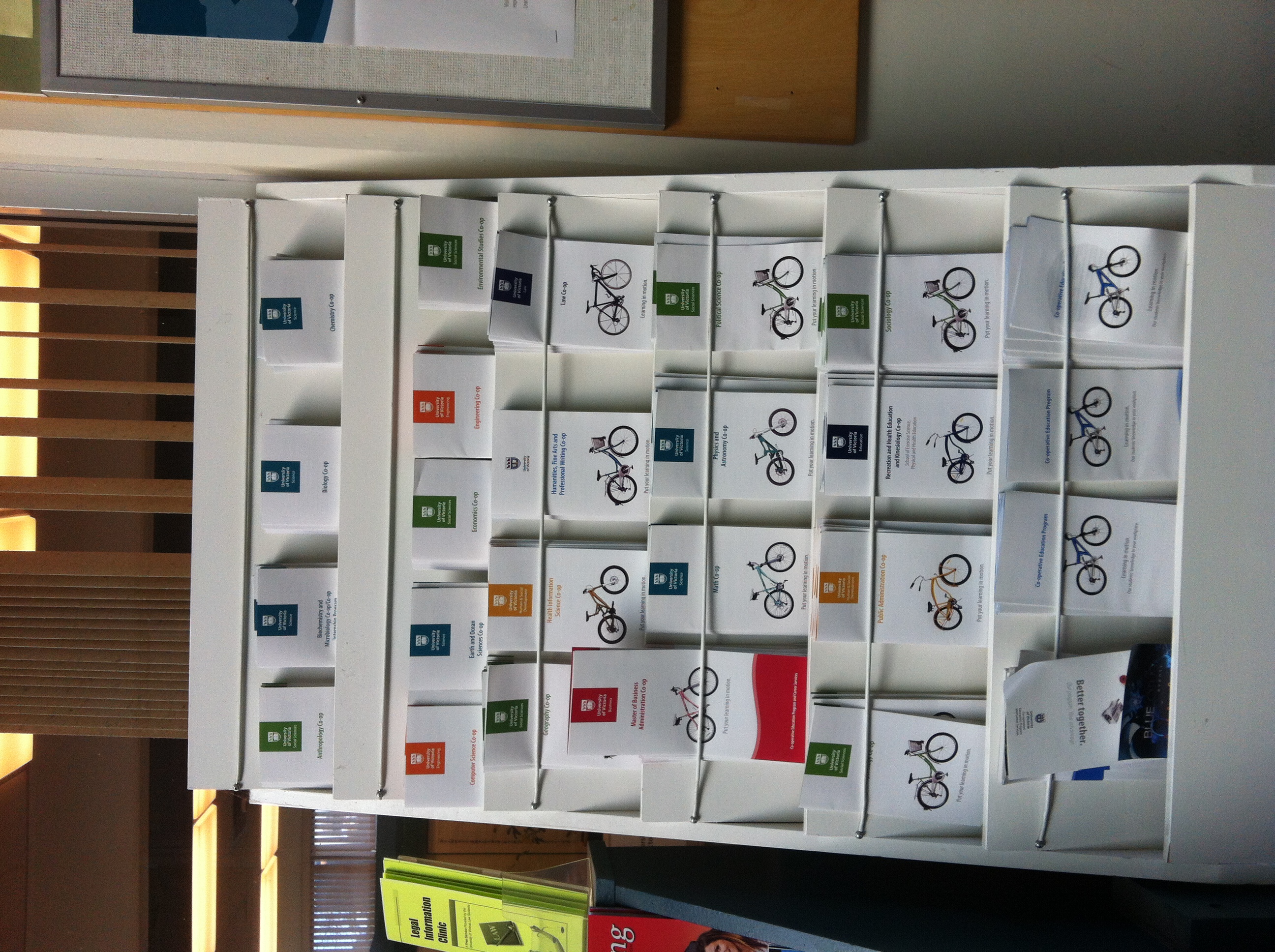
My second opinion is that the students reviewing the university budget and asking that advertising and administrative travel be slashed is completely unrealistic. This is an unfortunate example of sheer naiveté. I’m sorry, I said it. Most major universities and colleges will get some free advertising via their local newspaper and news affiliates and this free advertising will be worth tens of thousands of dollars and possibly more. But, there are other advertising costs that the university makes in order to recruit more students, staff, and world-class faculty. It costs money to put together recruitment materials. When the recruitment teams go to high schools those tri-fold brochures or larger paper matter costs money. The team of students and staff who take families on tours cost money.

Here is just one display of advertising materials:
I only noted one part of the advertising. There is also advertising in international venues.  Cutting advertising costs can also influence retention of current students, staff, and faculty. Advertising current initiatives costs money and this varies from the reports, advertisements about homecoming events, and more. If we break it down by faculty and department, money is often spent to showcase the great work that is taking place on the campus. It’s important to promote staff, student and faculty work. Slashing the advertising costs doesn’t just influence potential students, but also current students, staff, and faculty. I am sure that my colleagues in communications can weigh in and say more. Likewise, all the advertising that Career Services offices do is important.

Now, the upper administration travel costs is a sore spot at most universities. I think that the we could probably review some of this and see if more conference calls, webinars, Skyping or other technological use could defray costs. However, this is not always easy to do. Students might not realize that on top of running the respective units the upper admin also attend local, regional, and national deans meetings, provost, college presidents meetings, and then there are articulation and planning meetings. Add to this possible recruitment meetings and you can see how many of these upper admin types do have to travel lots. But, perhaps they don’t have to travel not as much as they currently do. I’m a bit more realistic with this point—even if I don’t completely agree

Funny enough I was reminded of this the other day when I was booking my accommodations for the Canadian Political Science Association meeting in Edmonton, AB. I was thinking about the protests and I booked the second most inexpensive arrangements. I’m not paying for this trip, but the Provost’s office is and in some way I was thinking that students are paying for this. (They are not). But, I’ll be in the dorms in my single room—with my own bathroom.