Energy Focus

It’s that time of the year when you have to reframe requests. I was chatting with some faculty colleagues about student work, and noted that I do not accept late work. The truth is that I do with qualifiers. I have a sentence or two in my syllabi that notes that students need to contact me before an assignment is due if they are deathly ill or an emergency has come up for them. I find it easier to specifically state my expectations. But, I also know that I have to be flexible. Life happens. 

I do not have enough mental energy to stress about late work. I was more rigid about deadlines, and then moved to rolling deadlines. And, an amazing thing happened, the percentage of students with excuses dropped. They knew that the first deadline meant more comments, and the last deadline was not late. This works well for my students. But, overall, my opinion with late work is one with less frustration. In some of my classes there are no rolling deadlines and just the policy–no late work is accepted. 

I have to choose what is my biggest concern. I want my students to be successful in the course. I do not want to hound them. I will not. They need my energies focused in the classroom and office hours. 

The photo below is the flip side of my Social Media name tag. My name is on the other side, but this side works. 

Why I Run Review Sessions

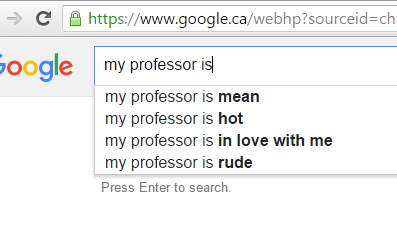
I am revisiting this idea. While I am not teaching a large first year course anymore, this post is relevant. I started this post a few years ago and saved it as a draft. Now, I am finishing it and mindful that it is a good reminder for my teaching and learning. I am an advocate of review sessions and workshops for students. We want students to think about how their professor is helpful. I include a screen grab from a search for “my professor is.”

my prof is

I am co-teaching a first year level course with three other faculty and one of the things that I take on as the professor of record is offering review sessions for the exams and other major assignments. I have taught first year courses for most of my academic career and the review sessions are important to helping my students with their learning. Review sessions or re-visiting “how to be successful” is not pandering to our students. It is an important part of active teaching.

Now that I have started my 19th year of teaching, I have come to realize several things. My students want more guidance about assignments. For an array of reasons, when I first started teaching the typical student would come to office hours or ask a question about an assignment in class. Now a majority of them want me to give them more information about the major assignments during class time. They likely feel that the stakes are higher for them and they want to fully understand my expectations.

I have also found that when we are blogging, uploading to Wikipedia or using any educational technology platforms in the classroom they need more than one workshop session to learn the technology. Some colleagues are surprised to hear this, “but they are the digital generation.” Yes, we can refer to our students as such, but when marks are involved it is a different story. This is not an exhaustive list of what I have learned over the years. I will certainly add to this post, as I ruminate why I am fine with clarifying, review sessions or otherwise digging deeper.


Epiphanies

Most instructors have likely experienced this. You get your mail in the department and you have a card from a former student that essentially says the following: I took your class a number of years ago and wanted to say thank you. I thought you were crazy, but now that I’ve been working I find that I think of you and the class fondly. I am sorry for being a jerk. Your class was important. Thank you. I appreciate the thanks, and I also appreciate the apologies for sarcasm or making the class discussion more difficult. These notes are quite meaningful.

Approximately ten times per year, I get emails, cards or Facebook messages like the above from my former students. Funny enough the cards are from an array of students and it is sloppy to say it is from the haters. The cards come from former students who are being honest. Some might think  that they were difficult, but I find that their memory and my memory vary. I can think of two very difficult groups over the years, and I have heard from one person out of that group, and the apology appeared honest at first. I say that, as that former student appeared lots in my social media being rather antagonistic. I wish I could say that the above is pure hyperbole. It is not.

Lately, this has happened more than most years. I think it’s the fact that the numbers of students that I have taught has increased or maybe it is the fact that I just finished my tenth year at the fourth university. They know how to contact me via snail mail, email or social media.

My point here is I have found that the students who send these notes surprise me. I am happily surprised that they contacted me. I am happily surprised with the thanks, and reminded about the privilege that I have working with them in the classroom. But, each card notes that I was approachable, enthusiastic or that my playing devil’s advocate made a difference. My students are not jerks. They are diligent, hard-working, exhausted, balancing lots, and do what they can. They are imperfect. And, so am I.

Great caption, excuse the f bomb


What My Students Have Taught Me

I submitted my students’ grades and I have now completed my 18th year of teaching. I want to reflect on this year, but also begin to think about the next school term. This post offers some thoughts about what my students have taught me.

What have I learned from my students?

  1. Some of them are at university as a placeholder. Everyone tells them it was next for them. For many of them they are in the right place, but for some they will need some time off or to do other things, and this is fine. We have to support them.
  2. Their first year is hard. They are acculturating to university life and possibly living away from their parents. You have to treat the students with extra patience during the first term. Be firm, but patient.
  3. They are excited. You really want to keep that enthusiasm up, as it will for them when they are exhausted, homesick or second guessing themselves.
  4. You are part of their university experience.
  5. Working with first years for the bulk of my years, you are one of many who have impact on their ability to get through the first year. It is important to set guidelines, but be kind.

Overall, my first years have taught me humility. They are the hardest students to work with, as they demand the most of me. They also offer the most harsh quantitative and qualitative assessment of my teaching. It is ironic that a class full of people who are for the most part new to university are assessing my ability to teach. Who are they comparing me to? But it is important to hear from all my students, and learn from them. They make me smile with their compliments and criticism. It’s interesting to see that three students might like my use of “keener,” but one thinks that it is offensive. Yes, offensive. I cannot please everyone, and I do not try to do so. It is impossible!

I really look forward to year 19, which starts next month with the new term. I include a photo of my favorite Supreme Court Justice, Ruth Bader Ginsburg, who is also known as the Notorious RBG.

notorious rbg


Cyberbullying

I read Sarah Darer Littman’s Backlash. The book’s cover notes, “What happens online doesn’t always stay online…” The book is a mature read in the Young Adult Literature #YALit genre. I read the book in one sitting staying up later than I really wanted to, but the book was a compelling page turner. Unfortunately, there are numerous cases of cyberbullying that make the mainstream news, so we know that this story is too real for so many young people.

The book does a great job of sharing the painful lesson that Cyberbullying is not a victimless crime. I suggest that parents, teachers, and young people read the book and then have discussions about the content. I encourage you to read this book.

backlash.PNG

Dear Professor: My Parents are Lost at Sea and I Need an Extension

I have revised this post. Today’s Fri Fun Facts is about keeping it real. I give lots of advice on the Fri Fun facts and today it’s about not crafting elaborate stories in order to get an extension on work. During the last several school years I am seeing that the grandparents are safe and not dying at the high rates that they used to and this might be related to how clear my syllabus is about providing proof. And, the proof about a death in the family usually is from the service—the funeral home or church typically puts together a program for the service. This might seem like an onerous request, but I find that it has kept many grandparents safe! In the last three years, I have stopped asking for this and have met one on one with the student who needs an extension. I just do not have enough mental capacity to ask for the proof. I need to come from a place of trust, and take my student’s word.

I am giving some quick advice about due dates and managing your time. In case you’re wondering, I did get a student email about parents lost at sea. I contacted tthe Coast Guard. The student was embellishing and did not get an extension. Today, I likely would not contact the Coast Guard–who has the time? I offer some advice, though.

1. Manage your time well. In my courses the paper assignments are included in the syllabus, so from day one the students know what the assignments are and when they are due.

2. If you’re in over your head, make an appointment or come to your instructor’s office hours. I’ll be honest, I do think that I am more likely to be more flexible when a student “owns” their education and sense of overwhelm and talks to me face to face and asks for an extension. I do not always give the extension, but I think I am more apt to weigh the request differently than a last minute email.

3. Rely on resources around campus. At UVIC the library has an assignment calculator and students can type in the due date and a schedule is calculated that helps students organize their time. Attend class, go to tutorial, office hours, and schedule the time to conduct research and writing time.

4. Re-read points 1-3. I cannot emphasize how much guidance you will get from your professor if you ask for it. There is a reason why I had 8 hours of office hours this last week and that there was a line up–I care and I’m here to help. The only way that you’ll get guidance from your professor is if you talk to her/him.

With this—I ask that you finish your term on a high note and organize your time before the final exams begin. Good luck!

Disclaimer: This post has nothing to do with any of my current courses or students. It is merely the time of year when a post of this nature is appropriate. Again, this is not about my current class! You are rocking it.

Performance Reviews: Coaching Your Grad Students

Today’s Fri Fun Facts is about my new use of writing Performance Reviews for the Teaching Assistants. After looking through the Canadian Union of Public Employee’s Agreement between my employer and the local group, I decided that it would behoove me to offer the Teaching Assistants a more formal review.  Today’s Fri Fun Facts will speak to how I will do this every term on.

My intention was to provide each Teaching Assistant with an honest, fair assessment of their work this term hoping that they could use the review in their teaching dossiers or as part of their resume paperwork. Writing the reviews took more time than I thought it would, as I really wanted to convey a personal review for each Teaching Assistant. How did I do this?

When I meet with each Teaching Assistant to review their graded work, I would email myself notes about the meeting and these summaries were useful. When students would see me during office hours and offer unsolicited comments about their Teaching Assistant, I would email myself a copy of the comments for my records. These little things were important to providing me a memory of the Teaching Assistant’s performance.

My suggestions:

1. Keep notes or records about the Teaching Assistant’s performance. If there is every tricky situations, these notes are really useful. More importantly, this will be helpful when you have to write a letter of reference or serve as a reference.

2. Check in with the Teaching Assistants to make sure that they are doing well and feel that they are getting enough support from you. You should assign a mentor Teaching Assistant to a new Teaching Assistant.

3. Provide them guidelines about your expectations. You might email or verbalize this. I actually provide a dossier: a one to two page expectations letter, sample graded work, exams, grading guidelines for the university, and a copy of the syllabus.

4. Be available. You need to set up times to be available for their questions or be willing to guide and coach the Teaching Assistants as needed. Some will need more of your time and others hit the ground running.

5. With the review, think about the Teaching Assistant’s grading, effort, interaction with the team, students, and comment on this. Note any areas for improvement and be willing to note if you think that you could have supported the Teaching Assistant more.

6. Be honest. The review should be helpful, but it does not need to only be positive. Constructive comments are sometimes needed, but offer them in a helpful manner.

Overall, the Performance Review should be helpful for you, the Teaching Assistant, and any future employer who sees the document. Remember that the arrangement is really an apprenticeship and you need to mentor or coach the graduate student, as this is not “free” grading for you. The cost is really supervising and helping the Teaching Assistant perform the duties. I have to remind myself of this occasionally! How do you evaluate your graduate students? Performance reviews is feedback, and we all deserve constructive feedback.

Do Not Burn that Bridge: Collegiality

get hired

I am in the throes of letter writing and giving job references for former students and staff. This post is not a book review of the book in the photograph. I took the screen shot and of the book and add my post as a suggestion for a job applicant or new employee. One of the things that I have heard from prospective employers is the ways in which a candidate or hired employee fails miserably and burns a bridge. In my line of work as an instructor, advisor, mentor, coach or supervisor, I also occasionally see a student or staff member burn a bridge. Occasionally this is done with a positive attitude or the expectation that rewards are instantaneous upon merely doing the job.

I have heard repeatedly that a good attitude can help a new employee. If you are new to a job that you are not sure about make sure that during your shift you act like you care. This job could turn into something else for you and it is hard to shake off a bad impression. Be careful with social media. Do not post negative statements about your employer or co-workers. Nothing is private online and the worst thing that you can do is make you or your employer look bad. Likewise, if you have some terrible customers you also do not want to post information about them. Be careful and smart.

Make sure that you are dressing in a way that fits the environment. If there is a dress code, follow it. If there is not a dress code, ask your immediate manager what she or he suggests. There is nothing more embarrassing than having a manager speak to you about your clothing. In my early twenties, this happened to me twice and I never wore that blouse or the skirt again. Both seemed fine with the ensemble, but giving further thought I realized that they did not meet the conservative norms of that work place. I always suggest to my students who have job interviews to think about the dropped pen exercise. If you have to pick up a pen, will you feel comfortable as you lean in to grab the pen. Bend with your knees–not your back!

Other hints for looking for work–keep in contact with people who are well-connected or who you might want a reference from at a later date. This might be a bi-annual email that updates or an occasional hand written note. Make sure that you keep your circle of references up to date with all the wonderful things that you are doing. Related to this, be careful on social media. There are numerous examples of poor use of social media. I imagine that the communications staff at one East Coast university spent part of this last Monday chatting about a student’s racist post and the follow up posts that only made his original tweet worse. While his Twitter account is now deleted, many screen-shotted the tweet. Plus, the response against his racism was swift. That original tweet could haunt him.

Overall, be smart while you are looking for work and new on the job. Even if you do not have a probationary period, your first few days, weeks, and months are scrutinized. Check in with your co-workers and manager. If you do not have regular performance reviews, ask if you could have some assessment. Think of it as a work tune up. Reflect and learn. And, if you have questions–ask them.

Review: danah boyd’s Work

Read More Books

First of all, author danah boyd does not capitalize her name, so this is not a typographical error. I have read her book It’s Complicated: The Social Lives of Networked Teens (2014) a few times and I’m now teaching it in my Technology and Society 400: Technologies of the Future seminar. She does a great job of offering a thoughtful and respectful examination of teens use of social media. The big takeaway is that today teens use social media to socialize with one another. It is their social space.

She is not offering a wagging finger at youth about narcissism or technology addiction. Sure, she covers cyber-bullying and cyber predators, but overall she treats teens with socio-political agency and not as mindless victims to technology. She also speaks to the digital divide and the ways that youth use technology for important personal connection, and establishing their identities.

My students talked about technology use and addiction and one student noted that addiction is serious term and that we should be mindful of the use of the term. The student was correct, and we chatted about technology addiction. When I queried the class about how many sleep with their phones near their pillow, I saw many sheepish smiles.

This book provides a good opener to the seminar. I find it better to start off on a good foot and not jump right into doom and gloom about data mining, terms of service, and surveillance. That is for next week! Seriously, we are going to cover lots of material about technology and culture and very little condemns it. The class has a major project developing a mock up for an app that is needed on campus or in the greater community. Right now some students want to add to the current mobile app and others want to enhance Fitbits or other wearables for students. From my point–the future is bright.

boyd, danah. 2014. It’s Complicated: The Social Lives of Networked Teens. New Have: Yale U P.

Points of Contact

It’s the first week of the term and I am thinking lots about interactions with people. I have been in line and heard someone tell a staff member that something minor was unacceptable. I was behind a student who kicked two doors open, instead of using his hand or forearm to open the door. These are only two examples, but I could share more about poor behavior. In both instances that I noted, I intervened. Is this one thing really unacceptable? Can you respect the library and not kick our doors, but use your hand or arm?  In both instances I was ignored, but the people around me commented positively. And, honestly, the poor service worker was quite thankful. She certainly does not set the price of food. 

How do you react when you see an adult having a tantrum or otherwise rude behavior toward another in public?  I include my screen shot of Entertainment Weekly with Rey on the cover. What type of Jedi are you? Hey it’s a new year and my post cannot be only heavy–it needs some levity.