Rona Manynard Rocking it at Breathe Now

I’m sharing my almost live tweets about Rona Maynard’s keynote today at #Breatheyyj. @ronamaynard Wow, great preso. Any keynote coach would say: Brava! #Breatheyyj Thinking about her comments about resentment. She grew up in alcoholic household, but on the outside everything looked fine. Maynard knew that she wanted more–a different type of life. Trailblazer.

She was part of the generation who was trying to do it all. Remember she was the Editor in Chief of Chatelaine. But, it was hard to do it all–hard to keep balance. Lots of head nodding in the room, as she shared these points. We think we have to be Super Women. This can be an issue in a hostile work environment. We will burnout. We will get sick or worse. Maynard left one job and worked at home and slipped into a depression. “With trembling fingers I made the call to a women’s mental health clinic.” I’m glad that she’s sharing this story with us today. We need to get rid of the stigma about mental illness, as it is so common.

“Say no to unreasonable demands.” Rona Maynard

This is really hard to do. People expect us to say yes. Oh, this is important to me right now. I’ve recently said no to a few things and stood my ground much to the surprise of those around me. I said no to protect myself and my integrity and refused to get bullied. Back to Maynard, I really want to read her book, My Mother’s Daughter: A Memoir. I want to read her life story, as I think I have something to learn from her.

“Saying no is not about fighting with people.” Rona Maynard

Her preso is reminding me that I’m not alone in parenting a teen. You do have to pick your battles. You do have to call a truce on certain issues with your teen. Boom. Thinking maybe a family meeting is in order to chat about things. Maynard’s speech is making me think of so many things.

“40 is a magical age for women.” Rona Maynard

Maynard shared that her articles led women to write her letters. She was motivating them. It’s refreshing to hear that she made a difference in so many women’s lives. I am impressed. What a perfect fit for @BreatheNow. I am so proud of the team of co-founders, sponsors, and volunteers in making this possible. This is our little slice of community building in Victoria #yyj.

“My gift is building community through stories…” Rona Maynard

I really love her comments about resentment. Makes me think of the resentment olympics. It’s important to protect your time, so that you don’t feel resentful. You need to keep the well-spring full. We need certain mantras to stay happy. It’s work. Can’t say, “Accio balance. Accio happiness.” You have to work on it and keep your boundaries in order to do it. And, I will be honest, I do keep the positive emails and when I need to–I will review them. It’s grounding after a tough day.

Thank you, Rona for giving me food for thought.
Fri Fun Fact: Finals

Final exams are here. This means lots of cramming for some students. Let me assume that you have attended class, taken notes, and read the readings. You now need to review your notes and the readings. People will study in different ways. I’m going to make some suggestions for prepping for the final.

  1. See the instructor or Teaching Assistant and talk about the final exam. Find out what the instructor is looking for with the final.
  2. I used to re-type all my notes so that the information would sink in deeper. If the class required learning lots of terms, I would use index cards and I would handwrite the answers and quiz myself with the index cards.
  3. Form a study group and work together with your classmates. This allows you to pool your knowledge and quiz one another as needed. Plus, some of the group members might have strengths in some areas that you do not.
  4. Study. Sleep. Eat. Exercise. Repeat.
  5. If you don’t know where your grade is prior to the final, confer with the instructor and find out what your mark is to date. This is a great incentive to help you figure out how much you really want to dedicate to studying for the final exam. Yes, I realize that students often do a cost-benefit analysis to figure out how much time or energy that they will dedicate toward a final.
  6. On the day of the final exam, sit down to write the exam. Close your eyes and picture your notes, the books, and think back to the lectures. If you’ve studied, the information is there, but you need to articulate it. You can do it.

Good luck!

Anti-Bullying Workshop: Part 1

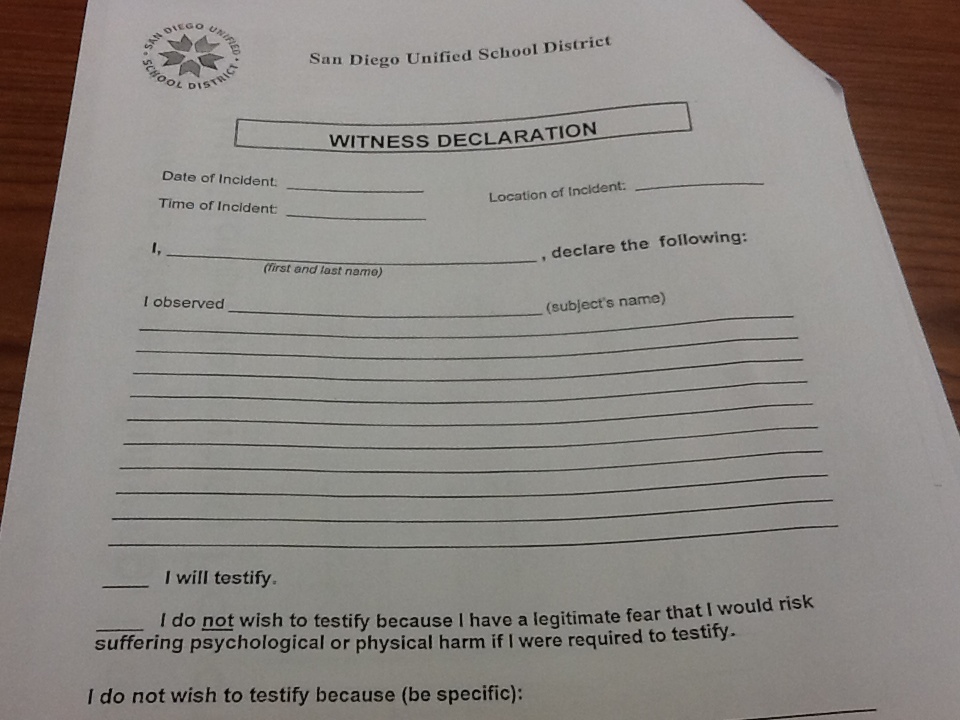
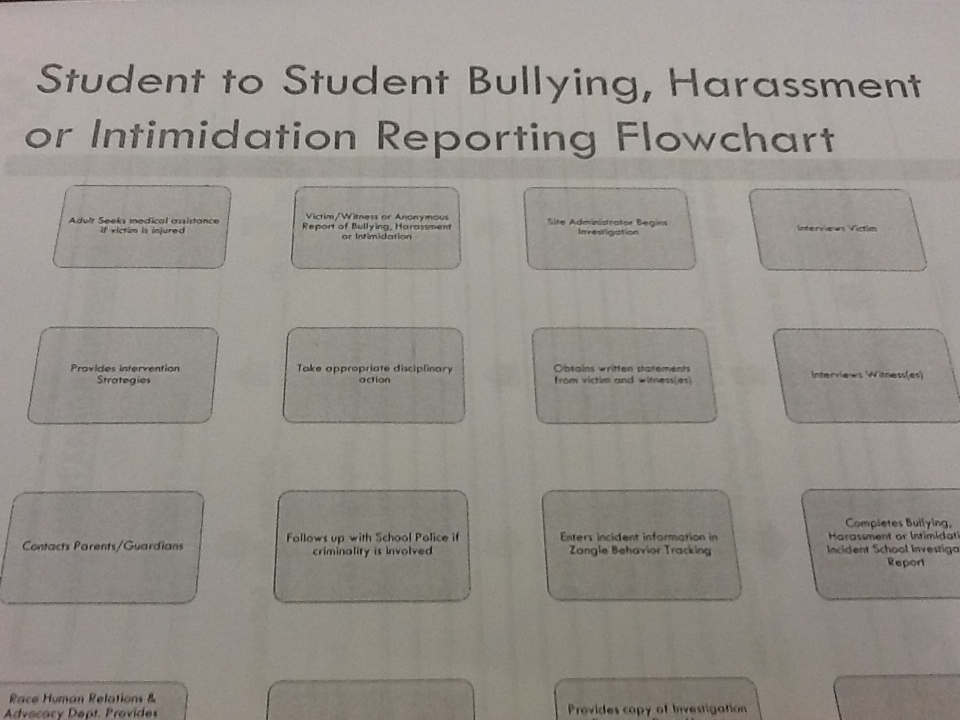
I had the distinct pleasure of the Voices of Women’s (VOW) Anti-Bullying workshop in San Diego, California on March 31st 2012. VOW collaborated with the United Women of East Africa for this workshop. I was quite pleased to be in the minority in the crowd. The majority of the attendees were women from the Somali community in City Heights neighborhood in San Diego. The array of panelists provided insight into the policies and realities of anti-bullying today in San Diego and more specifically the San Diego Unified School District (SDUSD). The array of handouts that SDUSD uses with documenting bullying and the anti-bullying efforts impressed me. I kept multiple copies so that I could share them at home. And, here I include my screen shots.

The first speaker, Agin Shaheed, is an administrator with the SDUSD. His exact position focuses on Race Relations. I couldn’t help but think that his job must be incredibly rewarding and exhausting. Shaheed noted that the SDUSD is the largest school district in San Diego County and second largest in the state. This would make it behind the Los Angeles Unified School District (LAUSD). Shaheed opened up his remarks reading a moving poem he wrote. He reminded the audience of 50 about the murders of Shaima and Trayvon. I was glad I packed my tissues. Shaheed made a germane point about cyberbullying and the way it invades the home–it makes this form of bullying more invasive. Victims of cyberbullying are not safe anywhere.

The next speaker Maslah Farah, Director of the Neighborhood Unity Foundation shared that he was bullied and got into trouble while he was in school. He shared that the bullying stays with you for the rest of your life. He also opened up my eyes to how important cultural issues are. He noted that in Somalia families really look to the teachers as a second parent and that corporal punishment is more common in the schools or other forms of discipline that are not allowed here. (I could hear some warm laughter as he noted this). What I took from his talk is that he was kicked out of high school and is now successful and using his community work to mentor others in the community. He reminded us that we need to move away from a mainstream culture that enjoys witnessing misery.

This portion of workshop really made me think about the ways that we think about bullying. I also wondered what sorts of policy the local schools in Victoria (where I live) have regarding bullying. We can talk until we’re blue in the face about how bullying is bad, and that kids should not do it. But, until we practice this and don’t encourage bullying among adults we unfortunately model bad behavior. Just turn on some reality television shows and we can see and hear bullying. Look at some of the news magazine shows and we can also see the bullying nature by the hosts. We live in a society where bullying is rampant. Not to seem trite–but we  need to model better behavior.

Collegiality via Email: Suggestions for Students

Last week I wrote about collegiality on campus and was really thinking about colleagues. Today I am thinking about students. Most of the original post applies; however, it is markedly different for students. I advise students and  I supervise students. But, I also assess student work and worth with graduate and undergraduate students in different capacities. I am in contact with lots of students and I had some interesting conversations with colleagues at #ISA2012 I know that email communication is a sore spot for lots of us.

I’ll list in no particular order some suggestions:

Never send an email that you have initial misgivings with or give you pause. Don’t send it. You might have a smartphone, but that doesn’t mean that you are making smart decisions. The tendency is to be less formal and send an incomplete sort of email.

Never send an email in anger or frustration concerning a mark. These situations really requires a face to face meeting. And, then you and the recipient have the record of your angry or frustrated email. Avoid sending an email that you might later feel sheepish about or regret.

Never send an email making statements that you wouldn’t say to someone’s face. We get brave  behind the screen or with the phone, so think before you send. Remember that your instructor or boss is not your peer and you should error on being more formal than informal.

What you should do if you feel you need to send an email: Send yourself the email and wait. Then, review the email. Practice smart computing and communicating.

Collegiality on Campus

Today’s Friday Fun Facts is a reminder. A reminder for me and others that when you work on a college campus–all the other employees are your colleagues.
  • At times the environment we work in on a college campus is stressful. The students’ stress vibrates off their bodies during certain points in the term. It’s always wise to confer with colleagues about student needs.
  • When conferring with colleagues across campus, remember that you are on the same side or the same team. We are all working together on this microcosm. And, this microcosm is ultimately smaller than you think.
  • Never say something via email that you would not say to someone’s face. Likewise, never say something on a voice mail or via a phone call that you would not say to someone’s face. I remember this instance a few years ago when a colleague across campus raised her voice at me, when she had incomplete information. I finished the phone conversation and assumed that she was having a bad day. Later, though, I wondered if I should follow up with a memo. I did not–I let it go.
  • Remember that while this is the students’ campus–it is your workplace, so act accordingly. A campus might seem really “chill” and laid back, but it is still your where you work.
  • Get out of your department or silo and meet people across campus. Yes, get out of your comfort zone and network. It’s healthy and you’ll make new friends.
I look forward to you comments about this post.

Blogging Assignments: Yes, I’m Sold on Them

For the last four to five years I have included a blogging assignment in my Women’s Studies or Political Science courses. During the last three years the blogging assignment is mandatory and I have found that most students find the assignment(s) liberating in that it offers them a place to combine analysis with a creative assignment. However, I find that it is good to offer some flexibility with the assignment. Last Summer students had an opportunity to blog, put together a zine or make an iMovie that responded to a series of course readings. Six to eight of them put together zines and more opted to blog. For the second year in a row–no one opted to complete the iMovie assignment. However, one person did vlogging for her assignment and I was pleased with her vlogs.

These creative assignments are coupled with class participation, and lots of writing–a major research paper. The students get ample opportunity to think and write. My expectations are that the series of blogs helps the student hone her/his analysis of the course readings and my comments, then, help them improve so that the final paper is not merely an extension, but the final product for their thoughtful analysis related to the course material. I will continue to offer them this opportunity to blog.

The blogging assignment also allows the student to become familiar with a blogging platform and I find that most students enjoy learning how to add different matter (photos, video clips and the like) to their posts. The students experience some pride of ownership with their particular blog and then they get to do that practical thing—add familiarity to said platform to their resume. That said, there is also a growing area of literature that is examining blogging as a genuine assignment in the classroom and the benefits of blogging. I do think that we will continue to see social media use in our classrooms and here I do not mean that student laughing or smiling into their hands, as they text one another. No, we will see more colleagues using social media platforms in the classroom assignments. How are you using Web 2.0 in your classroom?

Katniss Rocks

Before Reality TV was reality tv, Stephen King wrote about it giving readers pause about a cold-hearted dystopic future where people would watch poor people fight until the death (Running Man). The contestants wanted to make money and were paired against professional athletes and killers. They didn’t exactly fight, as much as attempt to survive.

Move forward a few decades to the Hunger Games by Suzanne Collins and we have a dystopic society where the totalitarian government has an annual Hunger Games that requires 12 Districts to offer a pair of Tributes to participate in a fight to the death. The one major difference–these Tributes are 12-18 years old. Yes, you read that right. Youth are fighting against one another in hope of being the surviving Tribute so that they can have an easier life after the fact—if they win.

The competition takes place in a controlled environment where the Gamekeeper and his staff can change the light, the weather, start fires, and even add interesting predators to the game. What is interesting to see here is how the more wealthy districts view the games as a moment of entertainment and not a matter of life and death for the contestants. They are amused by the games and this amusement says so much to the reader or person sitting in the cinema.

The protagonist, Katniss Everdeen, volunteers, after she is shocked to hear her 12 year old sister, Prim’s, name called. The movie stays relatively close to the book and is entertaining. I was lucky enough to sit in a sold out theater with an eager audience. Katniss clearly was at odds with how she had to play the game–to make herself desirable to the viewers. You see, the viewers can sponsor and give the Tributes gifts–medicine, food, or other necessities. The movie kept up the anxiety in all the crucial areas thanks to good direction and solid performances by the various actors. The movie was fabulous and I look forward to seeing it again. The movie offers commentary on politics, violence, class, gender, and what constitutes entertainment. Kissing my three middle fingers and raising them in the air for this first installment. I look forward to seeing Catching Fire and Mockingjay in the theater.

I noticed that the midnight line up included a handful of people dressed up as characters from the books. I did have a conversation after the movie regarding the pageantry of Reality TV. My friend said, “Well, I’m going to think more about watching American Idol.” Now, that show is not about the fight to the death, but the whole notion of the sponsorship and pageantry really does make you think. Let’s hope the odds are ever in your favor!

I want to thank Toshiba Canada for the tickets to the preview.

Dear Professor: My Parents are Lost at Sea and I Need an Extension

Today’s Fri Fun Facts is about keeping it real. I give lots of advice on the Fri Fun facts and today it’s about not crafting elaborate stories in order to get an extension on work. During the last two school years I am definitely seeing that the grandparents are safe and not dying at the high rates that they used to and this might be related to how clear my syllabus is about providing proof. And, the proof about a death in the family usually is from the service—the funeral home or church typically puts together a program for the service. This might seem like an onerous request, but I find that it has kept many grandparents safe! In all seriousness, I am giving some quick advice about due dates and managing your time. In case you’re wondering, I did get a student email about parents lost t at sea. I contacted tthe Coast Guard. The student was embellishing and did not get an extension.

1. Manage your time well. In my courses the paper assignments are included in the syllabus, so from day one the students know what the assignments are and when they are due.

2. If you’re in over your head, make an appointment or come to your instructor’s office hours. I’ll be honest, I do think that I am more likely to be more flexible when a student “owns” their education and sense of overwhelm and talks to me face to face and asks for an extension. I do not always give the extension, but I think I am more apt to weigh the request differently than a last minute email.

3. Rely on resources around campus. At UVIC the library has an assignment calculator and students can type in the due date and a schedule is calculated that helps students organize their time. Attend class, go to tutorial, office hours, and schedule the time to conduct research and writing time.

4. Re-read points 1-3. I cannot emphasize how much guidance you will get from your professor if you ask for it. There is a reason why I had 8 hours of office hours this last week and that there was a line up–I care and I’m here to help. The only way that you’ll get guidance from your professor is if you talk to her/him.

With this—I ask that you finish your term on a high note and organize your time before the final exams begin. Good luck!

Disclaimer: This post has nothing to do with any of my current courses or students. It is merely the time of year when a post of this nature is appropriate.

Remembering to Breathe

On Saturday, March 17th I had the distinct pleasure of participating in a Mom panel on Real Parenting with Shirley Broback and two of the three co-founders and organizers of Breathe Now. The interview was focused on parenting tweens and teens and what this means for us. It was a great interview and I was reminded how almost two years ago we decided that we wanted to organize a conference for women.

The idea was that we have all attended work-related conferences, mom conferences, and social media conferences, but we did not feel like there was a conference dedicated to the three in such a way that also dealt with issues unique to women. And, as I noted on Real Parenting the fateful meeting at Murchie’s was when we came up with the name, Breathe Now. We wanted to remind women that it’s important to inhale, exhale and breathe. We need to be nice to one another and more importantly to ourselves.

My involvement with Breathe Now has offered me opportunity to get to know the other three co-founders well. And, with that I’ve also met so many wonderful people in the local community. We see the conference as part of our project to build connections for women. We run the gamut, though, with a former government worker–turned personal chef, communications consultant, a hotel industry executive, and an academic. What we share with this conference is an acknowledgement of the importance of women supporting one another. There is so much knowledge that we can share with one another–but the only way this will be done is by taking the time to talk and chat.

Breathe Now offers a weekend of events that is sure to inspire. We are proud that Rona Maynard is our opening keynote and Bif Naked is our closing keynote. The array of our panels reminds women that it is OK to take time for yourself. We are also setting up our slate of panels to look at the theme of It’s OK.  For instance, it’s OK to take time out for yourself, it’s OK to be successful…this theme is important, as women often apologize for taking time out for themselves or for their success.

I’ll end saying that I hope to see you at the conference on April 14 and 15 2012 at the beautiful University of Victoria!

Revisiting Conferences and Making it Worth It

An academic conference provides the more than the venue to present your work and hear other presentations. It also is a great place to network and make connections, as well as learn from colleagues in the field. This post makes suggestions for a successful conference appearance. I know that the Western is this week and ISA is at the start of April. My hope is that this post will be useful for most.

If you are presenting and need technology (a video data projector), do make a point of making sure that your needs are met. Likewise, always have a Plan B if the technology does not work. This means copies of your slides for you to refer to and handouts of any pertinent slides or related matter is also copied (introduction, findings and conclusion) for distribution. I gave a talk on campus last week and had my iPad, thumbdrive, Slide Rocket and Drop Box versions of the presentation; however, everything worked fine with my iPad.

For graduate students, you should come with some business cards in hand. The standard in my areas of familiarity (Women’s Studies and Political Sciences) are that you can use the university crest and get cards printed. Please note that when you are writing your thesis, you are a candidate (for instance MA Candidate) otherwise you are a Graduate Student. When you have defended your prospectus for you dissertation, you are a PhD Candidate. You cannot put PhD on your card until you have defended or have your PhD in hand. I see that a few people have PhD on their Twitter profiles or blogs and they do not have this degree earned yet. This is misleading and unprofessional to do—don’t do it!

Practice your presentation in front of a mirror or a friendly audience. There is nothing harder to do than to sit by and pay to attention to a terrible or wooden presentation. Don’t stare at your computer. If you must, place phrases in your document that read: scan the room, breathe, smile, look up, etc. This will help you add some semblance of connection with your audience. Speaking of which you could present to one person or have no one in your audience, but this still counts as a presentation for your vitae. Enjoy your presentation!

Make sure that you take time to attend some of the receptions. This is a good place to network or catch up with others. Make sure that you are available to attend some of these events. The conference is not a vacation, but a working series of meetings. Take some time off, but your main job is to use the conference experience to help you share your research and meet people in your discipline. It is worth the time to meet people, too. I have found that some of my publications were thanks to a conference presentation, when an editor was in the audience or another panelist invited the panel to submit a special issue to a journal.

Before your trip you also want to peruse the conference program well so that you can organize your daily itinerary of what you have to do. If your advisor, mentor or other faculty in the department are attending the conference, go to some of their talks. Ask them to introduce you to some people at an event. A good committee member or mentor, will do this naturally, but some people need the little nudge to do so. Also, try and meet other graduate students. These people will provide the cohort of scholars you will see at the conferences and it is worth getting to know them.

The next few things are obvious: have fun, eat, sleep and exercise. Conferences are often 12 hour days and you want to make the most of them, but not work too hard that you return home exhausted or sick. Have a great time, but be careful to not drink too much. You are presenting yourself to others in your field. Likewise, be careful what you say on social media during the conference.

Remember that your first academic conference might appear a daunting experience, but it is not if you plan well and take the time to network and attend conference events. Also, engage with others online via social media–this way you can also meet people prior to the conference and have a meet up.

For the established academic, all of the above is obvious. But, let me add that we need to remember to make time to mentor. I try and take grad students out for a drink, coffee or a meal to chat with them about their progress. These brief meetings make a difference. I know that they did when I was a grad student.