Patience and Mid-Terms

I come to my classes with a sense of compassion. The first week is a major clusterbug for everyone. And, we can ratchet this higher for the new students. What I find that I need to work on is my sense of patience during the upcoming weeks. No matter how many times I gently remind students, some will not bother to review the syllabus and email me queries that can be answered ever so quickly with a glance to the course syllabus. This term I have done something different–the quiz and the mid-term have a question related to the syllabus.

I also am aware that my class is one of four or five and once the students get into the routine, they will have a better idea regarding the protocol on campus. Until then, I read the emails, pause, smile and reply that, “As the syllabus states…” If anything, the flip side, is that the student is bothering to care to make sure that s/he gets the right information and reads the material, shows up to class on time, comes to my office hours at the right time, right? And, let’s be honest, there are moments when a keen student eye finds an error on the syllabus and I appreciate it! So, I am not perfect and I know that my students aren’t either.

I also wish that patience worked the other way. Students need to remember that I am one person serving many. My office hours are limited to some 4 because I have to teach my classes, get some administrative work, prepare for my courses, and possibly steal time for my own work. We are at the start of month two of the new term, and I am sure it will be another great, busy one. At this moment, I am thinking of Guns and Roses. Smiles. This is a reference to their song.

Dr. Seuss

“Be who you are and say what you feel because those who mind don’t matter and those who matter don’t mind.” Dr. Seuss

I used my writing prompt book and I have to say that I appreciate this quote from Dr. Seuss. It speaks to me at the moment. I’ve read lots of his books to my kids and remember reading the books a long, long time ago. There is something about the books and reading them aloud that is soothing. It’s the wit and the nonsensical stories that entertain. I also think that Dr. Seuss holds a place in my memory as an academic due to the collection at the UCSD Library.

I spent many days at the library working on my grad school papers and my dissertation. The foyer occasionally displayed some of Dr. Seuss collections and I would at times procrastinate and pore through the holdings. Well, Dr. Seuss also had some war propaganda pieces and part of my work focused on Mass Political Behavior–I was doing research! In all seriousness, this quote is an important one for reflection. People who care about you  aren’t apt to take offense at what you say. The people who care about you get you and are more willing to accept you and your quirks. And, well the people who have problems with what you say…they might not be worth your time. I know that this is not a truth; however, it is worth thinking about when you interact thoughtfully with people.

Learning Commons at UVIC

Students will be hard pressed to complain that no one is helpful at UVIC. Between faculty, TAs, the workshops at the Counseling Centre and the Learning Commons they have help at their finger tips. OK. Maybe at their toes, as they will have to walk to these offices. I walked around the library this morning and was really excited with the Learning Commons. So, excited that I made a 90 second video on my iPhone just on the fly. Here is the link: http://tinyurl.com/26lvel7 

And, this does not include the International Commons! Don’t forget that near all of this are the desks for the Help Desk (satellite) and Reference Desk. The Library is the place to be to get help, study, research or grab a latte in the Biblio Cafe. Seriously, get into the Library. This is an old post of mine, but too good to not add to and share that there are even more resources dedicated to student learning. What are you waiting for?


Those TPS reports won’t write themselves. 

darth vader dark side

Students with an Edge

In my sixteen years of teaching, not one term has gone by when I do not have at least one student athlete in one of my classes. One thing that I have noticed with the vast majority of the student athletes is that they have drive. These students usually want to excel on the class. Their competitive edge extends into the classroom. They know that their coaches and education team (whoever this may be at the respective institution) expects them to show up to class and to practice. Most of these students will introduce themselves to me during the first week or two and my standard practice is to ask that their contact send me any invitational or team related travel dates. While I have taught at four different institutions none have been at a major sports school–no top ten football programs, which is often a marker for a “big name” institution. I have taught at Division 1 institutions; however, this was at the start of my teaching career.

I truly wish that more of my students had this same drive and felt accountable to their coach or team. This does not mean that my students who are not athletes are slackers! Not true. The typical student wants to do well, but knows that among their array of courses some get more effort. The student athletes are generally more competitive and want to do well in all of their courses, so it is not a big surprise to see at the annual fundraising breakfast that many of them have strong grade point averages. Can I just spend a quick moment to say that I am proud of them. Very proud. And, I know that my colleagues are, too.

It is less common for one of the student athletes to phone it in with their coursework. When I have had a student athlete under-perform, the student has immediately contacted me via email, come to office hours, or in one instance the basketball coach called me to meet with him. When I met with the coach, he made no excuses for the student and said, “His first job is being a student. Do not go easy on him.” I wasn’t going to, but let me tell you that walking into the office was an intimidating experience. I felt empowered and I know that many of my colleagues will counter with examples of grade changes or pressure by the administration to change grades; however, this is not my experience. Getting back to the students–when they under-perform they want to know what they can do to fix it. Thankfully, the student athlete under-performing in my classes is not very common. They are competitive through and through and want to do well. I do not give them any extra credit or leeway. What I want to see is more students with that fire in their belly. Be competitive and humble. The photo below is one I took at the McKinnon Pool–one of the pools where the student athletes swim.

20131230-210921.jpg

2013 The Year of Reflection

I’m reading lots of top ten posts about 2013 and thinking about the last year. The last year was consumed with having to find balance. This was not having some idealistic want for balance, but rather out of necessity. What have I learned in these last 12 months? Well, I’m going to share my top ten thoughts from 2013.

1. Stay Healthy–this includes exercise, sleep, and eating right

2. Say no strategically

3. Work smarter–this meant rethinking my productivity

4. Make time for family and friends

5. Say yes strategically

6. Read, relax, and run

7. Be firm

8. Honesty is important

9. Unwind

10. Happiness is more important than just about everything

The list is in no particular order. I will say this there is nothing like a health emergency to force you to rethink everything. I am forever grateful to the family and friends who were supportive during the last year, as we coped. I am looking forward to 2014. I am sure it will hold lots and I look forward to tackling it with my family by me.

20131230-055223.jpg

Helping or Hindering Students

I want to discuss the fine balance between helping and hindering student progress. I am trying hard to work on this balance, as I am quite aware that sixteen years into teaching I am still learning. My current student population is different from my students circa 2005-6. I have attended various workshops about our students and more specifically about first years. Our students require more hands on attention and most universities now have stronger recruitment and retention strategies.

What this means for me on the ground is that I try to provide students with as much information as possible. But, I have also learned some important lessons. Several years ago I helped my godson register for courses and purchase his books in the bookstore. This entire experience really stuck with me. I have more compassion for my students and I am less invested in “schooling” them when they miss the obvious. There is no obvious for the new student. When I say schooling I am really talking about how I know that I have to repeat myself about due dates, have the due dates bolded in the syllabi, and that students will still inquire about things in the syllabus.

I can only do so much, though, and the students need to meet me half way. What do I mean by that? They need to show up to class and come to my office hours. I am not in the habit of chasing students down between my various courses; however, I will make announcements in class or send announcements via the online learning management platform reminding them about course related issues or other campus events. I do contact students when they suddenly disappear. Here, I am not including students who are in crisis or have other issues like learning accommodations that I must take into account. Those students require a different level of attention.

I have resolved for honesty in my office and with my marking. This translates into support and at times brutal honesty while I am assessing work. I do my students no favor when I am not honest with them. This might mean that I am clear about my  assessment of an assignment or an issue regarding academic integrity. What does this also mean? I am listening more. Does this make me helpful? I hope so. This term a common statement, “What can I do to help your success in this course?” But, this requires that the student contact me. Like I often say in class, “I don’t have ESPN.” I know–I need to find new jokes.

prof a

Make Sure that Your Girls Aren’t Too Ambitious

One of my students shared the Cosmo Special Report in the October 2013 issue. I photo copied the article, read it, and have carried it around for two months. I wanted to blog about it immediately, but alas, grading and other work related responsibilities got in the way of a response. Here I am just weeks before a new year begins and I am finally ready to comment on the nine page article, “The Ambition Gap” by Lorie Gottlieb. The Cole’s Notes version is that single women are more ambitious and successful than their male cohort and consequently are having a hard time finding an equal. It is more complicated than this, but this article speaks to the supposed crisis of heterosexual masculinity (see Michael Atkinson for an informed position), women’s success, and the alleged post-feminist era. Yes, the article assumes that the coupling is between a heterosexual couple.

The first point that I want to make is that we are not in a post-feminist era. We are not in a feminist era. We are in an era that extols the importance of equality, but we wring our hands when we talk about the reality of who is successful, who sits at the table, and who are the high earners. Now, clearly, happiness and ambition are not mutually exclusive. What Gottleib is getting at, though, is that men are “losing their drive” (144). She recounts story after story of the young, single, successful woman who is more successful than their male partners or former partners. Thanks to the success of Liberal feminisms, we see more women working, buying homes, and in managerial positions (Gottleib 145). However, I want to ask: which women? Surely, we need to disaggregate and examine these numbers. Lots of statistics in the US and Canada illustrate that more single headed households are women headed households. We are also quite familiar with the fact that men, on average, make more money than women. And, when we look at upper management, board of directors, and chief executive officers the picture becomes more homogenous–male and white.

On page 147, Gottlieb has a column dedicated to “Watch Out for These Red Flags.” And, what are they?
1. He has no plan 2. He doesn’t communicate 3. He’s envious of your success 4. He takes advantage 5. He’s resistant to change

I am no dating expert; however, I think that these are red flags for most in their 20s and older and not so much about an ambition gap. Gottleib offers a shallow examination, but at the same time does not ask more important questions regarding race, class, sexual orientation, education, and types of career. Women might earn 60% of the undergraduate and graduate degrees (148), but she does not break this down enough for me. Why do I care? My experience as a university professor and one who has continued to look at women, politics, leadership, and higher education, I know that women tend to gravitate to certain fields of study that do not translate into higher earning jobs. We see women over-represented in Education, Humanities, and Social Work and under-represented in Engineering, Sciences, and Computer Sciences. This, then, influences the earning power for women.

What do I like about the article? Well, it was provocative and I read it closely several times. I also appreciated her column about “How You Can Bridge the Gap.” She pulls from Sheryl Sandberg’s Lean In (my thoughts on the Lean In movement).

She offers some points of advice: 1. Prescreen 2. Establish boundaries 3. Accept trade-offs 4. Give him a nudge

This advice is timeless and part of having a healthy partnership for heterosexual or same-sex couples. What do we do? Encourage people to think about what they want and how they want to pursue their dreams. Encourage girls to go into the STEM fields and work on the leaky pipeline for women and work. I am also concerned with this notion that women are too ambitious. There are parts of the article that equate being single with too much work success. This message is problematic.

Before The New Term Begins: Redux

This is a revised post that is still applicable. It’s that time of year when most college students are thinking about the next year’s classes. This is a slow teaching time for most regular faculty (note this doesn’t include the sessional instructors, who usually have to teach full-time in order to stay afloat). One of the things that we forget though, is that this time of year is very busy for advisors and others who help students figure out courses and other important matter that is important to student success.

This quick note is a reminder for patience. Patience for the frantic student who needs a little reassurance about classes. For instance, I am finding that I am fielding more emails where a student really wants advice. “Which classes should I take?” A few have actually said, I want to know your recommendations. This is a big responsibility for me. Typically the student who asks, has already taken a course with me. So, I need to think about his/her interests and weigh my knowledge of the department’s courses. At first I would suggest all our courses, but now I am more careful. This is not based on content, but rather thinking more strategically about the student and her/his interests and possible grad school interests.

One common response from students is that they have heard that a colleague is a GPA buster. I always smile at this and explain that if the student wants to focus on Area A, for instance, in grad school that she absolutely needs to have a class with said colleague. The majority of the students come back to my office the next term and thank me for my suggestion. The other thing is that most students will do better in a course that interests them. I usually do not feel that this is a good excuse to not take a course. Also, our sub-fields are small and prospective grad schools and or entrance committees get used to seeing the same names and marks and they might understand that Prof. X is a tough marker.

I think that when I am queried–it is acceptable for me to make course suggestions to students. But, that pesky need of having the syllabi done–not completed! Eeeps, yes, those syllabi will not write themselves.

Read the Syllabus, Please

The syllabus is the course contract. This statement sounds like a simple one, but alas, it is not. The statement might sound legalistic, but it is not. The truth is that the syllabus is our guide for the course, not a guideline, but the rules. The thing that I try to remember is that while I take special care with crafting the syllabus and the ways in which I will evaluate my students, I do not have control over their time. I need to make sure that my syllabus clearly states the all the necessary information for student success. I also know that students have multiple courses with multiple deadlines. And, as much as I want to get frustrated that they are not reading the syllabus, it is a waste of time to get frustrated about them not reading. Instead, I am prepared to re-read and revisit the syllabus as necessary prior to assignment due dates. Plus, I must remember that they have three to four other syllabi to keep track of during the term and that my class is one of many.

No, instead, I remind them about the information on the syllabus and refer them to it. Each term many will say something to the effect, “Oh, I must have missed that.” I typically smile and say, “I know that you have four other courses, it is easy to get the information mixed up.” This is a better use of my time and emotional energy. My job is not to chastise or scold. Frankly, I do not like scolding unless I absolutely have to do so. My job is to give the information and move on to the next query or item. Sure, I chat with colleagues about how syllabi are not read. I am sympathetic and am the first to talk to a colleague about what we can do to make this better. However, each term it is the same song and dance. This term I noted in two different places on my syllabus that class would not meet during our Reading Break. The note is in bold, too. My Teaching Assistants went to the class and found almost half of my class sitting in the lecture hall. They looked at the students and said, “You need to read the syllabus. There is no class today.” I  am guessing that my students really liked the material and were keen for another lecture.

What can we do? Review the syllabus with the students and review it more than once. Remind them of the deadlines and refer them repeatedly to the appropriate resources on campus. My syllabi are considerably longer than before, but I am OK with that. This means that I have as much helpful information as possible and I am doing my job. The other half of this is that the students must do their job and review the syllabus–highlighting due dates and keeping an organized calendar. Yes, I am speaking to the students owning part of this and that might require a different blog post. And, I probably should work on that blog post, but now, I am thinking about the syllabi for next term and how I need to be as clear as the water in Maui. I am pining for warmer weather–can you blame me it is almost winter and I know that in just a week I will start three weeks of intensive marking and occasionally write on papers: you should have read the syllabus and followed directions.

on the syllabus baby

Please note that the above  photo of “Sassy Syllabus Baby” is from a former student who did get permission from his family to use the photo. And, Kevin always read the syllabus. May he have a great post-university life!

National Day of Remembrance

Annually across Canada events are held as a day of action to help stop violence against women. Many refer to these events as part of the National Day of Remembrance. Some of us remember the utter shock and sadness when we found out about the terrible violence that took place in Montreal on that fateful day that 14 women were targeted solely because they were women. Today we have more events that speak out against violence. Just two weeks ago the international, annual Trans Day of Remembrance was held. It is important to remember that violence can touch all of our lives. Jackson Katz has explained that violence against women is a men’s issue. I concur with Katz and hope that you watch his TED Talk.

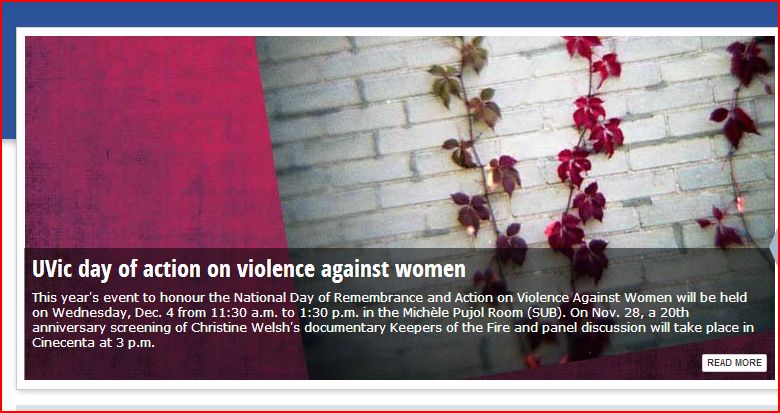
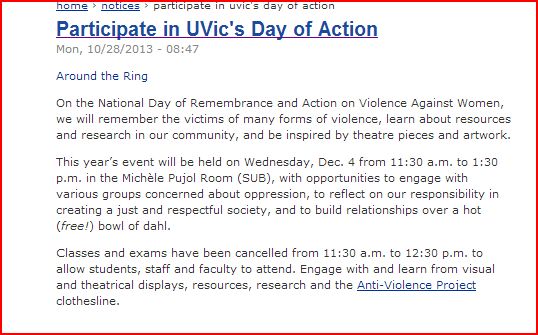
Find out if there are any events taking place in your community. We are all part of the struggle to stop violence. I have attached a screen shot of a campus event (Dec 4th) and local candlelight vigil (Dec 6th).  Please share this information. Day of Action

day of action part 2

candlelight vigil