Civility in the Classroom: Emotional Labor Redux

This Spring I wrote a blog post for the University of Venus about Emotional Labor in Academe and this post is a follow-up and will hopefully continue the conversation, as we approach a new school year. Emotional Labor takes many forms for instructors. Some of us teach topics that are provocative or outright controversial and this can energize the classroom environment, but it also can offer the instructor difficult moments. Likewise, some faculty teach topics that are not necessarily controversial, yet the classroom environment can be influenced by strong student personalities. How do you manage these situations. If you’re teaching at an institution new to you, see if there is a Code of Conduct for the campus. You might find that there is nothing, mish mash of policies or a Student Code of Conduct. Check with the department that you work for and find out if faculty include the code or other wording regarding collegiality in the classroom in the syllabus. Having the code or some verbiage related to the classroom behavior is useful as the class contract.

I’m not suggesting that you plan for the worst to take place. No, instead I’m suggesting that you prepare yourself accordingly. You hope for the best, and prepare for those interesting situations that occasionally present themselves in a classroom. Encourage good behavior by ensuring that the classroom provides a supportive environment. Here, I also assume that you will treat your students with respect and foster a civil environment. When I’ve had one of those moments when a student has said something troubling, I will often repeat what the student has said (within reason), and just this act often gets most students to hear what was said and want to clarify. Then, I give the student the opportunity to clarify the earlier statement. Usually a wave of hands go up just as the student made the comment, and I have to remind the class that we’ll discuss the matter at hand in a respectful way.

The above is a composite of different situations. Now, I am not referring to those moments when a student has used Hate Speech in the classroom. That is different and in my experience requires a different sort of reaction. I have usually stopped the student and asked that we speak outside. Then, outside we will talk about what just took place. In some situations the student will apologize and apologize to the classroom. And, in some instances the student refuses to admit that there was a problem. In the latter situation, I have asked the student to leave the classroom. Then, the protocol is to have a meeting. The meeting could be with just the student or the department head, me, and the student. You should verify what the policy is in your department or campus, and you should document everything immediately. You should also find out what the university policy is regarding these outlier situations. Do you have to report the student to Public Safety or to another student office? Confer with the department, the faculty association or your union representative.

Once the student is out of the classroom, I normally make one statement to the class about the need to have a collegial or civil, inclusive environment and then I move on. However, in my experience you need to be prepared for students to weigh in about the occurrence. Some will feel violated by their peer’s statement and it’s important that you listen and explain what the protocol is. Essentially, you’re explaining that you’re taking care of it–that there is a process. I have found that most students really want to make sure that their learning environment is supportive and this means different things to different students. And, some students will feel violated by the Hate Speech or offending comments and might want to chat with you individually.

This Summer I cleaned and reorganized the home office and I found one of two letters of apology. The short story is that one of my male students left his computer email open and his roommate and another decided to send lewd and threatening emails via my student’s Hotmail account. They also changed his password and were able to repeatedly send emails over the course of two days unbeknownst to my student. I reported the emails to the Chair and to the Campus Police. My student was banned from the classroom until this was sorted out. He bumped into me on campus and explained the situation. He was quite embarrassed and contrite and I realized that this was all some cruel stunt. The other students (roommate and friend) were contacted by the Campus Police and Student Affairs and had to write letters of apology. The letter below is the better of the two. I’m sure that this student never pulled a stunt like this again. Overall, I was thankful for the Chair, Campus Police, and university support.
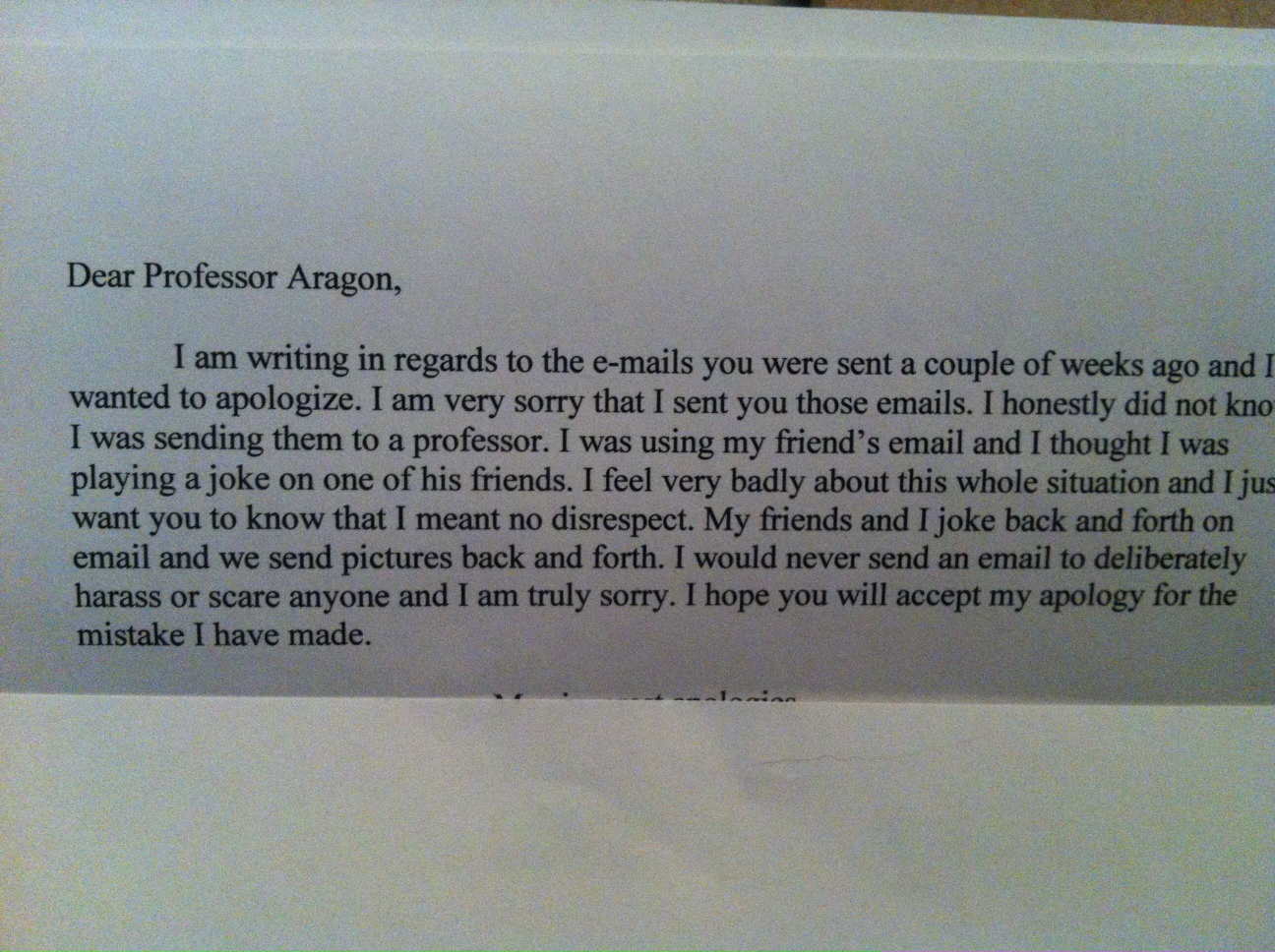
Hopefully my post will help you maneuver the tricky situations that faculty face on campus. You want your classroom to be a place of learning and not have some side dramas drop like little bombs. If you have these situations in the classroom with student behavior, deal with it immediately and by all means document, document, and document. Make sure that you have followed the university norms and confer with a trusted colleague about the protocol. Also, verify what the Code of Conduct states. And, remember that it is not always about you. Chances are it really is about the student who made the comment(s). Good Luck!
Managing Projects: Having More Balance

I did something radically different this Summer with my writing. I didn’t have a strict schedule and I worked daily on different projects. Normally I would have spent 60-120 minutes on different projects over the course of the day and work on multiple projects each day. This Summer was one per day–OK occasionally 1.5 per day. I have not decided which I preferred. Moments have taken place where I’ve wondered the veracity of this tactic. But, overall it’s freeing to try something new and then think about if it worked for me.

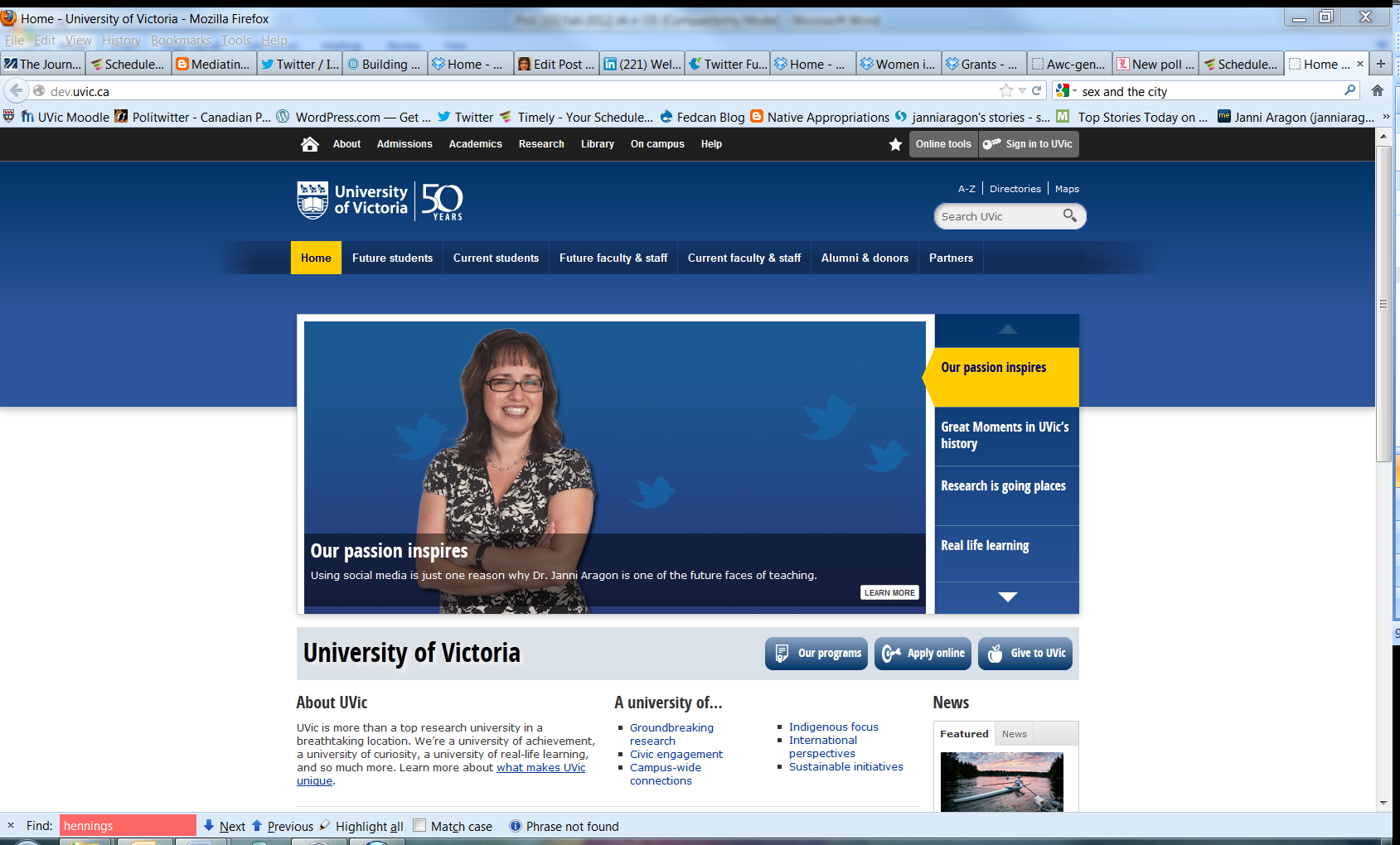
I’ve also made a point of taking some time off during my vacation this year. I ran twice a week with two close friends and kept this date firm in my schedule. I also was not the usual office rat. What this meant was that I did not go into the office every darn day, too. I was in the office 2-3 days per week. What I did differently–I worked at libraries, coffee shops, and outdoors. This meant more distractions and more conversations with people. And, looking at my bank account it also was a little more pricey. But, another way to look at this is that I was able to actually turn myself off from work. Some might say that this sounds unproductive or maybe less productive. Occasionally someone looked over my shoulder and would ask me some questions–even though I had my ear buds and music going. I was polite and engaged in some conversations. These interruptions were usually good. The best part was always the senior citizen who never believed that I was old enough to be a professor. I joked that they could go to the website and see me on the homepage. The screen shot below is of the new site that goes live in a few days, but the photo is the same one that has scrolled on the university website this Summer.

In all seriousness, I also spent as much time as I could outdoors–running helped me stay outdoors. I read outdoors–even if it was for only an hour. I am a Summer person and usually go back to Southern California for the Summer. I didn’t this year, so I tried to get as much Vitamin D as possible in Victoria, BC. This takes effort, as occasionally if you shower, you could miss Summer! No offense to fellow Victorians, but our Summer is sometimes forgetful. It seemed appropriate to try something different, since I was at home for the Summer.

I’ve thought about this again and again and at the end of the Summer I will evaluate what it meant for me and my productivity. To clarify, I am in a teaching tenure-track position and due to my heavy teaching load (8 courses per school year)–it really means that I have to write during the Summer months. Now, I realize that this situation is common for my colleagues who are lucky enough to teach half as much and more than common for my colleagues who don’t really get that much time off, since they have to teach year round to survive. Regardless, this Summer meant a few thing: write and relax! Oh, academe, thank you for these gifts! I know–I have a full-time job and should not complain. But, I’d like to remind that I did my time adjuncting (we call this sessional work in Canada) for more than 10 years.

Now that I’m in the last push before the term resumes, I can honestly say that I got less work done. I didn’t fret about it either. Oh, maybe I did a few times, but then I’d look at my kids and remember that I have to do better, as they observe and learn.  I had more balance in my life during these last two months. I spent lots of quality time with my family and by myself. Sure, I was in the office a day or two per week, but on my terms. The papers were revise (not ready to resubmit) and projects are further along, but I am happy. I won’t put a price on happiness, and all the time I spent with my two daughters. I also took up golf. Can you believe that? It was a great Summer!

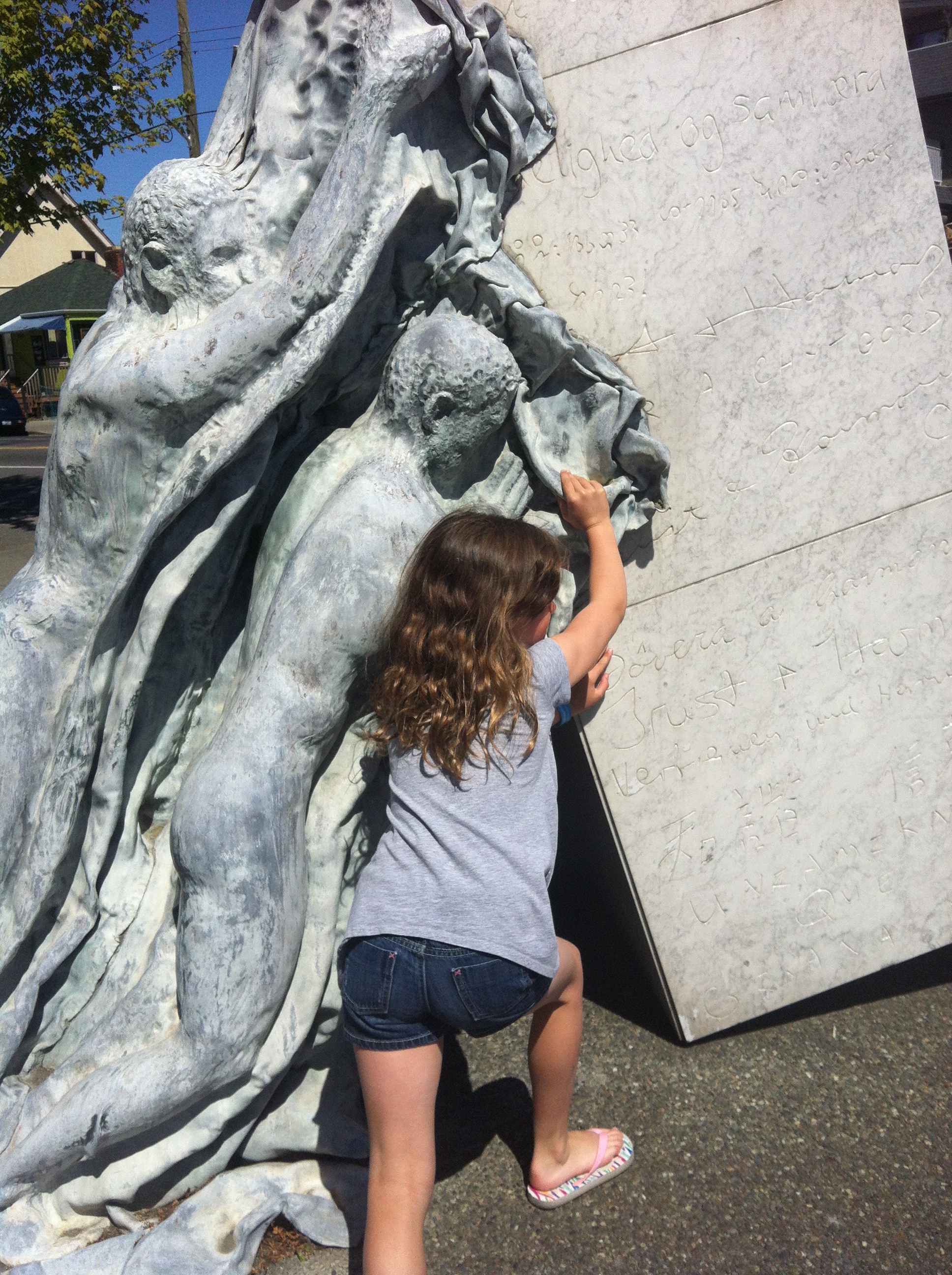
The two photos are shots of my girls. I don’t post photos of them on my blog, so these are not direct face shots. My two loveys.

Reminder for Grad School Applications

It is that time of year, before the term begins or before it gets really hairy…this is the perfect time for students to think about their grad school options. My words of advice is to be organized. Most students will approach faculty in October or later and this is when professors are writing lots of students letters of reference for graduate school. Be organized. You should hopefully have put together a list of schools that you’re going to apply to. Remember to include more than one school with this list! You should have a sure bet school, the programs you would really like, and then the dream options.

How can you make this application process easier?

1. Ask professors weeks before the letters are due.

2. Provide us all the information we need.

This includes~ Who, What, Where, and When, Fill out all necessary forms. Really organized students provide me a Word or Excel file with the schools, deadlines, and any additional information.

I ask for a copy of your letter of intent and cv/resume. I might even meet with you and ask what your motivation is for continuing your education.

3. Remind us. Send an email a few days before a due date.

4. Thank us. This can be an email or a note. It’s not necessary to do more. Remember that your tenure line faculty actually get paid to mentor and do things like write letters. Keep in mind that part-time faculty do not get compensated for this extra work. Remember to thank them profusely–a card, bottle of wine or a face to face thank you is nice.

Good luck with this process! And, remember this process is nerve wracking!

Looking for Work: There is a Book for That

I stumbled upon a shelf or two at the bookstore filled with career advice books for undergrads and other job seekers. I was quite curious and leafed through some. And, I took photos of a few of them. I’m sure that many of these books dispense good advice for job seekers, and given my penchant to read as much as I can I think it’s good to do your homework. But, there is a part of me that also hopes that students go to the Career Center or whatever name it’s called on campus. Here are some screen shots of some of the books that I leafed through the other day.

I didn’t see anything Earth shattering in the above book–but it does have a snazzy title and will definitely cause some to buy it hoping that the right equation is there for them. I’m not dismissing the book or endorsing it. But, it does catch the eye! I wonder how many copies of this book have sold? You, too can use Social Media to help you get a job. Yes, you can, but just being on social media is not enough. Big smile. Mind your digital footprint. It’s always good to occasionally Google yourself and see what is out there. Clean up your presence if you must. There are reputation management companies to assist you with this, too! Hopefully, most won’t need to resort to the consultant to clean up the digital footprint!

I’ve read the Parachute book and back in the day found it helpful. No wonder it’s been repeatedly published. Many people have no clue what they want to do and books like it are useful to get you thinking about the possibilities and the reality of your own skills and interests. And, nothing beats talking with a career educator, mentor, coach or trusted person in your life. Which brings me to my next thought–I really hope that students scouring the shelves in the university bookstore look to their network as a rich resource, too. Start off with your friends, family, profs, employers, and the career center! Set up coffee meetings and ask that contact to introduce you to a person or two so that you can increase your networks.

Another screen shot of a book and its secrets!

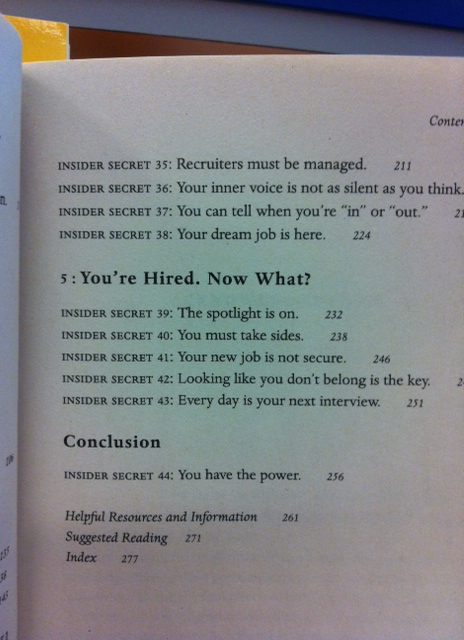
44 Secrets! Now, some of them make me think of Captain Obvious, but I’ve been working since I was 16. I do think that the book has lots of great hints/information for the job seeker. It looks helpful in a cheeky sort of way. I should have taken more photos of the table of contents, as this book really made me laugh out loud.

I liked the section about: You’re Hired, Now What? This is also an important part of the job seeking process. What to do when you get hired. Some of the best advice that I’ve heard about once you’ve been hired is that you act and dress for the job you want. I’ve had other great advice, too. You know–keep your head down and work hard, avoid landmines, make good allies, and don’t piss off the more senior people. This is a quick list of some of the advice and certainly not exhaustive.

I have lots of former students on the job hunt right now and I wish each and every one of them good luck. If any of these books look promising, stop by a bookstore and leaf through it before you buy it. And, remember that we have a great Career Center on campus! Have one of the career educators review your resume and a sample cover letter. The staff or mentors on campus are here to help and you want to represent yourself in the best way that you can. Good luck!

Boundaries: Saying No

I have had a hard time saying no. This is the nature of one dozen years as adjunct or sessional faculty–what many refer to as the New Faculty Majority. Now, I’m about to start my fourth year as tenure line faculty and this will mark the fourth year out of fifteen when I shut my door. My door is only open during office hours. I make no apologies for this. I am open and available for consultations during my office hours or appointments. Truthfully, a senior colleague insisted that I shut my door to get my work done. To this day, I thank him for his honesty.

Likewise, I’ve  become better at allowing myself to take a vacation. This means not responding to student emails and more importantly not feeling guilty about it. Of course, I never got the sheer volume of emails previously. This changed when I got my tenure line job and was also made an Undergraduate Advisor. Students need advising year round. The department where I work has assigned other faculty during my vacation, but that doesn’t stop the emails from trickling in. Perhaps it helps the deluge!

This May I started an email to myself where I remind myself of my professional declines. I cannot do everything and anything. I note my achievements via my CV, but what about those moments when I protect my time and sanity and say, “no.” Well, I have an email to self that shares my no accomplishments. I started this in May and I’m only at 18, but each one of these declines allowed me to spend more time on teaching, advising, myself, and work/life balance. So, I suggest that we remember to celebrate boundary keeping and those moments when we must politely decline.Don’t get me wrong–I say yes to lots of meetings and opportunities. I do believe the department head would concur that I am a good citizen in the department and for the faculty at large.

But, the department head has also encouraged me to say no more. I’ve had colleagues who have a printout that read: Just say NO within their field of vision as a reminder when they are on the phone. Oh, that reminds me to add another point. I’m at 19! And, I am also reminded me of themes at Breathe Now, a conference that I co-coordinated with Janice Mansfield, Angela Rafuse-Tahir, and Yukari Peerless. Many of our speakers noted that it’s important to take time for yourself–breathe. Say no, when you need to!

Mentoring and Coaching: Post-Graduation

I’ve blogged lots about mentoring and coaching. I’ve differentiated the ways that some students require more hands on approach–ergo the mentoring, and some require less and I view this as more of the coaching strategy. I decided to do something different and buy some stationery and send some of my mentees (will use just that word) a note. I wrote the notes recently, but will send them prior to the Fall term. Now, I’ve sent emails and messages via other social media platforms, but I’m kicking it old school with the note cards.

Some of them will start or continue graduate school in the Fall, and others will join the working world outside of academe. I bought these note cards at the Papery on Fort St in Victoria, BC and chose something that was not too big, so that the sentiment wasn’t a thesis. My intention was to write something supportive, and dispense some advice. Academics tend to live our lives term by term or maybe even school year by school year. Graduate students get used to this, too. After graduation many of my former students note that they miss college and the schedule. Thus, I felt it was appropriate to send the note card just when a school term starts and the graduate might reminisce about their undergraduate days. (I know that many of them do, as I get the emails or Facebook messages telling me that they miss their university days and their old schedules).

Each note card was personalized to the particular mentee and my wishes for them. I gave them well wishes and felt quite emotional as I wrote the cards. I’ve given cards for graduation during the last several years, but these cards of well-wishes were different. I don’t view them as closure to our relationship, as I see the mentoring or coaching as not having an expiration date. And, to be quite frank a few of these mentees are now actually great friends to me, and my family. Now, for any former students who didn’t get a note and are wondering where is there note card–this was a first time project and I sent out several. I will do this again. I really hope the students who get the note cards appreciate them. I’ve only started this and will see how it works.

Vacation Thoughts: Do Things You Enjoy

What do you do that you enjoy? People will often say, “My guilty pleasure is a trashy novel.” Replace novel with the name of a television show or magazine for others. I’m on a vacation from teaching and advising, but am researching and writing. And, thinking about what I enjoy or what helps me feel grounded.

1. Sleep. I need a good six to seven during the school year, but during vacation I might get eight. Eight.

2. Exercise. I have chronic back and neck issues thanks to some car accidents. (Rear-ended or t-boned). I need to exercise to keep myself healthy and happy.

3. Family. I have two kids and a partner. I love them dearly most days and want to spend time with them. I’m melting with love as I think of their smiling faces.

4. Yoga. I am a Type A person and yoga helps me relax and loosens up my attitude and body. I have found that I prefer a warm room for yoga and have moved to Moksha or the occasional Bikram’s class.

5. Reading. If I am not getting any fun reading in, I get grumpy. I have several books on the go usually and enjoy many genres.

6. Outdoors. I need fresh air and must get outdoors some. This is easier during the Summer in the Pacific Northwest, but I’m going on year two of not complaining about the rain as much as I used to and it’s working. I like the outdoors when it’s a little wet, too!

What are five or six things that you like to do? This can be during your vacation or just in general. I’m trying to do these six things lots as I slow down during my vacation.

Reappointment Process for Tenure-Line Faculty

I’ve been thinking lots about this last school year. It was a really amazing one in terms of my academic career. In the Fall I was unanimously endorsed by my colleagues for reappointment. While I hoped and suspected that my reappointment would be smooth to have it behind me was a big relief. I can only imagine the stress involved with the tenure review. I have now loaned my binders to a friend for her own review.

If you’re up for your first review here are some points of advice. I assume and hope that some of my friends will respond and add in their two cents about the review process.

  • Document all that you do. This is easier said than done. Make sure that your CV follows the department or faculty norm.
  •  Speak to a colleague or mentor familiar with the department or faculty process, so that you have an inside view.
  • Review the Faculty Agreement/Contract or similar document to make sure that you are familiar with all the guidelines.
  • Meet with the department Chair to review the process. Get as much input as you can from the Chair.
  • Make sure that someone else (mentor/friend) reviews your dossiers.
  • I had to put together a Teaching Dossier and Service Dossier. But, most will need a fulsome Research Dossier.
  • I made photocopies of thank you cards and emails from students and included them in the latter part of my Service Dossier. I also contacted some current and former students and asked for some short statements of support. They were (thankfully) willing to do so! I included these in a sub-section entitled, “Solicited letters of support.”
  • I had to include all my course syllabi and Course Experience Surveys. I was also able to include the verbal comments from courses of my choice, but if I included comments I had to include all. I opted to include comments from one 1st year, 3rd year, and 4th year seminar. I teach an array of courses and felt that I needed to demonstrate my effectiveness among all my courses. It’s easy to pick the class with the wholly positive reviews, but you might want to think about the comments that best highlight student learning. (Remember that my position is full-time, tenure-track, and teaching focused). Related to teaching–you might have more senior to you colleagues sit in your class and review your teaching. Review the guidelines, as you should have a choice of who reviews you and when. And, you should have a right of response for the review or be granted another opportunity. I was supposed to have one course reviewed twice. I requested two courses and was glad that I did so. Given that my position is teaching focused, I thought that this would best represent my teaching skills.

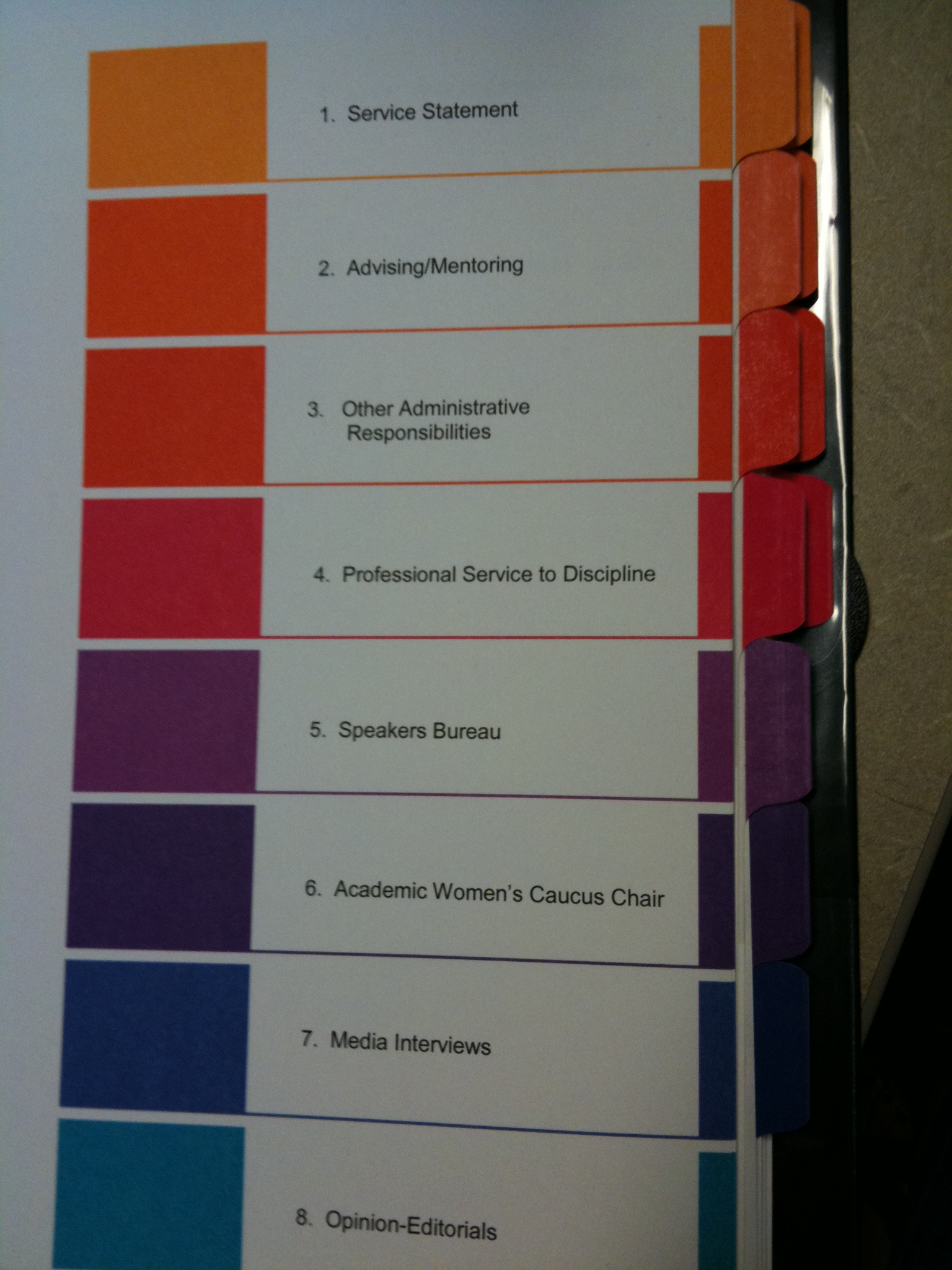
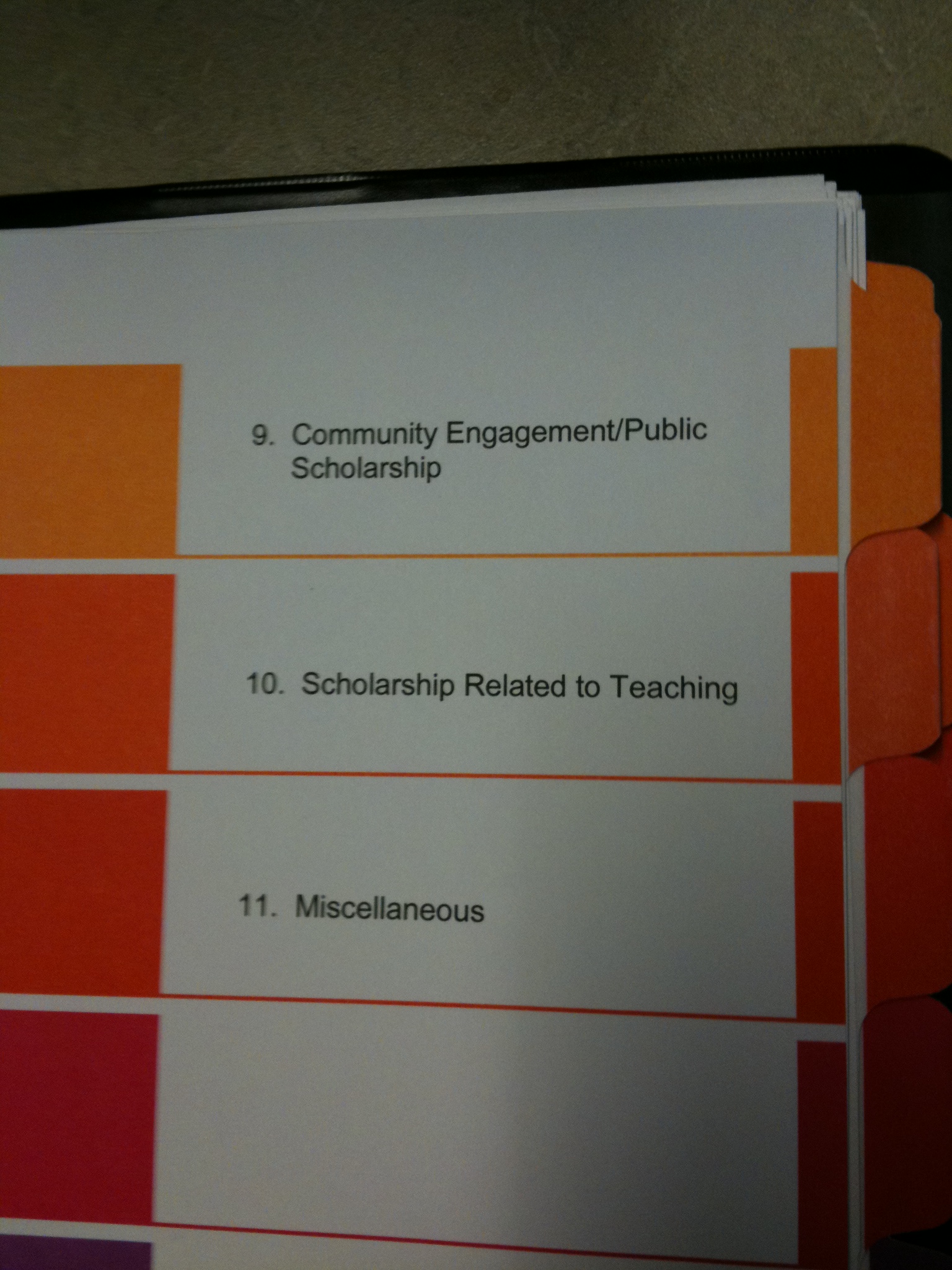
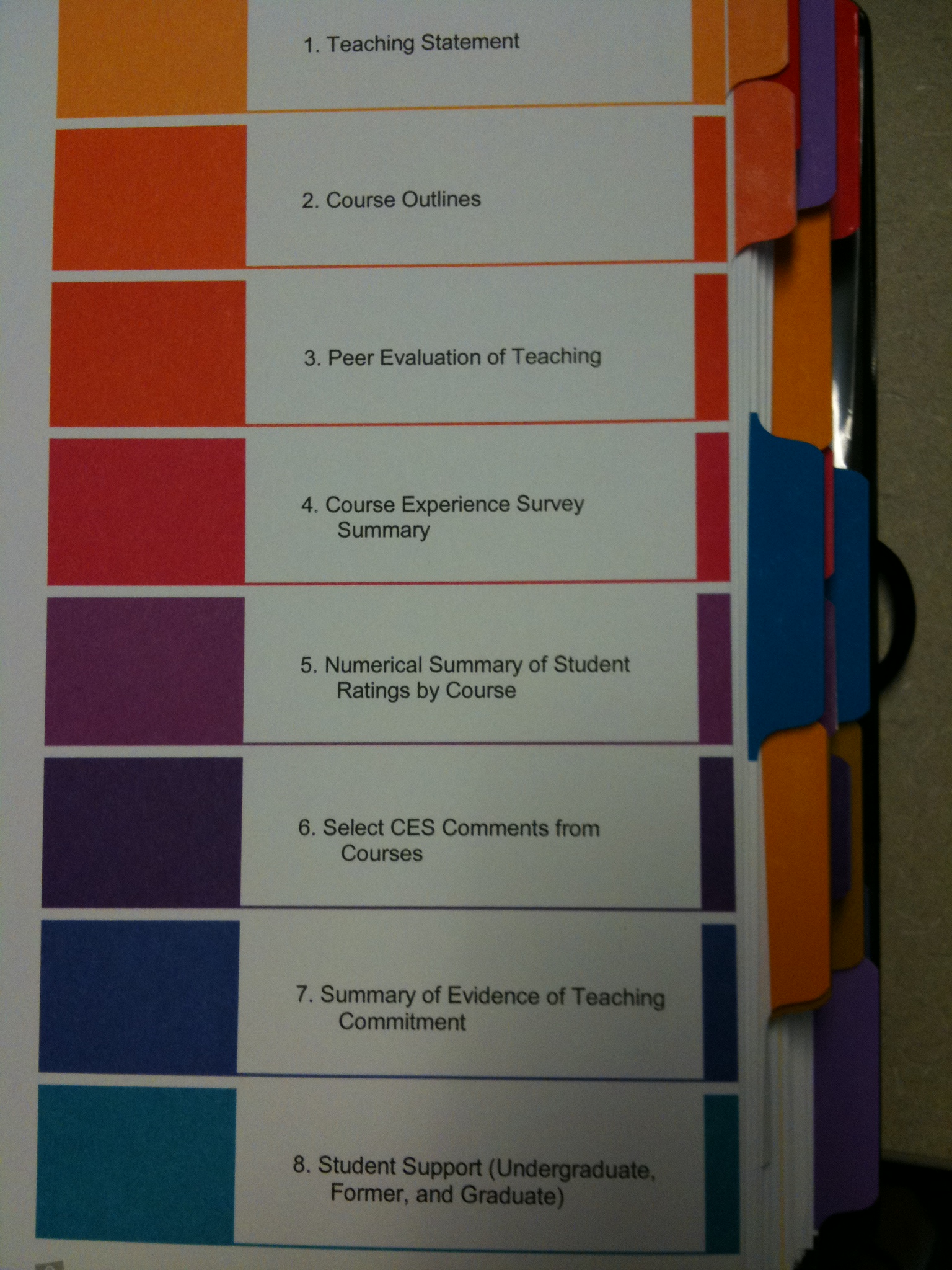
I’ve included screen shots of my two sets of Table of Contents. These fit the norm of the department, so verify what is the norm for your department. Overall, I would suggest that you take 2-4 weeks to put together your dossiers. And, during the review process be nice to yourself. Try to not stress about the review and stay focused (word choice) on each step that you have control over–which is little! Good luck!

Thinking about 2011-12 Courses

Revisiting this post and thinking about how my focus made a difference for me and for the Teaching Assistants. Giving first year students as much information as possible is helpful, but they need to read the syllabus and come to class prepared. I will say that the Fall term fielded lots of attribution issues–not quite plagiarism, but in the same family.

How did I re-think my courses? This is not going to be specific to  each of the three courses that I will be teaching. Instead, I am re-thinking assignments and other matter in my course syllabi. I realize that with the first year students I have to explain every single detail and contingency. My syllabus is a leviathan at about one dozen pages. It’s length will increase by a page with an example of what a topic sentence outline should look like.

Moving to the more advanced courses, I am emphasizing due dates as well as noting my new policy of not accepting any late research papers. The sheer number of late assignments can throw off the marking schedule. Given that most terms I have almost 300 students, I need to have a good schedule in order to return work back in 6-10 days. However, specific to the research papers, by and large late research papers are usually not strong assignments. Students have waited until the last minute and usually submit  mediocre work. They are exhausted from the entire term’s work load and submit what they could do in a day or two.

The other more cerebral matter is thinking about teaching or learning outcomes. What do I want the students to learn? What can certain readings or assignments offer? These are the more weighty decisions. I review each reading and ask–did this work? Was it successful last term or last year. I hear from some colleagues to not change a thing, but I have never done that. I always tweak and massage, and re-think. I’m still thinking.

Overall, it was a successful year and I’m still processing it.

11 Months Later: Revisiting the Life List

I decided to revisit this great exercise from one of the BlogHer 2011 pre-sessions.What do I think differently after this last year. I was reappointed unanimously by my colleagues, applied for an Associate Deanship and was shortlisted, didn’t get the job, had surgery, and then had a pretty rough term. The second term caused me to re-evaluate my priorities. Numbers 16-19 are new and I used a / to add to an original thought.

Life List exercise at the afternoon session for “My Blog as a Life Changer” was hard to do. Here is my first stab and again, unedited.  Try out the exercise. It’s fun.

  1. Go to Hawaii with Jason and both girls / See my family more. More quality time with them at home.
  2. See my family of origin more than one time per year. / Yes, see them more.
  3. Publish my books / I’m working on this and progress has been made.
  4. Get tenure / I was re-appointed, so step one is confirmed.
  5. Continue to Mentor / Ongoing
  6. Continue to Teach / Ongoing
  7. Learn French / I’ve heard more and have attempted to speak some. Does that count?
  8. Start a Women and Politics Center on campus / Oh, long term goal.
  9. Take kids to Grand Canyon and DC / Long term
  10. Work on either a Congressional , Senatorial or Presidential campaign / Long term
  11. Learn how to golf / Started learning in May!
  12. Spend time with friends in the US and elsewhere / Did some in March–ongoing want.
  13. Take kids to Europe / Long term goal
  14. Go to Harry Potter Theme Park / Long term goal
  15. Use sabbatical to attend conferences / To write book and to visit teen in university
  16. New to the list–take better care to relax. I am powering off my phone more and trying to not work for an hour or more every night. Balance
  17. Remember to schedule time for me and Jason
  18. Exercise as part of my daily routine
  19. Return to the life list once a year!