
Difficult Students: Public Court of Opinion

Lots of academics have been immersed in conversation about the NYU student’s outburst against her professor. The student ended up writing letters to the NYU President and went so far to repeatedly threaten her professor and the university. She wanted to take the issue to various papers, where she has family and friend connections and the court of public opinion.

Of course, the university cannot really respond openly, as it is an issue of the student’s privacy. But, what the student did was make her various diatribes public. These letters have been made public and have really made her look terrible–like a petulant, self-entitled young person. I have not used her name and I won’t. But, what I will respond to is the fact that she was unhappy with an assignment and contacted the university president to get her professor terminated! One of her diatribes also accused her professor of being only a “spousal hire.” Obviously this student has no idea about hiring in higher ed. Even if this professor was a spousal hire–she would still have to be qualified and a good fit for the department.

There is even a blog that includes many of the student’s alleged Facebook status updates and they display more of the same sort of outrageous statements. What this makes me think of is the difficult students that instructors have in classes. These students usually make up a small percentage of the student population, but at time they can actually take up more time than all the other students combined.

Some of us on Twitter responded using the hashtag #difficultstudents and my Facebook feed was full with friends in and outside of academe responding to the incident. The discussion that I would like to have is two-fold: acknowledge that some students are difficult and that faculty need to balance protecting student needs, protecting the integrity of the classroom and more so for contingent and pre-tenure faculty protecting your reputation/job.

This is part one of this discussion. What are your thoughts?
Career Advice for Advanced Undergrads

You’re in your last year of university and getting nervous as the school year starts, hits the half way point or is ending. But, for the sake of ease, let’s pretend it’s mid-way through your last year of university. I’m going to make some suggestions for you. And, these are my opinions alone and not endorsed by my employer. This advice comes from my university experience, 14 years of teaching, and years of advising unofficially and officially.

1. Get yourself to the Career Center or the Career offices. Your campus should have an office with extremely competent staff who are there to help you. But, understand that they aren’t there to help you get a job, rather they are there to give you the skills so that you get yourself that job. They will empower you, but it’s all about your own skills and your own file.

2. Speak with your departments Undergraduate Advisor. Believe it or not, s/he might have some good advice to give you. The advisor might know of additional job boards in your area of interest. See if this person is willing to review a cover letter or your resume. If they are not–don’t get offended–go back to number one and ask for help at the Career Services office.

3. Speak to trusted peers who are in your situation or who have recently graduated. Your peers are a useful resource, too.

4. Confer with other faculty or mentors that you have in the campus community or community at large. Now is not the time to feel shy. You have to reach out and make some effort.

5. If it works for your field (and which fields does it not work for?) get on social media. Yes, join Linked in and establish your profile there and meet others on the platform. Ask people questions—especially those in the industry that you’re interested in.

6. Are you blogging or on Twitter? Will these platforms be useful for you? If so, then do it. But, always be very careful with your digital footprint. Google yourself and see what is out there. That photo of you in residence engaging in naked beer sliding—might need to be deleted! OK, you really don’t have compromising photos, but do take a look and see what photos and status updates you’ve had so that you won’t have a future employer “creep” and find something that they don’t like.

Particular to Victoria, I suggest to students that they not only look at the local job boards (BC Public Service, municipality job boards, and UVIC’s U-Hire, but also VIATEC’s. You never know what you might find in many of these. I also explain to students that they most likely won’t get hired right out of their undergrad as a senior policy analyst. The truth is that you’re going to have to work your way up and this might mean that you’re working in a position that requires data entry, filing, and “gofer” work. You have to cut your teeth in a job and be prepared for this.

If you’re interested in working in Victoria, I suggest that you keep abreast of when there are Chamber of Commerce events (Victoria or Westshore) and attend some of the events to network and meet local members. Note that members of this organization aren’t only local business owners, but government types, elected officials, and just regular people who are interested in the community. Also, attend other local events and get to know the community. This might mean registering with Meet Up and looking for events that will allow you to meet other like minded people. The thought of doing this might make you feel uncomfortable, but you need to get out and meet more people and realize that the limited discomfort can pay off with a mentor, community building, contacts, and possibly a job connection.

I have seen students take 4-8 months to find work after they graduate and this is pretty common. The students who are willing to take risks or start at the entry level position are the ones who have been the most successful. What are you doing to do?

Fri Fun Facts: Happy New Year

Today’s Friday Fun Facts is dedicated to something that I’ve said before–advice to undergrads for a successful term. I have to repeat it because each time more of you hear it! No, in all serious these points work for all of us.

1. Sleep. Sleep right! You are better able to deal with the day if you’ve had a good night’s sleep.

2. Eat. Eat right! Refer to the previous point and add eat and you get the point. You need the fuel to run efficiently–to run coherently.

3. Exercise. I love seeing my friends or students at the gym. It’s important to take care of yourself. And, you’ll find that you’re able to get some thinking done, when you’re at the gym.

4. Office hours. Office hours are not only the place to clarify points about a reading or an assignment, but also to chat about how you’re doing in the class. Remember that your instructor might be teaching 50 or 300 other students and one way to get them to know you is to be a great student and/or also be memorable (in a good way). Office hours is a useful time to have one on one interaction with your instructor.

5. Time Management. Keep up with the reading and work in your classes and you’ll have a less stressful term. Seriously.

All of the above will work for me, and I’m not a student anymore. The advice will also work well for those of you not in academe. To everyone, I wish you a successful January through April. Now, I only have to remember to follow my advice!

Fri Fun Fact: Thinking about 2011

My Friday Fun Facts is dedicated to 2011 and thinking about the last year. This last year was filled with many great conferences and networking. What have I learned during this year.

1. To listen. I am a talker and anyone who knows me will smile broadly at this statement. I am also a good listener. One thing that I have done more in office hours is to remind students to listen. And, I have to remind myself to listen.

2. Generosity. I have met so many wonderful people who have been quite generous with their time and I am thankful for this. I also know that I do this, as well. And, will continue to do so.

3. Friendship. I have made some wonderful new friends in the last year and have had ample opportunity to meet people IRL who I first met via social media.

4. Mentoring. I have stepped up my focus on mentoring this calendar year and I do think that it’s had only positive results. I’ve always attempted to mentor, but I am more hands on now.

Overall, it’s been a fabulous year. I’m really excited for 2012.

Fri Fun Fact: Winding Down

Today’s Friday Fun Facts is really about winding down and my wishes for students.

1. I want you to know that I truly enjoyed both classes this term. And, hope that you enjoyed your classes.

2. Now that it’s the final exam period, it’s very important that you review your notes and the readings. You’re exhausted and I get that, but the last assignments are often the weakest. Do what you can–give it your all. Your grade is in your hands.

3. Eat, sleep, exercise and try to manage your stress. Walking around campus this week, I saw so many shoulders up to ears and exhaustion. BTDT. You must try to take care of yourself.

4. If you had a particularly good class, make sure you send off a quick email to the instructor.

5. Reflect. Think about the term and what you did well. Also, think about what you could have done better. And, in January when the new term begins, try to stick with the things you did well.

Good luck on your exams and with the final papers! Have a good holiday.

Feminism: Revisit

I’m re-posting this blog post. It first appeared in Jan 2010 and I feel that I need to share it again.

This is the first post in a series where I will ruminate on what it means to me to be a feminist. First things first, I have no problem self-identifying as a feminist. Just as some of my colleagues live by their Marxist or Socialist tendencies, I live by my feminist beliefs. I advocate feminism and I am an advocate of feminism, but I do not shirk the label.

Secondly, I am a strong believer of the fact that there are different types of feminisms. There is not a monolithic feminism or feminist club that I have to earn a card to be a member of and act and speak a certain way in order to keep my membership. Feminism is not Costco. Feminisms provides a philosophy of life, love, education, politics and so much more. My feminist politics includes an understanding of the importance of intersectionaliy. My feminism includes an understanding that politics and life are influenced by race, class, education, sexuality and many other indicators.

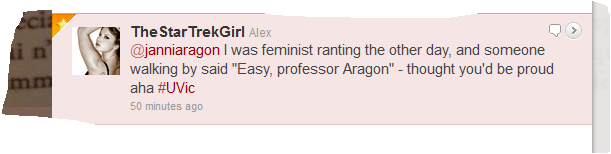
To be honest, I find it quite amusing when a student or other person outside of academe accuses me of having feminist politics. The student might as well accuse me of breathing and thinking. We are all guided by a philosophy of sorts–mine just happens to be feminism. And, some many decades later this term seems to scare, enrage or confuse people. I recall being in grad school and a professor asking me if I was a Chicana or Feminist first. I felt the question was a ridiculous question. Shall you take my right arm off or my left? My identification of my ethnic background is inextricably connected to my feminism. This is part of my identity.

Feminism informs the way I read pop culture, articles, people’s actions and I will not apologize for thinking. If my feminism intimidates you–you need to think about why is this the case? Do you understand feminism? Do you want to? Years ago I recall telling a friend that I was going to be a cultural critic when I grew up. I don’t think either of us understood this, but when she later told me that her mother thought that was a terrible idea, I knew I was on to something. I tell my students that my vocation is thinking, reading, writing, and more thinking. This thinking is informed by feminism.

The typology of feminism that best explains my own would be Women of Color feminisms circa This Bridge Called My Back  added with Third Wave feminisms. I was lucky enough to earn a BA in Women’s Studies (Go Aztecs! ) at SDSU, so most of my mentors were of the Second Wave persuasion. I feel well versed in different types of feminisms.

How does this feminism inform my daily life? Well, that is for a different post or two. One about my teaching, and another about relationships (parenting and love). Indeed, I have posted about these topics since this post went live.

Friday Fun Facts: Get Outside of Your Comfort Zone

My Friday Fun Facts are a response to some recent conversations in my office or around campus. After all these years of teaching, I am still a little surprised when I hear from a student some iteration of the following statement:

I’m so glad that I took a class with you. I just wish that my guy friends would.
This brings me to other quick statements that I hear from students that make me cringe a little as an instructor an advisor.

1. What is it with the Gender or Feminist in the title of only half of my classes that somehow instill some fear, dread or perhaps loathing in students of the male persuasion who feel loathe to take a course with a woman professor?! Maybe it’s just me. No, it’s just you. Get outside of your comfort zone and learn something. Be challenged.

2. If only we could all be so lucky to think and say: I refuse to work with her/him because their opinions differ from my own. Good luck with that! I wish you well in the workplace.

3. I’ve also heard occasionally from a student: I’ve already had one class about race, indigenous politics, gender, or sexuality. Surely you learned everything there was to learn in that one term! Why are you taking another International Relations, Canadian, History (you get the picture) course, when you are now an expert in the field! (Please note my sarcasm). Take a chance on a course and learn more!

4. I won’t take a class with Prof. X, as he is a GPA buster. When I hear this I have to smile or else I might frown. Take a class and learn something! Get to know the body of literature in the class and you might find that you enjoy the subject matter and that you might get more out of that B+ or A- in that course compared to an easy A or A-. And, you might even get the grade you deserve.

Overall my advice is to get out of your comfort zone and take different courses. Enjoy your education and remember that it’s not meant to be easy or merely affirm your particular beliefs. I have heard from many former students that they were glad they took that Environmental Studies, Legal Theory, Women’s Studies, Social Justice Studies, Political Science course or else they would not have found that they enjoyed the topic.

I remind students that I started off as a Journalism and Political Science student and changed my major during the end of my third year in college to Women’s Studies and kept Political Science as my minor. I remember reading the description of Sex, Power, and Politics with Dr. Kathy Jones and thinking that the class looked interesting. I had no idea that several years later I would teach that course and continue to teach iterations of it some twenty years later!

Student Plagiarism

I really wish I had the time to dedicate more than one session on each major assignment. For some students this is not enough. In a perfect world students would come to campus with strong time management skills and feel prepared for the rigors of academic life in the classroom. The reality is that many are not yet able to integrate source material well into their papers. Many also do not know how to cite, quote or even paraphrase.

There are also those times when students go further and plagiarize. At times some will do this unintentionally. They think that adding a “the” or another word to a quote is paraphrasing. Other students will outright copy and paste large passages and not attribute the source. In 99% of these cases I have found that when confronted the students are wholly apologetic and either admit to the plagiarism or offer that they did not realize that they were plagiarizing.

When I think that I need to upload a paper in to Turnitin, which is a plagiarism software program, I actually have a feeling of dread. I do not want to “catch” a student. I am most concerned with academic integrity and my hope is that the report will find that there is one sentence that was not attributed properly and then the bibliography comes up as a source, as it should. But, when the report finds one to two dozen hits I feel frustrated. I review the report line by line to differentiate between poor attribution or worse.

Contacting the student for a meeting is not fun either. I am prepared for anger, tears, denial and acceptance. I find that few students are angry. Most will own up to it and say some of these things: I knew it was a poor paper. It was not by best work. I was so tired that I did not pay attention. I did not think you would catch it.

My ultimate hope is that the student will learn from this and never do it again. And, more importantly my hope is that the student will work in his or her writing and pull from sources in a more efficient manner next term. I can only hope so!

Fri Fun Facts: Student Evaluations

This week’s Fun Fri Facts is a response to students’ informal evaluations of courses. Normally I offer students an opportunity to give me feedback about my classes. I also explain to the class that I take these evaluations seriously and will often change things in a course based on the thoughtful comments.

How do I do it? I do one of two things. I ask them to take out a piece of paper and list the readings that they liked or did not like or I borrow shamelessly from Dr. Heather Tapley and ask them to list what they would like me to start doing, stop doing and continue doing. I am going to refer to some of the common student comments during the last 12 months.

1. You assign too much reading. It is hard for most professors to not smirk at this comment. My job is to assign work that will cause us to think and chat about the ideas. During the last year, I have actually cut one to two readings in my 300-400 level courses. But, the students might know this! I did re-think the course allowing more time to chat about the readings.

2. The blank assignment is worth too much or not worth enough. With these sort of comments, I really can’t make all of the students happy. I could move things around and another few would complain that they want the paper worth more (or less)!

3. You are awesome. Do not change a thing. This class is like a mental hug, massage, best part of my day. I have to admit that the handful of statements of this sort do make me smile. And, I am thankful when the same person has given me constructive comments about what I can do better. I have previously noted that my teaching is not static, it’s fluid. And, I don’t pretend to not learn from the students. So, the positive comments are appreciated and weighed with the less than positive ones!

4. The blogging assignment is great, hard work, too much work. The students who have commented on the blogging assignments during the last two years have mostly been positive. And, a few of them acknowledged that they now read all the assignments and think: How would I blog about this? Fist in air! Now, as far as the blog being too much work in most classes they have to write a series of 4-6 blog posts, but this term the class has to write 6 over the course of 12 weeks. I’m hesitant to change this that much. I see that more students understand the expectation for the assignment, so I was more clear compared to 9 months ago.

5. I like that you offer us discussion time. I don’t like the discussion time and I want to hear you lecture more. This is a tough one. I use a combination of lecture and discussion in my courses and I find that more students prefer the balance. However, there will always be the 1-2 who want to hear me lecture more. I might need to dedicate one day to 100% lecture and the next day to lecture and discussion.

6. A student or two usually comments on my office hours. I don’t have enough or that I’m not available enough for him/her. As it stands, I have as many office hours as last year and I’m teaching one less course. Compared to my colleagues I actually have more office hours, but I know that I teach more students and I do make appointments as needed. My availability is not an issue in my humble opinion. And, during the busy times of the term I will add 1-2 more hours of office hour time.

Overall, I do think it’s an important exercise to check in with the students and see what is working or not working. I always hope that my classes are successful, but I also know that I am only one part of the class. The students are an integral part of the class.

Explanation for an Assignment

I did something a little different in my class on Tuesday. I walked in and gave them what I felt was a good explanation for an assignment. I distributed the guidelines and reviewed them with the students. But, what I did differently was explaining WHY they had to do this assignment. I don’t think we do this enough. Our syllabi notes how the students will be evaluated.

But, do we explain why each assignment is important or why it is necessary? These are not cheeky, deep questions that I pose here. I do think that there are times when you need to put your cards on the table and explain to them:

This assignment will make your next assignment easier. I know that some of you get uncomfortable that I am evaluating your writing, but this evaluation is not about you as a person. I know that I walked in to the classroom wanting to do this based on a few difficult office hour meetings during the last two days. A few students shed tears and were not completely able to separate their marks from who they are as a person. Their mark is not them, but for some students (especially the first year students) it is really hard to separate the mark from their identity.

Perhaps some of the third and fourth year students in my afternoon class found my explanation tedious? I don’t know, but I wanted to remind them about the why for the next assignment. And, I also wanted them to realize that I know that they feel vulnerable when they submit their written work for review. How many of us has shuddered when we’ve opened up the email that includes reviewers’ comments? I know that for some of them my purple pen is like a weapon of personal destruction and I don’t want them to feel like that. Their grade and my comments is not a rant. It’s an assessment of following directions, critical thinking, and overall presentation.

Do you give your students the why explanation?