Before You Email Your Professor: Redux 2013

This was my most popular post in 2012 with more than 600 views. Of all my posts, I didn’t expect that this was the one, but I don’t imagine that the metrics at Word Press are wrong! I have taken the liberty of revising some of this.

I haven’t taken a Netiquette 101 course recently, so I think it’s time to give some tips about sending emails to your instructors. Of course, I assume that my colleagues send concise, well-written, and respectful emails to students. Frankly, that is a given. (Fingers crossed)

1. Always assume that you should be more formal. Each department will vary; however, going with formal is easier than the reverse and then hearing: I expect to be referred to as…

2. Address the person in the email with a hello or even a “dear.” Avoid, “hey. And, use your full name, as your instructor might have many students who share your first name.

Sample~

Dear Instructor: I am emailing to find out information about your Fall class. Do you suggest any prerequisites for the class? I’d also like to talk with you about a paper topic that I have. Do you have any time to meet this Summer?

Thank you,

Student X

Avoid:

Hey, I’m going to enroll in you class. Should I be worried about your feminist bias?

Smitty

3. Never send an email that is incoherent. This is email and not a text to your best-friend. Type out all words, use punctuation, and proper spelling. What I mean is that even if you’re using your smart phone, be smart and use real words and avoid abbreviations. You could even wait to compose the email on your tablet or laptop!

4. Never send an email when you are mad. This goes for all emails. Send yourself the email and then wait a few hours or overnight, and then send the email that you won’t later regret. When you send an angry email, it is very hard to do un-do. I know that I won’t respond and I’ll call a  meeting with you to chat about your problematic email.

5. Be honest. Understand that your instructor might say that this conversation needs to take place face to face. Some conversations really need that human interaction. This really goes for talking about an assignment, reviewing a draft, talking about grad school, and other important conversations.

6. Do not be offended if the instructor corrects your use of their first name or some policy. Most of us will be kind and say–we have a 24 hour policy with emails after work is handed back and it’s in the syllabus or I expect students to call me Prof. Schmitdkins. (Apologies to my colleague who I used for part of this last name!)

7. Read the syllabus before sending the email. Perhaps the syll answers your question or notes that you should take the time to write a coherent email noting who you are and why you are emailing. And, some of my friends won’t even respond to an email if the question is answered in the syllabus. Avoid saying something like, “I don’t have time to read the syllabus, but was wondering…” Read the syllabus and if your question is not answered, then send the email.

Overall, treat email with the same integrity that you would treat an office hour visit. And, yes, I do get lots of emails that start off with “hey” and have been asked about my feminist bias…

The above advice is good for all of us–in and outside of academia.
keyboard

Happy New Year!

Happy New Year! I hope that 2013 bring you joy, happiness, and good health. What else do I hope for with this New Year. Sure, I can say world peace, a cure for Cancer and AIDS, and for the government to really take action with the Fiscal Cliff/Idle No More Movement. And, I truly do wish for all of the above, but this post will instead focus on what I hope for my students in this new year.

The 2012-13 school year is essentially halfway through and I hope that first year students learned how important time-management was during their September term. I also hope that all students realized that office hours are priceless. You might have to queue up and wait for five or fifteen minutes–but those meetings with your Teaching Assistant or Professor really is worth the wait. I have never heard a student tell me that it was a waste of time to see me or one of my Teaching Assistants. In fact, I get follow up emails, note cards, or tweets thanking me for suggesting that we meet or that they met with their Teaching Assistant. So, dear student, please take advantage of our availability!

I also send the gift of reading the syllabus to students. This means highlighting due dates and the instructions for assignments. This is a rich You Tube video about Reading the Syllabus. This made me laugh! Oh, wow. How many of us have had one of these moments?!  There is also a Facebook page about Reading the Syllabus. In all seriousness, the syllabus is the contract between the professor and the student. We expect students to read and review the syllabus.

Get into the library. Attend a workshop about research or citation. Learn how to use the databases and get outside of your Wikipedia or Google comfort zones. Learn other better ways to conduct research. The vast  majority of you are not yet skilled at researching and could use a workshop or two to hone these skills. The A students are the ones who have taken the time to use databases and dig deeper. Do not be embarrassed -go speak to the Reference Librarians and your academic mind will be blown.

My last wish for 2013 is that students stay healthy and this includes their physical well-being and mental health. I feel terrible when a student gets hit with a serious illness that turns their term upside down. I also feel for the student who is dealing with mental health issues and is having a really difficult time. I am not a medical doctor and I certainly am not a mental health professional, so all I can do is be supportive and suggest the health center or the counseling center. Remember, when you’re having a tough time, don’t be embarrassed -contact your professor. We are here to help and it’s much better if we are in the loop.

Happy New Year!

janni 2012

Thank you again, Twitter

This is a revised post. Initially I posted this some two years ago giving a shout out or hat tip to Twitter and tweeps. I’d like to add to it. I’ve been on Twitter for more than five years and in this time I’ve found it one of the most dynamic platforms. Sure, I loved all those Mayorships–cough, cough. Wait, I broke up with Foursquare in the Spring. Seriously, Twitter has given me the most engagement and networking opportunities.

Lately I have noticed that I have had some provocative conversations about higher education #higher ed  or #edchat, PhD programs #phdchat or #newPhD or other topics related to work. I am quite thankful to Twitter and the array of people on the twitterverse for these engaging discussions. I have learned from others and frankly, it’s nice to have conversations about things we like or dislike that help remind me of how lucky I am to work at the University of Victoria #UVIC. I have placed Twitter hashtags in the post with the hashtag symbol, #, normally this was the number symbol, but it has been reclaimed!

Some of the other tags that I’ve followed with great interest: #femlead #saturdayschool #election2012, and the various tags that I use for more courses. Each of these tags has meant connections. Getting to know people across the globe and have conversations about women leaders, history, politics, and then my great students at UVIC. The list is not exhaustive, but what I can remember on an early Monday morning. So, I raise my cup of coffee to Twitter!

Managing Projects: Having More Balance

I did something radically different this Summer with my writing. I didn’t have a strict schedule and I worked daily on different projects. Normally I would have spent 60-120 minutes on different projects over the course of the day and work on multiple projects each day. This Summer was one per day–OK occasionally 1.5 per day. I have not decided which I preferred. Moments have taken place where I’ve wondered the veracity of this tactic. But, overall it’s freeing to try something new and then think about if it worked for me.

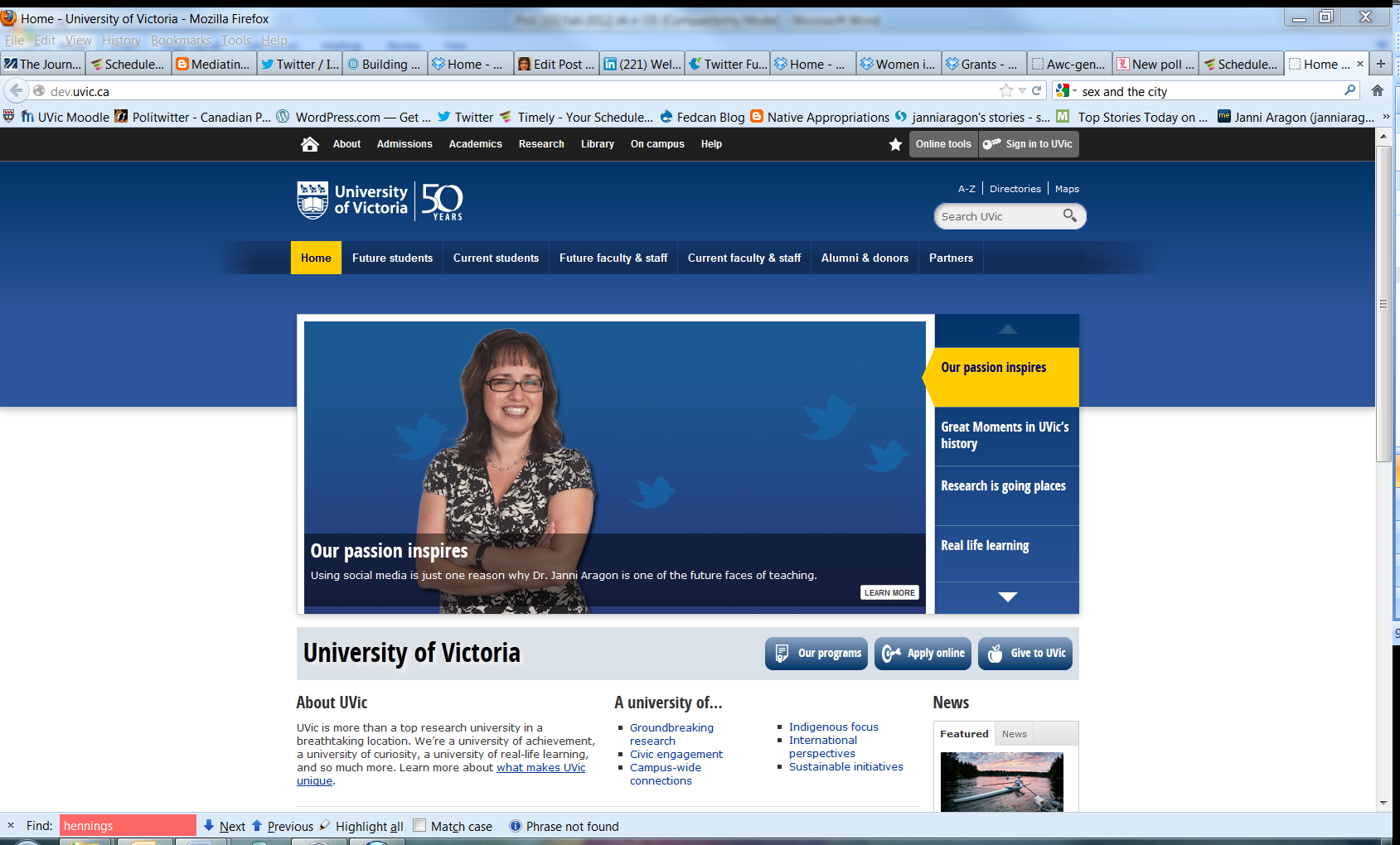
I’ve also made a point of taking some time off during my vacation this year. I ran twice a week with two close friends and kept this date firm in my schedule. I also was not the usual office rat. What this meant was that I did not go into the office every darn day, too. I was in the office 2-3 days per week. What I did differently–I worked at libraries, coffee shops, and outdoors. This meant more distractions and more conversations with people. And, looking at my bank account it also was a little more pricey. But, another way to look at this is that I was able to actually turn myself off from work. Some might say that this sounds unproductive or maybe less productive. Occasionally someone looked over my shoulder and would ask me some questions–even though I had my ear buds and music going. I was polite and engaged in some conversations. These interruptions were usually good. The best part was always the senior citizen who never believed that I was old enough to be a professor. I joked that they could go to the website and see me on the homepage. The screen shot below is of the new site that goes live in a few days, but the photo is the same one that has scrolled on the university website this Summer.

In all seriousness, I also spent as much time as I could outdoors–running helped me stay outdoors. I read outdoors–even if it was for only an hour. I am a Summer person and usually go back to Southern California for the Summer. I didn’t this year, so I tried to get as much Vitamin D as possible in Victoria, BC. This takes effort, as occasionally if you shower, you could miss Summer! No offense to fellow Victorians, but our Summer is sometimes forgetful. It seemed appropriate to try something different, since I was at home for the Summer.

I’ve thought about this again and again and at the end of the Summer I will evaluate what it meant for me and my productivity. To clarify, I am in a teaching tenure-track position and due to my heavy teaching load (8 courses per school year)–it really means that I have to write during the Summer months. Now, I realize that this situation is common for my colleagues who are lucky enough to teach half as much and more than common for my colleagues who don’t really get that much time off, since they have to teach year round to survive. Regardless, this Summer meant a few thing: write and relax! Oh, academe, thank you for these gifts! I know–I have a full-time job and should not complain. But, I’d like to remind that I did my time adjuncting (we call this sessional work in Canada) for more than 10 years.

Now that I’m in the last push before the term resumes, I can honestly say that I got less work done. I didn’t fret about it either. Oh, maybe I did a few times, but then I’d look at my kids and remember that I have to do better, as they observe and learn.  I had more balance in my life during these last two months. I spent lots of quality time with my family and by myself. Sure, I was in the office a day or two per week, but on my terms. The papers were revise (not ready to resubmit) and projects are further along, but I am happy. I won’t put a price on happiness, and all the time I spent with my two daughters. I also took up golf. Can you believe that? It was a great Summer!

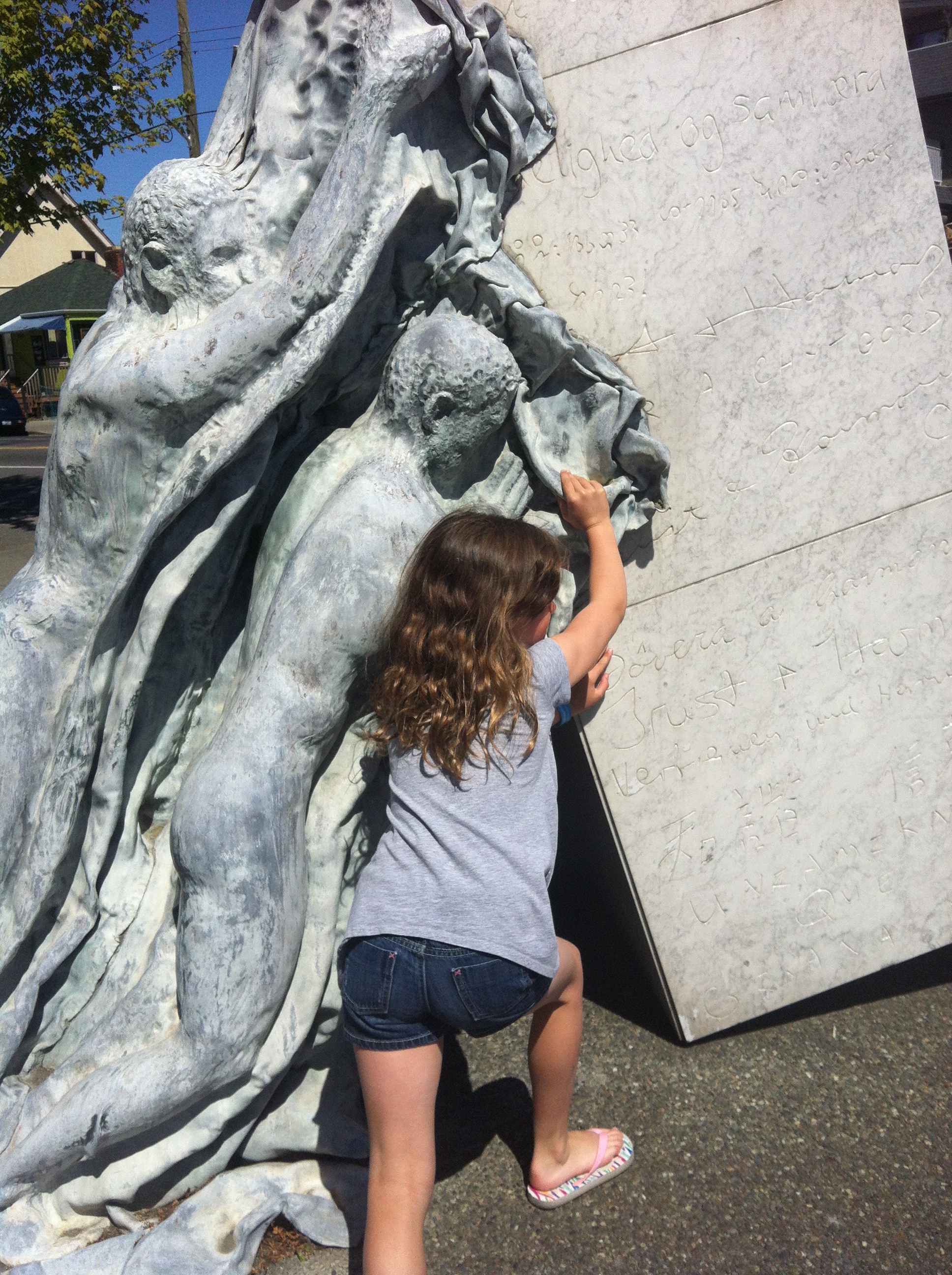
The two photos are shots of my girls. I don’t post photos of them on my blog, so these are not direct face shots. My two loveys.

Looking for Work: There is a Book for That

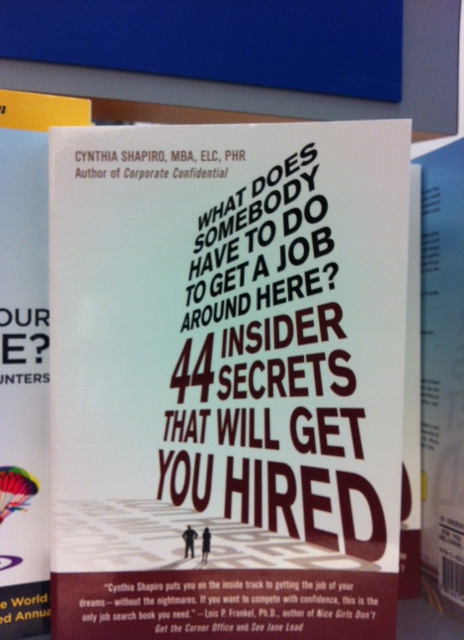
I stumbled upon a shelf or two at the bookstore filled with career advice books for undergrads and other job seekers. I was quite curious and leafed through some. And, I took photos of a few of them. I’m sure that many of these books dispense good advice for job seekers, and given my penchant to read as much as I can I think it’s good to do your homework. But, there is a part of me that also hopes that students go to the Career Center or whatever name it’s called on campus. Here are some screen shots of some of the books that I leafed through the other day.

I didn’t see anything Earth shattering in the above book–but it does have a snazzy title and will definitely cause some to buy it hoping that the right equation is there for them. I’m not dismissing the book or endorsing it. But, it does catch the eye! I wonder how many copies of this book have sold? You, too can use Social Media to help you get a job. Yes, you can, but just being on social media is not enough. Big smile. Mind your digital footprint. It’s always good to occasionally Google yourself and see what is out there. Clean up your presence if you must. There are reputation management companies to assist you with this, too! Hopefully, most won’t need to resort to the consultant to clean up the digital footprint!

I’ve read the Parachute book and back in the day found it helpful. No wonder it’s been repeatedly published. Many people have no clue what they want to do and books like it are useful to get you thinking about the possibilities and the reality of your own skills and interests. And, nothing beats talking with a career educator, mentor, coach or trusted person in your life. Which brings me to my next thought–I really hope that students scouring the shelves in the university bookstore look to their network as a rich resource, too. Start off with your friends, family, profs, employers, and the career center! Set up coffee meetings and ask that contact to introduce you to a person or two so that you can increase your networks.

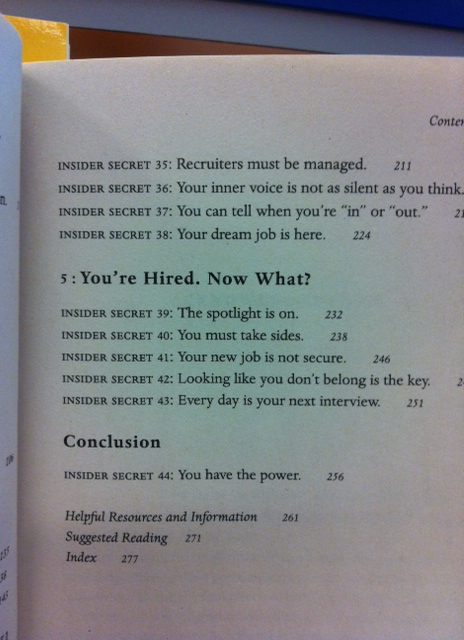
Another screen shot of a book and its secrets!

44 Secrets! Now, some of them make me think of Captain Obvious, but I’ve been working since I was 16. I do think that the book has lots of great hints/information for the job seeker. It looks helpful in a cheeky sort of way. I should have taken more photos of the table of contents, as this book really made me laugh out loud.

I liked the section about: You’re Hired, Now What? This is also an important part of the job seeking process. What to do when you get hired. Some of the best advice that I’ve heard about once you’ve been hired is that you act and dress for the job you want. I’ve had other great advice, too. You know–keep your head down and work hard, avoid landmines, make good allies, and don’t piss off the more senior people. This is a quick list of some of the advice and certainly not exhaustive.

I have lots of former students on the job hunt right now and I wish each and every one of them good luck. If any of these books look promising, stop by a bookstore and leaf through it before you buy it. And, remember that we have a great Career Center on campus! Have one of the career educators review your resume and a sample cover letter. The staff or mentors on campus are here to help and you want to represent yourself in the best way that you can. Good luck!

Are you serious? When Social Media Loudly Triggers

The interesting thing about social media is not just the immediate means of communicating with people locally and internationally, but you also learn more abou behavior. There are moments when things are rather serious in terms of discussion about education, politics, violence, and other hot button sorts of issues. There are also those moments, when things can get light-hearted and interesting. It isn’t all doom and gloom, and erudition. But there are times when you have to shake your head and wonder about the bravery, and cowardice demonstrated on social media platforms.

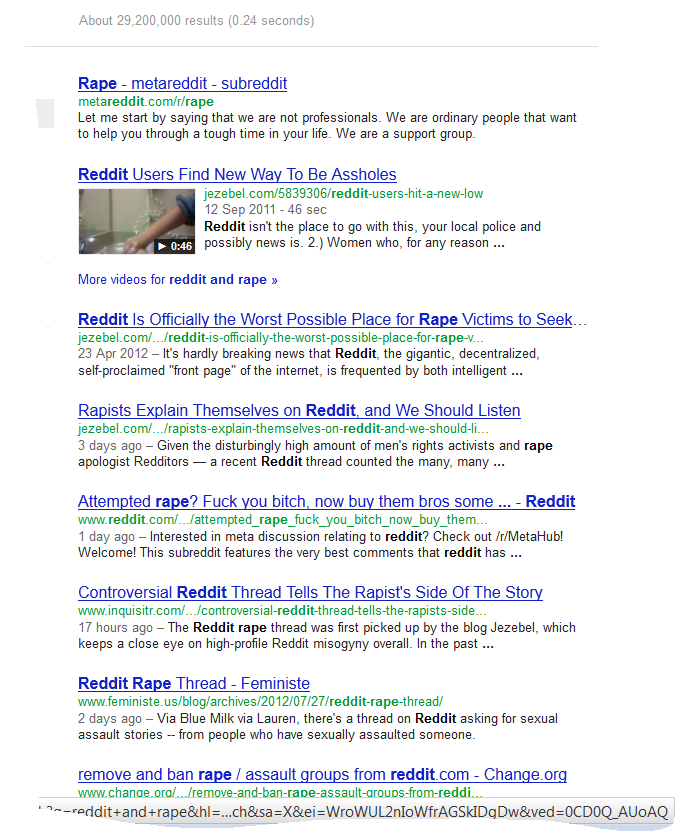
All of the above banter, though, doesn’t begin to explain my sheer frustration and anger over the continual dismissal of rape and rape victims on Reddit by some Reddit users. Here, I might as well place big red target on my chest. But, Googling Reddit and rape is illuminating, as there is a pattern of conversations about rape that second-guess survivors of both sexes. The pages of comments responding to posts is mind-numbing. I’m going to just say it–most of these posts drip with misogyny, and this saddens me. Perhaps I am painfully naive to expect more from people, but this is a serious issue.

The above image is from a screen shot of a Google search Reddit and Rape from July 30, 2012. Notice that there are hits from April related to rape discussions on Reddit.

The thing that really pisses me off about the out of control comments is that some of those commenting seem to not care that the survivors are speaking their truth. And, it’s cowardly to attack the survivors, and second guess the veracity of their statements. Rape statistics are notoriously under-reported. Whatever the exact statistics are for the country, state or province that you reside in–the number is actually higher. Why? There is a still a stigma with rape and violence. And, we know that in many instances the assailant is an acquaintance, which can complicate reporting.

So, Reddit I usually don’t weigh in on my problems with some of the posts, but today I’m calling out all the malcontents and cowards who used their strength behind their monitors, tablets, smart phones to attack survivors. Daniel Tosh (will not link to him) learned that joking about rape caused a reaction–but the fact that he joked about the gang rape of a heckler also speaks volumes. Please don’t shirk that we don’t live in rape culture. We do. We see it rear its ugly head more online, though. Remember this.

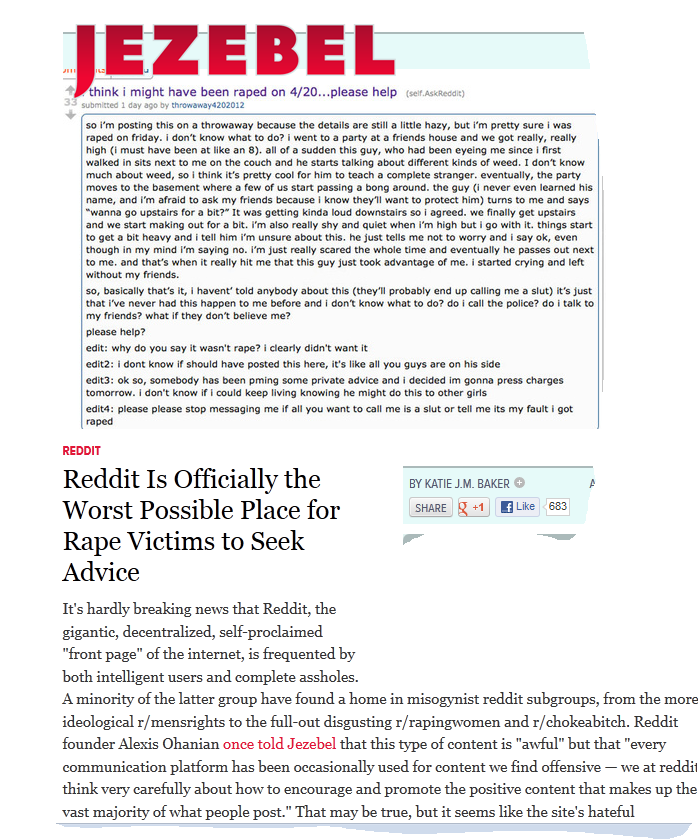
Jezebel has also weighed in again and again about misogyny on Reddit. Here is a screen shot from one post last week. As you might have noticed, I have not connected to the exact Reddit or Jezebel articles. I feel like I should, but then I don’t want to send people to the site for more hits. You are free to Google the articles!

I really hope that the next time there is a discussion about violence on Reddit or other social media platforms people will think before they second-guess the survivor and say even worse. The reality is that all of us knows a survivor of violence–she or he might not have shared it with you, yet.

Reappointment Process for Tenure-Line Faculty

I’ve been thinking lots about this last school year. It was a really amazing one in terms of my academic career. In the Fall I was unanimously endorsed by my colleagues for reappointment. While I hoped and suspected that my reappointment would be smooth to have it behind me was a big relief. I can only imagine the stress involved with the tenure review. I have now loaned my binders to a friend for her own review.

If you’re up for your first review here are some points of advice. I assume and hope that some of my friends will respond and add in their two cents about the review process.

  • Document all that you do. This is easier said than done. Make sure that your CV follows the department or faculty norm.
  •  Speak to a colleague or mentor familiar with the department or faculty process, so that you have an inside view.
  • Review the Faculty Agreement/Contract or similar document to make sure that you are familiar with all the guidelines.
  • Meet with the department Chair to review the process. Get as much input as you can from the Chair.
  • Make sure that someone else (mentor/friend) reviews your dossiers.
  • I had to put together a Teaching Dossier and Service Dossier. But, most will need a fulsome Research Dossier.
  • I made photocopies of thank you cards and emails from students and included them in the latter part of my Service Dossier. I also contacted some current and former students and asked for some short statements of support. They were (thankfully) willing to do so! I included these in a sub-section entitled, “Solicited letters of support.”
  • I had to include all my course syllabi and Course Experience Surveys. I was also able to include the verbal comments from courses of my choice, but if I included comments I had to include all. I opted to include comments from one 1st year, 3rd year, and 4th year seminar. I teach an array of courses and felt that I needed to demonstrate my effectiveness among all my courses. It’s easy to pick the class with the wholly positive reviews, but you might want to think about the comments that best highlight student learning. (Remember that my position is full-time, tenure-track, and teaching focused). Related to teaching–you might have more senior to you colleagues sit in your class and review your teaching. Review the guidelines, as you should have a choice of who reviews you and when. And, you should have a right of response for the review or be granted another opportunity. I was supposed to have one course reviewed twice. I requested two courses and was glad that I did so. Given that my position is teaching focused, I thought that this would best represent my teaching skills.

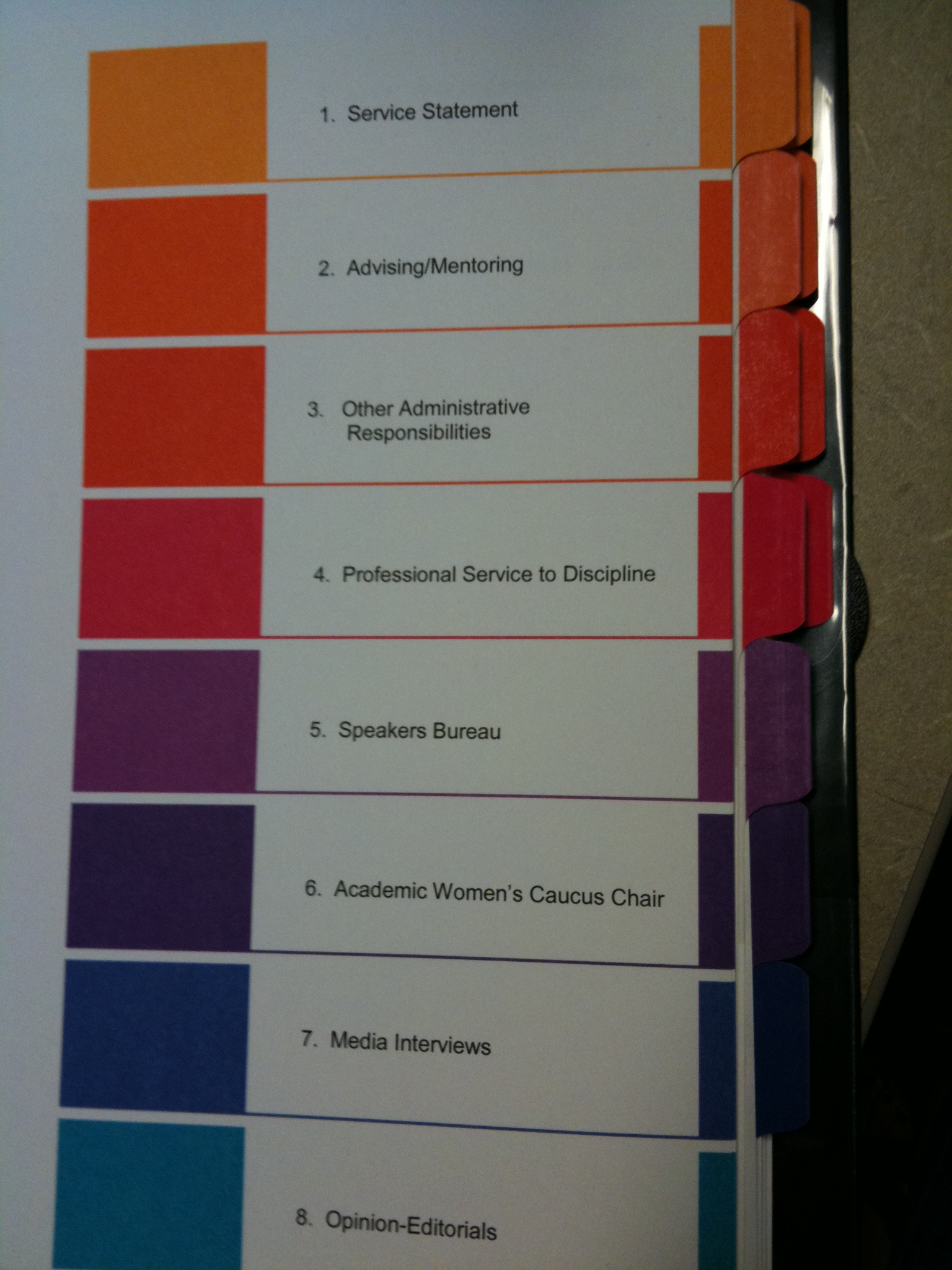
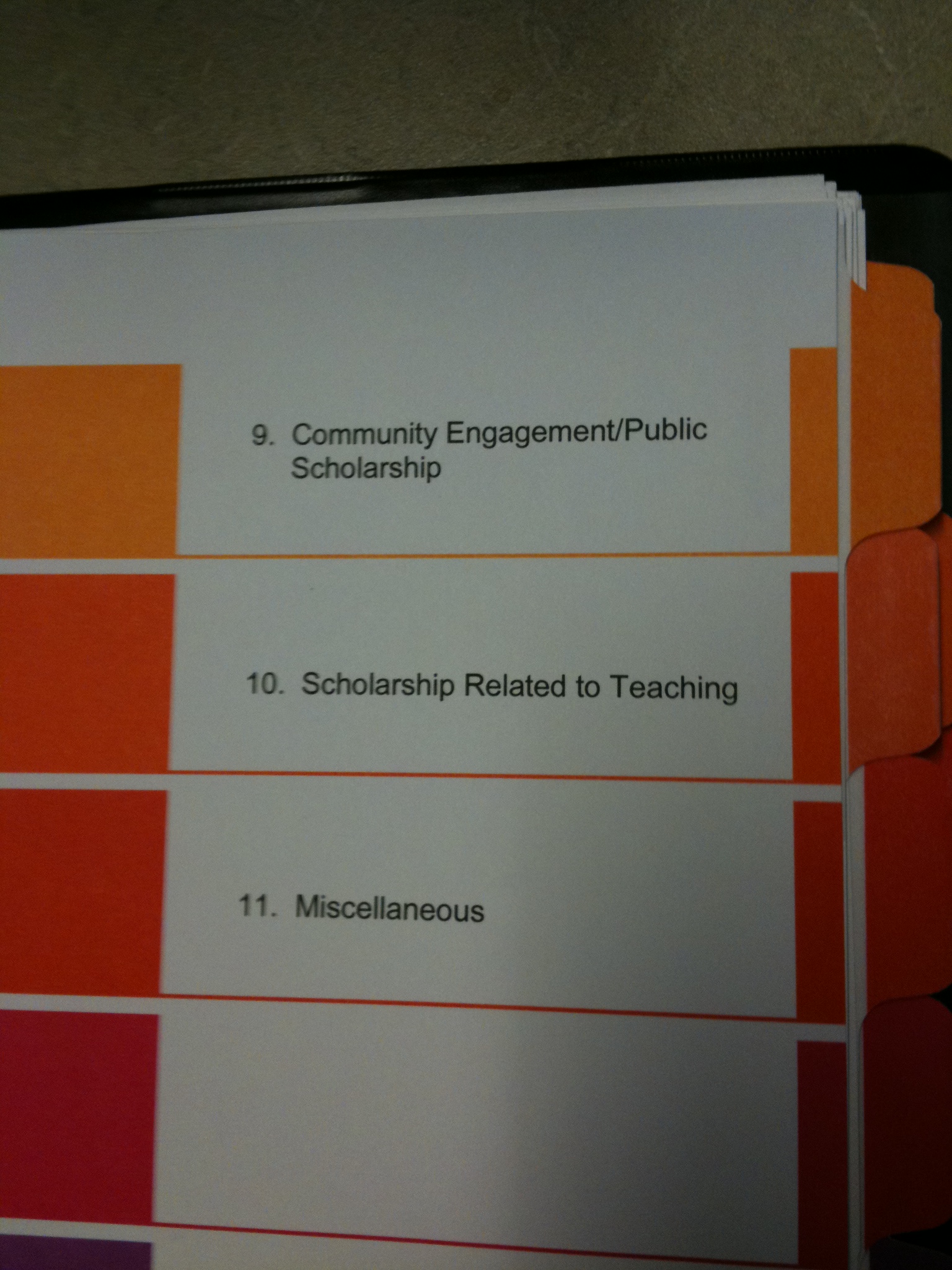
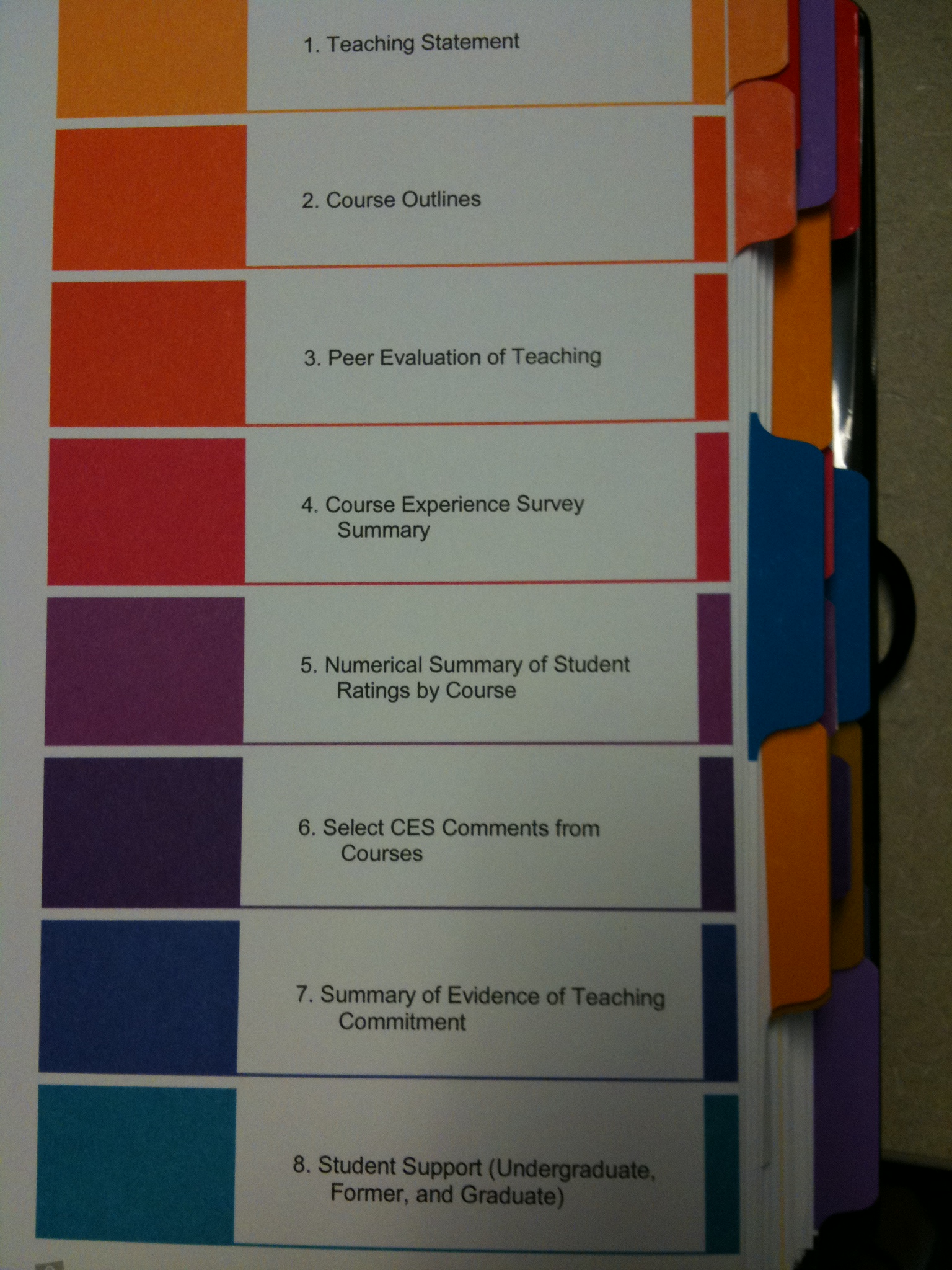
I’ve included screen shots of my two sets of Table of Contents. These fit the norm of the department, so verify what is the norm for your department. Overall, I would suggest that you take 2-4 weeks to put together your dossiers. And, during the review process be nice to yourself. Try to not stress about the review and stay focused (word choice) on each step that you have control over–which is little! Good luck!

11 Months Later: Revisiting the Life List

I decided to revisit this great exercise from one of the BlogHer 2011 pre-sessions.What do I think differently after this last year. I was reappointed unanimously by my colleagues, applied for an Associate Deanship and was shortlisted, didn’t get the job, had surgery, and then had a pretty rough term. The second term caused me to re-evaluate my priorities. Numbers 16-19 are new and I used a / to add to an original thought.

Life List exercise at the afternoon session for “My Blog as a Life Changer” was hard to do. Here is my first stab and again, unedited.  Try out the exercise. It’s fun.

  1. Go to Hawaii with Jason and both girls / See my family more. More quality time with them at home.
  2. See my family of origin more than one time per year. / Yes, see them more.
  3. Publish my books / I’m working on this and progress has been made.
  4. Get tenure / I was re-appointed, so step one is confirmed.
  5. Continue to Mentor / Ongoing
  6. Continue to Teach / Ongoing
  7. Learn French / I’ve heard more and have attempted to speak some. Does that count?
  8. Start a Women and Politics Center on campus / Oh, long term goal.
  9. Take kids to Grand Canyon and DC / Long term
  10. Work on either a Congressional , Senatorial or Presidential campaign / Long term
  11. Learn how to golf / Started learning in May!
  12. Spend time with friends in the US and elsewhere / Did some in March–ongoing want.
  13. Take kids to Europe / Long term goal
  14. Go to Harry Potter Theme Park / Long term goal
  15. Use sabbatical to attend conferences / To write book and to visit teen in university
  16. New to the list–take better care to relax. I am powering off my phone more and trying to not work for an hour or more every night. Balance
  17. Remember to schedule time for me and Jason
  18. Exercise as part of my daily routine
  19. Return to the life list once a year!

Post-Conference Thoughts

Last week I attended a national conference and had a great conference experience. This post will speak to things that we junior to mid-career faculty can do better. And, I’ll also have some advice for the advanced graduate students.

1. Walk around ready to engage in small talk with people you don’t know or want to meet. Try to avoid only chatting with your friends and colleagues. While picking up with them is important, you also can serve as a bridge to someone new at that meeting or new to the discipline.

2. Smile and say hello. It sounds simple, but it doesn’t come naturally for everyone. Ask people about their project. Try to be friendly. When Rita Mae Kelly died some years ago, I was quite upset. I didn’t know her well, but I recalled on numerous occasions she approached me and chatted with me for 5-15 minutes asking me about my grad school experience. She went out of her way to make me feel comfortable at the Political Science Meetings. When a session was held for her, I was in the audience crying. I looked forward to her chats. We never exchanged an email, but I was familiar with her work and I have all those memories of our chats that can’t count up to more than 5.

3. Go to the receptions and some of the dinners. It’s good be seen, but also it’s another opportunity for you to meet new people or strengthen old networks. When I walked into the banquet room with 270+ people I made the immediate decision to not look for friends. Instead I walked up to a half filled table and sat down there. As luck would have it, sitting across from me was someone I “met” via Twitter! I ended up having interesting conversations with a retired colleague and an advanced grad student from a UK program.

4. I was glad that I was active on the Twitter tag for the conference. The first morning I had breakfast with an undergrad from another province. We chatted and walked back to the conference site. I was also able to meet some others in real life, who I had previously known on Twitter. Social Media can be useful for the conference. I took notes at the Women’s’ Caucus Luncheon’s Mentoring Session and posted them immediately on Tumbler.

5. I attended lots of wonderful sessions and made a point to speak to one of the presenters. And, I also thanked the chair or discussant for their helpful comments. I paid attention. The panelists in some cases were senior people across the discipline, and in other instances are future colleagues. One of these conversations once led to a publication opportunity.

6. Take business cards. You might meet new people who want to contact you or vice versa. It’s good to have the cards at the ready. I find that I am apt to pass them out more so to advanced graduate students and let them know that I’m just an email or tweet away!

Overall, the conference was a success and from my comments you can glean: be out there!

Before You Send an Email to Your Professor

I haven’t taken a Netiquette 101 course recently, so I think it’s time to give some tips about sending emails to your instructors.

1. Always assume that you should be more formal.

2. Address the person in the email with a hello or even a “dear.” Avoid, “hey. And, use your full name, as your instructor might have many students who share your first name.

Sample~

Dear Instructor: I am emailing to find out information about your Fall class. Do you suggest any prerequisites for the class? I’d also like to talk with you about a paper topic that I have. Do you have any time to meet this Summer?

Thank you,

Student X

Avoid:

Hey, I’m going to enroll in you class. Should I be worried about your feminist bias?

Smitty

3. Never send an email that is incoherent. This is email and not a text to your best-friend. Type out all words, use punctuation, and proper spelling.

4. Never send an email when you are mad. This goes for all emails. Send yourself the email and then wait a few hours or overnight, and then send the email that you won’t later regret.

5. Be honest. Understand that your instructor might say that this conversation needs to take place face to face. Some conversations really need that human interaction.

6. Do not be offended if the instructor corrects your use of their first name or some policy. Most of us will be kind and say–we have a 24 hour policy with emails after work is handed back and it’s in the syllabus or I expect students to call me Prof. Schmitdkins.

7. Read the syllabus before sending the email. Perhaps the syll answers your question or notes that you should take the time to write a coherent email noting who you are and why you are emailing.

Overall, treat email with the same integrity that you would treat an office hour visit. And, yes, I do get lots of emails that start off with “hey” and have been asked about my feminist bias…