Mentoring and Coaching: Listening

I work with hundreds of students each term and do my best to help as many as I can. One way that I do this is to set up my course assignments in such a way that each one builds on the next and that the student can learn and improve. I also actively mentor and coach many students from the prospective student who I might take on a tour or chat with in my office through the graduate student teaching her or his first class.

As a mentor or coach, I appreciate those moments when I can celebrate a student’s success. And, those teachable moments, when focus is needed to figure out what is next. What is the next step after there is a set back. These moments provide lessons in coping, crying, and then the strategy. What are Plans B, C, and D? There are also times when you just have to keep quiet and listen. I find that in many instances, the person sitting across from me at the coffee table or in my office needs to articulate aloud what they’re thinking and you have to listen attentively and pause. For me, this occasionally means biting my tongue. I want to help, but the help is to just listen and encourage.

A good mentor/coach must listen. When a student gets closer to their last year, term or graduation a panic can set in for them. I remember this feeling before I graduated, as I wondered what graduate school would be like (that is another post). I’ve bumped into many current and soon to be former students and April was all about listening and encouraging them. They are on the precipice of major change and need to work through this. The best gift I can give is to listen. Today I’m thinking about the importance of listening.

misc-b-004.jpg

My Lifetime Listens to Yours. Muriel Ruckeyser

I have a book of quotes that serves as writing prompts and this is prompt two. There is space to write on the page, but I sent the first prompt to a friend in another department. And, have torn out the second prompt. Now, the title of this post comes from part of poem and the lengthy poem says lots. But, what does this excerpt say or how does it speak to you. I am thinking like a Political Scientist or Social Scientist at the moment and how I learn from reading and listening. If I think from a mentor’s point of view, I know that my reading and listening includes what is not said or spoken. People have “tells” for when they lie or feel uncomfortable and these nuances of movement are important to support and understand. What is your tell? I have different tells, but one is to stop and think and take a drink of water. During this short moment, I am thinking of my response–formulating what I want to say next.

We listen with more than our ears. But, do we learn from what we hear and see? I am in the midst of heavy marking and looked forward to this writing prompt and I come back to learning from others. I have also had several hours of office hours and meetings and tried my best to listen intently these past few work days. I firmly believe in life-long learning and this prompt reminds me of the importance of mindfulness. When I think of mindfulness, I always picture Dr. Juliann Allison, as she practices mindfulness in all that she does. This week I am trying to actively practice mindfulness. The Ruckeyser quote was the perfect reminder, as I try to balance out meetings, honors presentations, grading, and planning a conference. And, that is only part of the to do list. I’m breathing in and out and trying to listen.

My Comments to the UVIC Grad Class of 2013

I was an invited speaker to the UVIC Grad Luncheon. It was held on Sunday, March 24th at the Fairmont Empress. The following is my typed speech, but I ad-libbed some and will try to recall some of those comments.

Today I want to speak to you about a few things with my precious 10-15 minutes. Those of you who have classes with me know that I can gladly take more time!

First, thank you to the Grad Committee for inviting me to speak. I saw the flyers for this event and wondered if I should buy a ticket. I conferred with one of my friends, Dr. Annalee Lepp and decided that this was a student event, and had no idea that you invited faculty to speak (not lecture)! I was happily surprised when I was invited. I have so many current and soon to be former students graduating and thought it might be nice to attend. I believe at last year’s convocation I counted more than 100 former students graduating…so thank you for the invite. My family has been joking with me that it’s just me and some…oh, the college President! It’s definitely one of those moments when I can picture Vice President Biden smiling and saying, this is a BFD. I thank you for this humbling and amazing opportunity and hope that my comments are useful. I won’t lecture, I promise.

I want you to think about the words aspire, aspiration, and inspire.

Not too long ago I was in your shoes…I was about to graduate and wondering what was next. But, even before then I was thinking about going to college and my aspirations. Like many of you, I am a first generation college graduate and in the process of my post-secondary education, I earned four degrees. BA in Women’s Studies, minor in Political Science, MA in Liberal Arts and Sciences, then the MA and PhD in Political Science. With each degree my family was bursting with joy, yet also wondered when I was going to stop and finally become a college professor. I did lots of adjunct work (part-time teaching) between different universities in Southern California. I loved what I was doing and knew that I was in the right career on that fateful day in January 1996, when I lead my first section or as they call them at UVIC– tutorial. I’m lucky. I knew what I wanted to do, but alas my road to full-time work had some bumps in the road—few jobs in places that I was willing to work. Yes, I am a weather snob. I don’t do four seasons. My people thrive in warmer weather!

But, after many years of work, I took a big chance and immigrated to Canada in May 2004 with my family. My partner and I arrived in this beautiful city without jobs. Simply put, I took a chance on Victoria, and on Canada. I was glad for getting short-listed for some government jobs a few times, but when Dr. Colin Bennett called me and asked if I would be willing to teach Poli 335: Gender and Politics, I said: yes. I never looked back. I’m glad that I worked part-time for Political Science and Women’s Studies. I got the lay of the land. I networked. I went to talks, meetings, conferences, and taught lots of courses. I took a chance on UVIC and UVIC took a chance on me. (Here, I referred to Abba and think I sang, “Take A Chance on Me.”)

I want you to think about taking chances. I want you to think about what you aspire to do. Where do you see yourself in 1 year or in 5? How will you use your UVIC experiences to your advantage? How will your education help you get to your next goal? In the 5.1 years that you were at UVIC (that is the average time for most of our undergraduates to complete their degrees)–what have you done? You’ve attended courses, tutorials, hopefully office hours, clubs, events, worked, and occasionally let some steam off. But, how are you going to make use of this wonderful privilege–a post-secondary education? That is really up to you. Some of you will continue to graduate school and work, but most of you will continue working or look for what’s next–the career job. For most of you, that first year after graduating is the hardest. I hear from your friends who graduated–they say that they miss UVIC, they miss the freedom that they had. Believe it or not–your college years are some of your best years. You’ve made so many connections–you’ve learned so much. So, what is next?

I want you to think about people who inspire you. What qualities do they have that you admire? How can you learn from them? Who do you inspire? Many of you have been leaders in different respects on campus or off campus. There are certainly different ways of leading. Others of you are sitting perhaps thinking-who me? I’ve inspired someone. Yes, you have. It could be a classmate, a sibling, your parents, a coworker or one of your professors, who you have inspired. But, you’re not done. You’re just starting. You have more to do—to aspire to and to inspire.

Let me get back to people who have inspired you. I want you to get uncomfortable. I want you to make coffee appointments with some of these people who inspire you. You might send them a friend request on Linked In and then begin to interact with them there or maybe on Twitter. Get to know people in real life, but also within social media–these tools can be incredibly helpful for you. For the people that you can meet with face to face–ask if they have free time to meet with you. You’d be surprised at the number of people who are willing to meet with someone who is interested in learning more about their company—even when they aren’t currently hiring. They might say no—too busy to meet or they might be willing to meet with you. Ask them if they can introduce you to another person. You need to network. You will hear some nos, or people who might not respond to your email or call. Do not let that dissuade you.

You need to see our Career advisors on campus and have a set of eyes review your resume and get comfortable with promoting yourself. Your education is one part of who you are, but now you need to feel more comfortable networking and promoting yourself. You need to think about your aspirations. You cannot rest on your laurels–a BA. You have to go the next step. And network. Look for work. Meet people.

What can you do? Get out there. Join organizations or professional groups in your field of interest. Talk with your mentors. You do have some–think of your networks that you currently have, your former professors, teachers, family network, career services on campus. And, think about what you want to do next. Talk to people about what you think you want to do and this includes your peers. I am a strong believer in peer mentoring. Find a mentor, coach or sponsor–someone you trust who you can chat with occasionally or regularly. You need to articulate, plan, dream, and make things happen, but having someone to chat with is incredibly useful. You have this degree (just about) and what you make of it is up to you.

My hope is that you have some idea of what is next for you. Pursue it. And, remember that you can do so many things with that BA. What have I done? I worked retail, then retail banking from regular teller, business teller, customer service rep w/ loan work, educational foundation work (researcher), then did consulting work for non-profits and now I’m half way through 15 years of teaching and mentoring. I also am quite active in my discipline and I started that activity in 1996, when I was a PhD student. My point here is that you’re going to do lots of things with your career. Be patient, be strategic, and make mistakes. When you look back, they might not be mistakes, but what I refer to as teachable or learning moments.

Your BA demonstrates that you were able to start and complete something. It demonstrates to your family, peers, and potential employers that you have post-secondary education. But, you need to then demonstrate your skills. What are your skills? Think about this. This is where Career Services and Mentor/Coach are helpful. I cannot count the number of conversations with students who didn’t realize how important it is to note their skills, languages, computer software familiarity or social media literacy on their resumes. Ask for help. Think about what you’re good at and what you want to do. Talk to your peer network about your skills and what you want to do. I know this is scary. I’ve been there.

This next year will require you to be more introspective. I want you to be introspective, too. What single word describes you? I think about this lots and depending on the month or time of year I might have a different word. Today: it’s mentor. Mentor describes me. The mentor in me wants to encourage you to read some more. Yes, don’t groan. I want you to peruse What Color is Your Parachute. I want you (women and men alike) to read Sheryl Sandberg’s Lean In or join the website portal for the book. See what works for you, but remember that even if your formal education is complete–ultimately you will engage in life-long learning.

When I think about where I am today, I realize that years of preparation went into being a standout candidate for my job. I put a few years of prep into making sure that the hiring committee could not think about NOT interviewing me. Sure, I had experienced rejection letters, but this didn’t stop me from trying again, and again. What I’m saying that is success is not immediate. You need to try, you need to aspire. And, you need to get used to the fact that at times you won’t get the interview or be short-listed, but you take a deep breath and try again. Do not give up. I aspired to be the first college graduate from my family and I was. I am the first Dr. Aragon and hopefully not the last. Your BA is the first of many accomplishments for you. Try different things! Make your life list and write/type or text what you want to do and revisit this list periodically. Be flexible–be smart. And, update this life list—chat with your trusted network about your aspirations.

I want you to be introspective and remember to aspire for more. You are really at such a propitious moment of your life. I know that I speak for many– I am so proud of you. We are proud of you. You are on your way to becoming UVIC alums. And, looking out at your faces this afternoon I have a sense of inspiration. You inspire me—you make what I do rewarding. Congratulations UVIC Class of 2013!

Writing A Love Letter To Someone You Dislike: What?

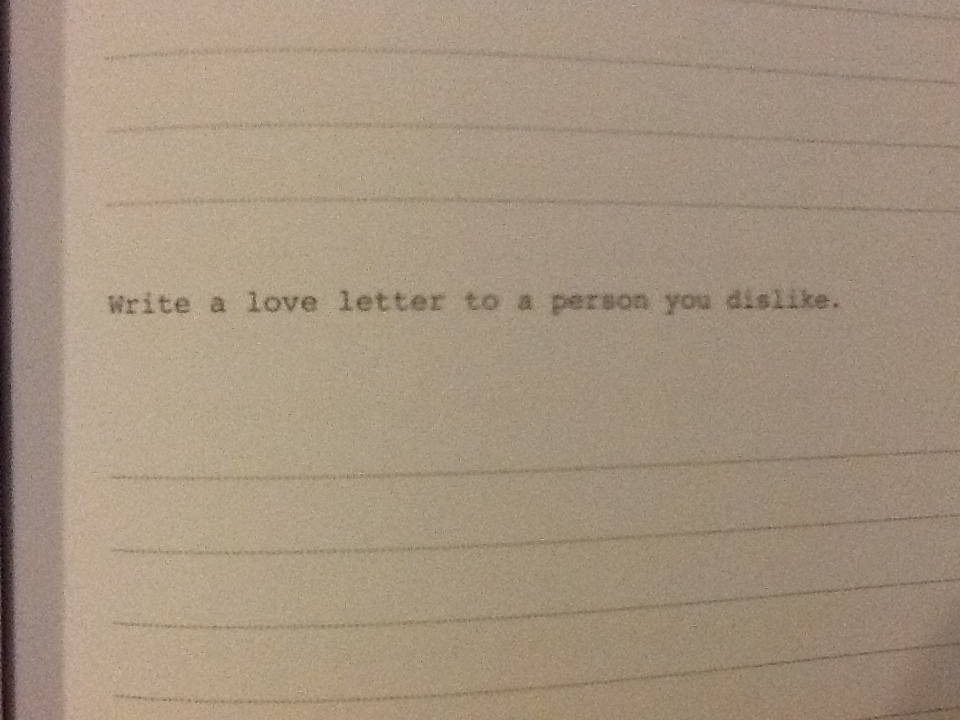
My spawn used some of her birthday money at the Assembly of Text on Sunday. She bought a journal, 642 Things to Write About by Raincoast. My spawn was smitten with it and was quite happy to make this purchase. I leafed through the journal and found some hilarious prompts. The journal is clearly for an adult given that there are a few prompts that speak to alcohol or more life experience, but overall the journal offers some great exercises in creative writing. I’m including a screen shot from one prompt about writing a love letter to a person you don’t like. Now, this post is not a love letter to such person or persons. But, it did make me think about what causes us to like or dislike another person. I am providing a list of traits that I immediately thought of and it is not exhaustive.

Things I like in a person (first six I thought of):

Honesty

Smile

Generosity

Intelligence

Witt

Compassion

Five things that turn me off (first six I thought of):

Dishonesty

Laziness

Arrogance

Disrespectful

Trolls

Patronizing

If I think of these traits and people who I have easily engaged with, I know that they had some or all of the six traits that I noted. We might have met at work, in the community, at a conference or at a kid-related event. And, as far as the turn offs–same places. I will add that I meet so many people each year given my work and family life. I know for a fact that I don’t click well with people who dislike strong women. There, I said it. And, yes, I have found this to be true from about high school onward.

And for the dear, sweet souls who feel that they have to stalk me online, this is not a love letter to any specific person.  That’s right–it’s not about you. The writing prompt made me think about traits. What traits do you like/dislike? Think about it–write them down and get blogging.

love letter

It is the time of the year when students are thinking about what they are going to do next. Some are in their last term or last year of school and wondering if grad school is for them. It is important to have some plans. Yes, I said plans. Plan A, B, C, and maybe even a plan D. Some students want to get organized several months before they have to apply. The grad school process is a frightening one, as it makes most students do something that they are completely unfamiliar with–promoting themselves.

I find that it does not matter if the student is a strong one or one with lots of potential most still have a hard time putting together their grad school dossier. I know that I did, but I was extremely lucky to have some wonderful mentors, and was involved with a peer mentoring group. This post is going to make some suggestions that assume that you are an undergraduate thinking about applying to grad school in the Fall.

Here, we are in the Spring (almost). The firs thing that I tell my students is that the grad school application process is like having another course. You need to research the schools and programs. You need to research potential mentors and their areas of expertise. You really should not just pick a program and land there without having done some research about the courses and the faculty.

Where do you want to live? Seriously. This was a concern for me. I knew that I did not want to leave the West Coast when I was looking at Political Science programs.

What do you want to study? Which courses did you find most interesting during your undergrad career? Which courses were the most fulfilling? These might not be the courses that you did the best in, but rather that rocked your world.

Where do you picture yourself in 1 year? Three years? Five years? There is not one answer for each of these questions. There should be multiple answers and that is perfectly fine.

What do you have to do to get there? To answer any of the above questions and this question, lean on your friends and your mentors. Now, you might not think that you have any mentors. It is not like you sign an agreement with your mentor and there is an understood relationship. No, I have had students send me cards after they graduated and found out that they referred to me as their mentor. There are different levels of mentoring and for some students being at the front of the classroom is enough. And, for other students there is more engaged relationship between the student and the faculty member. My point is that you probably do have a mentor or two! Seek them out and ask them for advice.

You’ve picked a program. Now, make sure that there is 2-3 faculty to work with there. Now, this might seem ridiculous at a smaller program, so maybe you might need to look for 1-2 people to work with at the program. One of the best ways to find out if you will be successful is to chat with current grad students. Find out what the lay of the land is. Also, find out what most graduates of the program do once they finish their theses. What do most of the grads end up doing? Policy work? Continue on with PhD programs?

Now, when you find out what you think you want to do, you need to get your application in order. Who are you going to get letters of support from for your dossier? Who will review your statement of intent? As they say, get your ducks in a row. Once you get your dossier together, you will need someone to review it all. This is where your friends and your mentors are important.

This is part one of a few posts. Good luck!

Grading and Offering Helpful Advice

I have large classes and this means lots of grading for me and my team of Teaching Assistants. I do not have Teaching Assistants for all of my courses, though. What I will say is that grading offers an interesting moment. That moment when you can assess if a student has: followed directions, read the material, organized her/his ideas well, and attempted to do the assignment in a timely fashion. Grading, though, is not about the student. It is about the work. And, this is where things get complicated.

Most of us take issue with people evaluating our work. It’s tough. The evaluation can make you squirm or sit taller in your chair. I’m cognizant of this, when I mark papers. There are moments, when I want to say: you totally kicked ass with this assignment. But, alas, that is not appropriate or even helpful. I might offer something like, it’s obvious that you have spent time thinking about the materials and have successfully articulated your analysis. Then, there are those moments, when you just know that a student did not have enough time to complete the assignment or did not manage his/her time well and you weigh what you need to say. I take no pleasure in offering critical commentary about student work. In most instances, I will offer that the assignment or paper did not meet the requirements. I try to avoid using the word: you. You is personal. The student reads it in a different way.

I have witnessed many students turn the to the last page for the grade. I was the type of student who read page by page the comments and if the grade was on the first or last page it did not matter. I wanted to get the feedback. I tweeted the other day that I was marking and was attempting to balance three things.

1. Firm    2. Fair    3. Compassion

These three things are important to me. The mark can influence a student’s assessment of their work, but also of the class, and the department. Maybe I’m thinking too much about this. But, I really do think that the feedback is important. Even if the assignment is just terrible–feedback is important. When the assignment is a failure, I do ask the student to come see me. I want to know what happened and if I can help. No student wants to earn the F. Usually there are extenuating circumstances and this is when I can offer guidance and compassion. Grading is not easy. I provide my first year students with a paper checklist, so that they can remind themselves of each component. This is a useful exercise for them, but even so it will not translate into 100% of the students using it or using the checklist properly. I continue to mark and think about the marking or grading process.

For my Teaching Assistants, the grading process is similar. I know from talking to them that some take the grading personally. They only want the students to succeed and feel a sense of frustration, when the students do not do well. They say, “I reminded them of this in tutorial. Why aren’t they following directions.” And, then, they are very proud when a student does well. Grading can seem so subjective at times, but ultimately it is not. We have our grading rubric and the grade categorization and explanation from the university. We know what we are looking for and we hope to find as many strong assignments as possible. In the interim, we plug away at the grading and offering useful commentary to our students.

Janni's files 388

Boundaries: Hard for This Workaholic

I’m always very honest in my blog posts and I have to admit that I don’t like seeing email in my queue. I try to get to the emails as quickly as possible. And, I don’t like seeing several hundred emails on Monday mornings. This means that I do respond to work emails during the weekend. Now, I don’t respond to all of them, as I will flag some noting that they are higher priority come Monday and then others I will respond to in a timely (immediately through the next 24 hours) manner. I have now taken to responding to some student emails and stating that I will get to their email (answer their query) on Monday and also state, “It’s the weekend, I hope that you enjoy it.”

I know that I’ll hear from people who swear that they don’t respond to students’ emails over the weekend or that no one at their campus does. Cue Bill Cosby acting like Noah and saying, “Riiiight” at the 58 second mark or 1.17.  It’s not that I don’t believe these people–it’s just that my reality is that if I don’t respond in about 24 hours, I hear repeatedly from the student. I rather say that I got the email and will attend to it. I also will make a point of responding to all emails when an assignment is due the next Monday. It’s the nature of my job and the students who I work with in the department. I also am responsible for this access, I know. Some will tweet me or Facebook message me. I am a heavy user of social media and this is one cost–access to me and my time. I am not going to complain, but I will try to have some work life balance.

I am trying to set a good example for my kids, co-workers, and the Teaching Assistants who report to me. I explain to my team of Teaching Assistants that they also do not have to respond to emails from students over the weekend and not from me, too. I ask them to act as if the email (if one gets sent during the weekend) arrived Monday morning and respond thereafter. I want them to see me encourage boundaries. This takes hard work, but I have to say that during the last year it’s been worth it. I’m protecting my schedule more and I feel happier. I still love my job, and look forward to walking into the classroom, office hours, and other teaching related events. I’m loathe to say that I love meetings, as that’s a lie. I like some meetings and do not look forward to others! How do you deal with your email queue?

Reminder: Breathe

Mid-terms are about to begin and I’ve been struck with a few things. I can announce things in class, send messages via our on-line learning platform, hold office hours, and attempt to hold G+ Hangout office hours. But, there are those moments when students just do not pay attention. It’s not yet important, as the assignment or exam is weeks away. Then, snap, suddenly everyone needs me. I had to remind myself of a few things in the last week.

1. Keep the hockey schedule in mind. Some of my students are avid hockey fans and my office hours cannot conflict with the game.

2. Remember that instructors need to remind students. They are taking three to five other courses and have multiple deadlines and are juggling so much. The majority will need the reminder. Move on.

3. Be more patient around this time of the term. Students will appreciate the patience and the last thing they want is for you to chastise them. Really–do I need to put any emotional energy in chastising students? No. I have other places to expend my energy.

4. Related to the previous point, I need to also be more available the week of the mid-term. I am also juggling multiple projects, but my first job is teaching and I know that this week my students need me.

This short  post really serves as a reminder to me–patience, compassion, and support. These are the three things that I must have this week. Wishing all students good luck on their mid-terms. And, sending an extra deep cleansing breath to other instructors, mentors, and ancillary staff who work with students. Ommmm!

These post its work for this week!

These post its work for this week!

Honesty Redux

This post just ran on UVenus and Inside Higher Education and I want to share it here on my personal blog. Saying that honesty is important almost feels like stating the obvious, but in practice it can be quite complicated.

A few weeks back I was chatting with a friend and she asked what my New Year’s Resolution was. I paused and thought about how I do not really believe in these sorts of things, but then realized that my resolutions are formed in late August or September, prior to a new school term starting. Last year my resolution was to continue to make mentoring my mandate. This school year my resolution was for honesty. Now, this honesty works both ways. I mean to continue to offer my honest, helpful comments to my students, mentees, and graduate students who I supervise or coach as my Teaching Assistants. But, it also means that I expect honesty.

What has this meant this last term? I have not responded to emails that crossed the line. I have set up face to face meetings with colleagues or students who sent the email to discuss the matter at hand. Life is too short to not communicate clearly and if I have the opportunity, I would rather clarify an issue face to face. This policy has worked like a charm. I have felt clarity with an honest conversation where all parties really come from a place of “I” and not “you”. I think I have to thank the Human Rights office and the two committees that I have sat on for the last year and a half for the foresight and tools to make me a better communicator and also expect the same from my students and colleagues.

In terms of my blogging and social media visibility, this has also meant that trolls exert no power or emotional energy for me. I am not saying that they took up that much space before, but now they take up zero space. I easily ignore them and move on, and this is quite freeing. I have used this place of honesty as a way to forge productive energies. I do not think that trolls are practicing honesty. No, the keyboard warrior is actually a coward. I have previously heard that I am blunt or brutally honest, and I think that these assessments have been fair. However, I do think that this resolution of honesty is different for me and my interactions with students.

I no longer circle around comments and waste time trying to not offend and choose my words ever so carefully. There are moments when you really cannot find something positive to say about a student’s work. This does not mean that I lack compassion or do not try to help my students perform well.  I offer constructive, honest comments and if this means that I state, “This is not your best work. This is sloppy work. You did not review my syllabus closely.” I will say it. I have said it. The reactions from students have varied and I know that one student thanked me profusely for my honesty. His next two assignments were stronger, and during the holidays he sent a nice thank you note. I was clear that he had not submitted his best work and that I expected more from him. I have told my mentee that I expect her to participate more in class—that she does not get a free pass—no favoritism. Guess what—she started talking more. I raised the bar, and many students responded with better work.

Sure, there was a student or two who noted something to the effect of, “I’ve never had a professor be so forward or speak to me this way.” My response was that I was sorry that no one had taken the time to be honest. I do not live my life by the students’ comments on sites about professors—see I won’t give them a shout out. I prefer to see the student do well, try harder, and graduate. I am not in the department to make friends. I am mentoring students and this includes honesty.  The year is halfway over and I will continue with my resolution of honesty. I really believe that the vast majority of my students appreciate it. Some of them might realize it a year or so later–and their cards or emails are a testament to the importance of honesty.

Word Camp Victoria 2013

I attended my third Word Camp in Victoria AKA #yyj this past weekend. It was another great event, where I learned lots about Word Press and the various functions of the platform. More importantly though, I got to see some of my students in action, as we sat on a panel together about blogging. I’m so impressed with these students and others and just want to send positive energy out there to: Renae Sinclair, Adrienne Sanders, and Alannah James. I’ve placed them in the order of our presentations. Way to go!

If you haven’t had the opportunity to attend a Word Camp, I would suggest that you do or look for a Word Press Meet up in your region. It’s good to bounce ideas off of others and to also hear about the plug ins that are tested or the favorites of the more advanced users. I’m really lucky to live in a tech saturated city–another name for Victoria is Tectoria. And, this May Social Media Camp will take place. Check it out!