
Fri Fun Facts: Gay Marriage/Same Sex Marriage

Today’s Fri Fun Facts is dedicated to thinking about the continued fight for human rights in the US. Yes, I’m weighing in on Gay Marriage or Same Sex Marriage. I have to share that this issue is such a no brainer here in Victoria, BC Canada. Same Sex Marriage is legal in Canada since the Civil Marriage Act was passed in 2005. Wait, yes, just 7 years ago. Canada joins nine other countries:

Argentina, Belgium, Iceland, Netherlands, Norway, Portugal, South Africa, Spain and Sweden. There are other countries that allow same-sex marriages to be performed and then another group of countries that recognize same-sex marriages, but do not allow them to be performed. Let’s think about what is so problematic to 30 of the states in the US, which have taken special care to ban same-sex marriages.

1. “50% percent of first marriages, 67% of second and 74% of third marriages end in divorce, according to Jennifer Baker of the Forest Institute of Professional Psychology in Springfield, Missouri.” via DivorceRate.org. This does not say much to the whole “sanctity of marriage” line of argument. Looking for divorce statistic is interesting, as the data varies depending on the source that you examine and the government records them according to the number of divorces within the population: Divorce rate: 3.4 per 1,000 population (44 reporting States and D.C.) via http://www.cdc.gov/nchs/fastats/divorce.htm 2009 data.

2. Many supporters of the ban refer to the Bible. The most commonly quoted saying that I’ve heard, “The Bible refers to Adam and Eve and not Adam and Steve.” Fair enough, but I we don’t have everything in the Bible literally. And, not everyone subscribes to the teachings in the Bible. Using the Bible as the guide to politics might offer a short-sighted means of thought and practice.

3. We need to think about how the 14th Amendment offers equality under the law. The bans do anything but this and actually discriminate against unmarried partnerships (heterosexual) and against the LGBTQ community. Why are we allowing hate legislation? This is a human rights issue or a civil rights issue at the very least.

4. Bans against Same Sex Marriage are draconian at best. What they really demonstrate is that bigotry is alive and well and seeping into the law. We need to re-think the motivation for these sorts of laws and respond.

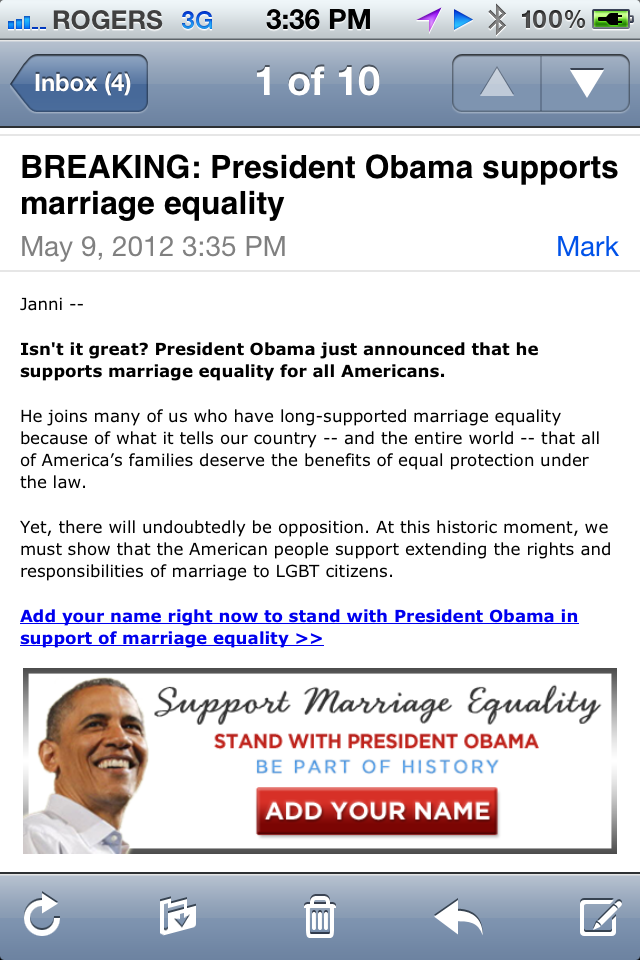
I support same sex marriage. And, unfortunately the Congressional Representative who does not represent me is in support of banning same sex marriage. Thankfully President Obama noted on May 9th that he is now in support of same sex marriage. With today’s Fri Fun Facts I am sending supportive energy to my sisters and brothers who demand that their families are protected by the states they live in or visit.

This was one of two emails that I received within hours of Obama’s interview.
Before a New Term Starts

I realize that many of my colleagues in the United States are still teaching. It’s the Spring term for them and they are slogging through those last few weeks or months in some cases. But for me, it’s the last harried week before my Summer term begins. So, it’s that time of year when many of my college students are thinking about the next year’s classes. This is a slow teaching time for most regular faculty (note this doesn’t include the sessional instructors, who usually have to teach full-time in order to stay afloat). One of the things that we forget though, is that this time of year is very busy for advisors and others who help students figure out courses and other important matter that is important to student success.

This quick note is a reminder for patience. In the last week, I’ve had many emails about books and course outlines/syllabi. Students want to know–where are the books? Bookstore. Where is the course outline. In my head, it’s in draft stage and gets distributed on the first day of class and possibly early on Moodle.

Patience for the frantic student who needs a little reassurance about classes. For instance, I am finding that I am fielding more emails where a student really wants advice. “Which classes should I take?” A few have actually said, I want to know your recommendations. This is a big responsibility for me. Typically the student who asks, has already taken a course with me. So, I need to think about his/her interests and weigh my knowledge of the department’s courses. At first I would suggest all our courses, but now I am more careful. This is not based on content, but rather thinking more strategically about the student and her/his interests and possible grad school interests. Students asking for more help with planning their academic career is more common today in my experience.

One common response from students is that they have heard that a colleague is a GPA buster. I always smile at this and explain that if the student wants to focus on Area A, for instance, in grad school that she absolutely needs to have a class with said colleague. The majority of the students come back to my office the next term and thank me for my suggestion. I’m sure that there are some who have opted to not come and complain to me, too! I would have never asked an instructor for advice about which course or professor to take, but from talking to other undergraduate advisors these sort of queries are more apt to take place today. I think that when I am queried–it is acceptable for me to make course suggestions to students. I am one of three undergraduate advisors in the department.

The other thing that happens lots is students want to check in and see where they stand with their programs. I get more queries that essentially are asking, “Am I on the right track” during these Summer term months. Many students have caught their breath after a busy year and are now assessing what they’ve done. I look forward to these conversations, as most students are pleasantly surprised with the progress made. I certainly do wish that more students would check in annually with either Academic Advising or the department advising team to verify where they are in the undergraduate program.

Fri Fun Facts: Performance Reviews

Today’s Fri Fun Facts is about my new use of writing Performance Reviews for the Teaching Assistants. After looking through the Canadian Union of Public Employee’s Agreement between my employer and the local group, I decided that it would behoove me to offer the Teaching Assistants a more formal review.  Today’s Fri Fun Facts will speak to how I will do this every term on.

Performance Review

My intention was to provide each Teaching Assistant with an honest, fair assessment of their work this term hoping that they could use the review in their teaching dossiers or as part of their resume paperwork. Writing the reviews took more time than I thought it would, as I really wanted to convey a personal review for each Teaching Assistant. How did I do this?

When I meet with each Teaching Assistant to review their graded work, I would email myself notes about the meeting and these summaries were useful. When students would see me during office hours and offer unsolicited comments about their Teaching Assistant, I would email myself a copy of the comments for my records. These little things were important to providing me a memory of the Teaching Assistant’s performance.

My suggestions:

1. Keep notes or records about the Teaching Assistant’s performance. If there is every tricky situations, these notes are really useful.

2. Check in with the Teaching Assistants to make sure that they are doing well and feel that they are getting enough support from you.

3. Provide them guidelines about your expectations. You might email or verbalize this. I actually provide a dossier: a one to two page expectations letter, sample graded work, exams, grading guidelines for the university, and a copy of the syllabus.

4. Be available. You need to set up times to be available for their questions or be willing to guide and coach the Teaching Assistants as needed. Some will need more of your time and others hit the ground running.

5. With the review, think about the Teaching Assistant’s grading, effort, interaction with the team, students, and comment on this. Note any areas for improvement and be willing to note if you think that you could have supported the Teaching Assistant more.

6. Be honest. The review should be helpful, but it does not need to only be positive. Constructive comments are sometimes needed, but offer them in a helpful manner.

Overall, the Performance Review should be helpful for you, the Teaching Assistant, and any future employer who sees the document. Remember that the arrangement is really an apprenticeship and you need to mentor or coach the graduate student, as this is not “free” grading for you. The cost is really supervising and helping the Teaching Assistant perform the duties. I have to remind myself of this occasionally! How do you evaluate your graduate students?

Hunger Games and Academia

The Hunger Games reminds me of academic work. Sure, we don’t kill one another for entertainment. And, academic life isn’t about life or death, but the stakes are high and at times people are quite petty. The Tributes, though, are the pre-tenure faculty who have to participate in the department’s arena. Some Tributes face an easier match than others, but ultimately the senior faculty and others watch and wait to see who wins. The odds are ever in your favor to: teach, write, and pay service to the department and university. But, most departments really expect you to write, keep your head down, and know your place.

Some of the departments are more favored and might even have a better market “value” and people from those departments (districts) are more privileged and have nicer offices, labs, and equipment. Some of the departments struggle for every little thing that they get and others are swimming in what looks like opulence. The favored districts also find that their students might have more opportunity and job prospects once they graduate. These students are thought of as lucky–they are most likely to have a better idea about what they will do after they graduate.

Meanwhile the Gamekeepers are really the book and journal publishers, who keep the Tributes on their toes trying to make sure that they publish enough to earn tenure. The Tributes do a cost-benefit analysis thinking about which journals are the highly ranked ones and have the fastest review and publication turn-around in order to meet the department requirements. There also is the possibility of sponsors, if you are lucky. You get the sponsors via courting the senior faculty members in the department. They might give you connections, publishing opportunities, and vote for you when your file is under review.

Admittedly I have taken some cheeky licenses here, but I am sure that some read this blog post and agreed. If not, hopefully readers merely enjoyed the post.

Patience Works Both Ways

There are easy terms and there are terms that make you earn a every penny. About three years ago I was in a car accident over the Summer and when the Fall term started I was quite aware that this would not be a normal term. I tried to work my schedule so that I could make a good impression on the job and meet the needs of my students. I was partially successful. And, this post offers me an opportunity to reflect on what I could have done better.

In most situations in life we do not get a change for a “do-over,” but it’s good to occasionally have the chance to think about the what if situation. Thinking about that Fall term I wish I had moved my afternoon class to earlier in the day, so that I would have had full use of my mind and body. That term was one of the toughest ever, as by about 4pm I was absolutely exhausted and could barely walk across campus. It was a rough. I was mildly embarrassed, but did announce to the class that I had a car accident and that I would not be my usual self. I stood by the podium must of the term and didn’t walk around and was not my usual peppy self. I found that most students were quite patient with me and I thank this for them. The morning class got the regular me, but the afternoon got the extremely tired, stiff version.

I have found that some students, though, have no patience for anything short of perfection from their instructor. And, this makes things interesting. You see, I have to accommodate students who are registered with the Resource Center for Students with a Disability, have notes from Health Services, are student athletes, and the like. And, I have no problem with flexibility, when it’s warranted. Some students are a little thick to understand that an instructor could have an illness or some other issue in their personal life. And, I learned that term to just roll with it and let it go. I also think that if I could go back I would have reminded the students more than once that I was struggling. I tried to act like things were fine. I’m not going to lie, though, the student evaluation that noted, “We don’t care if you were in a car accident–keep your personal life out of the classroom” really stung when I read it a few months later. I hope that person is never in a car accident or faces any physical hardship. This is really the only negative reaction that I recall.

My morning evaluation numbers were normal; however, the afternoon class numbers were slightly lower than the previous four times that I taught that class. Was the .7 difference because of my health? Maybe. What I do know is that term taxed my patience and I bet that some students felt the same way! My advice to other faculty–honesty. Let your students know if you are facing an unusual term. Most students will understand and offer you some compassion.

Thinking about the Term: Fri Fun Facts

The term just ended and it’s fresh in my mind. For students, staff, and faculty this is the best time to think about how the term ended. What can you do to make the next term better? And, more importantly what did you do well that you need to do again?

  1. I keep track of my emails and hold on to them for more than a year. I do this to protect myself and the students. I will continue to do this
  2. I had students blog in my seminars and I will continue to offer this as an assignment. The student blogs were good to strong.
  3. I did something different this school year and I had separated my office hours between my advanced class (the seminar) and my first year course. The seminar students enjoy having their own slated consultation time. I will continue to do this.
  4. I allowed one Teaching Assistant to run a series of writing workshops and I think that was a great use of his hours. The first session was small, but the next two included lots of students and they gave me positive feedback.
  5. There are instances when I photocopy work that gives me or the Teaching Assistant pause. I photocopied some work this time, but will take special care to to photocopy any work that requires “strict scrutiny.”

Overall, it was a great term and I look forward to Summer School.

Catching my Breath: One Week Post-Breathe Now

It’s been more than a week and I am still processing the magic behind the Breathe Now ( #breatheyyj ) conference that I co-cordinated with Angela Rafuse-Tahir, Janice Mansfield, and Yukari Peerless. We wanted to organize a conference that we wanted to attend in Victoria. Between the four of us we have attended business women conferences, social media conference, academic conferences, BlogHer, Blissdom, and other work-related conferences. We wanted something completely different that spoke to women’s need to balance work and life and remembering to take time out for yourself and breathe.

The conference was a resounding success from head to toe. The energy was pulsating at the various panels and workshops that the 100 delegates attended. I saw lots of smiles, tears, and heads nodding during the presentations. A common theme throughout the weekend was that it’s important to have balance in our lives. Many women spoke to how imbalance led to different types of crises and the need to reflect and reboot life. I was pleasantly surprised to hear repeated speakers talk about how important therapy, exercise, sleep, eating right, and taking time out for oneself was crucial to mental health and overall physical well-being. When the conference ended, I got sentimental and felt a little sad that the weekend was ending, but so many great connections were made.

I’m thankful for all the emails, coffee dates, and tweets that I’ve read since the conference. I learned lots about myself, my friends, and the various speakers. Our choice of keynote speakers was perfect, too. Rona Maynard and Bif Naked both spoke their truths and offered the delegates a chance for important reflection. We all left the conference energized and ready for everything and anything. I look forward to chatting with my friends about Breathe Now 2013!

Taking Time For Yourself: Fri Fun Facts

I used to have a hard time saying no to students. The infamous, “Do you have a minute” moments would eat away at my day. During the last four years I became more comfortable saying  no. This meant that I referred students to my office hours or encouraged them to email me to set up another time. The first few times that I said no I was a little excited. Did I actually say no?!

You’re probably wondering what is so liberating or dangerous about saying no. Well, when you’re part-time or junior faculty saying no can be an issue. Are you a team player? Do you carry your weight in the department and are you dependable. My Fri Fun Facts speaks to taking time for yourself.

1. In order to have a decent lunch step away from the compute or invite a colleague to your office for lunch. If not you might do what I often do (but try to do less) and eat at your keyboard and not really take a lunch break.

2. Walk around the building or to another building to get outside of the department. I have scheduled e-lerts that say, get outside, walk to DSB (another building), go visit so and so. Seriously.

3. Schedule coffees with friends across campus so that you have to walk across the campus. It’s OK to take 30-60 minutes and catch up with a friend. If you’re anything like me, it will be work-related. It will.

4. Say no and don’t feel guilty about it. Now, when I say no, I am going to picture Rona Maynard’s keynote at #breatheyyj Saying no is acceptable. Saying no can protect your time.

I’ll end noting that I have never had a student get mad that I said no. They are usually good about emailing to schedule a meeting or come  back during my office hours. With that–it’s OK to say no.

Reviewing Student Work: Teachable Moments

Reviewing graded work with students is not an easy task. This typically happens when a student wants to contest the mark, complain about the Teaching Assistant or about my assessment. Some students come in and they really want to learn from the assignment and do better the next time. Other students want to have an opportunity to complain. They merely want someone to listen to them. To be heard. I do not blame them–we all want someone to listen to us. It’s like Festivus–the airing of the grievances.

Educators need to remember that for so many of the students coming to office hours to chat with you is hard. Most students are a little nervous to come into the office and it’s best to immediately explain what the process is with the review. The student needs to know that you might lower or raise the grade. The student needs to know that they might have the option to revise and resubmit or contest the grade. The process will vary in different departments or different campuses.

All of this said, what I will do is re-grade the work and then review the graded work line by line or paragraph or by paragraph so that the student has a complete understanding of the grade. I also refer to the university grading system, so that the student understands that I am referring to the standards outlined by the institution. This is actually important as I feel it allows the student to understand that the grade is not personal–it is about the work and the guidelines for the assignment. This is also the appropriate time to review the assignment with the student.

Likewise, during the meeting in my office, I will allow the student to share her or his thoughts. This is the time to listen and to then respond as needed. I always end noting that the grade reflects the assessment of the assignment and not a judgement about the student as a person. I do think it’s important to add this last part, as many students really do think that the grade represents them and their effort. It does not.

Now, the last point that I want to speak to is effort and grade. I am hearing more students discuss how the grade does not reflect the effort that they put into the assignment. I listen to their explanation and think: I deserve to be paid more, but I am not. Effort does not entitlement to a better or strong grade. Some students will spend lots of time (revisions, office hour visits) and earn a B. Others will cram and pull an all nighter and earn an A-. It is not fair, but it happens. In my classes, the papers need to offer coherent analysis and follow directions. The assignment stipulates all the guidelines and some will not do well solely because they waited until the last minute or did not follow directions. Other papers will earn a weak grade due to the poor organization and writing.   Effort does not equal a strong grade.

Now there will be times when you review student work and you think that you might have been too hard. If so, admit it and raise the mark. My dad used to tell me, “I’m not perfect, you’re not perfect, nobody is perfect.” He’s right. Sometimes we make mistakes or are too harsh with a mark. Re-assess the work and move on. Explain why you are revising the mark and change the grade while the student is in your office, so that you don’t forget. Have fun grading and reviewing graded work!

Working in Man’s World: #Breatheyyj

It’s OK to be a Woman in a Man’s World! #Breatheyyj Really looking forward to this preso! Participants are: Marisa Goodwin @organicfoodme Anya Sereda @tinybean and Katie McDonald. What a great panel of woman who are working in male dominated fields. I just want to add that a great majority of the #BreatheNow meetings were held at Discovery Coffee, which Anya Sereda works for as their Green Bean Sourceress!

Sereda speaks to the coffee industry and refers to the baristas–the boys–as the show ponies, while the women are more apt to manage! It’s really interesting to hear about how so many coffee farms owned by women in the countries that she’s visited, but men run the farms. Interesting. I love that she admits to looking young. She’s 26 and looks like she’s 20. (Her words). She has a passion for beans, for coffee. And, after listening to her preso, she really knows coffee!

“Coffee has really taken me on a trip all around the world.” Anya Sereda

Her job sounds amazing. Out in the field doing her work… She noticed the ways that some people have treated her due to the issue of her youth and gender. She acknowledges her strengths and knowledge in the field and how it can at times be difficult for people to take her seriously. Happy sigh that my teen is here listening to this and hope it’s insightful to her and the rest of us in the audience.

The next speaker, Marissa Goodwin, reflected on her experience with her business Organicfair and the farm that she and her family run! She shared compelling stories about the level of sexism within the industry. We have more work to do! Looking at her bio it’s nice to see that their company includes 99% women employees. They are making change day to day in their work and their philosophy. Organicfair is based in Cobble Hill not too far from the Greater Victoria Region. Overall, Goodwin is another trailblazer! You, go!

The last speaker Katie McDonald is a mixologist who works at Veneto Tapa Lounge in Hotel Rialto. She has avoided thinking about being female in her career. She knows it’s there. “This elephant in the room.” I have to say that this is really common with lots of women—ignoring gender. But, she notes that we do need to think about gender. I like that she brought up equality and difference. Oh, those debates have not been resolved years later. Really? Some men call themselves, “Cocktailologist.” OK. She says that she’s a Mixologist or Bartender.

“It’s a dirty job. Lots of heavy lifting.” Katie McDonald

Interesting that for every one resume from a woman they field twenty resumes from men. And, this quote below also speaks to another binary in the job or industry. These quotes are telling. I’ll say it again and again: we have more work to do.

“If I’m the best female bartender on the line…you don’t have to compete with me.” Katie McDonald

She’s right, it’s an idealist view if we insist on saying that we’re all just people. This erases different components of identity. I do think that at times when people say this they are coming from a place of privilege and do not think that any difference exist at all. Again, this is in some instances and not meant as a sweeping generalization. And, McDonald notes that she wants to be just another Bartender and not the fact that she’s the “best woman bartender on the island.” On the flip side, she likes seeing women at competitions so that more women can/will attend these competitions. She’s sharing some honest, good points in her preso. I’m really enjoying the frank anecdotes.

“I do notice my gender.” Katie McDonald