
Make Sure that Your Girls Aren’t Too Ambitious

One of my students shared the Cosmo Special Report in the October 2013 issue. I photo copied the article, read it, and have carried it around for two months. I wanted to blog about it immediately, but alas, grading and other work related responsibilities got in the way of a response. Here I am just weeks before a new year begins and I am finally ready to comment on the nine page article, “The Ambition Gap” by Lorie Gottlieb. The Cole’s Notes version is that single women are more ambitious and successful than their male cohort and consequently are having a hard time finding an equal. It is more complicated than this, but this article speaks to the supposed crisis of heterosexual masculinity (see Michael Atkinson for an informed position), women’s success, and the alleged post-feminist era. Yes, the article assumes that the coupling is between a heterosexual couple.

The first point that I want to make is that we are not in a post-feminist era. We are not in a feminist era. We are in an era that extols the importance of equality, but we wring our hands when we talk about the reality of who is successful, who sits at the table, and who are the high earners. Now, clearly, happiness and ambition are not mutually exclusive. What Gottleib is getting at, though, is that men are “losing their drive” (144). She recounts story after story of the young, single, successful woman who is more successful than their male partners or former partners. Thanks to the success of Liberal feminisms, we see more women working, buying homes, and in managerial positions (Gottleib 145). However, I want to ask: which women? Surely, we need to disaggregate and examine these numbers. Lots of statistics in the US and Canada illustrate that more single headed households are women headed households. We are also quite familiar with the fact that men, on average, make more money than women. And, when we look at upper management, board of directors, and chief executive officers the picture becomes more homogenous–male and white.

On page 147, Gottlieb has a column dedicated to “Watch Out for These Red Flags.” And, what are they?
1. He has no plan 2. He doesn’t communicate 3. He’s envious of your success 4. He takes advantage 5. He’s resistant to change

I am no dating expert; however, I think that these are red flags for most in their 20s and older and not so much about an ambition gap. Gottleib offers a shallow examination, but at the same time does not ask more important questions regarding race, class, sexual orientation, education, and types of career. Women might earn 60% of the undergraduate and graduate degrees (148), but she does not break this down enough for me. Why do I care? My experience as a university professor and one who has continued to look at women, politics, leadership, and higher education, I know that women tend to gravitate to certain fields of study that do not translate into higher earning jobs. We see women over-represented in Education, Humanities, and Social Work and under-represented in Engineering, Sciences, and Computer Sciences. This, then, influences the earning power for women.

What do I like about the article? Well, it was provocative and I read it closely several times. I also appreciated her column about “How You Can Bridge the Gap.” She pulls from Sheryl Sandberg’s Lean In (my thoughts on the Lean In movement).

She offers some points of advice: 1. Prescreen 2. Establish boundaries 3. Accept trade-offs 4. Give him a nudge

This advice is timeless and part of having a healthy partnership for heterosexual or same-sex couples. What do we do? Encourage people to think about what they want and how they want to pursue their dreams. Encourage girls to go into the STEM fields and work on the leaky pipeline for women and work. I am also concerned with this notion that women are too ambitious. There are parts of the article that equate being single with too much work success. This message is problematic.

Welcome to the New Term

I live my life according to the academic year. This means the Fall term, Winter term, then the Summer term are my work cycles. A new term is right around the corner and I am thinking about what I want this term. I am going to refer to a previous post about my want to not glorify busy. Academics love lists. This includes explaining in an exasperated way that we are very busy, and then listing the number of items that we must get to before we go into the sun and sparkle like a Cullen vamp or worse yet, explode like a vamp in True Blood.

I am trying to have better work life balance and hope that I can continue this in the next term. What am I doing? I am taking special care to not check my phone the first thing in the morning, and this is a major coup. I will start with my stretches, coffee, and paper, and then get to the phone (this translates into checking my email accounts and Twitter feed). I do not know about you, but I can go down the social media rabbit hole and suddenly be late for the gym or to take my spawnlette to school. This past Spring, I was better at leaving emails and Twitter for last, and no one complained about email response times, and I bet my Twitter followers gave a sigh of relief to see fewer tweets.

By not glorifying busy, I might post/share that I got something done, but I am done with listing and trying to prove that I am busy. I know that I am and I know that you are also busy. I also am not engaging those conversations where it feels like a colleague online or in real life is glorifying busy. For Petra’s sake, those of us on the tenure track have: great job flexibility, a job, and yes, we have to teach and publish in order to keep our jobs. But, overall, we get paid to think and talk. I am not competing in the Busy Olympics and if you feel that you have to, you might want to re-think that. How do I model this, though? I have to tell myself to not respond so quickly to emails and not email colleagues during the weekend. I am trying to have better boundaries. I explain to my Teaching Assistants that emails over the weekend are meant to be thought of as a Monday morning email. I also schedule emails so that they are sent Monday-Friday during the workday. These smart devices keep us connected, but also do not allow us to have time off without feeling guilty.

The new term is starting and I am not going to feel guilty that my to-do list is long, as I chip away at it. But, my job’s priority is teaching and I promise to not phone that in, as students do not appreciate that. When they come to class, ready to discuss the readings, they want me there ready to teach and facilitate. I am ready. Oh, and I am not a Cylon. I am human and have to remember this…I am not a machine. Well, my daughter says, “How do you know? You could be a sleeper agent.” I am going to assume that I am not a Cylon.

IMG_1569

I took the above photo at the EMP in Seattle, Washington. It was part of a Battlestar Galactica exhibit. So say we all!

Continuing the Conversation About Leaning In

Many are still responding to Sheryl Sandberg’s Lean In. People have both applauded and attacked the book and Sandberg. I was recently catching up on my magazines and read a review in the April issue of the Atlantic and came across Garance Franke-Ruta’s “Miss Education.” Franke-Ruta notes that women are doing a great job in seeking higher education. Women are leaning in at university, but once they leave they fall behind. In short, we do well at school, but when we get our first job we do not negotiate well. I do not really agree with all of her article. Franke-Ruta uses dating as a metaphor. She explains that women are waiting to be noticed or wooed and this is different for men, since they seek out the job and feel more comfortable negotiating their salaries. Many articles and books point out that women do not negotiate their salaries and benefits well or as well as their male counterparts.

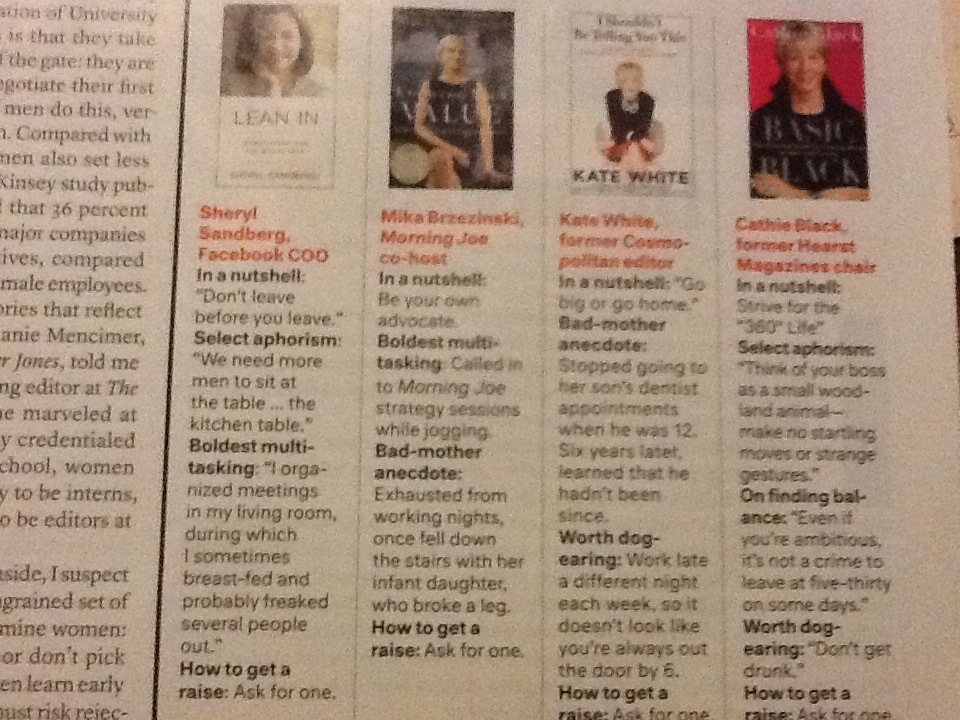
What the author is getting at in an interesting if not problematic way is that women are socialized to not negotiate well and to not find work in the same way that men do. This might explain why some 4.2% of Fortune 500 CEOs are women (28). What we might actually need is more leadership training for women, better mentoring programs in university, and in the workplace. Franke-Ruta is correct that education is not the panacea, but it is not just the formal education that is needed, but re-education of peoples’ expectations about women and men. We need better career education and mentoring all along the education and work pipeline. And, we need stop dismissing the career advice in Lean In and other books. They are targeting professional women and we need to embrace the message and not just attack the messenger. These books are clearly not for everyone–which career book is? I am including a screen shot from the article that assesses other similar books. Many thanks to the Franke-Ruta for her provocative review. You can see that these books share one major point: it’s important to ask for a raise.

20130715-112238.jpg

The Art of Phoning It In

What does it mean to “phone it in.” Generally speaking this means to give something little effort. To phone it in means that you made an attempt to do something. This does not mean that you tried hard, as you merely phoned it in. There are the occasional work outs that I phone in and hopefully get inspired to do more half way through the work out. There are days at work when I phone it in at a meeting or go through the motions, when I am not feeling well. However, I do not make a habit of doing this, as my job is too important to me to do this. Plus, students are smart. They know when a professor is phoning it in, and frankly, they do not like it. Can I blame them? This is my job. But, alas, I have expectations for them, too.

When do you phone it in?

I’m done teaching for about seven weeks and I am thinking about the last school year and the moments when I have phoned it in or when my coworkers or students phone it in. People say that Cs and Ds earn degrees, while this is true these sort of grades do not normally expedite getting jobs. Some students are clearly going through the motions, and I understand that. Some students do not want to be at the university or are not ready to do the work. But, there is something to say about a focused, hard worker who might have those occasional moments of phoning it in, but does not make a habit of phoning it in at work. Yes, I am saying that school is work. Students learn critical thinking, writing, time management, and hopefully get opportunities to collaborate with classmates. School is work and work is school. Success in university does not necessarily correlate into success off campus, and many college drop outs in the tech industry can attest to this. But, I have a word of advice for the rest of us:

Do not phone it in.

The photo below is a beautiful cake made my Real Food Made Easy, @toots11, Janice Mansfield. She never phones it in!

20130704-154626.jpg

Putting Your Best Foot Forward: Interviewing

I serve as an instructor and undergrad advisor to many and then to another group I am also a mentor or coach. I have also cultivated relationships with employers locally and outside of the city. I take these relationships seriously and they know that I try to send them strong candidates. Likewise, I try to check in with some of these contacts periodically to keep the connection fresh and to also ask them questions. I want to know  what is the profile of a strong candidate. Who are they looking for? And, they know that when they call to check references, they will get an honest reference about the candidate.

During the last month or so, I have met with some of my contacts and even made some new ones. I’m going to share some points from these conversations. This list is not an exhaustive list of advice, but a start. Now, it’s not uncommon to have an interview with more than one person and I refer to this group as the interview panel.

You got the Interview! Congratulations to you. Now, you need to impress them so that they call your references and then hire you.

Dress to impress. Ignore those articles on Linked In and elsewhere to dress how you are comfortable and don’t worry about impressing. Nope.You need to dress to impress and try to dress appropriately for the employer. If you’re interviewing for a non-profit, government, or conservative business you should dress according to the culture of that workplace.

Prepare for the interview. Google interview questions and review them and your answers in the mirror or hopefully with some trusted friends, mentor or sponsor. Also, do your research about the company. Why do you want to work with the organization? Make sure that you have a question or two for them, too. You do not want to make it painfully obvious that you haven’t taken the time to research the company and what they do. What is their mission statement? Who do they serve? Make sure that you have these basics down pat.

Be humble. You got the interview and you do not want to turn off the interview panel with arrogant responses. None of us are perfect, so think about what you have to learn or work on and how the company can help you grow. I am not suggesting that you downplay your skill set, but remember that you are getting assessed about how you will work with a team of people. I often remind my students about one employer sharing that a candidate was late to the meeting and one person opened the door to an apology asking, “Did you get lost?” The candidate responded with a quick, “No.” Big mistake. She was late to a job interview and needed to apologize for this. She did not and this set the tone for the interview. Remember that you are the short list and anything that you do that makes you look like a less serious candidate can hurt you.

Google yourself and check your digital footprint. The reality is that employers often creep and check you out–especially if they do not have good references or have a gut instinct about a candidate. I have heard from several employers who are honest about doing their research about job candidates. And, reminding you here to Google the company and what they do. This will give you ample information to ask the panel a question or two.

Prepare examples. When answering questions, offer examples from previous employment or volunteer experience that highlights your skills. You must remind the panel that you are more than competent for the job. For instance, if the panel asks you about working under deadlines, you need to refer to a situation that demonstrates your ability to work under a tight deadline and juggle multiple projects. Now, some of you might have a thin resume and could offer that you worked part-time and was enrolled in courses full-time and maintained a good grade point average. The panel will typically ask about working with a difficult situation or person–be prepared to offer a good example that highlights your ability to combine professionalism and team work.

Get a good night’s sleep and show up to the interview 10 minutes early. And, the next day place a thank you card in the mail. Yes, send a thank you card to the panel who interviewed you. Good Luck!

Happy New Year!

Happy New Year! I hope that 2013 bring you joy, happiness, and good health. What else do I hope for with this New Year. Sure, I can say world peace, a cure for Cancer and AIDS, and for the government to really take action with the Fiscal Cliff/Idle No More Movement. And, I truly do wish for all of the above, but this post will instead focus on what I hope for my students in this new year.

The 2012-13 school year is essentially halfway through and I hope that first year students learned how important time-management was during their September term. I also hope that all students realized that office hours are priceless. You might have to queue up and wait for five or fifteen minutes–but those meetings with your Teaching Assistant or Professor really is worth the wait. I have never heard a student tell me that it was a waste of time to see me or one of my Teaching Assistants. In fact, I get follow up emails, note cards, or tweets thanking me for suggesting that we meet or that they met with their Teaching Assistant. So, dear student, please take advantage of our availability!

I also send the gift of reading the syllabus to students. This means highlighting due dates and the instructions for assignments. This is a rich You Tube video about Reading the Syllabus. This made me laugh! Oh, wow. How many of us have had one of these moments?!  There is also a Facebook page about Reading the Syllabus. In all seriousness, the syllabus is the contract between the professor and the student. We expect students to read and review the syllabus.

Get into the library. Attend a workshop about research or citation. Learn how to use the databases and get outside of your Wikipedia or Google comfort zones. Learn other better ways to conduct research. The vast  majority of you are not yet skilled at researching and could use a workshop or two to hone these skills. The A students are the ones who have taken the time to use databases and dig deeper. Do not be embarrassed -go speak to the Reference Librarians and your academic mind will be blown.

My last wish for 2013 is that students stay healthy and this includes their physical well-being and mental health. I feel terrible when a student gets hit with a serious illness that turns their term upside down. I also feel for the student who is dealing with mental health issues and is having a really difficult time. I am not a medical doctor and I certainly am not a mental health professional, so all I can do is be supportive and suggest the health center or the counseling center. Remember, when you’re having a tough time, don’t be embarrassed -contact your professor. We are here to help and it’s much better if we are in the loop.

Happy New Year!

janni 2012

Time Management: Own It

If I could give students some advice this time of the term it would focus on the importance of time management. Sound time management should pervade all aspects of your life right now. Students are on a specific schedule with classes, tutorials, and paid work. You add to this the need to study more and time to think. Thinking time is time to strategize about assignments and writing.

It’s really hard to schedule writing time, as you might have the time window, but not be in the writing mood. Use that time to research, mind map or outline your paper. Then, when you are ready to write you will have a plan for the next step. I realize that it’s hard to “schedule” writing–trust me–I really do understand. One of my mentors told me to try to write a page everyday and this was excellent advice. For undergrads, I suggest that managing your time means that you set up time almost rigidly for studying and planning for the term.

As I have suggested before, use an assignment calculator. UVIC has a great one that I emphasize (I use this term and others might say recommend or nag) to students. It’s a great way of setting up mini-deadlines for the research process. Another important thing to do is to schedule down time, sleep, exercise, and eating properly. You can’t function at your best consistently if you’re not taking of yourself. I like to say that a major part of being a student is managing your time well and demonstrating that you can start and finish a project–this includes coursework. Please don’t be too surprised if your instructors aren’t too sympathetic when you ask for a deadline and note that you have other assignments due around the same time. We are well aware of this and will most likely note that students have had the due dates noted in the syllabus weeks or months in advance.

Managing time is something that everyone needs to do well. Teaching is a major part of my job, but I am also advising, sitting on various committees, chairing the Academic Women’s Caucus, sitting on Senate, and working on different professional organizations or boards. I use Outlook and appreciate its functionality to invite other Outlook users to book meetings. My point here is that my schedule is like a well-oiled machine. Try to do the same with your schedule–stay on top of it. Stay focused. Highlight due dates, go to class, read, and meet with your instructors.

Pink says, “We’ve had a shit day…” This is going to happen to all of us, but try to lessen it by managing your time better.

The Professor Who Has Expectations

Taking care of the classroom is not just about standing at the podium giving a lecture or leading a lecture and discussion session with your students. And, it’s not just about grading lots of assignments. Instructors are helping students manage their time, learn material, and offering them opportunities to interact with their peers and the instructor.

Part of the instructor’s responsibility is to maintain the integrity of the classroom, and this might mean a host of things. This means that the instructor provides a clear syllabus that notes the expectations for the class and carefully explains student evaluation. This way the students know exactly what they are assessed on for the class. Another responsibility for the instructor is maintaining a good learning environment for all students. While I’ve blogged previously about emotional labor, codes of conduct, and non-academic misconduct, I do think that this post is different.

The instructor is responsible to all the students to ensure a positive learning environment. The instructor will come to class on time and ready to teach/lead discussion. The instructor will also treat students with respect and encourage learning. In a similar vein, the instructor needs to also ensure that student behavior does not negatively influence other students’ learning or the overall learning environment of the classroom. My syllabus is clear about avoiding multi-tasking, watching videos or the overall misuse of the network per the university guidelines. But, I have now come to realize that I have to add an additional point to my syllabus. Drum roll~ in January my syllabi will now include a sentence about not wearing ear buds or headphones during lecture.

Part of the university experience for students is about the ability to acculturate to department or university norms. Hopefully, these exercises will be useful in the workplace–public speaking skills, writing, critical thinking, and working well with co-workers. A major part of being in an undergraduate program includes working well with others and following the rules, procedures, deadlines, and other expectations regarding student behavior. These norms—be it deadlines for assignments and understanding the importance of managing one’s time or being respectful of one’s peers and instructor are part of the university experience. I certainly do not think it is too much to ask a student to only come to class if they want to do so–especially when roll is not taken.

Likewise, I do think that it’s important for students to not come into class remembering that their instructors hopefully have had ample training and want to see them do well. However, instructors are also professionals who are at work and expect mature behavior. Save the eye rolling, sighing, and raising your voice for your friends and family. Seriously–your instructors are your future job references, mentors, and possible letter writers. People often say that the university isn’t the real world. It is a slice or microcosm of it. It doesn’t get more real than this. So, the next time your instructor asks you to please stop talking during her lecture or when other students are giving a presentation. Pause for a moment and think about your behavior.

Taking Chances: Applying for an Academic Job

Another Fall and another season for academic job seekers. The calls for applicants are going out in full force and I want to offer some points of advice for applicants. I’ve previously blogged about this issue, but this post is slightly different and will speak more so to the fact that so much of this process is out of your control. Seriously, it is. Part of the vetting process is the committee looking at the files and thinking, “Do I want to work with this person.” That is really outside of your control–it’s essentially gleaned from the overall file.

You have control over most of your file. You need to write a great cover letter and put together an overall strong dossier. You hope that your references are strong and that the entire package stands out to the committee. But, unless you are part of the long list or lucky short list—it’s really out of your control. A great dossier makes it clear that you have looked closely at the call for applications and that you have done your homework. You have included teaching evaluations, publications, a research statement, and teaching statement. (I’m assuming here that these documents or parts of the dossier were requested in the call).

The department or faculty unit has put together a call that might be rather vague and offer them a “let’s see what we get” expectation or the call is so specific that they either have a candidate or two in mind or have made it so that the pool of applicants will be a small one. This is tricky. If the call is vague, you don’t know what they really want and they might not either! Try to find out more about the position–maybe send the department head an email. If it’s specific and it speaks to your fit, then go for it.

Remember to do thorough research about the department. Review the courses that they offer and speak to both the call and the courses that you are prepared or willing to teach. Also, explain where your current research is at and where you see your research progressing during the next 3-5 years. You should demonstrate that you are not only prepared to hit the ground running when you’re hired, but that you bring something special or specific to the department. You might also note why you would want to move to the region or join the department. Overall, be concise and promote yourself wisely.

Now, for the things that are beyond your control: there might be different factions in the department and Faction A wants a generalist and Faction B wants a niche candidate, then Faction C doesn’t particularly like your file,your dissertation, and/or your letter writers due to the pedigree and sub-field. There are some moments that you just have no control over, when you’re applying for a job. The other important thing to understand is that no job is “your job.” Be careful. You don’t want to go on public record diminishing the application process and you also don’t want to possibly piss off the hiring committee. Even if you have an inside track (occasionally this does happen) be careful. You need to impress the department, the Dean, and the Provost (in most hiring instances).

And, yes, one time I did apply to a department and was told that I was a sure thing for an interview by several people close to the department. I didn’t get an interview. I kept my chin up and was very quiet about it. Everyone around me—librarians, colleagues, and friends were pissed off. Hell, I was pissed off for a few weeks, but kept quiet. It was the best thing that  I could have done. I got over it.

Related to this, if you don’t get short-listed or do and don’t get offered the job—please, please, please don’t be filled with sour grapes and insist that the “winner” was hired based on her gender, race, or connections. First of all, that sounds very unprofessional and do you really want to be that person making possibly false and hurtful assertions? You might in fact be correct or just plain wrong, but be the consummate professional. Each discipline and sub-discipline is smaller than you think and words always seem to make the rounds and then you might feel really embarrassed when your claims of discrimination or just plain sour grapes makes it way around to the person who got the job, around the campus or the discipline. Looking for work in higher education requires patience, thick skin, and good luck. Well, this is in my experience in the Humanities, Arts, and Social Sciences.

With that–I do wish anyone on the job market in higher ed or other wise–some good luck!

Thinking about the Term: Fri Fun Facts

The term just ended and it’s fresh in my mind. For students, staff, and faculty this is the best time to think about how the term ended. What can you do to make the next term better? And, more importantly what did you do well that you need to do again?

  1. I keep track of my emails and hold on to them for more than a year. I do this to protect myself and the students. I will continue to do this
  2. I had students blog in my seminars and I will continue to offer this as an assignment. The student blogs were good to strong.
  3. I did something different this school year and I had separated my office hours between my advanced class (the seminar) and my first year course. The seminar students enjoy having their own slated consultation time. I will continue to do this.
  4. I allowed one Teaching Assistant to run a series of writing workshops and I think that was a great use of his hours. The first session was small, but the next two included lots of students and they gave me positive feedback.
  5. There are instances when I photocopy work that gives me or the Teaching Assistant pause. I photocopied some work this time, but will take special care to to photocopy any work that requires “strict scrutiny.”

Overall, it was a great term and I look forward to Summer School.