
When Students are Petty

This is an old post, but worth sharing. As an academic, you must develop thick skin. We are constantly critiquing one another and praise is not common. However, I try to rectify this with sending note cards via campus mail and positive emails to colleagues and people who work with and for me. Overall, at times people can be petty. This post speaks more so to some of my experiences with students.

Once again, I’m in the process of reviewing my annual Faculty Activity Report. For those of you not familiar with this process, once a year you meet with the department Chair and review your productivity. The array of information includes publications, service, and teaching. I just reviewed the teaching portion with my evaluation scores that the department is most concerned with for my review. My numbers have always been pretty good as a part-time worker and now as a full-time employee. However, I did notice a blip, if you will in one course from the Fall 2009. I had to think back and I recall two industrious people who were so kind to remind me, “We don’t care if you were in a car accident, keep your personal life out of the classroom.” Now, this isn’t a direct quote, but rather a paraphrase from two of the written evaluations. These same two lovely people also scored me with all 0’s. This was the first time ever in my academic career that I was scored with the lowest score.

In July of 2009, I was in a car accident and consequently to this day am still recovering from injuries sustained in the accident. This particular class was in the afternoon and afternoons in the Fall 2009 were hard for me. During the first week of classes, I explained to the class that I was going to stand at the podium more than usual. Usually I work the room–I walk around the room and am very animated. That term–not so much. The truth was that there were some days that I held on to the podium for fear that my left knee might just give out and I might collapse. On one other occasion, I was walking into the class and my knee did give out. I heard a few students gasp.  I was quite embarrassed and explained that this was part of my health issues and end of story. I never belabored my accident more than this.

I was frustrated when I read these two written comments. And, the 0’s factored into my overall score did influence the numbers for that particular course. What is really interesting for me is that per the university guidelines, I have to work with students and their learning disabilities, illnesses, and other registered issues. Students can register with the Resource Centre for Students with a Disability. Their learning plan might include more time with exams or more flexibility with due dates. But apparently for some students–I am not allowed to be human. I cannot mention twice that I am not as mobile around the classroom. I certainly hope that those two people look back at the class and think fondly of those two minutes when they chose to write a cruel comment and circle a series of 0’s.

The good news is that my evaluations were still at or above the department mean so this didn’t mean that I wasn’t eligible for a raise. However, I don’t think that some students realize how they can be cruel. I was more troubled with the statements than the 0’s. The 0’s are really an outlier for the statistical scores. I know that I take the written comments more seriously.

Updating that in 2012 when my partner had a serious illness the vast majority of my students were patient; however, a few were clear that my turnaround for graded work in 10-14 days was unacceptable. I wish them good luck in their lives. I am usually a super star and get graded work returned in 3-7 days. But, alas, my partner was in the hospital and I dropped the ball. <Note sarcasm>. Did I see a drop in my numbers for one class–yes I did. Were the qualitative comments interesting? Yes, the first year students applauded my availability knowing that I had a family crisis, while some of my students in an upper-division course complained about the turn around time for graded work. I had to smile. I cannot please them all and surprisingly the first year students were the most patient.
Continuing the Conversation About Leaning In

Many are still responding to Sheryl Sandberg’s Lean In. People have both applauded and attacked the book and Sandberg. I was recently catching up on my magazines and read a review in the April issue of the Atlantic and came across Garance Franke-Ruta’s “Miss Education.” Franke-Ruta notes that women are doing a great job in seeking higher education. Women are leaning in at university, but once they leave they fall behind. In short, we do well at school, but when we get our first job we do not negotiate well. I do not really agree with all of her article. Franke-Ruta uses dating as a metaphor. She explains that women are waiting to be noticed or wooed and this is different for men, since they seek out the job and feel more comfortable negotiating their salaries. Many articles and books point out that women do not negotiate their salaries and benefits well or as well as their male counterparts.

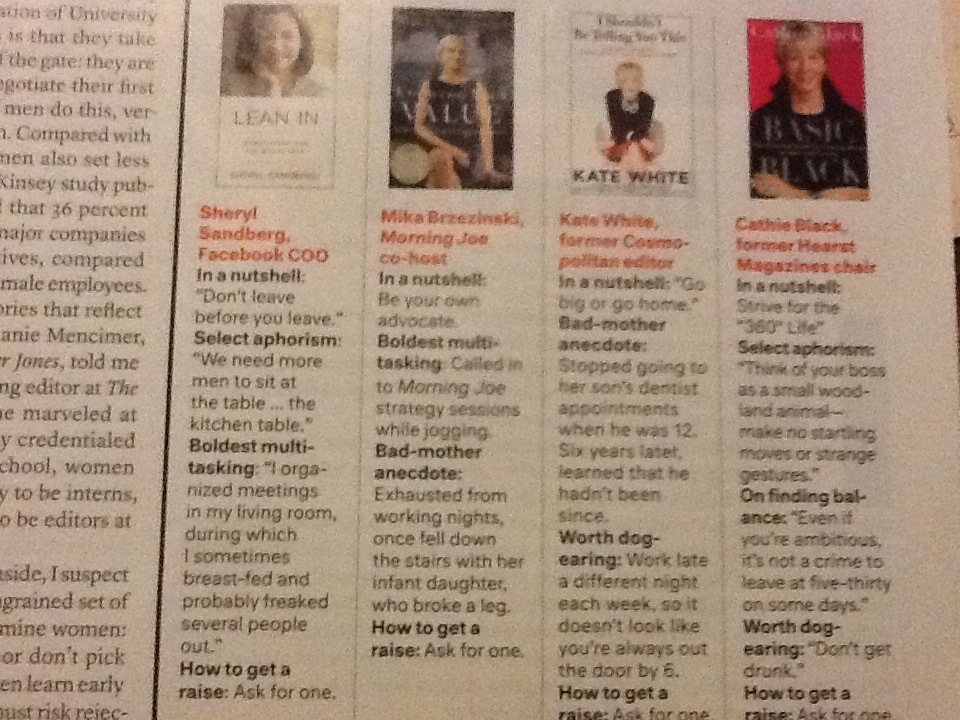
What the author is getting at in an interesting if not problematic way is that women are socialized to not negotiate well and to not find work in the same way that men do. This might explain why some 4.2% of Fortune 500 CEOs are women (28). What we might actually need is more leadership training for women, better mentoring programs in university, and in the workplace. Franke-Ruta is correct that education is not the panacea, but it is not just the formal education that is needed, but re-education of peoples’ expectations about women and men. We need better career education and mentoring all along the education and work pipeline. And, we need stop dismissing the career advice in Lean In and other books. They are targeting professional women and we need to embrace the message and not just attack the messenger. These books are clearly not for everyone–which career book is? I am including a screen shot from the article that assesses other similar books. Many thanks to the Franke-Ruta for her provocative review. You can see that these books share one major point: it’s important to ask for a raise.

20130715-112238.jpg

Patience Works Both Ways

There are easy terms and there are terms that make you earn a every penny. About three years ago I was in a car accident over the Summer and when the Fall term started I was quite aware that this would not be a normal term. I tried to work my schedule so that I could make a good impression on the job and meet the needs of my students. I was partially successful. And, this post offers me an opportunity to reflect on what I could have done better.

In most situations in life we do not get a change for a “do-over,” but it’s good to occasionally have the chance to think about the what if situation. Thinking about that Fall term I wish I had moved my afternoon class to earlier in the day, so that I would have had full use of my mind and body. That term was one of the toughest ever, as by about 4pm I was absolutely exhausted and could barely walk across campus. It was a rough. I was mildly embarrassed, but did announce to the class that I had a car accident and that I would not be my usual self. I stood by the podium must of the term and didn’t walk around and was not my usual peppy self. I found that most students were quite patient with me and I thank this for them. The morning class got the regular me, but the afternoon got the extremely tired, stiff version.

I have found that some students, though, have no patience for anything short of perfection from their instructor. And, this makes things interesting. You see, I have to accommodate students who are registered with the Resource Center for Students with a Disability, have notes from Health Services, are student athletes, and the like. And, I have no problem with flexibility, when it’s warranted. Some students are a little thick to understand that an instructor could have an illness or some other issue in their personal life. And, I learned that term to just roll with it and let it go. I also think that if I could go back I would have reminded the students more than once that I was struggling. I tried to act like things were fine. I’m not going to lie, though, the student evaluation that noted, “We don’t care if you were in a car accident–keep your personal life out of the classroom” really stung when I read it a few months later. I hope that person is never in a car accident or faces any physical hardship. This is really the only negative reaction that I recall.

My morning evaluation numbers were normal; however, the afternoon class numbers were slightly lower than the previous four times that I taught that class. Was the .7 difference because of my health? Maybe. What I do know is that term taxed my patience and I bet that some students felt the same way! My advice to other faculty–honesty. Let your students know if you are facing an unusual term. Most students will understand and offer you some compassion.

Catching my Breath: One Week Post-Breathe Now

It’s been more than a week and I am still processing the magic behind the Breathe Now ( #breatheyyj ) conference that I co-cordinated with Angela Rafuse-Tahir, Janice Mansfield, and Yukari Peerless. We wanted to organize a conference that we wanted to attend in Victoria. Between the four of us we have attended business women conferences, social media conference, academic conferences, BlogHer, Blissdom, and other work-related conferences. We wanted something completely different that spoke to women’s need to balance work and life and remembering to take time out for yourself and breathe.

The conference was a resounding success from head to toe. The energy was pulsating at the various panels and workshops that the 100 delegates attended. I saw lots of smiles, tears, and heads nodding during the presentations. A common theme throughout the weekend was that it’s important to have balance in our lives. Many women spoke to how imbalance led to different types of crises and the need to reflect and reboot life. I was pleasantly surprised to hear repeated speakers talk about how important therapy, exercise, sleep, eating right, and taking time out for oneself was crucial to mental health and overall physical well-being. When the conference ended, I got sentimental and felt a little sad that the weekend was ending, but so many great connections were made.

I’m thankful for all the emails, coffee dates, and tweets that I’ve read since the conference. I learned lots about myself, my friends, and the various speakers. Our choice of keynote speakers was perfect, too. Rona Maynard and Bif Naked both spoke their truths and offered the delegates a chance for important reflection. We all left the conference energized and ready for everything and anything. I look forward to chatting with my friends about Breathe Now 2013!

Continuing the Conversation about Guilt: Academics on Academia

I’ve enjoyed my conversations with Liana Silva. Her last post really touched me and troubled me. I was not frustrated with Liana, but with the truths she spoke about the ways in which academics allow the constant blurring of our work and personal lives. She made me look into the mirror and think about my work and the infamous to do lists that I keep. I spent all last week thinking about guilt. The guilty way I feel when I think about my day and the constant struggle to get all the tasks completed.

There is always a paper to write, assignments to grade, lectures to work on and other work. Then, add to that projects, publications, and service in the department, faculty and wider campus. The reality is that most academics do not work a 40 hour work week. No, we work easily work 50-60 and during the crunch periods more than this. And, this doesn’t include all the time responding to emails or thinking about the job. Alas, we do not get to bill by the fifteen minute increments!

Continue reading

Rehashing Reverb: 2012

I’m shamelessly borrowing the theme for this post from the University of Venus and the #Reverb11 theme for December 29th that was about Habits and 12 things your life doesn’t need in 2012. I’ll amend it and speak to less than that for the post. At first it seems very easy to think of 10-12 things that you don’t need in your life—bills, debt, and perhaps grumpy people. But, when you sit back and think more thoughtfully, you take stock of what you want and don’t want in your life.

1. I don’t want so many excuses. It gets really frustrating to hear excuses. Own your education, your job, and your life. You do have some control. Particular to students, once you graduate most of you will look back at your 5.1 years as an undergraduate and think about how lucky you were. Yes, you will, and some of you email me or send Facebook messages August- November wishing that you were back in school. You wish that you could go back and try harder or spend more time on that one assignment. To this I say, own it. Own your responsibility. For people who aren’t students this also applies. Before you say, I can’t—think about why you can’t. What is your motivation or lack thereof. What is holding you back?

2. I don’t want to complain about the weather—so I won’t. I spent 2010 and 2011 taking special care to not complain about the weather as much as I used to and I’ve even attempted to embrace it. This is hard, as I fully admit to being a weather princess. I grew up used to Spring and Summer and now in the Pacific Northwest I get four seasons. OK, I don’t get the Winters that Alberta, Manitoba and most other provinces get, but I still get colder weather than I’ll ever become accustomed to. So, I endeavor to complain less!

3. I don’t want negative energy in my life and this includes tightening the inner circle of good friends. I’ve come to realize that I have had a few friends in my life who really thrive on the negative and are passive aggressive. I’ve tried to walk away and limit my time around these people, as I notice that I leave a coffee date thinking about some petty comment. I don’t have time for the negative energy and will protect my time more so in 2012.

4. I don’t want to feel bad about working lots, but need to balance this with more quality time with my family. I need to work smarter and as soon as I figure this out successfully I’ll sell the secret! Seriously, since I live my life term to term, my schedule fluctuates. I need to have better control of the schedule, but also admit that I do need two long days of work or else I have to work on the weekend. Whoever thinks that academics work a 40 hour work week should shadow me or my countless colleagues across campus.

I do think that four things complete my list for now. I’ll keep you posted about how I work on these points. I have control over all of them—my reaction. I’ll have to remember that!

Learning to Say No: Boundaries

I am still learning how to say no at work and in my personal life. I am an energetic person and I like to do things and have a sense of giving back—be involved in the communities that I belong to. This includes on campus, off campus, both kids, and other communities that I engage with in my daily life. The only problem—there are only 24 hours in the day and I am not cloned, yet!

I am venturing into year three of working with my door completely shut at work. It took me a good six months or so to feel completely comfortable with that. I really thought that my previous open door policy was sound and important. Then, I came to realize that I had to get work done and that as an Undergrad Advisor I had students at my door all the time. The best advice was from a colleague who suggested that I shut my door. Now, I no longer have any issues with the door shut and establishing boundaries when I am available and not for office houring.

The virtual advising, though, is something that I’ve had to come to grips with, as students will email at all hours of the day and advising questions are important and in some instances time intensive. This Summer, like most, I was in California for a month and was not available for advising. I had the usual auto-email explaining my absence. I made a special point of acknowledging emails and directing most students to the department for the advisor of the week. And, this year I didn’t feel guilty about it.
This is an ongoing process for me, though. I find that I’m getting better at saying no and directing the student or other request to a more mutually convenient time. I have to say that most reactions are fine. No one is put out that I cannot make a coffee date for two weeks or that they have to wait a week for my office hours.

As a fan of sci-fi and fantasy I will admit that the cloning in #BSG intrigues me. I would have a clone to do certain work, but I would save the real me for enjoying life!

Maclean’s Article about Dutch Women: Class and the Welfare State

Last week Macleans ran an article by Claire Ward, “The Feminism Happiness Axis: Are Dutch Women Powerless, or Simply Smarter Than the Rest of Us? The article can be found: http://awe.sm/5RZQ1 The first thing that I find most interesting is the immediate connection to feminism with work, family life and happiness. I’m so thankful that feminism has made my life complete and I embrace my politics head on, but why must the media make the knee jerk connection to cookies, family and feminism. While I enjoy cooking and especially baking, it has nothing to do with my feminist politics. This is where we see how strong stereotypes are about the alleged man-hating, mother, children hating, angry feminists. If I had a dollar for every feminist I met like this, I wouldn’t have a dollar.

The media needs to get clued in to the fact that feminists comment or write about institutions that have not given women a fair shake. Nowhere in Of Woman Born does Adrienne Rich say that she hates mothers (like herself) or that she hates her children. No. Her classic book is a wise, provocative rumination about the institution of motherhood and the lack of choices that women have or had for her generation. It’s not quite as sexy to say that we feminists are cultural critics or public intellectuals. No, it’s easier (lazy) to say that we hate men and that we judge other women for “opting out” of the workplace. The opting out discussions typically miss the inclusion of a class analysis and how women who can opt out have class privilege thanks to their partner’s income. Likewise, there is an assumption that these women are opting out forever, when some are taking time off to raise their children until primary school. Like most issues, there is so much here.

Getting back to the Macleans article, though, what is really missing is a class analysis. I’d also like to see an immigration/refugee and race analysis, as well as the basic demographic analysis. There is more to this study and our understanding of what is going on for women. I want women to feel happy–happy in the home, workplace, parliament, congress, farm, university, etc. But, I want a full picture of what this will take. And, I do not want to see the scapegoating of feminisms. If we want to point fingers, we have to look in the mirror. We have to also think about what constitutes success.  And, we have to look at social welfare programs, education rates, leadership rates, and so much more. This is a rather detailed, important conversation that it going to sell lots of magazines!

What Macleans has artfully done is offered data from an interesting study and spun it about feminism-blaming and guilt. Here, we have a small country with a strong welfare state. This is not a fair comparison to the US or Canada for that matter. As  social scientist, I want to see the study and I want to see demographics disaggregated and then compared to other nations. This study offers us food for thought and no more. But, alas, the spin cycle is whirring.

Fri Fun Facts: Things I Love to Do

Yet another great exercise at #BlogHer: Things I love to do. This was another writing prompt exercise.

1. Spend time with my family.

2. Yoga

3. Reading

4. Writing

5. Baking

6. Mentor

7. Teach

8. Blog

9. Network

10. Research

11. Talk with girlfriends (email/text/fb/twitter)

12. Feel the sun on me–warmth

13. Keep in touch with my mentors

I’m going to stop at lucky 13. I had 30. What are 13 things you like to do?